

Class 8 Mathematics Practice Sheet: CBSE Class 8 Mathematics Practical Geometry Worksheet Set 01
Explore structured practice materials through the CBSE Class 8 Mathematics Practical Geometry Worksheet Set 01. Tailored for Class 8 learners, utilizing these Mathematics worksheets ensures thorough preparation and strengthens problem-solving accuracy before final school evaluations.
Download Chapter 04 Practical Geometry Worksheet PDF with Answers
View or download the dedicated CBSE Class 8 Mathematics Practical Geometry Worksheet Set 01 resource below. Engaging with these practice papers under focused study conditions ensures continuous academic progress and mastery of the 2026-27 curriculum for Chapter 04 Practical Geometry.
Question. How many measurement can determine a quadrilateral uniquely?
Answer : 5
Question. In the given figure which angles are equal.
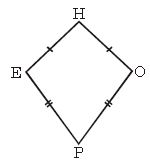
Answer : ∠E and ∠O
Question. Which property is used to construct a parallelogram. If its one side and two diagonals are given.
Answer : Diagonals are bisects to each other.
Question. In the given figure ZEAL is a parallelogram. If ∠Z = 90°. What the new shape obtained.
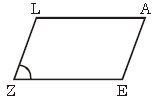
Answer : Rectangle
Question. In the given figure TRUE is a parallelogram find TE + EU.
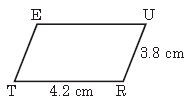
Answer : 8 cm
Question. How many measurement can determine a square?
Answer : 1
Question. How many measurements can determine a parallelogram uniquely?
Answer : 3
Question. How many measurement can determine a rhombus.
Answer : 2
Question. What property is used to construct a rhombus. If its two diagonals are given.
Answer : Diagonals of a rhombus bisect each other at right angle.
Question. HOME is a rhombus. If DM = 4 cm and ED = 3 cm, then what is HM + OE
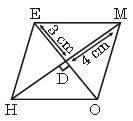
Answer : 14 cm
Practical Geometry
Question 1. Name the quadrilateral whose opposite sides are parallel.
Answer: Parallelogram
In simple words: A parallelogram has both pairs of opposite sides parallel.
Exam Tip: Remember that rectangles, squares, and rhombuses are also special types of parallelograms.
Question 2. Name the quadrilateral whose diagonals are equal and bisect each other at right angle.
Answer: Square
In simple words: A square has equal diagonals that intersect at 90 degrees.
Exam Tip: A rhombus has perpendicular diagonals, but they are not necessarily equal in length.
Question 3. Why do we call square as a regular quadrilateral?
Answer: A square is called a regular quadrilateral because all its four sides are of equal length and all its four interior angles are equal (each measuring \(90^\circ\)).
In simple words: A polygon is regular if all its sides and angles are equal.
Exam Tip: Regular means equilateral and equiangular combined.
Question 4. Construct the quadrilateral ABCD in which AB = 5 cm, BC = 4 cm, \(\angle A = 60^\circ\), \(\angle B = 105^\circ\) and \(\angle C = 105^\circ\).
Answer:
Steps of construction:
1. Draw a line segment AB = 5 cm.
2. At point A, draw an angle of \(60^\circ\) using a compass.
3. At point B, draw an angle of \(105^\circ\).
4. With B as center and radius 4 cm, cut an arc on the ray of angle \(105^\circ\) to mark point C.
5. At point C, draw an angle of \(105^\circ\) such that its ray meets the ray from A at point D.
6. Join C and D to complete the required quadrilateral ABCD.
In simple words: Draw the base, construct the given angles at the vertices, cut off side lengths, and close the shape.
Exam Tip: Always construct angles carefully using a compass where possible for accuracy.
Question 5. The adjacent sides SP and PQ of a parallelogram PQRS are 4 cm each. State the measure of all the sides. What is another name of this figure?
Answer:
In a parallelogram, opposite sides are equal.
Given adjacent sides SP = 4 cm and PQ = 4 cm.
Therefore, all four sides are equal: PQ = QR = RS = SP = 4 cm.
Another name for this figure is a rhombus.
In simple words: A parallelogram with all equal sides is a rhombus.
Exam Tip: A parallelogram with adjacent sides equal is always a rhombus.
Question 6. The ratio of two adjacent sides of a parallelogram is 4:5. If its perimeter is 72 cm, find its adjacent sides.
Answer:
Let the adjacent sides be \(4x\) and \(5x\).
Perimeter of a parallelogram = \(2 \times (\text{sum of adjacent sides})\)
\(2(4x + 5x) = 72\)
\(2(9x) = 72\)
\(18x = 72\)
\(x = \frac{72}{18} = 4 \text{ cm}\)
First side = \(4 \times 4 = 16 \text{ cm}\)
Second side = \(5 \times 4 = 20 \text{ cm}\)
In simple words: Use the perimeter formula with the given ratio to find the multiplier x, then find each side.
Exam Tip: Always verify that \(2 \times (16 + 20) = 72\) cm to check your answer.
Question 7. The park in a town is made in the form of a kite. Its perimeter is 90 metres and one side is 10m more than other side. What are the lengths of other sides?
Answer:
In a kite, two pairs of adjacent sides are equal.
Let one pair of unequal sides be \(x\) and \(x + 10\).
Perimeter = \(2(x + (x + 10)) = 90\)
\(2(2x + 10) = 90\)
\(2x + 10 = 45\)
\(2x = 35\)
\(x = 17.5 \text{ m}\)
Other side = \(17.5 + 10 = 27.5 \text{ m}\)
Thus, the lengths of the four sides of the kite are 17.5 m, 17.5 m, 27.5 m, and 27.5 m.
In simple words: A kite has two pairs of equal adjacent sides, and the perimeter is twice the sum of the two distinct adjacent sides.
Exam Tip: Remember a kite has two equal sides of length 17.5 m and two equal sides of length 27.5 m.
Question 8. Construct the trapezium ABCD in which \(AB \parallel CD\), AB = 8 cm, BC = 6 cm, CD = 4 cm and \(\angle B = 60^\circ\).
Answer:
Steps of construction:
1. Draw line segment AB = 8 cm.
2. At point B, construct an angle of \(60^\circ\).
3. With center B and radius 6 cm, draw an arc intersecting the ray at point C.
4. Draw a line parallel to AB through C.
5. With center C and radius 4 cm, cut an arc on the parallel line to get point D.
6. Join A to D to complete the trapezium ABCD.
In simple words: Construct the base, make the given angle and side at B, draw a parallel line for the top base, and cut off the given length for CD.
Exam Tip: Ensure the top and bottom bases are strictly parallel.
Question 9. Construct the quadrilateral ABCD in which AB = 4.5 cm, BC = 5.5 cm, CD = 4 cm, AD = 6 cm and AC = 7 cm.
Answer:
Steps of construction:
1. Draw a diagonal AC = 7 cm.
2. With center A and radius 4.5 cm, draw an arc above AC.
3. With center C and radius 5.5 cm, draw an arc to intersect the previous arc at point B. Join AB and BC.
4. With center A and radius 6 cm, draw an arc below AC.
5. With center C and radius 4 cm, draw an arc to intersect the previous arc at point D. Join AD and CD.
6. ABCD is the required quadrilateral.
In simple words: Construct two triangles (ABC and ADC) sharing the common diagonal AC.
Exam Tip: When four sides and one diagonal are given, always start by constructing the triangle containing the diagonal.
Question 10. Construct the quadrilateral PQRS where PQ = 4 cm, QR = 6 cm, RS = 5 cm, PS = 5.5 cm and PR = 7 cm.
Answer:
Steps of construction:
1. Draw diagonal PR = 7 cm.
2. With P as center and radius 4 cm, draw an arc. With R as center and radius 6 cm, draw an arc intersecting the first arc at Q. Join PQ and QR.
3. With P as center and radius 5.5 cm, draw an arc on the opposite side of PR. With R as center and radius 5 cm, draw an arc intersecting the previous arc at S. Join PS and RS.
4. PQRS is the required quadrilateral.
In simple words: Build two triangles, PQR and PRS, using the diagonal PR as the common base.
Question 11. Construct Quadrilateral ABCD in which AB = 3.5 cm, BC = 4 cm, CD = 5 cm, \(\angle B = 45^\circ\) and \(\angle C = 150^\circ\).
Answer:
Steps of construction:
1. Draw line segment BC = 4 cm.
2. At B, construct an angle of \(45^\circ\).
3. With B as center and radius 3.5 cm, cut an arc on the ray to mark point A. Join AB.
4. At C, construct an angle of \(150^\circ\).
5. With C as center and radius 5 cm, cut an arc on the ray to mark point D. Join CD.
6. Join A and D to complete quadrilateral ABCD.
In simple words: Start with side BC, build the angles and adjacent sides at both B and C, then join the remaining endpoints.
Exam Tip: Constructing \(150^\circ\) requires making a \(180^\circ\) angle and subtracting \(30^\circ\), or using a protractor if allowed.
Question 12. Construct the quadrilateral TRUE in which TR = 3.5 cm, RU = 3 cm, UE = 4 cm, \(\angle R = 75^\circ\) and \(\angle U = 120^\circ\).
Answer:
Steps of construction:
1. Draw line segment RU = 3 cm.
2. At R, construct an angle of \(75^\circ\).
3. With R as center and radius 3.5 cm, cut an arc on the ray to mark point T. Join TR.
4. At U, construct an angle of \(120^\circ\).
5. With U as center and radius 4 cm, cut an arc on the ray to mark point E. Join UE.
6. Join T and E to complete quadrilateral TRUE.
In simple words: Draw the base RU, construct the given angles at R and U, mark the side lengths, and connect T to E.
Exam Tip: Ensure angles are measured accurately from the baseline RU.
Question 13. Construct the parallelogram ABCD with AB = 3.5 cm, BC = 4 cm and AC = 6.5 cm.
Answer:
Steps of construction:
1. Draw line segment AB = 3.5 cm.
2. With A as center and radius 6.5 cm, draw an arc. With B as center and radius 4 cm, draw an arc intersecting the first arc at C. Join AC and BC.
3. With A as center and radius 4 cm, draw an arc opposite to C. With C as center and radius 3.5 cm, draw an arc intersecting the previous arc at D. Join AD and CD.
4. ABCD is the required parallelogram.
In simple words: Construct triangle ABC first, then use opposite side lengths to locate point D.
Exam Tip: Opposite sides of a parallelogram are equal, so AD = BC = 4 cm and CD = AB = 3.5 cm.
Question 14. Construct a rhombus with side 4.5 cm and one diagonal 6 cm.
Answer:
Steps of construction:
1. Draw diagonal AC = 6 cm.
2. With A as center and radius 4.5 cm, draw an arc above AC and another below AC.
3. With C as center and radius 4.5 cm, draw arcs above and below AC intersecting the previous arcs at B and D respectively.
4. Join AB, BC, CD, and DA.
5. ABCD is the required rhombus.
In simple words: Since all sides of a rhombus are equal, construct two congruent triangles (ABC and ADC) on the diagonal.
Exam Tip: All four sides of a rhombus are equal in length.
Question 15. Construct the quadrilateral ABCD with AB = 4 cm, BC = 6 cm, CD = 5.5 cm, AD = 5 cm and AC = 8 cm.
Answer:
Steps of construction:
1. Draw diagonal AC = 8 cm.
2. With A as center and radius 4 cm, and C as center and radius 6 cm, draw arcs intersecting at B. Join AB and BC.
3. With A as center and radius 5 cm, and C as center and radius 5.5 cm, draw arcs intersecting at D. Join AD and CD.
4. ABCD is the required quadrilateral.
In simple words: Draw diagonal AC, then construct triangles ABC and ADC using SSS criterion.
Exam Tip: Verify that the sum of two sides in any triangle is greater than the third side.
Question 16. Construct the quadrilateral HOPE with HO = 4.5 cm, OP = 4 cm, PE = 6.5 cm, EH = 3 cm and OE = 6.5 cm.
Answer:
Steps of construction:
1. Draw diagonal OE = 6.5 cm.
2. With O as center and radius 4.5 cm, and E as center and radius 3 cm, draw arcs intersecting at H. Join OH and EH.
3. With O as center and radius 4 cm, and E as center and radius 6.5 cm, draw arcs intersecting at P. Join OP and EP.
4. HOPE is the required quadrilateral.
In simple words: Use diagonal OE to split the quadrilateral into two triangles, OHE and OPE.
Question 17. Construct the quadrilateral PQRS in which PQ = 4 cm, QR = 3 cm, PS = 2.5 cm, PR = 4.5 cm and QS = 4 cm.
Answer:
Steps of construction:
1. Draw diagonal PR = 4.5 cm.
2. With P as center and radius 4 cm, and R as center and radius 3 cm, draw arcs intersecting at Q. Join PQ and QR.
3. Now use diagonal QS = 4 cm. With R as center and radius equal to RS, or construct triangle PQS using PS = 2.5 cm, PQ = 4 cm, and QS = 4 cm to locate S.
4. Join PS, RS, and QS to complete PQRS.
In simple words: Construct triangle PQR first, then use the second diagonal QS and side PS to locate vertex S.
Exam Tip: When two diagonals and three sides are given, select a base triangle that uses one diagonal and two known sides.
Question 18. ABCD is a trapezium with \(AB \parallel CD\), and \(\angle A = 50^\circ\) and \(\angle B = 50^\circ\). Prove that (i) BC = DA (ii) \(\angle C = \angle D\) and find the measurement of \(\angle C\).
Answer:
(i) Since \(AB \parallel CD\) and AD, BC are transversal lines, consecutive interior angles add up to \(180^\circ\).
\(\angle A + \angle D = 180^\circ \implies 50^\circ + \angle D = 180^\circ \implies \angle D = 130^\circ\)
Similarly, \(\angle B + \angle C = 180^\circ \implies 50^\circ + \angle C = 180^\circ \implies \angle C = 130^\circ\)
Since base angles \(\angle A = \angle B = 50^\circ\), the trapezium is an isosceles trapezium.
Therefore, non-parallel sides are equal: BC = DA.
(ii) From the calculation above, \(\angle C = 130^\circ\) and \(\angle D = 130^\circ\), so \(\angle C = \angle D\).
In simple words: An isosceles trapezium has equal base angles and equal non-parallel legs.
Exam Tip: Consecutive interior angles between parallel lines are supplementary.
Question 19. The perimeter of a parallelogram is 140 cm. If one of the sides is greater than the other by 20 cm, find the lengths of all the sides of the parallelogram.
Answer:
Let the smaller side be \(x\).
Then the adjacent side = \(x + 20\).
Perimeter = \(2(\text{side}_1 + \text{side}_2) = 140\)
\(2(x + x + 20) = 140\)
\(2(2x + 20) = 140\)
\(2x + 20 = 70\)
\(2x = 50\)
\(x = 25 \text{ cm}\)
Smaller sides = 25 cm each.
Larger sides = \(25 + 20 = 45 \text{ cm}\) each.
Thus, the lengths of all four sides are 25 cm, 45 cm, 25 cm, and 45 cm.
In simple words: Set up an equation using the perimeter formula and solve for the unknown side length x.
Exam Tip: Opposite sides of a parallelogram are equal in length.
Question 20. ABCD is a trapezium in which \(AB \parallel DC\) and AD = BC. If CE is drawn parallel to AD, meeting AB at E, prove the following: (i) AECD is a parallelogram. (ii) AD = EC
Answer:
(i) In quadrilateral AECD:
\(AE \parallel DC\) (since \(AB \parallel DC\))
\(AD \parallel CE\) (by construction)
Since both pairs of opposite sides are parallel, AECD is a parallelogram.
(ii) Since AECD is a parallelogram, opposite sides are equal.
Therefore, AD = EC.
In simple words: Constructing a parallel line creates a smaller parallelogram whose opposite sides are equal.
Exam Tip: Drawing auxiliary parallel lines is a powerful technique for solving trapezium problems.
Question 21. Construct the square READ with RE = 5.1 cm.
Answer:
Steps of construction:
1. Draw line segment RE = 5.1 cm.
2. At R and E, construct angles of \(90^\circ\).
3. With centers R and E, draw arcs of radius 5.1 cm on the perpendicular rays to mark points A and D.
4. Join A and D.
5. READ is the required square.
In simple words: All sides of a square are equal and all interior angles are \(90^\circ\).
Exam Tip: Use a set square or compass to ensure accurate \(90^\circ\) corners.
Question 22. Construct a rhombus ABCD where AC = 5.2 cm and BD = 6.4 cm.
Answer:
Steps of construction:
1. Draw diagonal AC = 5.2 cm.
2. Draw the perpendicular bisector of AC, intersecting AC at point O.
3. From O, cut off arcs of length \(\frac{6.4}{2} = 3.2 \text{ cm}\) on the perpendicular bisector above and below AC to mark points B and D.
4. Join AB, BC, CD, and DA.
5. ABCD is the required rhombus.
In simple words: Diagonals of a rhombus bisect each other at right angles. Draw one diagonal, find its midpoint, and set off half the length of the second diagonal on the perpendicular bisector.
Exam Tip: Remember that diagonals of a rhombus bisect each other at \(90^\circ\).
Question 23. Construct a rectangle ABCD with AB = 5 cm and BC = 4 cm.
Answer:
Steps of construction:
1. Draw line segment AB = 5 cm.
2. At points A and B, construct angles of \(90^\circ\).
3. With centers A and B, draw arcs of radius 4 cm along the perpendicular rays to mark points D and C.
4. Join D and C.
5. ABCD is the required rectangle.
In simple words: A rectangle has adjacent sides perpendicular to each other and opposite sides equal.
Exam Tip: Opposite sides of a rectangle are equal: AB = CD = 5 cm and BC = AD = 4 cm.
Question 24. Construct a quadrilateral ABCD in which AB = 6 cm, BC = 5 cm, \(\angle A = 55^\circ\), \(\angle B = 110^\circ\) and \(\angle D = 90^\circ\).
Answer:
First, find the missing angle \(\angle C\).
Sum of interior angles of a quadrilateral = \(360^\circ\)
\(\angle A + \angle B + \angle C + \angle D = 360^\circ\)
\(55^\circ + 110^\circ + \angle C + 90^\circ = 360^\circ\)
\(255^\circ + \angle C = 360^\circ\)
\(\angle C = 360^\circ - 255^\circ = 105^\circ\)
Steps of construction:
1. Draw line segment AB = 6 cm.
2. At B, construct \(\angle B = 110^\circ\) and cut off BC = 5 cm.
3. At C, construct \(\angle C = 105^\circ\).
4. At A, construct \(\angle A = 55^\circ\) such that its ray intersects the ray from C at point D.
5. ABCD is the required quadrilateral.
In simple words: Find the fourth angle using the angle sum property of quadrilaterals, then construct using base side and angles.
Exam Tip: Always find all possible missing angles before starting construction.
Most Important Questions
Question 1. Is it possible to construct a quadrilateral ABCD in which AB = 3 cm, CD = 3 cm, DA = 7.5 cm, AC = 8 cm and BD = 4 cm? If not, give reason.
Answer:
No, it is not possible to construct this quadrilateral.
Reason: In triangle ABC, the lengths are AB = 3 cm, AC = 8 cm, and BC is not directly given, but considering triangle ADC with sides AD = 7.5 cm, CD = 3 cm, and AC = 8 cm, the sum of two sides is \(3 + 7.5 = 10.5 \text{ cm}\), which is greater than AC = 8 cm. However, checking triangle inequality for triangle ABD where AB = 3 cm, BD = 4 cm, and DA = 7.5 cm: \(AB + BD = 3 + 4 = 7 \text{ cm}\), which is less than DA = 7.5 cm. Since the sum of two sides (\(AB + BD\)) is less than the third side (DA), triangle ABD cannot be formed.
In simple words: The sum of the lengths of any two sides of a triangle must be greater than the third side. Here, \(3 + 4 < 7.5\), so triangle ABD is impossible.
Exam Tip: Always verify the triangle inequality theorem (\(a + b > c\)) for component triangles before constructing quadrilaterals.
Question 2. Is it possible to construct a quadrilateral ABCD in which AB = 5 cm, BC = 7.5 cm, \(\angle A = 80^\circ\), \(\angle B = 140^\circ\), \(\angle C = 145^\circ\)? If not, give reason.
Answer:
No, it is not possible.
Reason: The sum of the given three angles is \(80^\circ + 140^\circ + 145^\circ = 365^\circ\). Since the sum of all four interior angles of a quadrilateral must be exactly \(360^\circ\), and three angles alone exceed \(360^\circ\), this quadrilateral cannot exist.
In simple words: The sum of interior angles of any quadrilateral is always \(360^\circ\). Here, three angles already sum to \(365^\circ\), which is impossible.
Exam Tip: Check the angle sum property before attempting angle-based constructions.
Question 3. Construct a quadrilateral ABCD in which AB = 4.4 cm, BC = 4 cm, CD = 6.4 cm, DA = 2.8 cm and BD = 6.6 cm.
Answer:
Steps of construction:
1. Draw diagonal BD = 6.6 cm.
2. With B as center and radius 4 cm, and D as center and radius 2.8 cm, draw arcs intersecting at A. Join AB and AD.
3. With B as center and radius 4.4 cm (Wait, using BC = 4 cm, CD = 6.4 cm from D and C), with B as center and radius 4 cm (BC), and D as center and radius 6.4 cm (CD), draw arcs intersecting at C. Join BC and DC.
4. ABCD is the required quadrilateral.
In simple words: Construct triangles ABD and CBD on common diagonal BD using SSS condition.
Exam Tip: Double check which side belongs to which triangle when a diagonal is given.
Question 4. Construct a parallelogram ABCD where AB = 3.6 cm, BC = 4.2 cm and AC = 6.5 cm.
Answer:
Steps of construction:
1. Draw line segment AB = 3.6 cm.
2. With A as center and radius 6.5 cm, draw an arc. With B as center and radius 4.2 cm, draw an arc intersecting the first arc at C. Join AC and BC.
3. With A as center and radius 4.2 cm, and C as center and radius 3.6 cm, draw arcs intersecting at point D. Join AD and CD.
4. ABCD is the required parallelogram.
In simple words: Build triangle ABC first, then use opposite side lengths to complete the parallelogram.
Exam Tip: Opposite sides of a parallelogram are equal in length.
Question 5. Construct a rhombus with side 4.5 cm and one diagonal 6 cm.
Answer:
Steps of construction:
1. Draw diagonal AC = 6 cm.
2. With A and C as centers and radius 4.5 cm, draw arcs above and below AC intersecting at B and D.
3. Join AB, BC, CD, and DA.
4. ABCD is the required rhombus.
In simple words: Construct two isosceles triangles with side lengths 4.5 cm sharing the diagonal AC.
Exam Tip: All four sides of a rhombus are equal.
Question 6. Construct a quadrilateral ABCD in which AB = 5 cm, BC = 4 cm, AD = 3 cm, CD = 6 cm and BD = 5 cm.
Answer:
Steps of construction:
1. Draw diagonal BD = 5 cm.
2. With B as center and radius 4 cm, and D as center and radius 6 cm, draw arcs intersecting at C. Join BC and DC.
3. With B as center and radius 5 cm, and D as center and radius 3 cm, draw arcs intersecting at A. Join AB and AD.
4. ABCD is the required quadrilateral.
In simple words: Construct triangles BCD and BAD sharing the diagonal BD.
Exam Tip: Verify triangle side lengths before drawing intersecting arcs.
Question 7. Construct a quadrilateral ABCD in which AB = BC = 3 cm, AD = 5 cm, \(\angle A = 90^\circ\) and \(\angle B = 105^\circ\).
Answer:
Steps of construction:
1. Draw line segment AB = 3 cm.
2. At B, construct \(\angle B = 105^\circ\) and cut off BC = 3 cm.
3. At A, construct \(\angle A = 90^\circ\) and cut off AD = 5 cm.
4. Join C and D to complete quadrilateral ABCD.
In simple words: Start with AB, construct the given angles and side lengths at A and B, then connect the endpoints C and D.
Exam Tip: Ensure angles are measured precisely from the base line AB.
Question 8. Construct a rectangle with sides 4.5 cm and 6 cm.
Answer:
Steps of construction:
1. Draw base line AB = 6 cm.
2. At points A and B, construct \(90^\circ\) angles.
3. With centers A and B, cut arcs of radius 4.5 cm along the perpendicular rays to mark points D and C.
4. Join D and C.
5. ABCD is the required rectangle.
In simple운동: A rectangle has four right angles and opposite sides equal in length.
Exam Tip: Opposite sides are equal: AB = CD = 6 cm and AD = BC = 4.5 cm.
Question 9. Construct a quadrilateral ABCD in which AB = 7 cm, AD = 6 cm, AC = 7 cm, BD = 7.5 cm and BC = 5 cm.
Answer:
Steps of construction:
1. Draw diagonal AC = 7 cm.
2. With A as center and radius 7 cm, and C as center and radius 5 cm, draw arcs intersecting at B. Join AB and BC.
3. With A as center and radius 6 cm, and B as center and radius 7.5 cm (using diagonal BD), draw arcs intersecting at D. Join AD and BD.
4. Join CD to complete quadrilateral ABCD.
In simple words: Construct triangle ABC, then locate point D using sides AD and BD.
Exam Tip: Choose the best triangle to start with based on the available three side lengths.
Question 10. Construct a quadrilateral ABCD in which AB = 5.5 cm, AD = 4.4 cm, CD = 6.5 cm, AC = 6.5 cm and BD = 7.1 cm.
Answer:
Steps of construction:
1. Draw diagonal AC = 6.5 cm.
2. With A as center and radius 5.5 cm, and C as center and radius 6.5 cm, draw arcs intersecting at B. Join AB and BC.
3. With A as center and radius 4.4 cm, and using diagonal BD = 7.1 cm with point C/B, locate point D.
4. Join AD, CD, and BD.
In simple words: Use diagonal AC to construct triangle ABC, then locate vertex D using AD and DC.
Exam Tip: Verify all given dimensions correspond correctly to the constructed figure.
Question 11. Construct a quadrilateral ABCD in which AB = 5.4 cm, BC = 2.5 cm, CD = 4 cm, AC = 6.5 cm and BD = 5 cm.
Answer:
Steps of construction:
1. Draw diagonal AC = 6.5 cm.
2. With A as center and radius 5.4 cm, and C as center and radius 2.5 cm, draw arcs intersecting at B. Join AB and BC.
3. With C as center and radius 4 cm (CD), and using diagonal BD = 5 cm from B, locate point D.
4. Join AD, CD, and BD.
In simple words: Build triangle ABC on diagonal AC, then locate point D using side CD and diagonal BD.
Exam Tip: Keep track of which diagonal connects which vertices.
Question 12. Construct a quadrilateral ABCD in which AB = 6 cm, BC = 5 cm, \(\angle A = 55^\circ\), \(\angle B = 110^\circ\) and \(\angle D = 90^\circ\).
Answer:
First, find \(\angle C\):
\(\angle A + \angle B + \angle C + \angle D = 360^\circ\)
\(55^\circ + 110^\circ + \angle C + 90^\circ = 360^\circ\)
\(255^\circ + \angle C = 360^\circ \implies \angle C = 105^\circ\)
Steps of construction:
1. Draw AB = 6 cm.
2. At B, make \(\angle B = 110^\circ\) and cut BC = 5 cm.
3. At C, make \(\angle C = 105^\circ\).
4. At A, make \(\angle A = 55^\circ\) to meet the ray from C at D.
5. ABCD is the required quadrilateral.
In simple words: Calculate the missing angle first, then construct using base and angles.
Exam Tip: The sum of interior angles in a quadrilateral is always \(360^\circ\).
Question 13. Construct a quadrilateral PQRS in history where \(\angle Q = 45^\circ\), \(\angle R = 90^\circ\), QR = 5 cm, PQ = 4 cm and RS = 3 cm.
Answer:
Steps of construction:
1. Draw line segment QR = 5 cm.
2. At Q, construct an angle of \(45^\circ\) and cut off PQ = 4 cm.
3. At R, construct an angle of \(90^\circ\) and cut off RS = 3 cm.
4. Join P and S to complete quadrilateral PQRS.
In simple words: Draw the base QR, construct the given angles and side lengths at Q and R, then close the shape by joining P and S.
Exam Tip: Ensure angle measurements are exact.
Question 14. Construct a quadrilateral ABCD in which AB = 3.6 cm, BC = 5.5 cm, CD = 5 cm, angle B = 125 and angle C = 80.
Answer:
Steps of construction:
1. Draw line segment BC = 5.5 cm.
2. At B, construct an angle of \(125^\circ\) and cut off AB = 3.6 cm.
3. At C, construct an angle of \(80^\circ\) and cut off CD = 5 cm.
4. Join A and D to complete quadrilateral ABCD.
In simple words: Start with side BC, construct the given angles and side lengths at B and C, then join AD.
Question 15. Construct a quadrilateral ABCD in which AB = 5.1 cm, AD = 4 cm, BC = 2.5 cm, angle A = 60 and angle B = 85.
Answer:
Steps of construction:
1. Draw line segment AB = 5.1 cm.
2. At A, construct an angle of \(60^\circ\) and cut off AD = 4 cm.
3. At B, construct an angle of \(85^\circ\) and cut off BC = 2.5 cm.
4. Join C and D to complete quadrilateral ABCD.
In simple words: Draw base AB, construct angles and side lengths at A and B, then connect C and D.
Exam Tip: Check all side and angle specifications before finishing the drawing.
Question 16. Construct a quadrilateral ABCD in which AB = 3.5 cm, BC = 6.5 cm, \(\angle A = 75^\circ\), \(\angle B = 105^\circ\) and \(\angle C = 120^\circ\).
Answer:
First, find the fourth angle \(\angle D\):
\(\angle A + \angle B + \angle C + \angle D = 360^\circ\)
\(75^\circ + 105^\circ + 120^\circ + \angle D = 360^\circ\)
\(300^\circ + \angle D = 360^\circ \implies \angle D = 60^\circ\)
Steps of construction:
1. Draw AB = 3.5 cm.
2. At B, construct \(\angle B = 105^\circ\) and cut BC = 6.5 cm.
3. At C, construct \(\angle C = 120^\circ\).
4. At A, construct \(\angle A = 75^\circ\) to intersect the ray from C at point D.
5. ABCD is the required quadrilateral.
In simple words: Calculate angle D first using the angle sum property, then construct the shape.
Exam Tip: The sum of all four interior angles in any quadrilateral is \(360^\circ\).
Question 17. Construct a quadrilateral ABCD in which AB = 5.3 cm, AD = 2.9 cm, \(\angle A = 70^\circ\), \(\angle B = 95^\circ\) and \(\angle C = 85^\circ\).
Answer:
First, find \(\angle D\):
\(\angle A + \angle B + \angle C + \angle D = 360^\circ\)
\(70^\circ + 95^\circ + 85^\circ + \angle D = 360^\circ\)
\(250^\circ + \angle D = 360^\circ \implies \angle D = 110^\circ\)
Steps of construction:
1. Draw AB = 5.3 cm.
2. At A, construct \(\angle A = 70^\circ\) and cut AD = 2.9 cm.
3. At B, construct \(\angle B = 95^\circ\).
4. At D, construct \(\angle D = 110^\circ\) (or use angle C at the other end) to complete ABCD.
In simple words: Determine the missing angle D first, then draw using side AB and the known angles.
Exam Tip: Verify angle sums carefully before proceeding with construction.
Question 18. Construct a quadrilateral in which QR = 7.5 cm, RP = PS = 6 cm, RS = 5 cm and QS = 10 cm.
Answer:
Steps of construction:
1. Draw diagonal QS = 10 cm.
2. With Q as center and radius 7.5 cm (QR), and S as center and radius 5 cm (RS), draw arcs intersecting at R. Join QR and RS.
3. With S as center and radius 6 cm (PS), and R as center and radius 6 cm (RP), draw arcs intersecting at P. Join SP and RP.
4. PQRS is the required quadrilateral.
In simple words: Construct triangles QSR and PSR sharing the diagonal QS.
Exam Tip: Make sure diagonal QS is drawn accurately as the baseline.
Question 19. Construct a trapezium ABCD in which \(AB \parallel CD\), AB = 8 cm, BC = 6.0 cm, CD = 4 cm and \(\angle B = 60^\circ\).
Answer:
Steps of construction:
1. Draw line segment AB = 8 cm.
2. At B, construct an angle of \(60^\circ\) and cut off BC = 6 cm.
3. Draw a line parallel to AB through C.
4. With C as center and radius 4 cm (CD), cut an arc on the parallel line to mark point D.
5. Join A and D to complete trapezium ABCD.
In simple words: Construct the base and side BC with its angle, draw a parallel line for the top base, and mark length CD.
Exam Tip: Ensure the top base CD is parallel to AB.
Question 20. Construct a parallelogram whose two sides and one angle are 4 cm, 5.5 cm and \(70^\circ\) respectively.
Answer:
Steps of construction:
1. Draw line segment AB = 5.5 cm.
2. At A, construct an angle of \(70^\circ\).
3. With A as center and radius 4 cm, cut an arc on the ray to mark point D. Join AD.
4. With D as center and radius 5.5 cm, and B as center and radius 4 cm, draw arcs intersecting at point C.
5. Join DC and BC to complete parallelogram ABCD.
In simple words: Draw one side and the given angle, mark the adjacent side length, then use opposite side lengths to complete the parallelogram.
Exam Tip: Opposite sides of a parallelogram are equal in length.
Free study material for Mathematics
Free CBSE Practice Worksheets: Class 8 Mathematics Chapter 04 Practical Geometry
Download Chapter Worksheets: Class 8 Mathematics
Explore reliable practice questions for Chapter 04 Practical Geometry tailored for Class 8 Mathematics learners. Use these structured worksheets to evaluate exam preparedness and strengthen problem-solving skills throughout the 2026 academic session.
Concept Clarification for Chapter 04 Practical Geometry
Built using official NCERT guidelines for Class 8 Mathematics, these practice sheets provide reliable academic support. Cross-reference your completed work with our detailed solutions to learn standard answer-writing formats for CBSE exams.
Effective Revision Strategies for School Exams
Consistent engagement with these exercises builds familiarity with recurring exam themes. If specific areas within Chapter 04 Practical Geometry cause trouble, utilize our dedicated NCERT solutions for Class 8 Mathematics to clear up doubts immediately.
FAQs
You can download the latest chapter-wise printable worksheets for Class 8 Mathematics Chapter 04 Practical Geometry for free from StudiesToday.com. These have been made as per the latest CBSE curriculum for this academic year.
Yes, Class 8 Mathematics worksheets for Chapter 04 Practical Geometry focus on activity-based learning and also competency-style questions. This helps students to apply theoretical knowledge to practical scenarios.
Yes, we have provided solved worksheets for Class 8 Mathematics Chapter 04 Practical Geometry to help students verify their answers instantly.
Yes, our Class 8 Mathematics test sheets are mobile-friendly PDFs and can be printed by teachers for classroom.
For Chapter 04 Practical Geometry, regular practice with our worksheets will improve question-handling speed and help students understand all technical terms and diagrams.