

Official Class 8 Mathematics Worksheets: Chapter 01 Rational Numbers
Access comprehensive chapter-wise worksheets for Chapter 01 Rational Numbers using the CBSE Class 8 Mathematics Rational Numbers Worksheet Set 10. Designed to align with the 2026-27 academic syllabus for Class 8 Mathematics, these printable practice sets help students reinforce key concepts and improve their overall exam readiness.
Solved Practice Worksheets for Mathematics
Access the complete worksheet PDF for Class 8 Mathematics below. Regular practice with these targeted academic tasks builds familiarity with standard question patterns and helps secure higher marks in final school examinations.
Question. Which is the largest negative integer having 4 digits?
(a) -1000
(b) -9999
(c) -1023
(d) -1111
Answer : A
Question. x and y are two rational numbers. If x + y < 5 and 3 < x < 5 ,which of the following values can y have
(a) 8/3
(b) 2
(c) 0
(d) 3
Answer : C
Question. (-7) - ? = 14
(a) -7
(b) 7
(c) 21
(d) -21
Answer : D
Question. A number line is shown below with a point P marked on it:
Which of the following points will be the furthest from P when marked on the number line?
(a) -1/5
(b) 1/4
(c) -8/7
(d) -7/3
Answer : D
Question. Which of the following lists has numbers arranged in INCREASING order?
(a) -1/8, -1/7, 1/7, 1/8
(b) -17, -1/8, 1/7, 1/8
(c) -1/8, -1/7, 1/8, 1/7
(d) -1/7, -1/8, 1/8, 1/7
Answer : D
Question. 9.03 ÷ 899.8 is closest to
(a) 0.01
(b) 0.001
(c) 1
(d) 100
Answer : A
Question. What is 7799 ÷ 19?
(a) Quotient = 41, Remainder = 0
(b) Quotient = 41, Remainder = 9
(c) Quotient = 41.4, Remainder = 14
(d) Quotient = 410, Remainder = 9
Answer : D
Question. (As you know, 1/3, 0.5, 0 and -10 are examples of rational numbers.)....
Which is the SMALLEST POSITIVE rational number?
(a) 0
(b) 0.1
(c) 1
(d) There is no such number.
Answer : D
Question. x and y are two numbers such that 0 < x < 1 and 1 < y < 2.
Which of the following COULD be an integer?
(a) x + y
(b) y - 1
(c) x + 2
(d) Y
Answer : A
Question. 0, 1, 2, 3, 4... are called Whole Numbers.
x and y are two numbers which satisfy ALL these conditions:
(x + y) is a whole number,
(x - y) is not a whole number and
xy is not a whole number
Which of the following COULD BE values of x and y?
(a) x = 3, y = 2
(b) x = 6, y = 8
(c) x = 4.6, y = 6.4
(d) x = 1.3, y = 6.3
Answer : C
Question. The sum of two numbers is -6.5 and their difference is 4.5. What are the numbers?
(a) -1.25 and -5.25
(b) 1.25 and -5.25
(c) -1 and -5.5
(d) 1 and -7.5
Answer : C
Question. For what numbers N will the statement N/4 < 23 be true?
(a) All numbers
(b) All numbers greater than 5
(c) All numbers greater than 91
(d) All numbers less than 92
Answer : D
Question. Look at this tube of Glow Face cream being sold under a special offer:
How many grams of cream does the tube contain?

(a) 30
(b) 37.5
(c) 120
(d) 150
Answer : D
Question. Anjana has 4 pencils in her box. Their average length is 10 cm. Which of the following is NOT POSSIBLE?
(a) The shortest pencil in the box is 2 cm long.
(b) The longest pencil in the box is 8 cm long.
(c) Two of the pencils are 10 cm each.
(d) All the pencils are of the same length.
Answer : B
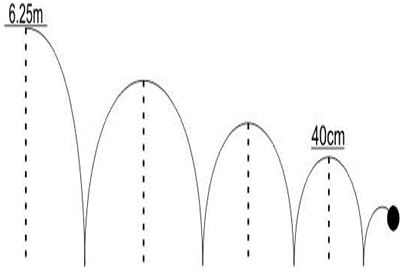
Question. Ayub drops a ball from a height of 6.25 metres to the flat ground below. After the third bounce, the ball rises to a height of 40 cm.
The height to which the ball rises after each bounce is the SAME FRACTION of the height reached on its PREVIOUS BOUNCE. What is the fraction?
(a) 1/2
(b) 2/5
(c) 5/8
(d) 39/125
Answer : B
Question 1. Using appropriate properties find:
(a) \(\left[ -\frac{2}{3} \times \frac{3}{5} + \frac{5}{2} - \frac{3}{5} \times \frac{1}{6} \right]\)
(b) \(\frac{2}{5} \times \left[ -\frac{3}{7} - \frac{1}{6} \right]\)
Answer:
(a) Rearranging terms using commutativity and applying distributivity:
\(= \left( -\frac{2}{3} \times \frac{3}{5} \right) - \left( \frac{3}{5} \times \frac{1}{6} \right) + \frac{5}{2}\)
\(= \frac{3}{5} \left( -\frac{2}{3} - \frac{1}{6} \right) + \frac{5}{2}\)
\(= \frac{3}{5} \left( \frac{-4 - 1}{6} \right) + \frac{5}{2}\)
\(= \frac{3}{5} \left( \frac{-5}{6} \right) + \frac{5}{2}\)
\(= -\frac{1}{2} + \frac{5}{2} = \frac{4}{2} = 2\)
(b) Using distributivity or simplifying inside the bracket first:
\(= \frac{2}{5} \times \left( \frac{-18 - 7}{42} \right)\)
\(= \frac{2}{5} \times \left( \frac{-25}{42} \right)\)
\(= \frac{2 \times (-25)}{5 \times 42} = \frac{-50}{210} = -\frac{5}{21}\)
In simple words: Use properties like distributive and commutative laws to simplify fractions before calculating.
Exam Tip: Look for common factors in products to group them together before performing addition or subtraction.
Question 2. Write the additive inverse of each of the following:
(a) \(\frac{2}{8}\)
(b) \(\frac{-5}{9}\)
(c) \(\frac{-6}{-5}\)
(d) \(\frac{2}{-9}\)
(e) \(\frac{19}{-6}\)
Answer:
The additive inverse of a number \(a\) is \(-a\) such that \(a + (-a) = 0\).
(a) \(-\frac{2}{8}\)
(b) \(\frac{5}{9}\)
(c) Since \(\frac{-6}{-5} = \frac{6}{5}\), its additive inverse is \(-\frac{6}{5}\)
(d) Since \(\frac{2}{-9} = -\frac{2}{9}\), its additive inverse is \(\frac{2}{9}\)
(e) Since \(\frac{19}{-6} = -\frac{19}{6}\), its additive inverse is \(\frac{19}{6}\)
In simple words: Change the sign of the rational number to find its additive inverse.
Exam Tip: Always simplify signs in fractions (like negative divided by negative) before finding the inverse.
Question 3. Verify that \(-(-x) = x\) for:
(a) \(x = \frac{11}{15}\)
(b) \(x = \frac{-13}{17}\)
Answer:
(a) Given \(x = \frac{11}{15}\). The negative of \(x\) is \(-\frac{11}{15}\).
Now, \(-(-x) = -\left(-\frac{11}{15}\right) = \frac{11}{15} = x\). Hence verified.
(b) Given \(x = \frac{-13}{17}\). The negative of \(x\) is \(-\left(\frac{-13}{17}\right) = \frac{13}{17}\).
Now, \(-(-x) = -\left(\frac{13}{17}\right) = -\frac{13}{17} = x\). Hence verified.
In simple words: The negative of a negative number is the positive number itself.
Exam Tip: Clearly show substitution step-by-step to earn full credit.
Question 4. Find the multiplicative inverse of the following:
(a) \(-13\)
(b) \(\frac{-13}{19}\)
(c) \(\frac{1}{5}\)
(d) \(\frac{-5}{8} \times \frac{-3}{7}\)
(e) \(-1 \times \frac{-2}{5}\)
(f) \(-1\)
Answer:
The multiplicative inverse (reciprocal) of \(a\) is \(\frac{1}{a}\) such that \(a \times \frac{1}{a} = 1\).
(a) \(-\frac{1}{13}\)
(b) \(-\frac{19}{13}\)
(c) 5
(d) First simplify: \(\frac{-5}{8} \times \frac{-3}{7} = \frac{15}{56}\). Its multiplicative inverse is \(\frac{56}{15}\)
(e) First simplify: \(-1 \times \frac{-2}{5} = \frac{2}{5}\). Its multiplicative inverse is \(\frac{5}{2}\)
(f) -1
In simple words: Flip the numerator and denominator while keeping the same sign.
Exam Tip: Simplify composite expressions into a single fraction before finding the reciprocal.
Question 5. Name the property under multiplication used in each of the following:
(a) \(\frac{-4}{5} \times 1 = 1 \times \frac{-4}{5} = \frac{-4}{5}\)
(b) \(\frac{-13}{17} \times \frac{-2}{7} = \frac{-2}{7} \times \frac{-13}{17}\)
(c) \(\frac{-19}{29} \times \frac{29}{-19} = 1\)
Answer:
(a) Multiplicative Identity (1 is the multiplicative identity)
(b) Commutative Property
(c) Multiplicative Inverse Property
In simple words: Identify whether the rule deals with multiplying by 1, changing order, or getting 1 as a result.
Exam Tip: Memorize the standard definitions and names of algebraic properties.
Question 6. Multiply \(\frac{6}{13}\) by the reciprocal of \(\frac{-7}{16}\).
Answer:
Reciprocal of \(\frac{-7}{16}\) is \(\frac{16}{-7}\)
Product = \(\frac{6}{13} \times \frac{16}{-7}\)
\(= \frac{96}{-91} = -\frac{96}{91}\)
In simple words: First find the reciprocal, then multiply the two fractions.
Exam Tip: Pay careful attention to the word "reciprocal of" before setting up the multiplication.
Question 7. Tell what property allows you to compute \(\frac{1}{3} \times \left( 6 \times \frac{4}{3} \right)\) as \(\left( \frac{1}{3} \times 6 \right) \times \frac{4}{3}\).
Answer:
Associativity of multiplication: \(a \times (b \times c) = (a \times b) \times c\).
In simple words: Changing the grouping of numbers in multiplication does not change the result.
Exam Tip: Associativity involves three numbers and changing brackets.
Question 8. Is \(\frac{8}{9}\) the multiplicative inverse of \(-1\frac{1}{8}\)? Why or why not?
Answer:
Mixed fraction \(-1\frac{1}{8} = -\frac{9}{8}\)
Product = \(\frac{8}{9} \times \left(-\frac{9}{8}\right) = -1\)
Since the product is not \(1\) (it is \(-1\)), \(\frac{8}{9}\) is not the multiplicative inverse of \(-1\frac{1}{8}\).
In simple words: Two numbers are multiplicative inverses only if their product is exactly positive 1.
Exam Tip: Always convert mixed fractions to improper fractions before checking products.
Question 9. Is \(0.3\) the multiplicative inverse of \(3\frac{1}{3}\)? Why or why not?
Answer:
\(0.3 = \frac{3}{10}\)
Mixed fraction \(3\frac{1}{3} = \frac{10}{3}\)
Product = \(\frac{3}{10} \times \frac{10}{3} = 1\)
Yes, \(0.3\) is the multiplicative inverse of \(3\frac{1}{3}\) because their product is \(1\).
In simple words: Convert decimals and mixed fractions to standard fractions and check if their product equals 1.
Exam Tip: Express all numbers in fractional form to verify inverses easily.
Question 10. Write:
(a) The rational number that does not have a reciprocal.
(b) The rational numbers those which are equal to their reciprocals.
(c) The rational number that is equal to its negative.
Answer:
(a) 0
(b) 1 and -1
(c) 0
In simple words: Recall special properties of numbers regarding reciprocals and negatives.
Exam Tip: Remember that 0 has no reciprocal because division by zero is undefined.
Question 11. Fill in the blanks:
(a) Zero has __________ reciprocal.
(b) The numbers __________ and __________ are their own reciprocals.
(c) The reciprocal of -5 is __________
(d) Reciprocal of \(\frac{1}{x}\), where \(x \neq 0\) is __________
(e) The product of two rational numbers is always a __________
(f) The reciprocal of a positive rational number is __________
Answer:
(a) no
(b) 1, -1
(c) \(-\frac{1}{5}\)
(d) \(x\)
(e) rational number
(f) positive rational number
In simple words: Fill in standard mathematical facts about rational numbers.
Exam Tip: Closure property guarantees that the product of rational numbers is always rational.
Question 12. Represent these numbers on a number line:
(a) \(\frac{7}{4}\)
(b) \(\frac{-5}{6}\)
Answer:
(a) Divide the segment between 0 and 2 into 4 equal parts per unit. Mark 7 parts to the right of 0.
(b) Divide the segment between 0 and -1 into 6 equal parts. Mark 5 parts to the left of 0.
In simple words: Use the denominator to divide unit intervals and the numerator to count steps from zero.
Exam Tip: Draw clear tick marks and label integers on the number line.
Question 13. Represent \(\frac{-2}{11}, \frac{-5}{11}, \frac{-9}{11}\) on the number line.
Answer:
Divide the segment between 0 and -1 into 11 equal parts. Mark the 2nd, 5th, and 9th ticks to the left of 0 for \(\frac{-2}{11}\), \(\frac{-5}{11}\), and \(\frac{-9}{11}\) respectively.
In simple words: All three negative fractions lie between 0 and -1 on the number line.
Exam Tip: Since denominators are the same, divide the unit distance into 11 equal subdivisions.
Question 14. Write five rational numbers which are smaller than 2.
Answer:
Any five numbers less than 2, for example: 1, 0, -1, \(\frac{1}{2}\), \(\frac{3}{2}\).
In simple words: Choose any numbers lying to the left of 2 on the number line.
Exam Tip: Integers as well as fractions can be used as rational numbers.
Question 15. Find ten rational numbers between \(\frac{-2}{5}\) and \(\frac{1}{2}\).
Answer:
Make denominators equal:
\(-\frac{2}{5} = -\frac{4}{10} = -\frac{8}{20}\)
\(\frac{1}{2} = \frac{5}{10} = \frac{10}{20}\)
Ten rational numbers between them can be chosen as:
\(-\frac{7}{20}, -\frac{6}{20}, -\frac{5}{20}, -\frac{4}{20}, -\frac{3}{20}, -\frac{2}{20}, -\frac{1}{20}, 0, \frac{1}{20}, \frac{2}{20}\)
In simple words: Convert to a common denominator with a larger multiplier to create enough space between the numbers.
Exam Tip: Expand the denominators further if you need more intermediate numbers.
Question 16. Find five rational numbers between:
(a) \(\frac{2}{3}\) and \(\frac{4}{5}\)
(b) \(\frac{-3}{2}\) and \(\frac{5}{3}\)
(c) \(\frac{1}{4}\) and \(\frac{1}{2}\)
Answer:
(a) Common denominator 15: \(\frac{10}{15}\) and \(\frac{12}{15}\). Expanding by 6: \(\frac{60}{90}\) and \(\frac{72}{90}\).
Five numbers: \(\frac{61}{90}, \frac{62}{90}, \frac{63}{90}, \frac{64}{90}, \frac{65}{90}\).
(b) Common denominator 6: \(\frac{-9}{6}\) and \(\frac{10}{6}\).
Five numbers: \(\frac{-8}{6}, \frac{-7}{6}, 0, \frac{1}{6}, \frac{2}{6}\).
(c) Common denominator 4: \(\frac{1}{4}\) and \(\frac{2}{4} = \frac{4}{8} = \frac{8}{16}\). Expanding by 4: \(\frac{4}{16}\) and \(\frac{8}{16}\).
Five numbers: \(\frac{4.2}{16}, \frac{4.4}{16}, \frac{4.6}{16}, \frac{4.8}{16}, \frac{5.0}{16}\) (or using denominator 24: \(\frac{7}{24}, \frac{8}{24}, \frac{9}{24}, \frac{10}{24}, \frac{11}{24}\)).
In simple words: Make denominators equal and scale up the fractions to insert the required quantity of numbers.
Exam Tip: Multiplying numerator and denominator by a larger power of 10 or integer helps find many rational numbers easily.
Question 17. Write five rational numbers greater than -2.
Answer:
Any five numbers greater than -2, for example: -1, 0, 1, 2, 3.
In simple words: Choose any numbers lying to the right of -2 on the number line.
Exam Tip: Remember that every positive number and zero is greater than any negative number.
Question 18. Find ten rational numbers between \(\frac{3}{5}\) and \(\frac{3}{4}\).
Answer:
Make denominators equal (LCM of 5 and 4 is 20):
\(\frac{3}{5} = \frac{12}{20} = \frac{120}{200}\)
\(\frac{3}{4} = \frac{15}{20} = \frac{150}{200}\)
Ten rational numbers between them: \(\frac{121}{200}, \frac{122}{200}, \frac{123}{200}, \frac{124}{200}, \frac{125}{200}, \frac{126}{200}, \frac{127}{200}, \frac{128}{200}, \frac{129}{200}, \frac{130}{200}\).
In simple words: Scale the denominators high enough so there is a gap of at least 10 integers between the numerators.
Exam Tip: Scaling by multiplying numerator and denominator by 10 is a quick way to generate space.
Question 19. Find \(\frac{3}{7} + \left( \frac{-6}{11} \right) + \left( \frac{-8}{21} \right) + \frac{5}{22}\).
Answer:
Group terms with related denominators (7 and 21; 11 and 22):
\(= \left( \frac{3}{7} - \frac{8}{21} \right) + \left( -\frac{6}{11} + \frac{5}{22} \right)\)
\(= \left( \frac{9 - 8}{21} \right) + \left( \frac{-12 + 5}{22} \right)\)
\(= \frac{1}{21} + \left( -\frac{7}{22} \right) = \frac{1}{21} - \frac{7}{22}\)
LCM of 21 and 22 is 462:
\(= \frac{22 - 147}{462} = -\frac{125}{462}\)
In simple words: Combine fractions with common or multiple denominators first to simplify addition.
Exam Tip: Finding the LCM carefully is crucial for adding fractions with large denominators.
Question 20. Find \(\frac{-4}{5} \times \frac{3}{7} \times \frac{15}{16} \times \left( \frac{-14}{9} \right)\).
Answer:
Multiply numerators and denominators while cancelling common factors:
\(= \frac{-4 \times 3 \times 15 \times (-14)}{5 \times 7 \times 16 \times 9}\)
Cancel terms: 5 and 15 gives 3; 3 and 9 gives 3; 3 and 3 cancels out; 7 and -14 gives -2; -4 and 16 gives 4; -2 and 4 gives 2 in denominator; negative signs cancel out.
Result = \(\frac{1}{2}\)
In simple words: Cross-cancel common factors across numerators and denominators to simplify before final multiplication.
Exam Tip: Always cancel common factors before multiplying large numbers to avoid arithmetic errors.
Question 21. Write the additive inverse of the following:
(a) \(\frac{-7}{19}\)
(b) \(\frac{21}{112}\)
Answer:
(a) \(\frac{7}{19}\)
(b) \(-\frac{21}{112}\) (which simplifies to \(-\frac{3}{16}\))
In simple words: Reverse the sign of each rational number.
Exam Tip: Simplify the fraction in the final answer if required.
Question 22. Verify that \(-(-x)\) is the same as \(x\) for:
(a) \(x = \frac{13}{7}\)
(b) \(x = \frac{-21}{31}\)
Answer:
(a) Given \(x = \frac{13}{7} \implies -(-x) = -\left(-\frac{13}{7}\right) = \frac{13}{7} = x\). Verified.
(b) Given \(x = \frac{-21}{31} \implies -(-x) = -\left(-\left(\frac{-21}{31}\right)\right) = -\left(\frac{21}{31}\right) = \frac{-21}{31} = x\). Verified.
In simple words: Two consecutive negative signs turn a number back into its original positive or negative value.
Exam Tip: Keep track of all negative signs during substitution.
Question 23. Find \(\frac{2}{5} - \frac{3}{7} - \frac{1}{14} - \frac{3}{7} \times \frac{3}{5}\).
Answer:
First perform multiplication: \(\frac{3}{7} \times \frac{3}{5} = \frac{9}{35}\)
Expression becomes: \(\frac{2}{5} - \frac{3}{7} - \frac{1}{14} - \frac{9}{35}\)
Group terms with common denominators (5 and 35; 7 and 14):
\(= \left( \frac{2}{5} - \frac{9}{35} \right) - \left( \frac{3}{7} + \frac{1}{14} \right)\)
\(= \left( \frac{14 - 9}{35} \right) - \left( \frac{6 + 1}{14} \right)\)
\(= \frac{5}{35} - \frac{7}{14} = \frac{1}{7} - \frac{1}{2}\)
\(= \frac{2 - 7}{14} = -\frac{5}{14}\)
In simple words: Follow BODMAS/PEMDAS by doing multiplication before subtraction, then combine terms.
Exam Tip: Always apply multiplication before addition or subtraction.
Question 24. Write any three rational numbers between -2 and 0.
Answer:
Three rational numbers between -2 and 0: \(-1, -\frac{1}{2}, -\frac{3}{2}\).
In simple words: Choose any numbers strictly between -2 and 0.
Exam Tip: Fractions and decimals are valid rational numbers between any two integers.
Question 25. Find any ten rational numbers between \(\frac{-5}{6}\) and \(\frac{5}{8}\).
Answer:
Make denominators equal (LCM of 6 and 8 is 24):
\(\frac{-5}{6} = \frac{-20}{24} = \frac{-200}{240}\)
\(\frac{5}{8} = \frac{15}{24} = \frac{150}{240}\)
Ten rational numbers between them: \(-\frac{10}{24}, -\frac{9}{24}, -\frac{8}{24}, -\frac{7}{24}, -\frac{6}{24}, -\frac{5}{24}, -\frac{4}{24}, -\frac{3}{24}, -\frac{2}{24}, -\frac{1}{24}\).
In simple words: Find a common denominator and scale up to ensure enough intermediate values exist.
Exam Tip: Any ten distinct fractions within the range will be accepted.
Question 26. Find a rational number between \(\frac{1}{4}\) and \(\frac{1}{2}\).
Answer:
Using the mean method \(\frac{a+b}{2}\) or common denominator:
\(\frac{1}{4} = \frac{2}{8}\) and \(\frac{1}{2} = \frac{4}{8}\)
A rational number between them is \(\frac{3}{8}\).
In simple words: Find the midpoint or a fraction lying directly between the two given numbers.
Exam Tip: The average of two numbers always lies strictly between them.
Question 27. Find three rational numbers between \(\frac{1}{4}\) and \(\frac{1}{2}\).
Answer:
Make denominators equal with a larger multiplier (e.g., denominator 16):
\(\frac{1}{4} = \frac{4}{16}\)
\(\frac{1}{2} = \frac{8}{16}\)
Three rational numbers between them: \(\frac{5}{16}, \frac{6}{16} \left(=\frac{3}{8}\right), \frac{7}{16}\).
In simple words: Scale up the denominators to create enough room to list three intermediate fractions.
Exam Tip: Simplify your final fractions if possible, though unsimplified forms are also correct.
Free study material for Mathematics
Free CBSE Practice Worksheets: Class 8 Mathematics Chapter 01 Rational Numbers
Daily Practice Questions for Class 8 Mathematics
Access structured practice worksheets for Chapter 01 Rational Numbers aligned with the 2026 CBSE curriculum. These downloadable exercises for Class 8 Mathematics help students build accuracy and reinforce core concepts for upcoming school tests.
Detailed Answers for Class 8 Mathematics Chapter 01 Rational Numbers
Designed around the official curriculum for Class 8 Mathematics, these practice sheets guarantee standard compliance. Reviewing step-by-step solutions after completion sharpens your accuracy and clarifies complex sub-topics within Chapter 01 Rational Numbers.
Complete Your Chapter Revision
Consistent engagement with these exercises builds familiarity with recurring exam themes. If specific areas within Chapter 01 Rational Numbers cause trouble, utilize our dedicated NCERT solutions for Class 8 Mathematics to clear up doubts immediately.
FAQs
You can download the latest chapter-wise printable worksheets for Class 8 Mathematics Chapter 01 Rational Numbers for free from StudiesToday.com. These have been made as per the latest CBSE curriculum for this academic year.
Yes, Class 8 Mathematics worksheets for Chapter 01 Rational Numbers focus on activity-based learning and also competency-style questions. This helps students to apply theoretical knowledge to practical scenarios.
Yes, we have provided solved worksheets for Class 8 Mathematics Chapter 01 Rational Numbers to help students verify their answers instantly.
Yes, our Class 8 Mathematics test sheets are mobile-friendly PDFs and can be printed by teachers for classroom.
For Chapter 01 Rational Numbers, regular practice with our worksheets will improve question-handling speed and help students understand all technical terms and diagrams.