

Chapter-wise Worksheets for Class 8 Mathematics: Chapter 11 Mensuration
Explore structured practice materials through the CBSE Class 8 Mathematics Mensuration Worksheet Set 02. Tailored for Class 8 learners, utilizing these Mathematics worksheets ensures thorough preparation and strengthens problem-solving accuracy before final school evaluations.
Practice Class 8 Mathematics Worksheets: Chapter 11 Mensuration
Navigate directly to the solved Mathematics worksheets using the digital viewer below. Each practice set includes detailed step-by-step solutions, allowing students to instantly cross-check their work and identify areas requiring further revision.
Question. EVERY number in area Q must be divisible by
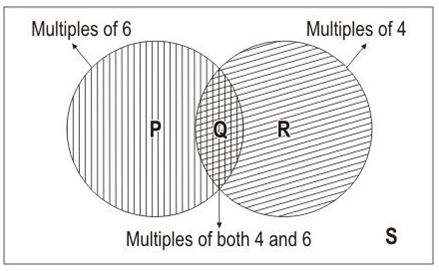
(a) 10
(b) 12
(c) 16
(d) 24
Answer : B
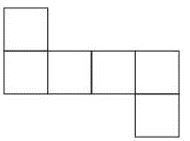
Question. The shape given below is made up of identical small squares.
If the area of the whole shape is 24 cm2, what is its perimeter?
(a) 24 cm
(b) 28 cm
(c) 48 cm
(d) 56 cm
Answer : B
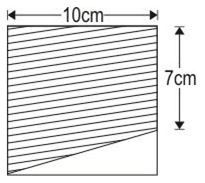
Question. What is the area of the shaded part of the SQUARE shown below?
(a) 35 sq cm
(b) 70 sq cm
(c) 85 sq cm
(d) 93 sq cm
Answer : C
Question. In a triangle PQR, ∠Q =500 and ∠R=750 . Which of these statements is true about the sides of the triangle?
(a) PR < QR
(b) QR = PQ
(c) PQ < PR
(d) PQ < QR
Answer : D
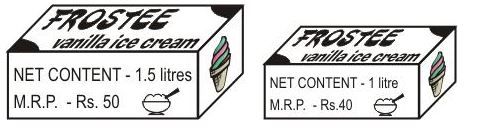
Question. Frostee ice cream packs are available in two different sizes as shown below.
Abbas needs 10 litres of vanilla ice cream for a party. What is the MINIMUM cost at which Abbas can get enough ice cream for his party?
(a) Rs. 340
(b) Rs. 350
(c) Rs. 400
(d) Rs. 450
Answer : A
Question. How many pieces exactly like this one are needed to form a complete circle (circular region)?
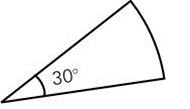
(a) 6
(b) 8
(c) 10
(d) 12
Answer : D
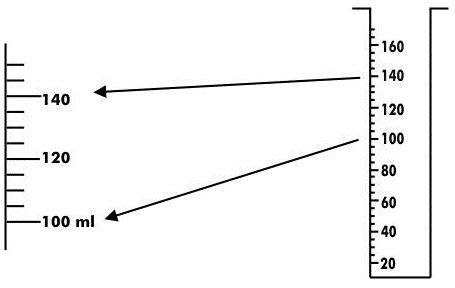
Question. A part of one side of a vessel is shown below.
Using this beaker which of these measurements can be made EXACTLY?
(a) 121.5 ml
(b) 124 ml
(c) 125 ml
(d) 128 ml
Answer : C
Question. If the above figure is turned by 270° in an ANTICLOCKWISE direction, which of these would be the result?

Answer : A
Question. What is the area of the shaded part of the square?
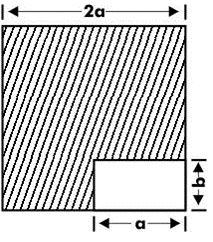
(a) 2a2 - ab
(b) 4a - ab
(c) 4a2 - ab
(d) 2a2 + ab
Answer : C
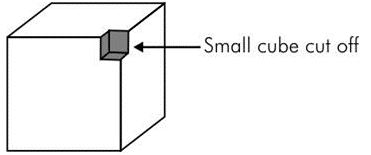
Question. A small cube is cut off from a larger cube as shown below.
For the ORIGINAL CUBE, which of the following will remain unchanged
(a) the volume
(b) the total surface area
(c) the number of edges
(d) the number of corners
Answer : B
Question. Which figure below has the same perimeter as?
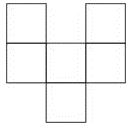

Answer : A
Question. The three sides of which of these triangles could be 9, 12 and 15 units?

Answer : C
Question. A triangle can be formed using which of the following sets of sticks?
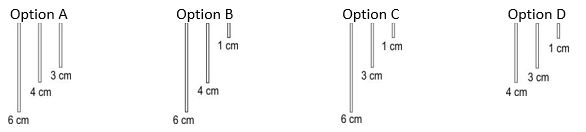
Answer : A
Question. What is the perimeter of the figure shown below?
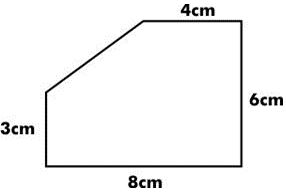
(a) 21 units
(b) 24 units
(c) 26 units
(d) 28 units
Answer : C
Question. In the above figure, which of these will NOT equal 180°?
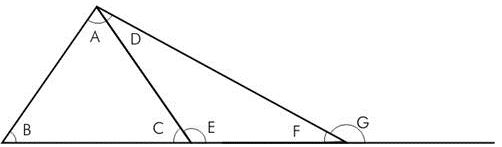
(a) ∠A + ∠B + ∠C
(b) ∠F + ∠G
(c) ∠A + ∠B + ∠D + ∠F
(d) ∠E + ∠A + ∠B
Answer : D
Question. A man bought a rectangular field of length 144 m and width 64 m. In exchange for this field he wanted to buy a square field of the same area. What would the side of the square field be?
(A) 104m
(B) 208m
(C) 96m
(D) 416m
Answer : C
Question. A tank with a square base has a volume of 384 cm3. If its height is 6 em, find the length of the side of the square base.
(A) 10 cm
(B) 8 cm
(C) 12 cm
(D) 6 cm
Answer : B
Question. In the figure given, RSTV is a square inscr ibed in a circle with centre 0 and radius 'r'. What is the total area of unshaded region?
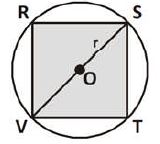
(A) r 2(n- 2) sq. units
(B) 2r(2 - 7t) sq. units
(C) 1t(r2 - 2) sq. units
(D) (nr2 - 8r) sq. units
Answer : A
Question. The area of a parallelogram is 120 cm2 and its altitude is 10 em. Find the length of the base.
(A) 24 cm
(B) 12 cm
(C) 8 cm
(D) 4 cm
Answer : B
Question. The area of a rhombus is 28 cm2 and one of its diagonals is 4 cm. Find its perimeter.
(A) 4J53 cm
(B) 36 cm
(C) 2J53 cm
(D) 44 cm
Answer : A
Question. The base of an isosceles right triangle is 30 cm. Find its area.
(A) 225 cm2
(B) 225.√3 cm2
(C) 5√2 cm2
(D) 6√3 cm2
Answer : A
Question. What is the percentage change in the area of a rectangle obtained by decreasing its length and increasing its breadth by 5%?
(A) 2.5% increase
(B) 0.25% increase
(C) 0.25% decrease
(D) 2.5% decrease
Answer : C
Question. What is the area of an isosceles triangle having base 'x' em and one side 'y' cm?
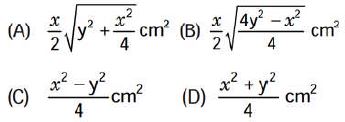
Answer : B
Question. What is the length of the diagonal of a square whose area is 16900 m2 ?
(A) 130m
(B) 130√2m
(C) 169m
(D) 144m
Answer : B
Question. The sides of a triangle are 3 em, 5 cm and 4 cm. What is its area?
(A) 6 cm2
(B) 7.5 cm2
(C) s.J2 cm2
(D) 10 cm2
Answer : A
Question. Find the area of the sector of a circle, whose radius is 6 m when the angle at the centre is 42 °.
(A) 13.2 m2
(B) 14.2 m2
(C) 13.4 m2
(D) 14.4 m2
Answer : A
Question. A sector of 120" cut out from a circle has an area of 9(3/7) sq. em. What is the radius of the circle?
(A) 3 cm
(B) 2.5 cm
(C) 3.5 cm
(D) 3.6 cm
Answer : A
Question. The sides of a triangle are 16 em, 30 cm and 34 cm. What is its area ?
(A) 120 cm2
(B) 260 cm2
(C) 240 cm2
(D) 272 cm2
Answer : C
Question. The area of a trapezium is 28 cm2 and one of its parallel sides is 6 em. If its altitude is 4 cm, find its other parallel side.
(A) 4 cm
(B) 8 cm
(C) 6 cm
(D) 10 cm
Answer : B
Question. The perimeter of a triangular field is 144 m and the ratio of its sides is 3 : 4 : 5. What is the area of the field?
(A) 864m2
(B) 468m2
(C) 824m2
(D) 486m2
Answer : A
Question. Find the area of a segment of a circle of radius 21 em if the arc of the segment has a measure of 60°. (Take √3 = 1.73)
(A) 45.27 cm2
(B) 40.8 cm2
(C) 40.27 cm2
(D) 42.07 cm2
Answer : C
Question. An empty tank was 5 full after 1.5 l of water was poured in it. The base area of the tank was 250 cm2. What was the height of the tank?
(A) 15 cm
(B) 5 cm
(C) 4 cm
(D) 8 cm
Answer : A
Question. A rectangular field has its length and breadth in the ratio 5 : 3. Its area is 3.75 hectares. Find the cost of fencing it at ₹5 per metre.
(A) ₹400
(B) ₹4000
(C) ₹1000
(D) ₹500
Answer : B
Question 1. (i) The parallel sides of a trapezium are 28 cm and 16 cm and its area is \(220\text{ cm}^2\). The distance between its parallel sides is
(a) 5 cm
(b) 10 cm
(c) 15 cm
(d) 20 cm
Answer: (b) 10 cm
Area of trapezium = \(\frac{1}{2} \times (\text{sum of parallel sides}) \times \text{height}\)
\(220 = \frac{1}{2} \times (28 + 16) \times h\)
\(220 = \frac{1}{2} \times 44 \times h\)
\(220 = 22 \times h\)
\(h = \frac{220}{22} = 10\text{ cm}\)
In simple words: The distance between the parallel sides (height) is found by dividing twice the area by the sum of the parallel sides.
Exam Tip: Always write the formula for the area of a trapezium before substituting the given values to avoid calculation errors.
Question 1. (ii) If an edge of a cube is doubled, then its surface area will become
(a) twice
(b) thrice
(c) \(\frac{4}{3}\) times
(d) four times
Answer: (d) four times
Let the original edge of the cube be \(x\).
Original surface area \(S_1 = 6x^2\)
New edge = \(2x$
New surface area \(S_2 = 6(2x)^2 = 6(4x^2) = 4(6x^2) = 4S_1\)
In simple words: When the edge is doubled, the area increases by the square of 2, which is 4 times.
Exam Tip: For any 3D figure, scaling linear dimensions by a factor \(k\) scales surface areas by \(k^2\) and volumes by \(k^3\).
Question 1. (iii) The volume of a cube of edge \(0.01\text{ m}\) (in \(\text{cm}^3\)) is
(a) 0.000001
(b) 1
(c) 0.0001
(d) 0.001
Answer: (b) 1
Edge of cube = \(0.01\text{ m} = 0.01 \times 100\text{ cm} = 1\text{ cm}\)
Volume of cube = \((\text{edge})^3 = (1\text{ cm})^3 = 1\text{ cm}^3$
In simple words: Convert the edge from meters to centimeters first, then cube the value.
Exam Tip: Pay close attention to the required unit in brackets \(\text{(in cm}^3\text{)}\) before performing calculations.
Question 1. (iv) The radius of a right circular cylinder is doubled keeping its height same. The ratio between the volumes of new cylinder and the original cylinder is
(a) 3 : 1
(b) 4 : 1
(c) 2 : 1
(d) 8 : 1
Answer: (b) 4 : 1
Let original radius be \(r\) and height be \(h\).
Original volume \(V_1 = \pi r^2 h$
New radius \(R = 2r$, height remains \(h\).
New volume \(V_2 = \pi R^2 h = \pi (2r)^2 h = 4\pi r^2 h$
Ratio \(\frac{V_2}{V_1} = \frac{4\pi r^2 h}{\pi r^2 h} = \frac{4}{1} = 4 : 1\)
In simple words: Since volume depends on the square of the radius (\(r^2\)), doubling the radius makes the volume \(2^2 = 4\) times larger.
Exam Tip: When finding ratios, write formulas in fraction form so that common constants like \(\pi\) and \(h\) cancel out easily.
Question 2. The area of a square is \(42.25\text{ m}^2\). Find the side of the square. If the tiles measuring \(13\text{ cm} \times 13\text{ cm}\) are paved on the square area, find how many tiles are required for paving it?
Answer:
Area of square = \(42.25\text{ m}^2$
Side of square = \(\sqrt{42.25} = 6.5\text{ m}\)
Converting side into centimeters: \(6.5\text{ m} = 6.5 \times 100 = 650\text{ cm}\)
Area of square in \(\text{cm}^2 = 650 \times 650 = 422500\text{ cm}^2$
Area of one tile = \(13\text{ cm} \times 13\text{ cm} = 169\text{ cm}^2$
Number of tiles required = \( \frac{\text{Area of square}}{\text{Area of one tile}} = \frac{422500}{169} = 2500 $
In simple words: First find the side length from the area, convert it to centimeters to match the tile units, and then divide the total area by the area of one tile.
Exam Tip: Always ensure all dimensions are in the same unit before calculating the number of items needed for tiling.
Question 3. A field in the form of a rhombus has each side of length 64 m and altitude 16 m. What is the side of a square field which has the same area as that of the rhombus?
Answer:
Side of rhombus = \(64\text{ m}$
Altitude (height) of rhombus = \(16\text{ m}$
Area of rhombus = \(\text{Base} \times \text{Altitude} = 64 \times 16 = 1024\text{ m}^2$
Area of square = Area of rhombus = \(1024\text{ m}^2$
Let the side of the square be \(s\).
\(s^2 = 1024$
\(s = \sqrt{1024} = 32\text{ m}$
In simple words: Calculate the area of the rhombus using base and altitude, set it equal to the area of the square, and take the square root to find the side of the square.
Question 4. The perimeter of the rhombus is 20 cm and the altitude is 4.8 cm. If the length of one diagonal is 6 cm, find the length of the other diagonal.
Answer:
Perimeter of rhombus = \(20\text{ cm}$
Side of rhombus (\(a\)) = \(\frac{20}{4} = 5\text{ cm}\)
Altitude (\(h\)) = \(4.8\text{ cm}$
Area of rhombus = \(\text{Side} \times \text{Altitude} = 5 \times 4.8 = 24\text{ cm}^2$
Also, Area of rhombus = \(\frac{1}{2} \times d_1 \times d_2\)
\(24 = \frac{1}{2} \times 6 \times d_2$
\(24 = 3 \times d_2$
\(d_2 = \frac{24}{3} = 8\text{ cm}$
In simple words: Find the area using side and altitude, then use the diagonal area formula to find the missing diagonal.
Exam Tip: A rhombus has two different area formulas (\(b \times h\) and \(\frac{1}{2}d_1 d_2\)); equating them is a very common technique in mensuration problems.
Question 5. The area of a trapezium is \(210\text{ cm}^2\). The ratio between the lengths of its parallel sides is 3:4. If its height is 6 cm, find the length of both the parallel sides.
Answer:
Let the parallel sides be \(3x\) and \(4x\).
Height (\(h\)) = \(6\text{ cm}$
Area of trapezium = \(\frac{1}{2} \times (\text{sum of parallel sides}) \times \text{height}\)
\(210 = \frac{1}{2} \times (3x + 4x) \times 6$
\(210 = \frac{1}{2} \times 7x \times 6$
\(210 = 21x$
\(x = \frac{210}{21} = 10$
Length of first parallel side = \(3x = 3 \times 10 = 30\text{ cm}$
Length of second parallel side = \(4x = 4 \times 10 = 40\text{ cm}$
In simple words: Use a variable \(x\) for the ratio, substitute into the trapezium area formula to solve for \(x\), and then find the actual side lengths.
Exam Tip: Whenever side lengths are given in a ratio (like 3:4), always represent them as \(3x\) and \(4x\).
Question 6. How many cubical blocks of edge 25 cm can be cut from a cubical block of edge 1 m?
Answer:
Edge of large cube = \(1\text{ m} = 100\text{ cm}$
Volume of large cube = \(100 \times 100 \times 100 = 1000000\text{ cm}^3$
Edge of small cubical block = \(25\text{ cm}$
Volume of small cube = \(25 \times 25 \times 25 = 15625\text{ cm}^3$
Number of blocks = \( \frac{\text{Volume of large cube}}{\text{Volume of small cube}} = \frac{1000000}{15625} = 64 $
In simple words: Divide the volume of the big cube by the volume of one small cube after converting units to centimeters.
Exam Tip: Never find the number of blocks by dividing linear edges (\(\frac{100}{25} = 4\)) and cubing that result unless checking mentally; always divide total volume by unit volume.
Question 7. A powder is available in two packs - a tin can with a square base of each side 5 cm and having height 14 cm or one with a circular base of radius 3.5 cm and having height 12 cm. Which of them has greater capacity and by how much?
Answer:
Capacity of square-based tin (cuboid) = \(\text{Base area} \times \text{Height} = (5 \times 5) \times 14 = 25 \times 14 = 350\text{ cm}^3$
Capacity of circular-based tin (cylinder) = \(\pi r^2 h = \frac{22}{7} \times (3.5)^2 \times 12 = \frac{22}{7} \times 3.5 \times 3.5 \times 12$
\(= 22 \times 0.5 \times 3.5 \times 12 = 11 \times 42 = 462\text{ cm}^3$
Comparison: \(462\text{ cm}^3 > 350\text{ cm}^3$
The circular-based tin has greater capacity.
Difference in capacity = \(462 - 350 = 112\text{ cm}^3$
In simple words: Calculate the volume of both cans (one is a rectangular prism, the other is a cylinder) and compare their volumes.
Exam Tip: Use \(\pi = \frac{22}{7}\) when the radius is a multiple of \(0.5\) or \(7\) to simplify decimal calculations.
Question 8. Three cubes of edge 10 cm each are placed side by side and stuck together. If the outer surface alone is painted at 2 paise per \(\text{cm}^2\), find the cost of painting.
Answer:
When three cubes of edge \(10\text{ cm}\) are joined side by side, they form a cuboid with:
Length (\(l\)) = \(10 + 10 + 10 = 30\text{ cm}$
Breadth (\(b\)) = \(10\text{ cm}$
Height (\(h\)) = \(10\text{ cm}$
Total surface area of the resulting cuboid = \(2(lb + bh + hl)\)
\(= 2(30 \times 10 + 10 \times 10 + 10 \times 30)\)
\(= 2(300 + 100 + 300) = 2(700) = 1400\text{ cm}^2$
Rate of painting = Rs \(0.02\) per \(\text{cm}^2$ (or 2 paise per \(\text{cm}^2\))
Total cost = \(1400 \times 0.02 = \text{Rs } 28$
In simple words: Joining the cubes forms a cuboid where the length triples while breadth and height remain the same. Calculate its total surface area and multiply by the rate.
Exam Tip: Remember to convert paise to rupees by dividing by 100 when calculating final monetary cost in standard currency units.
Question 9. A cuboidal tin open at the top has dimensions \(20\text{ cm} \times 16\text{ cm} \times 14\text{ cm}\). What is the total area of a sheet of metal required to make 10 such tins.
Answer:
Dimensions of the open cuboidal tin: \(l = 20\text{ cm}\), \(b = 16\text{ cm}\), \(h = 14\text{ cm}\)
Since the tin is open at the top, area of metal sheet for one tin = \(\text{Total surface area} - \text{Area of top}\)
\(= 2(lb + bh + hl) - lb$
\(= lb + 2bh + 2hl$
\(= (20 \times 16) + 2(16 \times 14) + 2(14 \times 20)\)
\(= 320 + 2(224) + 2(280)\)
\(= 320 + 448 + 560 = 1328\text{ cm}^2$
Area of metal sheet required for 10 such tins = \(10 \times 1328 = 13280\text{ cm}^2$
In simple words: Subtract the top face area (\(l \times b\)) from the total surface area formula since the box is open, then multiply by 10.
Exam Tip: Read carefully whether containers are open or closed; open containers do not include the top face area.
Question 10. The circumference of the base of a right circular cylinder is 176 cm and it is 1 m high. Find the lateral surface area of the cylinder.
Answer:
Circumference of base (\(2\pi r\)) = \(176\text{ cm}$
Height of cylinder (\(h\)) = \(1\text{ m} = 100\text{ cm}$
Lateral surface area (Curved Surface Area) = \(\text{Circumference of base} \times \text{Height}\)
\(= 2\pi r \times h = 176 \times 100 = 17600\text{ cm}^2$
In simple words: The curved surface area of a cylinder is simply the base circumference multiplied by the height.
Exam Tip: Converting height from meters to centimeters is crucial to match the circumference unit before multiplying.
Question 11. A cylindrical pillar is 50 cm in diameter and 3.5 m high. Find the cost of white washing its curved surface at the rate of Rs 1.25 per square metre.
Answer:
Diameter of pillar = \(50\text{ cm} = 0.5\text{ m}$
Radius (\(r\)) = \( \frac{0.5}{2} = 0.25\text{ m} $
Height (\(h\)) = \(3.5\text{ m}$
Curved Surface Area = \(2\pi r h = 2 \times \frac{22}{7} \times 0.25 \times 3.5$
\(= 2 \times \frac{22}{7} \times \frac{1}{4} \times \frac{7}{2} = \frac{11}{2} = 5.5\text{ m}^2$
Rate of white washing = Rs \(1.25\text{ per m}^2$
Total cost = \(5.5 \times 1.25 = \text{Rs } 6.875\text{ (or Rs } 6.88\text{)}$
In simple words: Convert dimensions to meters, calculate the curved surface area, and multiply by the given rate per square meter.
Exam Tip: Convert centimeter dimensions to meters early when the rate is given in square meters.
Question 12. The diameter of a roller is 80 cm and its length is 126 cm. It takes 750 complete revolutions moving once over to level a playground. Find the area of the playground.
Answer:
Diameter of roller = \(80\text{ cm}\(, Radius (\(r\)) = \(40\text{ cm} = 0.4\text{ m}\)
Length (height of cylinder, \(h\)) = \(126\text{ cm} = 1.26\text{ m}$
Area covered in 1 revolution = Curved surface area of roller = \(2\pi r h$
\(= 2 \times \frac{22}{7} \times 0.4 \times 1.26$
\(= 2 \times \frac{22}{7} \times 0.4 \times 0.18 = 3.168\text{ m}^2$
Area of playground (covered in 750 revolutions) = \(750 \times 3.168 = 2376\text{ m}^2$
In simple words: Find the curved surface area covered in one rotation of the roller and multiply by the total number of revolutions.
Exam Tip: A roller covers ground equal to its curved surface area in one complete rotation.
Question 13. A room is 5.5 m long, 4 m wide and 3.5 m high. Find the cost of papering its walls with paper 90 cm wide at Rs 1.20 per metre.
Answer:
Length (\(l\)) = \(5.5\text{ m}\(, Breadth (\(b\)) = \(4\text{ m}\), Height (\(h\)) = \(3.5\text{ m}$
Area of 4 walls (lateral surface area) = \(2(l + b) \times h$
\(= 2(5.5 + 4) \times 3.5 = 2(9.5) \times 3.5 = 19 \times 3.5 = 66.5\text{ m}^2$
Width of wallpaper = \(90\text{ cm} = 0.9\text{ m}$
Length of wallpaper required = \( \frac{\text{Area of walls}}{\text{Width of paper}} = \frac{66.5}{0.9} = \frac{665}{9}\text{ m} $
Cost of paper = \(\text{Length} \times \text{Rate} = \frac{665}{9} \times 1.20 = \frac{665}{9} \times \frac{6}{5} = \frac{133 \times 2}{3} = \frac{266}{3} = \text{Rs } 88.67$
In simple words: Find the wall area, divide by the wallpaper width to get the required length of paper, and multiply by the cost per meter.
Exam Tip: Wallpaper cost is based on length, not area, so divide the total wall area by the width of the paper first.
Question 14. The area of a rhombus is equal to the area of a triangle with base 24.8 cm and altitude 16.5 cm. If one of the diagonals of the rhombus is 22 cm, find the other diagonal.
Answer:
Area of triangle = \( \frac{1}{2} \times \text{base} \times \text{altitude} = \frac{1}{2} \times 24.8 \times 16.5 $
\(= 12.4 \times 16.5 = 204.6\text{ cm}^2$
Area of rhombus = Area of triangle = \(204.6\text{ cm}^2$
Let the other diagonal be \(d_2\). Given \(d_1 = 22\text{ cm}$
Area of rhombus = \(\frac{1}{2} \times d_1 \times d_2\)
\(204.6 = \frac{1}{2} \times 22 \times d_2$
\(204.6 = 11 \times d_2$
\(d_2 = \frac{204.6}{11} = 18.6\text{ cm}$
In simple words: Calculate the triangle's area, equate it to the rhombus area formula, and solve for the unknown diagonal.
Exam Tip: Equating areas of two different geometric shapes is a standard multi-step problem type in mensuration.
Question 15. A cardboard box open from the top is 1.5 m long, 1.25 m wide and 65 cm deep. Find the area of cardboard required for making the box and the cost of cardboard required at Rs 25 per sq m.
Answer:
Length (\(l\)) = \(1.5\text{ m}\(, Breadth (\(b\)) = \(1.25\text{ m}\), Depth (\(h\)) = \(65\text{ cm} = 0.65\text{ m}$
Since the box is open from the top, area of cardboard = \(lb + 2bh + 2hl$
\(= (1.5 \times 1.25) + 2(1.25 \times 0.65) + 2(0.65 \times 1.5)\)
\(= 1.875 + 2(0.8125) + 2(0.975)\)
\(= 1.875 + 1.625 + 1.95 = 5.45\text{ m}^2$
Cost of cardboard = \(\text{Area} \times \text{Rate} = 5.45 \times 25 = \text{Rs } 136.25$
In simple words: Calculate the surface area of the open box (four walls plus bottom) and multiply by the rate per square meter.
Exam Tip: Convert height into meters before calculating surface area to keep all units consistent.
Question 16. A rich person wants to donate a rectangular piece of land measuring 500m length and 300m breadth. He distributes his land equally among his 5 servants.
(i) How much area does each servant get?
(ii) Do you believe in donation/charity? If yes, write one incidence when you have donated something.
(iii) Can you name the great Indian leader who started Bhoodan Movement?
Answer:
(i) Total length = \(500\text{ m}\(, Breadth = \(300\text{ m}\)
Total area of land = \(\text{Length} \times \text{Breadth} = 500 \times 300 = 150000\text{ m}^2$
Number of servants = 5
Area each servant gets = \( \frac{150000}{5} = 30000\text{ m}^2$
(ii) Yes, donation and charity help uplift society and support those in need. (Personal response example: I donated my old storybooks and winter clothes to an underprivileged children's NGO last winter.)
(iii) Acharya Vinoba Bhave started the Bhoodan (Land Gift) Movement in 1951.
In simple words: Find the total area of the rectangular land and divide it equally among the 5 servants. The rest are value-based and general knowledge questions.
Exam Tip: For value-based questions, write thoughtful, honest personal reflections and accurate historical facts.
Free study material for Mathematics
Download Class 8 Mathematics Chapter 11 Mensuration Practice Worksheets
Download Chapter Worksheets: Class 8 Mathematics
Access structured practice worksheets for Chapter 11 Mensuration aligned with the 2026 CBSE curriculum. These downloadable exercises for Class 8 Mathematics help students build accuracy and reinforce core concepts for upcoming school tests.
Concept Clarification for Chapter 11 Mensuration
Built using official NCERT guidelines for Class 8 Mathematics, these practice sheets provide reliable academic support. Cross-reference your completed work with our detailed solutions to learn standard answer-writing formats for CBSE exams.
Effective Revision Strategies for School Exams
Wrap up your chapter revision by testing your knowledge against standard objective question formats. Explore our full library of free, up-to-date printable assignments to maximize your academic results in upcoming CBSE evaluations.
FAQs
You can download the latest chapter-wise printable worksheets for Class 8 Mathematics Chapter 11 Mensuration for free from StudiesToday.com. These have been made as per the latest CBSE curriculum for this academic year.
Yes, Class 8 Mathematics worksheets for Chapter 11 Mensuration focus on activity-based learning and also competency-style questions. This helps students to apply theoretical knowledge to practical scenarios.
Yes, we have provided solved worksheets for Class 8 Mathematics Chapter 11 Mensuration to help students verify their answers instantly.
Yes, our Class 8 Mathematics test sheets are mobile-friendly PDFs and can be printed by teachers for classroom.
For Chapter 11 Mensuration, regular practice with our worksheets will improve question-handling speed and help students understand all technical terms and diagrams.