

Chapter-wise Worksheets for Class 8 Mathematics: Chapter 01 Rational Numbers
Explore structured practice materials through the CBSE Class 8 Mathematics Rational Numbers Worksheet Set 01. Tailored for Class 8 learners, utilizing these Mathematics worksheets ensures thorough preparation and strengthens problem-solving accuracy before final school evaluations.
Practice Class 8 Mathematics Worksheets: Chapter 01 Rational Numbers
Access the complete worksheet PDF for Class 8 Mathematics below. Regular practice with these targeted academic tasks builds familiarity with standard question patterns and helps secure higher marks in final school examinations.
Question. Mr. Shah, an industrialist, is estimated to have assets worth Rs. 5.2 crores. Which of these could be the actual value of his assets?
(a) Rs. 52,07,900
(b) Rs. 50,29,790
(c) Rs. 5,02,56,770
(d) Rs. 5,23,45,990
Answer : D
Question. Mr. Kaul deposits a fixed amount of money for a 5 year period. Some details of the account (Interest compounded annually) are given below:
Principal on which interest is computed for the first year : Rs 40000 .Interest earned for the first year : Rs 2000
Interest earned for the second year : Rs 2100
Interest earned for the third year : Rs 2205
The amount (Principal) on which the interest for the fourth year will be calculated is
(a) 2,205
(b) 40,000
(c) 46,305
(d) 46,615
Answer : C
Question. 6789678967896789 ÷ 6789 is equal to
(a) 1111
(b) 10101
(c) 1000100010001
(d) 1000100010001000
Answer : C
Question. Point M (not shown) on the number line is MORE than 4 units away from point Q and LESS than 1 unit away from point S. Where does point M lie?

(a) Between Q and R
(b) Between R and S
(c) Between S and T
(d) To the right of T
Answer : C
Question. Which of these is true for any non-zero rational number p?
(a) p × (- p) = 1
(b) (-p) ÷ p = -1
(c) p - (-p) = 0
(d) -1/ p=p
Answer : B
Question. The integer that is 25 more than (-435) is
(a) -450
(b) -460
(c) -410
(d) 460
Answer : C
Question. Any number that can be written in the form x⁄y (where x, y are integers and y ≠ 0) is a rational number.
Which of the following is NOT a rational number?
(a) 2.353535....
(b) -1/4
(c) 3/0
(d) 7
Answer : C
Question. On which number line is the position of 3.508 shown most accurately?
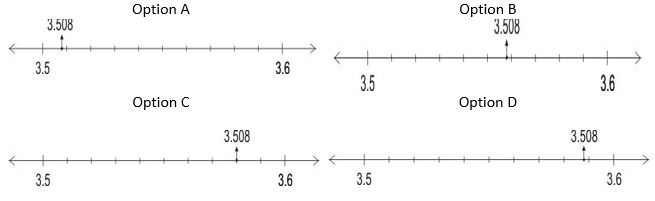
Answer : A
Question. A pair of rational numbers, when MULTIPLIED, gives the answer as (-1). The numbers could be
(a) (-p) and p
(b) (-p) and (-1)
(c) (-p ) and 1
(d) (-p) and 1/p
Answer : D
Question. A new operation ★ is defined as follows:
p ★ q=2q - p for all rational numbers p and q.
According to this, what will be the value of 5 ★ 1? ★
(a) -8
(b) -3
(c) 8
(d) 9
Answer : B
Question. c and d are two integers. Which of the following MUST BE TRUE if (-3d) ÷ c is to be a rational number?
(a) d should be a positive number.
(b) d and c should be of opposite signs.
(c) d should be completely divisible by c.
(d) c should not be 0.
Answer : D
Question. .............. represents a number such that -5/6 × .............. = 1
Which of the following statements about .............. is NOT true?
(a) ............... ÷ 5⁄6 = 1
(b) ..............< -5⁄6
(c) 6⁄5 - .............. = 0
(d) .............. lies between -1 and –2
Answer : A
Question. What is one crore, two lakhs and three thousand PLUS twenty seven lakhs, forty three thousand and twenty one?
(a) 2866021
(b) 12946021
(c) 14746021
(d) 14773021
Answer : B
Question. 0, 1, 2, 3, 4... are called Whole Numbers.
x and y are two numbers which satisfy ALL these conditions:
(x + y) is a whole number,
(x - y) is not a whole number and
xy is not a whole number
Which of the following COULD BE values of x and y?
(a) x = 3, y = 2
(b) x = 6, y = 8
(c) x = 4.6, y = 6.4
(d) x = 1. 3, y = 6. 3
Answer : C
Question. Which rational number does the pointer on the number line show?

(a) -1.2
(b) -0.4
(c) 1.2
(d) -0.8
Answer : D
True and False :
Question. Every whole no. is a rational no.
Answer : True
Question. Every integer is a rational no.
Answer : True
Question. 0 is a whole number but it is not a rational no.
Answer : False
Question. The reciprocal of a positive rationaln umber is positive.
Answer : True
Very Short Answer type Questions
Question. Ramesh’s camera was loaded with a new roll of film. The film can take 36 snaps. During the class picnic he took 20 pictures. What fraction of the roll can still be used to take snaps.
Answer : 4/9
Question. What is the value of 3/4 x 2/5 + 3/4 x 3/5
Answer : 3/4
Question. Which is not a rational number
(a) 22/39
(b) 731/0
(c) 288
(d) 8(1/3)
Answer : B
Question. Find -5/48 + -11/24
Answer : -9/16
Question. Find -2/15 + 7/30
Answer : 1/10
Question. Complete the following a/b + ........ = 0
Answer : -a/b
Question. If a and b are rational numbers then which is not always true
(a) a + b is a rational number
(b) a – b is a rational number
(c) a × b is a rational number
(d) a + b is a rational number.
Answer : D
Question. What is the additive inverse of 4/9
Answer : 4/9
Question. What is the value of 17/9 x -2/3 + 17/9 x 8/3 - 34/9
Answer : 0
Question. Complete the following .......... + 0 = - (-5/8)
Answer : 5/8
Question. What fraction is 20 paisa of Rs. 6.20?
Answer : 1/31
Question. Find out the missing number 3/7 x x/7 x 7/45 = 1/21
Answer : (5)
Question. Find x if 13/11 x 22/39 x x = 1/9
Answer : 1/6
Question. Find 3/4 + -7/48
Answer : -36/7
Question. Express -3/5 as a rational number with denominator-
i) 20
ii) -30
Answer : i) -3/5 x 4/5 = -12/20
ii) -3/5 x -6/6 = 18/-30
Question. Which of the twor ational numbers is greater in the given pair?
i) -3/4 or 1/4
ii) 2/3 or 3/4
Answer : i) -3/4 is a negative rational no.
So,-3/4 < 0 and 1/4 > 0
i.e -3/4 < 1/4
ii) LCM of 3 and 4 is 12
so, 2/3 x 4/4 = 8/12
3/4 x 3/3 = 9/12
8/12 < 9/12 i.e, 2/3 < 3/4
Question. Express -42/98 as a rational number with denominator 7.
Answer : -42/98 ÷ 14/14 = -3/7
Question. Thesum of two rational numbersis -14/5. If one of them is-2,find the other.
Answer : Let the other no. be x
According to ques. x + (-2) = -14/5
x = (-14/5) + 2
= -14 + 10/5
= ans. -4/5
Question. What number should be added to-1 so as to get 5/7.
Answer : Let x be added
According to ques.
x + (-1) = 5/7
x = 5/7 +1
x = (5+7)/7
x = 12/7ans
Question. The product of two rational number is -9. If one of the numbers is -12, find theo ther.
Answer : Let the no. bex
x ×(-12)=-9
x = -9/-12
x = 3/4 ans.
1. Tick the correct alternative :
Question i. If \(a\) is an integer, which of the following is always true
(a) \(|a| = a$
(b) \(|a| < a$
(c) \(|a| \ge a$
(d) \(|a| > a$
Answer: (c) \(|a| \ge a$
For any integer \(a\), if \(a\) is positive or zero, \(|a| = a\). If \(a\) is negative, \(|a| = -a\), which is strictly greater than \(a\). Thus, \(|a| \ge a\) is always true.
In simple words: The absolute value of any number is always greater than or equal to the number itself.
Exam Tip: Test with a negative integer like \(a = -5\). Then \(|-5| = 5\), and \(5 \ge -5\) is true.
Question ii. Which of the following rational numbers lies between \(\frac{-1}{4}\(and \(\frac{1}{4}\)?
(a) \(\frac{-1}{8}$
(b) \(\frac{-2}{5}$
(c) \(\frac{-1}{3}$
(d) \(\frac{1}{3}$
Answer: (a) \(\frac{-1}{8}$
Converting the given limits to a common denominator of 8: \(\frac{-1}{4} = \frac{-2}{8}\(and \(\frac{1}{4} = \frac{2}{8}\).
Checking option (a): \(\frac{-1}{8}\(clearly lies between \(\frac{-2}{8}\) and \(\frac{2}{8}$.
In simple words: Find a common denominator to easily compare and locate the number between the given limits.
Exam Tip: Convert fractions to like fractions with the same denominator to easily check inequalities.
Question iii. \(\frac{-7}{5} - \left(\frac{-3}{5}\right)$ is
(a) \(\frac{-10}{40}$
(b) \(\frac{-11}{40}$
(c) \(\frac{-59}{40}$
(d) \(\frac{11}{40}$
Answer: (None of the options)
Evaluating the expression:
\(\frac{-7}{5} - \left(\frac{-3}{5}\right) = \frac{-7}{5} + \frac{3}{5}\)
\( = \frac{-7 + 3}{5} = \frac{-4}{5} $
In simple words: Subtracting a negative number is the same as adding its positive counterpart.
Exam Tip: Be careful with signs: subtracting a negative number changes the sign to positive.
Question iv. Which of the following is a false statement?
(a) \(a + b$ is a rational number
(b) \((a + b) + c = a + (b + c)$
(c) \(-a + a = -1$
(d) \((a - b) + c \neq a + (b + c)$
Answer: (c) \(-a + a = -1$
By the additive inverse property, \(-a + a = 0\(, not \(-1\). Therefore, statement (c) is false.
In simple words: Adding a number to its negative always results in zero.
Exam Tip: Remember that the sum of a number and its additive inverse is always \(0$.
Question 2. Find 4 rational numbers between \(\frac{1}{2}\(and \(\frac{3}{5}\).
Answer:
Make the denominators equal by taking the LCM of 2 and 5, which is 10.
\( \frac{1}{2} = \frac{1 \times 5}{2 \times 5} = \frac{5}{10} $
\( \frac{3}{5} = \frac{3 \times 2}{5 \times 2} = \frac{6}{10} $
To find 4 rational numbers, multiply numerator and denominator by \(4 + 1 = 5$ (or a larger number like 10):
\( \frac{5}{10} = \frac{50}{100} $
\( \frac{6}{10} = \frac{60}{100} $
Four rational numbers between them are \(\frac{51}{100}\), \(\frac{52}{100}\), \(\frac{53}{100}\), and \(\frac{54}{100}\).
In simple words: Convert the fractions to have the same denominator, then expand them to insert the required numbers in between.
Exam Tip: Always make denominators equal first, then multiply both numerator and denominator by \((n+1)\) or more to get enough space between the numbers.
Question 3. Evaluate : \(\left(\frac{2}{11} \times \frac{-22}{15}\right) + \left(\frac{-3}{5} \times \frac{3}{5}\right) + \left(\frac{3}{21} \times \frac{3}{5}\right)$
Answer:
Simplify each term step by step:
First term: \( \frac{2}{11} \times \frac{-22}{15} = \frac{2 \times (-2)}{1 \times 15} = \frac{-4}{15} $
Second term: \( \frac{-3}{5} \times \frac{3}{5} = \frac{-9}{25} $
Third term: \( \frac{3}{21} \times \frac{3}{5} = \frac{1}{7} \times \frac{3}{5} = \frac{3}{35} $
Now combine all terms: \(\frac{-4}{15} - \frac{9}{25} + \frac{3}{35}$
LCM of 15, 25, and 35 is 525.
\( = \frac{-4 \times 35 - 9 \times 21 + 3 \times 15}{525} $
\( = \frac{-140 - 189 + 45}{525} $
\( = \frac{-329 + 45}{525} = \frac{-284}{525} $
In simple words: Simplify each multiplication part first, then add and subtract using a common denominator.
Exam Tip: Always apply BODMAS and simplify individual fractions by canceling common factors before finding the LCM.
Question 4. Subtract the sum of \(\frac{-4}{5}\(and \(\frac{2}{3}\) from 1.
Answer:
First, find the sum of \(\frac{-4}{5}\(and \(\frac{2}{3}\):
\( \text{Sum} = \frac{-4}{5} + \frac{2}{3} $
LCM of 5 and 3 is 15.
\( \text{Sum} = \frac{-4 \times 3 + 2 \times 5}{15} = \frac{-12 + 10}{15} = \frac{-2}{15} $
Now, subtract this sum from 1:
\( 1 - \left(\frac{-2}{15}\right) = 1 + \frac{2}{15} $
\( = \frac{15}{15} + \frac{2}{15} = \frac{17}{15} $
In simple words: First calculate the sum of the two numbers, then subtract that result from 1.
Exam Tip: "Subtract A from B" means writing it as \(B - A\), not \(A - B\).
Question 5. Evaluate using distributive property : \(\frac{9}{11} \times \frac{-16}{3} + \frac{9}{11} \times \frac{-18}{7}$
Answer:
Using the distributive property \(a \times b + a \times c = a \times (b + c)\):
Here, \(a = \frac{9}{11}\), \(b = \frac{-16}{3}\), and \(c = \frac{-18}{7}\).
\( = \frac{9}{11} \times \left(\frac{-16}{3} + \frac{-18}{7}\right) $
Find the LCM of 3 and 7, which is 21 inside the parentheses:
\( = \frac{9}{11} \times \left(\frac{-16 \times 7 + (-18) \times 3}{21}\right) $
\( = \frac{9}{11} \times \left(\frac{-112 - 54}{21}\right) $
\( = \frac{9}{11} \times \left(\frac{-166}{21}\right) $
Simplify by canceling 9 and 21 by 3:
\( = \frac{3}{11} \times \left(\frac{-166}{7}\right) $
\( = \frac{-498}{77} $
In simple words: Factor out the common term and simplify the addition inside the bracket first.
Exam Tip: Look for common terms in addition/subtraction expressions to apply the distributive property and save calculation time.
Question 6. The product of two rational numbers is \(\frac{-16}{28}\(. If one of them is \(\frac{-18}{7}\), find the other.
Answer:
Let the other rational number be \(x$.
\( x \times \left(\frac{-18}{7}\right) = \frac{-16}{28} $
Simplify \(\frac{-16}{28}\) to \(\frac{-4}{7}$:
\( x \times \left(\frac{-18}{7}\right) = \frac{-4}{7} $
\( x = \frac{-4}{7} \div \left(\frac{-18}{7}\right) $
\( x = \frac{-4}{7} \times \frac{7}{-18} $
\( x = \frac{-4}{-18} = \frac{4}{18} = \frac{2}{9} $
In simple words: Divide the given product by the known number to find the missing number.
Exam Tip: Division of fractions is performed by multiplying the dividend by the reciprocal of the divisor.
Question 7. Divide the sum of \(\frac{3}{8}\(and \(\frac{-5}{12}\) by their product.
Answer:
Step 1: Find the sum of \(\frac{3}{8}\(and \(\frac{-5}{12}\):
LCM of 8 and 12 is 24.
\( \text{Sum} = \frac{3 \times 3 + (-5) \times 2}{24} = \frac{9 - 10}{24} = \frac{-1}{24} $
Step 2: Find the product of \(\frac{3}{8}\(and \(\frac{-5}{12}\):
\( \text{Product} = \frac{3}{8} \times \frac{-5}{12} = \frac{1}{8} \times \frac{-5}{4} = \frac{-5}{32} $
Step 3: Divide the sum by the product:
\( \text{Result} = \frac{-1}{24} \div \frac{-5}{32} $
\( = \frac{-1}{24} \times \frac{32}{-5} $
\( = \frac{-1 \times 32}{24 \times (-5)} = \frac{-32}{-120} = \frac{4}{15} $
In simple words: Calculate the sum first, then the product, and finally divide the sum result by the product result.
Exam Tip: Simplify intermediate fractions whenever possible to make final multiplication and division easier.
Question 8. Bhargav had a piece of ribbon \(4\frac{3}{8}\) m long. She used \(2\frac{1}{2}\) m from it. How much ribbon was left with her?
Answer:
Total length of ribbon = \(4\frac{3}{8}\text{ m} = \frac{35}{8}\text{ m}$
Length of ribbon used = \(2\frac{1}{2}\text{ m} = \frac{5}{2}\text{ m}$
Ribbon left = Total length - Length used
\( = \frac{35}{8} - \frac{5}{2} $
LCM of 8 and 2 is 8.
\( = \frac{35 - 5 \times 4}{8} = \frac{35 - 20}{8} = \frac{15}{8}\text{ m} = 1\frac{7}{8}\text{ m} $
In simple words: Subtract the used length from the total length to find the remaining ribbon.
Exam Tip: Convert mixed fractions into improper fractions before performing subtraction.
Question 9. The area of a rectangle is \(118\frac{3}{4}\) sq m. If its breadth is \(6\frac{3}{5}\) m, find its length.
Answer:
Area = \(118\frac{3}{4} = \frac{475}{4}\text{ sq m}$
Breadth = \(6\frac{3}{5} = \frac{33}{5}\text{ m}$
Since \(\text{Area} = \text{Length} \times \text{Breadth}\):
\( \text{Length} = \frac{\text{Area}}{\text{Breadth}} $
\( \text{Length} = \frac{475}{4} \div \frac{33}{5} $
\( = \frac{475}{4} \times \frac{5}{33} $
\( = \frac{2375}{132}\text{ m} = 17\frac{131}{132}\text{ m} $
In simple words: Divide the total area by the given breadth to find the length.
Exam Tip: Remember the formula: \(\text{Length} = \frac{\text{Area}}{\text{Breadth}}\).
Question 10. One sixth of the students of a class joined the sports club. Three fifth of these students opted to play table tennis. If 6 students play table tennis, how many students are there in the class?
Answer:
Let the total number of students in the class be \(x$.
Students who joined the sports club = \(\frac{1}{6}x$
Students who opted to play table tennis = \(\frac{3}{5} \times \left(\frac{1}{6}x\right) = \frac{3}{30}x = \frac{1}{10}x$
Given that 6 students play table tennis:
\( \frac{1}{10}x = 6 $
\( x = 6 \times 10 = 60 $
In simple words: Form an equation based on the given fractions and solve for the total number of students.
Exam Tip: Work backward from the final given number by reversing the fraction operations.
Question 11. Write 5 rational numbers between \(\frac{-3}{8}\(and \(\frac{7}{12}\).
Answer:
First, make the denominators equal by finding the LCM of 8 and 12, which is 24.
\( \frac{-3}{8} = \frac{-3 \times 3}{8 \times 3} = \frac{-9}{24} $
\( \frac{7}{12} = \frac{7 \times 2}{12 \times 2} = \frac{14}{24} $
The integers between \(-9\) and \(14\) in the numerator are \(-8, -7, \dots, 13$.
We can choose any 5 rational numbers between them:
\(\frac{-8}{24}\), \(\frac{-7}{24}\), \(\frac{0}{24}\), \(\frac{5}{24}\(, and \(\frac{10}{24}\) (or simplify them to \(\frac{-1}{3}\), \(\frac{-7}{24}\), \(0\(, \(\frac{5}{24}\), \(\frac{5}{12}\)).
In simple words: Equalize denominators and pick any five numerators that lie between the two numbers.
Exam Tip: Choosing numbers with a common denominator makes selecting intermediate values simple.
Question 12. If \(x = \frac{2}{3}\(and \(y = \frac{3}{2}\), find \((x + y) \div (x - y)\).
Answer:
Calculate \((x + y)\):
\( x + y = \frac{2}{3} + \frac{3}{2} = \frac{4 + 9}{6} = \frac{13}{6} $
Calculate \((x - y)\):
\( x - y = \frac{2}{3} - \frac{3}{2} = \frac{4 - 9}{6} = \frac{-5}{6} $
Now divide \((x + y)\) by \((x - y)\):
\( (x + y) \div (x - y) = \frac{13}{6} \div \left(\frac{-5}{6}\right) $
\( = \frac{13}{6} \times \frac{6}{-5} = \frac{13}{-5} = \frac{-13}{5} $
In simple words: Evaluate the addition and subtraction parts separately first, then divide the two results.
Exam Tip: Always evaluate bracketed expressions completely before performing the final division.
Question 13. What should be subtracted from the product of \(\frac{3}{7}\(and \(\frac{2}{5}\) to get \(\frac{-3}{35}$?
Answer:
First, find the product of \(\frac{3}{7}\(and \(\frac{2}{5}\):
\( \text{Product} = \frac{3}{7} \times \frac{2}{5} = \frac{6}{35} $
Let the number to be subtracted be \(z$.
\( \frac{6}{35} - z = \frac{-3}{35} $
\( z = \frac{6}{35} - \left(\frac{-3}{35}\right) $
\( z = \frac{6}{35} + \frac{3}{35} = \frac{9}{35} $
In simple words: Find the product first, then set up a subtraction equation and solve for the unknown value.
Exam Tip: Formulate equations carefully: "What should be subtracted from A to get B" translates to \(A - z = B\).
Question 14. One coin weighs \(5\frac{3}{8}\) g. Find the weight of 12 such coins.
Answer:
Weight of 1 coin = \(5\frac{3}{8}\text{ g} = \frac{43}{8}\text{ g}$
Weight of 12 coins = \(12 \times \frac{43}{8} $
\( = \frac{3 \times 43}{2} = \frac{129}{2}\text{ g} = 64\frac{1}{2}\text{ g} $
In simple words: Multiply the weight of one coin by 12 to get the total weight.
Exam Tip: Cancel common factors between the numerator and denominator before multiplying to simplify calculations.
Question 15. Find at least four rational numbers between \(\frac{-1}{2}\(and \(\frac{1}{2}\).
In the above question, one of the values is positive and the other one is negative. In the same manner, some people are optimistic (thinking positive) and others are pessimistic (thinking negative). In which category do you belong to?
Answer:
First part - Finding rational numbers:
Make denominators equal with LCM of 2, which is already 10 when expanded:
\( \frac{-1}{2} = \frac{-5}{10} $
\( \frac{1}{2} = \frac{5}{10} $
Four rational numbers between \(\frac{-5}{10}\) and \(\frac{5}{10}\) are \(\frac{-2}{10}\), \(\frac{-1}{10}\), \(\frac{1}{10}\), and \(\frac{2}{10}$ (which simplify to \(\frac{-1}{5}\), \(\frac{-1}{10}\), \(\frac{1}{10}\), and \(\frac{1}{5}\)).
Second part - Personal reflection:
I belong to the optimistic category, as looking at challenges with a positive mindset helps in finding creative solutions and overcoming obstacles effectively.
In simple words: Expand the fractions to find numbers in between, and choose an optimistic mindset for personal attitude.
Exam Tip: For value-based questions, provide a thoughtful and positive response aligned with personal growth and constructive thinking.
Free study material for Mathematics
CBSE Class 8 Mathematics Worksheets for Chapter 01 Rational Numbers
Practice Exercises for Class 8 Mathematics Chapter 01 Rational Numbers
Review targeted practice exercises for Class 8 Mathematics Chapter 01 Rational Numbers. Curated to match official CBSE guidelines, these printable problem sets support daily revision and improve overall test readiness.
Step-by-Step Solutions and Practice Guidelines
Designed around the official curriculum for Class 8 Mathematics, these practice sheets guarantee standard compliance. Reviewing step-by-step solutions after completion sharpens your accuracy and clarifies complex sub-topics within Chapter 01 Rational Numbers.
Enhance Speed with Online Practice
Follow up your worksheet practice by attempting the interactive online MCQ tests for Chapter 01 Rational Numbers to evaluate your execution speed. All printable assignments and revision sheets on our platform are updated for the 2026 session and available free of charge.
FAQs
You can download the latest chapter-wise printable worksheets for Class 8 Mathematics Chapter 01 Rational Numbers for free from StudiesToday.com. These have been made as per the latest CBSE curriculum for this academic year.
Yes, Class 8 Mathematics worksheets for Chapter 01 Rational Numbers focus on activity-based learning and also competency-style questions. This helps students to apply theoretical knowledge to practical scenarios.
Yes, we have provided solved worksheets for Class 8 Mathematics Chapter 01 Rational Numbers to help students verify their answers instantly.
Yes, our Class 8 Mathematics test sheets are mobile-friendly PDFs and can be printed by teachers for classroom.
For Chapter 01 Rational Numbers, regular practice with our worksheets will improve question-handling speed and help students understand all technical terms and diagrams.