

Official Class 8 Mathematics Worksheets: Chapter 01 Rational Numbers
Explore structured practice materials through the CBSE Class 8 Mathematics Rational Numbers Worksheet Set 02. Tailored for Class 8 learners, utilizing these Mathematics worksheets ensures thorough preparation and strengthens problem-solving accuracy before final school evaluations.
Solved Practice Worksheets for Mathematics
Navigate directly to the solved Mathematics worksheets using the digital viewer below. Each practice set includes detailed step-by-step solutions, allowing students to instantly cross-check their work and identify areas requiring further revision.
Question. Which of the following statements is true?
(A) Every fraction is a rational number.
(B) Every rational number is a fraction.
(C) Every integer is a rational number.
(D) Both (A) and (C).
Answer : D
Question. If (-3)/x = x/(-27), what is the positive value of 'x'?
(A) - 9
(B) 9
(C) - 81
(D) 81
Answer : B
Question. Which number is in the middle if -1/6. 4/9, 6/-7, 2/5 and -3/4 are arranged in descending order ?
(A) 2/5
(B) 4/9
(C) -1/6
(D) -6/7
Answer : C
Question. Which of the following numbers must be subtracted from 7/-8 to get -13/12 ?
(A) 5/24
(B) 9/24
(C) -7/24
(D) -5/24
Answer : A
Question. Simpli5f 2/5 + 8/3 + -11/15 + 4/5 + -2/3 .
(A) 37/15
(B) -37/15
(C) -35/5
(D) -38/9
Answer : A
Question. Compare -8/9 and 4/-5.
(A) -8/9 > - 4/5
(B) -4/5 < -5/9
(C) -8/9 = - (-4/5)
(D) -8/9 < -4/5
Answer : D
Question. What is the resultant obtained when the additive inverse of 5/6 is subtracted from the multiplicative inverse of -5/7 x 15?
(A) 3/2
(B) -2/3
(C) -3/2
(D) 2/3
Answer : B
Question. What number should be added to -4/7 to get 5/9?
(A) -71/63
(B) 71/63
(C) 1/63
(D) -1/63
Answer : B
Question. Evaluat
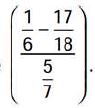
(A) 49/45
(B) -1(4/45)
(C) 45/49
(D) 1(4/45)
Answer : B
Question. What is the multiplicative inverse of 0 ?
(A) 1/0
(B) 0
(C) Does not exist
(D) 0/0
Answer : C
Question. The sum of two rational numbers is - 3. If one of them is -11/5, find the other.
(A) -4/5
(B) -8/5
(C) 4/5
(D) 8/5
Answer : A
Question. Which of the following is the resultant of 1/12 + -1/3 + -1/6 + -5/7 + 3/4 + 10/7 ?
(A) 1(1/21)
(B) -1
(C) 0
(D) 1
Answer : A
Question. Find four rational numbers between 1/6 and 1/3
(A) -1/4, 7/24, 13/48, -27/96
(B) 1/4. -7/24, 13/48, 27/96
(C) 1/4, 7/24, -13/48, 27/96
(D) 1/4, 7/24, 13/48, 27/96
Answer : D
Question. Which of the following are three rational numbers between - 2 and - 1?
(A) -1/2, -1/3, -1/5
(B) -3/2, -7/4, -5/4
(C) -12/5, - 22/5, 12/5
(D) 3/2, 7/4, 5/4
Answer : B
Question. Find the value of (5/9 ÷ 15/36) ÷ (-5/6)
(A) -4/3
(B) 3/5
(C) -8/3
(D) -3/8
Answer : C
Question. State which of the numbers given in the box are rational.
(i) √2 x √8 (ii) 22/7 (iii) 2√3 (iv) π
(A) (i) and (ii) only
(B) (i) and (iii) only
(C) (ii) and (iv) only
(D) (iii) and (iv) only
Answer : A
Question. What is the simplified form of (-9/7 x -1/3) + (15/8 x -4/5) - (27/14 x 2/9) ?
(A) 3/2
(B) -3/7
(C) -3/2
(D) 3/7
Answer : C
Question. What should be subtracted from -7/11 to get -2?
(A) 15/11
(B) -15/11
(C) 29/11
(D) -29/11
Answer : A
Question. By what rational number should -3/5 be multiplied to obtain 21?
(A) 507/4
(B) 35
(C) - 35
(D) 507
Answer : C
Question. Which of the following is a rational number between 4 and 3?
(A) 7/24
(B) /815
(C) 48
(D) Both (A) & (C)
Answer : D
Question. Which of the following is the correct arrangement of -11/15, -3/10, -1/5 and 13/20 in descending order?
(A) 13/20, -1/5, -11/15, -3/10
(B) 13/20, -1/5, -3/10, -11/15
(C) 13/20, -11/15, -3/10, 1/5
(D) 13/20, -3/10, -11/15, 1/5
Answer : B
Question. How is -28/84 expressed as a rational number with numerator 4?
(A) 4/7
(B) 4/12
(C) 4/12
(D) 4/-7
Answer : B
Question. Which of the following sets of rational numbers is arranged in ascending order?
(A) - 5/14, - 25/28, - 4/7, - 1/2
(B) - 25/28, -15/14, -3/7, - 1/2
(C) - 25/28, - 1/2, - 3/7, - 5/14
(D) - 1/2, -3/7, -5/14, -25/28
Answer : C
Question. Which of the following statements is false ?
(A) 5/7 < 7/9 < 9/13 < 11/13
(B) 11/13 < 9/11 < 7/9 < 5/7
(C) 5/7 < 11/13 < 7/9 < 9/11
(D) Both (B) & (C)
Answer : D
Question. What is the average of the two middle rational numbers when 4/-9, -6/9, 5/9, -7/9. 8/9. 1/9 and 9 are arranged in ascending order?
(A) 1/8
(B) 2/7
(C) -3/7
(D) -1/6
Answer : D
Question. Subtract -5/9 from -3/7.
(A) 62/63
(B) 8/63
(C) -8/63
(D) -62/63
Answer : D
Question. Which of the following numbers must be added to -5/16 to get 7/24 ?
(A) 21/28
(B) -29/48
(C) 15/48
(D) 29/48
Answer : D
Question. What is the sum of the additive inverse and multiplicative inverse of 2?
(A) 3/2
(B) - 3/2
(C) 1/2
(D) -1/2
Answer : B
Question. Subtract 2/3 from 7/8
(A) -5/24
(B) 5/24
(C) 7/16
(D) 5/16
Answer : B
Question. Which among the following is a rational number equivalent to -5/-3 ?
(A) -25/15
(B) 25/-15
(C) 25/15
(D) -25/30
Answer : C
Question. The product of two numbers is 9. If one -35/24 of the numbers is "24. find the other.
(A) 8/7
(B) -8/21
(C) -3/7
(D) 8/21
Answer : B
Question. The area of a rectangle is 45(5/16) cm2. If one edge is 6(1/4)cm. find the other in cm.
(A) 7(1/8)
(B) 7/4
(C) 7(1/4)
(D) 4(1/7)
Answer : C
Question. Arrange -4/5, 9/-15 and -2/3 in descending order.
(A) 9/-15, -2/3, -4/5
(B) -2/3, -4/5 -9/15
(C) 9/-15, -4/5, -2/3
(D) -2/3, -9/15, -4/5
Answer : A
Question. Simplify 4/7 + 0 + -8/9 + -13/7 + 17/21.
(A) -56/63
(B) -86/63
(C) 86/63
(D) 56/63
Answer : B
Question. What is the sum of the greatest and the least numbers of 5/9, 1/9 and 11/9 ?
(A)2/9
(B) 4/9
(C) 4/3
(D) 2/3
Answer : C
Question. Find two rational numbersb etween -3 and -2.
Answer : Number between -3 and -2 = 1/2 × (-3-2) = -5/2
Number between -3 and -5/2 = 1/2 × (-3 + -5/2)
= 1/2 × [(-6-5)/2]
= (1/2) x (-11/2) = -11/4 ans
Question. Find a rational number between1/4and1/3.
Answer : requiredno :- (1/4 + 1/3)/2
(3+4/12)/2
(1/2) x (7/12) = 7/24 ans
Question. Find 10 rational numbers between -3/4 and 5/6.
Answer : Given numbers are - 3/4 and 5/6
Making denominator same- (LCM of 4 and 6 are 12)
-3x3/4x3, 5x2/6x2 = -9/12 and 10/12
Thus ten rationaln umbers be -8/12, -7/12, -5/12, -4/12, -3/12, -1/12, 0, 1/12, 2/12, 4/12.
i.e -2/3, -7/12, -5/12, -1/3.-1/4, -1/12, 0, 1/12, 1/6, 1/3.
Question. Find three rational numbers between 4 and 5.
Answer : Given no. can be written as - 4/1 and 5/1
= 4x5/1x5, 5x5/1x5
= 20/5, 25/5
Thus three rational numbers be 21/5, 22/5, 23/5 ans
Question. Find ten rational numbers between −2/5 and 1/2
Answer : Given numbers can be written as :-
(by same denominator method)
= − 2×2 / 5×2 and 1×5 / 2×5 (LCM of 5 and 2 is 10)
= − 4/10 and 5/10
Thus, some five rational numbers between given rational numbers may
be −3/10, −2/10, −1/10, 0 and 1/10 ans
Question. Find 12 rational numbers between -1 and 2.
Answer : Given no. can be written as -1/1 and 2/1
= -1x10/1x10, 2x10/1x10
= -10/10, 20/10
Thus 12 rational numbers between- 9/10,-7/10, -3/10, -1/10, 0, 1/10, 3/10, 7/10, 1, 11/12, 13/12, 17/12. ans
1. Rational Numbers
Question 1. Find the reciprocal of -2.
Answer: The reciprocal of a non-zero rational number \(a\) is \(\frac{1}{a}\).
Reciprocal of \(-2\) = \(-\frac{1}{2}\)
In simple words: Flip the number upside down to find its reciprocal.
Exam Tip: Do not change the negative sign when finding the reciprocal.
Question 2. The sum of two numbers is \(\frac{5}{9}\). If one of the numbers is \(\frac{1}{3}\), find the other.
Answer: Let the other number be \(x\).
According to the question:
\(x + \frac{1}{3} = \frac{5}{9}\)
\(x = \frac{5}{9} - \frac{1}{3}\)
Convert \(\frac{1}{3}\) to have a denominator of 9:
\(\frac{1}{3} = \frac{1 \times 3}{3 \times 3} = \frac{3}{9}\)
\(x = \frac{5}{9} - \frac{3}{9} = \frac{2}{9}\)
In simple words: Subtract the given number from the total sum to get the other number.
Exam Tip: Always make the denominators equal before subtracting fractions.
Question 3. Write the additive inverse of \(\frac{2}{3}\) and show that their sum is zero.
Answer: The additive inverse of \(\frac{2}{3}\) is \(-\frac{2}{3}\).
Sum = \(\frac{2}{3} + \left(-\frac{2}{3}\right) = \frac{2 - 2}{3} = \frac{0}{3} = 0\)
In simple words: The additive inverse is the same number with the opposite sign, which adds up to zero.
Exam Tip: A number plus its additive inverse always equals 0.
Question 4. Simplify \(\frac{7}{6} \times \frac{-3}{28}\) and find its reciprocal.
Answer: Simplify the expression:
\(\frac{7}{6} \times \frac{-3}{28} = \frac{7 \times (-3)}{6 \times 28}\)
Cancel out common factors:
\(= \frac{1 \times (-1)}{2 \times 4} = -\frac{1}{8}\)
Now, find the reciprocal of \(-\frac{1}{8}\):
Reciprocal = \(-8\)
In simple words: Multiply the fractions first, simplify the result, and then flip it to get the reciprocal.
Exam Tip: Reduce fractions to their lowest terms before finding the reciprocal to avoid calculation errors.
Question 5. The product of two rational numbers is 15. If one of the numbers is \(-10\), find the other.
Answer: Let the other number be \(x\).
According to the question:
\(x \times (-10) = 15\)
\(x = \frac{15}{-10}\)
Simplify the fraction by dividing numerator and denominator by 5:
\(x = -\frac{3}{2}\)
In simple words: Divide the product by the given number to find the missing number.
Exam Tip: Keep the negative sign in the numerator or in front of the entire fraction.
Question 6. Write any three rational numbers between \(-5\) and 0.
Answer: Write \(-5\) and 0 as rational numbers with denominator 1 or 10:
\(-5 = -\frac{50}{10}\) and \(0 = \frac{0}{10}\)
Three rational numbers between them are: \(-\frac{1}{10}, -\frac{2}{10}, -\frac{3}{10}\) (or simply \(-1, -2, -3\)).
In simple words: Choose any three numbers that lie between \(-5\) and 0 on the number line.
Exam Tip: There are infinitely many rational numbers between any two integers.
Question 7. True or False: 1 is the only rational number that is equal to its reciprocal.
Answer: False.
Both 1 and \(-1\) are equal to their own reciprocals because \(\frac{1}{1} = 1\) and \(\frac{1}{-1} = -1\).
In simple words: \(-1\) is also equal to its own reciprocal, so 1 is not the only one.
Exam Tip: Always check negative numbers as well when testing properties of numbers.
Question 8. Simplify: \(\frac{-4}{13} - \frac{-3}{26}\)
Answer: Rewrite the expression by changing subtracting a negative to adding a positive:
\(= \frac{-4}{13} + \frac{3}{26}\)
The LCM of 13 and 26 is 26.
Convert \(\frac{-4}{13}\) to have denominator 26:
\(\frac{-4 \times 2}{13 \times 2} = \frac{-8}{26}\)
Now add the numerators:
\(= \frac{-8 + 3}{26} = \frac{-5}{26}\)
In simple words: Find the common denominator, adjust the numerators, and combine them.
Exam Tip: Watch out for double negative signs like \(- \left(-\frac{3}{26}\right)\), which become positive.
Question 9. Verify \(\frac{-2}{5} + \left[\frac{3}{5} + \frac{1}{2}\right] = \left[\frac{-2}{5} + \frac{3}{5}\right] + \frac{1}{2}\).
Answer: This verifies the associative property of addition.
Left Hand Side (LHS):
\(= \frac{-2}{5} + \left[\frac{3}{5} + \frac{1}{2}\right]\)
Inside bracket, LCM of 5 and 2 is 10:
\(\frac{3}{5} = \frac{6}{10}, \quad \frac{1}{2} = \frac{5}{10}\)
\(\frac{3}{5} + \frac{1}{2} = \frac{6 + 5}{10} = \frac{11}{10}\)
Now add to \(\frac{-2}{5}\) (convert to denominator 10 as \(-\frac{4}{10}\)):
LHS = \(-\frac{4}{10} + \frac{11}{10} = \frac{7}{10}\)
Right Hand Side (RHS):
\(= \left[\frac{-2}{5} + \frac{3}{5}\right] + \frac{1}{2}\)
Inside bracket:
\(\frac{-2 + 3}{5} = \frac{1}{5}\)
Now add \(\frac{1}{2}\) (LCM is 10):
\(\frac{1}{5} = \frac{2}{10}, \quad \frac{1}{2} = \frac{5}{10}\)
RHS = \(\frac{2}{10} + \frac{5}{10} = \frac{7}{10}\)
Since LHS = RHS, verified.
In simple words: Grouping numbers differently in addition does not change the final sum.
Exam Tip: Solve brackets first following the BODMAS rule.
Question 10. Verify: \(\left[\frac{1}{2} \div \frac{-1}{3}\right] \div \frac{2}{5} \neq \frac{1}{2} \div \left[\frac{-1}{3} \div \frac{2}{5}\right]\)
Answer: Left Hand Side (LHS):
\(= \left[\frac{1}{2} \div \frac{-1}{3}\right] \div \frac{2}{5}\)
\(= \left[\frac{1}{2} \times \left(\frac{-3}{1}\right)\right] \div \frac{2}{5}\)
\(= \left(-\frac{3}{2}\right) \div \frac{2}{5}\)
\(= -\frac{3}{2} \times \frac{5}{2} = -\frac{15}{4}\)
Right Hand Side (RHS):
\(= \frac{1}{2} \div \left[\frac{-1}{3} \div \frac{2}{5}\right]\)
\(= \frac{1}{2} \div \left[\frac{-1}{3} \times \frac{5}{2}\right]\)
\(= \frac{1}{2} \div \left(-\frac{5}{6}\right)\)
\(= \frac{1}{2} \times \left(-\frac{6}{5}\right) = -\frac{6}{10} = -\frac{3}{5}\)
Since \(-\frac{15}{4} \neq -\frac{3}{5}\), LHS \(\neq\) RHS, verified.
In simple words: Division is not associative for rational numbers.
Exam Tip: Division and subtraction do not follow the associative property.
Question 11. Verify the associative property of multiplication in \(\frac{-7}{3} \times \left(\frac{5}{4} \times \frac{2}{9}\right) = \left(\frac{-7}{3} \times \frac{5}{4}\right) \times \frac{2}{9}\).
Answer: Left Hand Side (LHS):
\(= \frac{-7}{3} \times \left(\frac{5}{4} \times \frac{2}{9}\right)\)
\(= \frac{-7}{3} \times \left(\frac{10}{36}\right) = \frac{-70}{108} = -\frac{35}{54}\)
Right Hand Side (RHS):
\(= \left(\frac{-7}{3} \times \frac{5}{4}\right) \times \frac{2}{9}\)
\(= \left(\frac{-35}{12}\right) \times \frac{2}{9} = \frac{-70}{108} = -\frac{35}{54}\)
Since LHS = RHS, verified.
In simple words: Changing the grouping of numbers in multiplication gives the same result.
Question 12. Find \(\frac{3}{7} + \frac{6}{11} + \left(\frac{-8}{21}\right)\)
Answer: Find the LCM of denominators 7, 11, and 21.
LCM = 231
Convert each fraction to have the denominator 231:
\(\frac{3}{7} = \frac{3 \times 33}{7 \times 33} = \frac{99}{231}\)
\(\frac{6}{11} = \frac{6 \times 21}{11 \times 21} = \frac{126}{231}\)
\(\frac{-8}{21} = \frac{-8 \times 11}{21 \times 11} = \frac{-88}{231}\)
Now add the numerators:
\(= \frac{99 + 126 - 88}{231} = \frac{225 - 88}{231} = \frac{137}{231}\)
In simple words: Find the LCM of denominators, convert all fractions, and add/subtract the numerators.
Exam Tip: Always double check your LCM calculation.
Question 13. Simplify: \(\left[\frac{1}{2} \div \left(\frac{-1}{2}\right)\right] \div \frac{2}{5}\)
Answer: Solve the bracket first:
\(\frac{1}{2} \div \left(\frac{-1}{2}\right) = \frac{1}{2} \times \left(\frac{2}{-1}\right) = -1\)
Now divide by \(\frac{2}{5}\):
\(-1 \div \frac{2}{5} = -1 \times \frac{5}{2} = -\frac{5}{2}\)
In simple words: Solve inside the square brackets first by converting division to multiplication by the reciprocal.
Exam Tip: Dividing a number by itself gives 1 (here \(\frac{1}{2} \div \frac{1}{2} = 1\), with a negative sign makes it \(-1\)).
Question 14. Find a rational number between \(\frac{1}{4}\) and \(\frac{1}{2}\).
Answer: Make the denominators equal. The LCM of 4 and 2 is 4.
\(\frac{1}{4}\) remains \(\frac{1}{4}\)
\(\frac{1}{2} = \frac{1 \times 2}{2 \times 2} = \frac{2}{4}\)
To find a rational number between them, multiply numerator and denominator by 2 (or any larger number):
\(\frac{1}{4} = \frac{2}{8}, \quad \frac{2}{4} = \frac{4}{8}\)
A rational number between \(\frac{2}{8}\) and \(\frac{4}{8}\) is \(\frac{3}{8}\).
In simple words: Make denominators larger to easily find numbers in between.
Exam Tip: You can also use the mean formula \(\frac{a + b}{2}\) to find a rational number between two numbers.
Question 15. Find two rational numbers between \(-2\) and 0.
Answer: Write \(-2\) and 0 with a common denominator, say 3:
\(-2 = -\frac{6}{3}\) and \(0 = \frac{0}{3}\)
Two rational numbers between them are \(-\frac{1}{3}\) and \(-\frac{2}{3}\) (or \(-\frac{4}{3}, -\frac{5}{3}\)).
In simple words: Express integers as fractions with a common denominator to spot numbers in between.
Exam Tip: Any fractions between \(-\frac{6}{3}\) and 0 will be correct.
Question 16. Find \(\frac{-6}{5} \times \frac{3}{8} \times \frac{15}{24} \times \left(\frac{-16}{9}\right)\)
Answer: Write all terms together in a single fraction:
\(= \frac{-6 \times 3 \times 15 \times (-16)}{5 \times 8 \times 24 \times 9}\)
Cancel common factors:
- \(15\) and \(5\) cancel out to \(3\) (in numerator)
- \(-6\) and \(9\) simplify by dividing by 3 to give \(-2\) and \(3\)
- \(-16\) and \(8\) simplify to \(-2\) and \(1\)
Multiply remaining numbers:
Numerator = \(-2 \times 3 \times 3 \times (-2) = 36\)
Denominator = \(1 \times 1 \times 24 \times 3 = 72\)
\(= \frac{36}{72} = \frac{1}{2}\)
In simple words: Multiply all numerators and denominators while cross-cancelling common factors to simplify.
Exam Tip: Look for diagonal cancellation to make numbers smaller before multiplying.
Question 17. By what number should \(\frac{3}{-14}\) be multiplied so as to get \(\frac{5}{12}\)?
Answer: Let the required number be \(x\).
\(x \times \left(\frac{3}{-14}\right) = \frac{5}{12}\)
\(x = \frac{5}{12} \div \left(\frac{3}{-14}\right)\)
\(x = \frac{5}{12} \times \left(\frac{-14}{3}\right)\)
Multiply numerators and denominators:
\(x = \frac{5 \times (-14)}{12 \times 3} = \frac{-70}{36}\)
Simplify by dividing by 2:
\(x = -\frac{35}{18}\)
In simple words: Divide the target number by the given multiplier to find the unknown number.
Question 18. Represent \(-\frac{7}{4}\) on the number line.
Answer: 1. Draw a number line with integers marked at equal intervals (\(0, -1, -2, \dots\)).
2. Since the denominator is 4, divide each unit interval between integers into 4 equal parts.
3. Count 7 parts to the left of 0 (since it is negative).
4. The point corresponds to \(-\frac{7}{4}\) (which lies between \(-1\) and \(-2\), specifically at \(-1\frac{3}{4}\)).
In simple words: Split the spaces between numbers on a number line into 4 parts and count 7 steps to the left.
Exam Tip: Mixed fractions like \(-1\frac{3}{4}\) make it easier to see which two integers the number lies between.
Question 19. Divide \(\frac{1}{2}\) by \(\left(\frac{-1}{3} + \frac{2}{5}\right)\)
Answer: First, simplify the bracket expression: \(\frac{-1}{3} + \frac{2}{5}\)
LCM of 3 and 5 is 15.
\(\frac{-1}{3} = \frac{-5}{15}, \quad \frac{2}{5} = \frac{6}{15}\)
\(\frac{-5}{15} + \frac{6}{15} = \frac{1}{15}\)
Now, divide \(\frac{1}{2}\) by \(\frac{1}{15}\):
\(\frac{1}{2} \div \frac{1}{15} = \frac{1}{2} \times \frac{15}{1} = \frac{15}{2}\)
In simple words: Solve the addition inside the bracket first, then perform the division.
Exam Tip: Always evaluate parentheses before applying operations outside.
Question 20. Multiply \(\frac{-7}{3} \times \left(\frac{-5}{4} \times \frac{2}{9}\right)\)
Answer: Solve inside the bracket first:
\(\frac{-5}{4} \times \frac{2}{9} = \frac{-10}{36} = -\frac{5}{18}\)
Now multiply by \(\frac{-7}{3}\):
\(\frac{-7}{3} \times \left(-\frac{5}{18}\right) = \frac{(-7) \times (-5)}{3 \times 18} = \frac{35}{54}\)
In simple words: Multiply the terms inside the brackets first, then multiply the result by the outer fraction.
Exam Tip: A negative number multiplied by a negative number gives a positive result.
Question 21. Find \(\frac{-2}{3} - \left[\frac{-4}{5} - \frac{1}{2}\right]\)
Answer: Solve inside the bracket first: \(\frac{-4}{5} - \frac{1}{2}\)
LCM of 5 and 2 is 10.
\(\frac{-4}{5} = \frac{-8}{10}, \quad \frac{1}{2} = \frac{5}{10}\)
\(\frac{-8}{10} - \frac{5}{10} = \frac{-13}{10}\)
Now substitute back into the expression:
\(= \frac{-2}{3} - \left(-\frac{13}{10}\right) = \frac{-2}{3} + \frac{13}{10}\)
LCM of 3 and 10 is 30.
\(\frac{-2}{3} = \frac{-20}{30}, \quad \frac{13}{10} = \frac{39}{30}\)
\(= \frac{-20 + 39}{30} = \frac{19}{30}\)
In simple words: Simplify the inner bracket first, change the double negative to positive, and combine using a common denominator.
Exam Tip: Be very careful with signs when removing brackets.
Question 22. Using appropriate properties, find \(\frac{-2}{3} \times \frac{3}{5} + \frac{5}{2} - \frac{3}{5} \times \frac{1}{6}\)
Answer: Rearrange using commutative property:
\(= \frac{-2}{3} \times \frac{3}{5} - \frac{3}{5} \times \frac{1}{6} + \frac{5}{2}\)
Apply distributive property by taking out common term \(\frac{3}{5}\):
\(= \frac{3}{5} \left(\frac{-2}{3} - \frac{1}{6}\right) + \frac{5}{2}\)
Solve inside the bracket (LCM of 3 and 6 is 6):
\(\frac{-2}{3} = \frac{-4}{6}\)
\(\frac{-4}{6} - \frac{1}{6} = \frac{-5}{6}\)
Now multiply:
\(= \frac{3}{5} \times \left(\frac{-5}{6}\right) + \frac{5}{2}\)
\(= -\frac{15}{30} + \frac{5}{2} = -\frac{1}{2} + \frac{5}{2}\)
Combine terms:
\(= \frac{-1 + 5}{2} = \frac{4}{2} = 2\)
In simple words: Group terms with common factors and use the distributive property to make calculation easier.
Exam Tip: Look for common multipliers like \(\frac{3}{5}\) in different terms to apply distributivity.
Question 23. Find three rational numbers between \(-\frac{5}{6}\) and \(-\frac{5}{8}\).
Answer: Make denominators equal. LCM of 6 and 8 is 24.
\(-\frac{5}{6} = \frac{-5 \times 4}{6 \times 4} = -\frac{20}{24}\)
\(-\frac{5}{8} = \frac{-5 \times 3}{8 \times 3} = -\frac{15}{24}\)
To find three rational numbers between \(-\frac{20}{24}\) and \(-\frac{15}{24}\), we can choose:
\(-\frac{16}{24}, -\frac{17}{24}, -\frac{18}{24}\) (which simplify to \(-\frac{2}{3}, -\frac{17}{24}, -\frac{3}{4}\)).
In simple words: Convert fractions to a common denominator and pick numerators that lie between them.
Question 24. By what number should \(\frac{-33}{8}\) be divided to get \(\frac{-11}{2}\)?
Answer: Let the required number be \(x\).
\(\frac{-33}{8} \div x = \frac{-11}{2}\)
\(x = \frac{-33}{8} \div \frac{-11}{2}\)
\(x = \frac{-33}{8} \times \frac{2}{-11}\)
Cancel common factors:
\(-33\) and \(-11\) cancel to give \(3\) and \(1\)
\(8\) and \(2\) cancel to give \(4\) and \(1\)
\(x = \frac{3 \times 1}{4 \times 1} = \frac{3}{4}\)
In simple words: Divide the first number by the target result to find the divisor.
Exam Tip: Be careful with the order of division: \(A \div x = B\) means \(x = A \div B\).
Question 25. Using the distributive property, find \(\frac{-3}{4} \times \frac{2}{3} + \left(\frac{-3}{4} \times \frac{-5}{6}\right)\).
Answer: Factor out the common term \(\frac{-3}{4}\):
\(= \frac{-3}{4} \left[\frac{2}{3} + \left(\frac{-5}{6}\right)\right]\)
Find LCM of 3 and 6, which is 6:
\(\frac{2}{3} = \frac{4}{6}\)
\(\frac{4}{6} - \frac{5}{6} = \frac{-1}{6}\)
Multiply by \(\frac{-3}{4}\):
\(= \frac{-3}{4} \times \left(\frac{-1}{6}\right) = \frac{3}{24} = \frac{1}{8}\)
In simple words: Pull out the common fraction and add the remaining terms inside the brackets first.
Exam Tip: Distributive property \(a(b+c) = ab + ac\) works in reverse too (\(ab + ac = a(b+c)\)).
Question 26. What should be subtracted from \(\frac{-2}{3}\) to get \(\frac{5}{6}\)?
Answer: Let the number to be subtracted be \(x\).
\(\frac{-2}{3} - x = \frac{5}{6}\)
\(-x = \frac{5}{6} - \left(\frac{-2}{3}\right)\)
\(-x = \frac{5}{6} + \frac{2}{3}\)
Convert \(\frac{2}{3}\) to denominator 6: \(\frac{4}{6}\)
\(-x = \frac{5}{6} + \frac{4}{6} = \frac{9}{6} = \frac{3}{2}\)
Therefore, \(x = -\frac{3}{2}\)
In simple words: Set up the equation and isolate \(x\) by moving terms across the equals sign.
Exam Tip: "What should be subtracted from A to get B" translates to \(A - x = B\).
Question 27. Find the sum of \(\frac{3}{7} + \left(\frac{-6}{11}\right) + \left(\frac{-8}{21}\right) + \frac{5}{22}\).
Answer: Find the LCM of denominators 7, 11, 21, and 22.
LCM = 462
Convert each fraction:
\(\frac{3}{7} = \frac{3 \times 66}{462} = \frac{198}{462}\)
\(\frac{-6}{11} = \frac{-6 \times 42}{462} = \frac{-252}{462}\)
\(\frac{-8}{21} = \frac{-8 \times 22}{462} = \frac{-176}{462}\)
\(\frac{5}{22} = \frac{5 \times 21}{462} = \frac{105}{462}\)
Add all numerators:
\(= \frac{198 - 252 - 176 + 105}{462} = \frac{303 - 428}{462} = -\frac{125}{462}\)
In simple words: Find the LCM for all four denominators and combine all numerators together.
Exam Tip: Group positive and negative numerators separately before final addition.
Question 28. Find two rational numbers between \(\frac{1}{4}\) and \(\frac{1}{2}\).
Answer: Make denominators equal with LCM 4:
\(\frac{1}{4}\) and \(\frac{2}{4}\)
Multiply numerator and denominator by 3 to create space:
\(\frac{1 \times 3}{4 \times 3} = \frac{3}{12}\)
\(\frac{2 \times 3}{4 \times 3} = \frac{6}{12}\)
Two rational numbers between them are \(\frac{4}{12}\) and \(\frac{5}{12}\) (which simplify to \(\frac{1}{3}\) and \(\frac{5}{12}\)).
In simple words: Expand the fractions by multiplying top and bottom by a larger number to fit two numbers in between.
Exam Tip: Multiplying by \(n+1\) (where \(n\) is the number of required rational numbers) always works.
Question 29. Find three rational numbers between \(\frac{2}{3}\) and \(\frac{4}{5}\).
Answer: LCM of 3 and 5 is 15.
\(\frac{2}{3} = \frac{2 \times 5}{3 \times 5} = \frac{10}{15}\)
\(\frac{4}{5} = \frac{4 \times 3}{5 \times 3} = \frac{12}{15}\)
Since there are not 3 numbers between 10 and 12, multiply both by 2:
\(\frac{10 \times 2}{15 \times 2} = \frac{20}{30}\)
\(\frac{12 \times 2}{15 \times 2} = \frac{24}{30}\)
Three rational numbers between them are \(\frac{21}{30}, \frac{22}{30}, \frac{23}{30}\) (which simplify to \(\frac{7}{10}, \frac{11}{15}, \frac{23}{30}\)).
In simple words: Expand the denominator further if you cannot find enough numbers in between.
Exam Tip: Expanding denominators is a foolproof method for finding any number of rational numbers.
Question 30. Find two rational numbers between \(\frac{1}{4}\) and \(\frac{1}{2}\).
Answer: (Repeated question pattern)
\(\frac{1}{4} = \frac{3}{12}\) and \(\frac{1}{2} = \frac{6}{12}\)
Two rational numbers between them are \(\frac{4}{12}\) and \(\frac{5}{12}\) (or \(\frac{1}{3}\) and \(\frac{5}{12}\)).
In simple words: Convert to a common denominator and select numbers between the numerators.
Exam Tip: Consistent practice of equivalent fractions ensures accuracy.
Question 31. Find three rational numbers between \(\frac{3}{5}\) and \(\frac{3}{4}\).
Answer: LCM of 5 and 4 is 20.
\(\frac{3}{5} = \frac{3 \times 4}{5 \times 4} = \frac{12}{20}\)
\(\frac{3}{4} = \frac{3 \times 5}{4 \times 5} = \frac{15}{20}\)
To find three numbers, expand by multiplying by 2:
\(\frac{12 \times 2}{20 \times 2} = \frac{24}{40}\)
\(\frac{15 \times 2}{20 \times 2} = \frac{30}{40}\)
Three rational numbers between them are \(\frac{25}{40}, \frac{26}{40}, \frac{27}{40}\) (or \(\frac{5}{8}, \frac{13}{20}, \frac{27}{40}\)).
In simple words: Make denominators equal, then scale up to fit the required count of numbers.
Exam Tip: Always check if your fractions are in lowest terms if required.
Question 32. Find three rational numbers between \(\frac{3}{5}\) and \(\frac{3}{4}\).
Answer: (Repeated question)
\(\frac{3}{5} = \frac{24}{40}\) and \(\frac{3}{4} = \frac{30}{40}\)
Three rational numbers between them are \(\frac{25}{40}, \frac{26}{40}, \frac{27}{40}\).
In simple words: Common denominators help easily identify numbers in between.
Exam Tip: Verify your steps for equivalent fractions.
Most Important Questions
Question 1. Using appropriate properties of rational numbers, find the sum \(\frac{3}{4} + \frac{4}{21} + \frac{7}{8} + \frac{5}{7}\).
Answer: Group terms with compatible denominators:
\(= \left(\frac{3}{4} + \frac{7}{8}\right) + \left(\frac{4}{21} + \frac{5}{7}\right)\)
For the first group (LCM = 8):
\(\frac{3}{4} = \frac{6}{8}\)
\(\frac{6}{8} + \frac{7}{8} = \frac{13}{8}\)
For the second group (LCM = 21):
\(\frac{5}{7} = \frac{15}{21}\)
\(\frac{4}{21} + \frac{15}{21} = \frac{19}{21}\)
Now add both groups (LCM of 8 and 21 is 168):
\(\frac{13 \times 21}{168} + \frac{19 \times 8}{168} = \frac{273 + 152}{168} = \frac{425}{168}\)
In simple words: Rearrange terms to add fractions with easier common denominators first.
Exam Tip: Use commutativity and associativity to group fractions with related denominators.
Question 2. Using appropriate properties of rational numbers, find \(-\frac{5}{12} \times \frac{3}{16} - \frac{3}{8} + \frac{7}{8} \times \frac{5}{7}\).
Answer: Simplify individual products first:
\(-\frac{5}{12} \times \frac{3}{16} = -\frac{15}{192} = -\frac{5}{64}\)
\(\frac{7}{8} \times \frac{5}{7} = \frac{5}{8}\)
Expression becomes:
\(-\frac{5}{64} - \frac{3}{8} + \frac{5}{8}\)
Combine like terms \(-\frac{3}{8} + \frac{5}{8}\):
\(\frac{-3 + 5}{8} = \frac{2}{8} = \frac{1}{4}\)
Now add to \(-\frac{5}{64}\) (LCM is 64):
\(\frac{1}{4} = \frac{16}{64}\)
\(-\frac{5}{64} + \frac{16}{64} = \frac{11}{64}\)
In simple words: Simplify multiplications first, then combine like terms.
Exam Tip: Always reduce fractions before performing additions.
Question 3. What is additive identity of rational number?
Answer: The additive identity of a rational number is 0.
For any rational number \(a\):
\(a + 0 = 0 + a = a\)
In simple words: Adding 0 to any number leaves the number unchanged.
Exam Tip: 0 is the additive identity for all real and rational numbers.
Question 4. Find the additive inverse of (i) \(\frac{4}{21}\) (ii) \(-\frac{7}{11}\) (iii) \(\frac{9}{-2}\) (iv) \(2\frac{3}{7}\).
Answer:
(i) Additive inverse of \(\frac{4}{21}\) is \(-\frac{4}{21}\).
(ii) Additive inverse of \(-\frac{7}{11}\) is \(\frac{7}{11}\).
(iii) Additive inverse of \(\frac{9}{-2}\) (which is \(-\frac{9}{2}\)) is \(\frac{9}{2}\).
(iv) Additive inverse of \(2\frac{3}{7}\) (which is \(\frac{17}{7}\)) is \(-\frac{17}{7}\) or \(-2\frac{3}{7}\).
In simple words: Change the sign of the number to find its additive inverse.
Exam Tip: Convert mixed fractions into improper fractions before finding inverses if needed.
Question 5. What is multiplicative identity of rational number?
Answer: The multiplicative identity of a rational number is 1.
For any rational number \(a\):
\(a \times 1 = 1 \times a = a\)
In simple words: Multiplying any number by 1 gives the number itself.
Exam Tip: 1 is the multiplicative identity for all rational numbers.
Question 6. Find the multiplicative inverse of (i) \(\frac{3}{11}\) (ii) \(-2\frac{2}{7}\) (iii) \(\frac{-9}{-2}\) (iv) \(1\frac{8}{9}\).
Answer:
(i) Multiplicative inverse of \(\frac{3}{11}\) is \(\frac{11}{3}\).
(ii) \(-2\frac{2}{7} = -\frac{16}{7}\), so its multiplicative inverse is \(-\frac{7}{16}\).
(iii) \(\frac{-9}{-2} = \frac{9}{2}\), so its multiplicative inverse is \(\frac{2}{9}\).
(iv) \(1\frac{8}{9} = \frac{17}{9}\), so its multiplicative inverse is \(\frac{9}{17}\).
In simple words: Flip the fraction upside down to get the multiplicative inverse.
Question 7. Add \(\frac{4}{13}\) with the multiplicative inverse of \(5\frac{1}{5}\).
Answer: First, convert \(5\frac{1}{5}\) to an improper fraction: \(\frac{26}{5}\).
Its multiplicative inverse is \(\frac{5}{26}\).
Now add \(\frac{4}{13}\) and \(\frac{5}{26}\):
Convert \(\frac{4}{13}\) to denominator 26: \(\frac{8}{26}\)
Sum = \(\frac{8}{26} + \frac{5}{26} = \frac{13}{26} = \frac{1}{2}\)
In simple words: Find the reciprocal of the mixed fraction, then add it to the given fraction.
Exam Tip: Multiplicative inverse is simply the reciprocal.
Question 8. Add \(-\frac{2}{5} \times \frac{15}{4}\) by the reciprocal of \(\frac{4}{13} \times \frac{-39}{5}\).
Answer: Simplify the first part:
\(-\frac{2}{5} \times \frac{15}{4} = \frac{-30}{20} = -\frac{3}{2}\)
Simplify the second part:
\(\frac{4}{13} \times \frac{-39}{5} = \frac{4 \times (-3)}{1 \times 5} = -\frac{12}{5}\)
Reciprocal of the second part is \(-\frac{5}{12}\).
Now add them:
\(-\frac{3}{2} + \left(-\frac{5}{12}\right) = -\frac{3}{2} - \frac{5}{12}\)
Convert \(-\frac{3}{2}\) to denominator 12: \(-\frac{18}{12}\)
Sum = \(\frac{-18 - 5}{12} = -\frac{23}{12}\)
In simple words: Simplify both expressions, find the reciprocal of the second result, and add them together.
Exam Tip: Carefully follow all instructions: multiplication, reciprocal, and addition.
Question 9. Is 0.15 the multiplicative inverse of \(-6\frac{2}{3}\)?
Answer: Convert 0.15 into a fraction: \(\frac{15}{100} = \frac{3}{20}\)
Convert \(-6\frac{2}{3}\) into an improper fraction: \(-\frac{20}{3}\)
Multiply them to check if their product is 1:
\(\frac{3}{20} \times \left(-\frac{20}{3}\right) = -1\)
Since the product is \(-1\) and not \(1\), 0.15 is NOT the multiplicative inverse of \(-6\frac{2}{3}\) (it is the additive inverse).
In simple words: Two numbers are multiplicative inverses if their product equals 1. Here the product is \(-1\).
Exam Tip: The product of a number and its multiplicative inverse must be strictly \(+1\).
Question 10. Add the multiplicative inverses of \(\frac{3}{8}\) and \(\frac{7}{12}\).
Answer: Multiplicative inverse of \(\frac{3}{8}\) is \(\frac{8}{3}\).
Multiplicative inverse of \(\frac{7}{12}\) is \(\frac{12}{7}\).
Add them: \(\frac{8}{3} + \frac{12}{7}\)
LCM of 3 and 7 is 21.
\(\frac{8 \times 7}{21} + \frac{12 \times 3}{21} = \frac{56 + 36}{21} = \frac{92}{21}\)
In simple words: Flip both fractions and add their results using a common denominator.
Exam Tip: Multiplicative inverse means reciprocal.
Question 11. Multiply the additive inverses of \(\frac{3}{8}\) and \(\frac{7}{12}\).
Answer: Additive inverse of \(\frac{3}{8}\) is \(-\frac{3}{8}\).
Additive inverse of \(\frac{7}{12}\) is \(-\frac{7}{12}\).
Multiply them:
\(\left(-\frac{3}{8}\right) \times \left(-\frac{7}{12}\right) = \frac{21}{96}\)
Simplify by dividing numerator and denominator by 3:
\(= \frac{7}{32}\)
In simple words: Change the signs of both numbers and multiply them together.
Question 12. Verify \(-(-x) = x\) for \(x = \frac{7}{12}\).
Answer: Given \(x = \frac{7}{12}\).
First find \(-x\):
\(-x = -\frac{7}{12}\)
Now find \(-(-x)\):
\(-(-x) = -\left(-\frac{7}{12}\right) = \frac{7}{12}\)
Since \(\frac{7}{12} = x\), LHS = RHS, verified.
In simple words: Applying a negative sign twice brings back the original positive number.
Exam Tip: A negative of a negative is always positive.
Question 13. For \(a = \frac{2}{3}, b = -\frac{5}{6}, c = \frac{1}{2}\), prove that \(a \times (b + c) = a \times b + a \times c\).
Answer: This verifies the distributive property of multiplication over addition.
Left Hand Side (LHS): \(a \times (b + c)\)
\(= \frac{2}{3} \times \left(-\frac{5}{6} + \frac{1}{2}\right)\)
Inside bracket (LCM = 6):
\(-\frac{5}{6} + \frac{3}{6} = -\frac{2}{6} = -\frac{1}{3}\)
Multiply by \(\frac{2}{3}\):
LHS = \(\frac{2}{3} \times \left(-\frac{1}{3}\right) = -\frac{9}{9} \text{ (wait: } -\frac{2}{9} \text{)}\)
Right Hand Side (RHS): \(a \times b + a \times c\)
\(= \left(\frac{2}{3} \times -\frac{5}{6}\right) + \left(\frac{2}{3} \times \frac{1}{2}\right)\)
\(= -\frac{10}{18} + \frac{2}{6} = -\frac{5}{9} + \frac{1}{3}\)
Convert \(\frac{1}{3}\) to denominator 9: \(\frac{3}{9}\)
RHS = \(-\frac{5}{9} + \frac{3}{9} = -\frac{2}{9}\)
Since LHS = RHS, proved.
In simple words: Multiplying a number by a sum gives the same result as multiplying by each addend separately.
Exam Tip: Distributive property holds for all rational numbers.
Question 14. Using appropriate properties of rational numbers, find \(\left[\frac{7}{11} + \left(\frac{5}{7} + \frac{3}{22}\right)\right]\).
Answer: Rearrange terms using associativity and commutativity:
\(= \left(\frac{7}{11} + \frac{3}{22}\right) + \frac{5}{7}\)
Solve the first group (LCM of 11 and 22 is 22):
\(\frac{7}{11} = \frac{14}{22}\)
\(\frac{14}{22} + \frac{3}{22} = \frac{17}{22}\)
Now add \(\frac{5}{7}\) (LCM of 22 and 7 is 154):
\(\frac{17 \times 7}{154} + \frac{5 \times 22}{154} = \frac{119 + 110}{154} = \frac{229}{154}\)
In simple words: Group fractions with related denominators together to simplify addition.
Exam Tip: 11 and 22 share a common factor, making them easy to combine.
Question 15. Find \(\left[-\frac{2}{5} \times \left(\frac{5}{3} \times \frac{15}{22}\right)\right]\).
Answer: Solve inside the bracket first:
\(\frac{5}{3} \times \frac{15}{22} = \frac{5 \times 5}{1 \times 22} = \frac{25}{22}\)
Now multiply by \(-\frac{2}{5}\):
\(-\frac{2}{5} \times \frac{25}{22} = \frac{-2 \times 5}{1 \times 22} = -\frac{10}{22} = -\frac{5}{11}\)
In simple words: Simplify inside the brackets by cross-cancelling, then multiply by the remaining fraction.
Exam Tip: Always look for cross-cancellation in multiplication to keep numbers small.
Question 16. Represent the rational number \(\frac{12}{5}\) on the number line.
Answer: 1. Convert to mixed fraction: \(\frac{12}{5} = 2\frac{2}{5}\).
2. Draw a number line showing integers 0, 1, 2, 3, etc.
3. Divide the space between 2 and 3 into 5 equal parts.
4. Count 2 parts to the right of 2 and mark the point as \(\frac{12}{5}\).
In simple words: Locate the whole number 2 and go 2 small ticks further towards 3 on a divided scale.
Exam Tip: Mixed fractions clearly show between which two integers the number lies.
Question 17. Represent the rational number \(\frac{13}{6}\) on the number line.
Answer: 1. Convert to mixed fraction: \(\frac{13}{6} = 2\frac{1}{6}\).
2. Draw a number line and focus on the section between 2 and 3.
3. Divide the interval between 2 and 3 into 6 equal parts.
4. Mark the first subdivision after 2 as \(\frac{13}{6}\).
In simple words: It lies just past 2, one-sixth of the way toward 3.
Exam Tip: The denominator dictates how many parts each unit interval is split into.
Question 18. Represent the rational numbers \(\frac{2}{9}, \frac{5}{9}, \frac{8}{9}\) on a number line.
Answer: 1. Draw a number line with 0 and 1 clearly marked.
2. Since all numbers have a denominator of 9 and lie between 0 and 1, divide the segment between 0 and 1 into 9 equal parts.
3. Mark the 2nd, 5th, and 8th ticks from 0 as \(\frac{2}{9}, \frac{5}{9},\) and \(\frac{8}{9}\) respectively.
In simple words: All three numbers fit between 0 and 1 on 9 equal subdivisions.
Question 19. Find two rational numbers between 0 and \(\frac{7}{9}\).
Answer: Express 0 as \(\frac{0}{9}\).
The numbers are between \(\frac{0}{9}\) and \(\frac{7}{9}\).
Two rational numbers between them are \(\frac{1}{9}\) and \(\frac{2}{9}\) (or any numbers up to \(\frac{6}{9}\)).
In simple words: Pick any two numerators between 0 and 7 while keeping the denominator 9.
Exam Tip: Ensure denominators match when picking numbers in a given range.
Question 20. Find five rational numbers between \(\frac{3}{5}\) and \(\frac{2}{3}\).
Answer: Make denominators equal. LCM of 5 and 3 is 15.
\(\frac{3}{5} = \frac{9}{15}\)
\(\frac{2}{3} = \frac{10}{15}\)
To find 5 numbers, multiply numerator and denominator by 6:
\(\frac{9 \times 6}{15 \times 6} = \frac{54}{90}\)
\(\frac{10 \times 6}{15 \times 6} = \frac{60}{90}\)
Five rational numbers between them are \(\frac{55}{90}, \frac{56}{90}, \frac{57}{90}, \frac{58}{90}, \frac{59}{90}\) (which simplify to \(\frac{11}{18}, \frac{28}{45}, \frac{19}{30}, \frac{29}{45}, \frac{59}{90}\)).
In simple words: Expand the denominator significantly to easily fit 5 numbers in between.
Exam Tip: Multiplying by \(n+1\) or higher creates enough room for \(n\) rational numbers.
Question 21. Find four rational numbers between \(\frac{7}{9}\) and \(\frac{1}{3}\).
Answer: Make denominators equal. LCM of 9 and 3 is 9.
\(\frac{1}{3} = \frac{3}{9}\)
The range is between \(\frac{3}{9}\) and \(\frac{7}{9}\).
Four rational numbers between them are \(\frac{4}{9}, \frac{5}{9}, \frac{6}{9}\) (only 3 numbers). To find 4, multiply by 2:
\(\frac{3}{9} = \frac{6}{18}\)
\(\frac{7}{9} = \frac{14}{18}\)
Four rational numbers are \(\frac{7}{18}, \frac{8}{18}, \frac{9}{18}, \frac{10}{18}\).
In simple words: Equalize denominators first, then expand if needed to get the exact count.
Exam Tip: Always double check that all generated numbers fall strictly within the given range.
Question 22. Find ten rational numbers between \(-\frac{1}{10}\) and \(-\frac{2}{5}\).
Answer: Make denominators equal. LCM of 10 and 5 is 10.
\(-\frac{2}{5} = \frac{-2 \times 2}{5 \times 2} = -\frac{4}{10}\)
The range is between \(-\frac{1}{10}\) and \(-\frac{4}{10}\).
To find 10 numbers, multiply numerator and denominator by a larger factor, e.g., 4:
\(-\frac{1}{10} = -\frac{4}{40}\)
\(-\frac{4}{10} = -\frac{16}{40}\)
Ten rational numbers between \(-\frac{4}{40}\) and \(-\frac{16}{40}\) are:
\(-\frac{5}{40}, -\frac{6}{40}, -\frac{7}{40}, -\frac{8}{40}, -\frac{9}{40}, -\frac{10}{40}, -\frac{11}{40}, -\frac{12}{40}, -\frac{13}{40}, -\frac{14}{40}\).
In simple words: Expand the fractions with a larger multiplier to create a wide enough gap for 10 numbers.
Exam Tip: Scaling up the denominator is crucial when finding a large set of rational numbers.
Question 23. Find five rational numbers less than \(-3\).
Answer: Write \(-3\) as a fraction: \(-\frac{3}{1} = -\frac{15}{5}\).
Five rational numbers less than \(-3\) (moving further left on the number line) are:
\(-4, -5, -6, -7, -8\) (or fractional equivalents like \(-\frac{16}{5}, -\frac{17}{5}, -\frac{18}{5}, -\frac{19}{5}, -\frac{20}{5}\)).
In simple words: Pick any numbers smaller than \(-3\) (further to the left).
Exam Tip: Numbers to the left on the number line are smaller.
Question 24. Find ten rational numbers greater than 4.
Answer: Write 4 as a fraction with denominator 1 or 10: \(\frac{40}{10}\).
Ten rational numbers greater than 4 are:
\(4.1, 4.2, 4.3, 4.4, 4.5, 4.6, 4.7, 4.8, 4.9, 5\) (or \(\frac{41}{10}, \frac{42}{10}, \dots, \frac{50}{10}\)).
In simple words: Pick any ten numbers that are larger than 4.
Exam Tip: Decimal representations are often the easiest way to find numbers greater than an integer.
Free study material for Mathematics
CBSE Class 8 Mathematics Worksheets for Chapter 01 Rational Numbers
Download Chapter Worksheets: Class 8 Mathematics
Explore reliable practice questions for Chapter 01 Rational Numbers tailored for Class 8 Mathematics learners. Use these structured worksheets to evaluate exam preparedness and strengthen problem-solving skills throughout the 2026 academic session.
Concept Clarification for Chapter 01 Rational Numbers
Designed around the official curriculum for Class 8 Mathematics, these practice sheets guarantee standard compliance. Reviewing step-by-step solutions after completion sharpens your accuracy and clarifies complex sub-topics within Chapter 01 Rational Numbers.
Effective Revision Strategies for School Exams
Follow up your worksheet practice by attempting the interactive online MCQ tests for Chapter 01 Rational Numbers to evaluate your execution speed. All printable assignments and revision sheets on our platform are updated for the 2026 session and available free of charge.
FAQs
You can download the latest chapter-wise printable worksheets for Class 8 Mathematics Chapter 01 Rational Numbers for free from StudiesToday.com. These have been made as per the latest CBSE curriculum for this academic year.
Yes, Class 8 Mathematics worksheets for Chapter 01 Rational Numbers focus on activity-based learning and also competency-style questions. This helps students to apply theoretical knowledge to practical scenarios.
Yes, we have provided solved worksheets for Class 8 Mathematics Chapter 01 Rational Numbers to help students verify their answers instantly.
Yes, our Class 8 Mathematics test sheets are mobile-friendly PDFs and can be printed by teachers for classroom.
For Chapter 01 Rational Numbers, regular practice with our worksheets will improve question-handling speed and help students understand all technical terms and diagrams.