

Chapter-wise Worksheets for Class 8 Mathematics: Chapter 01 Rational Numbers
Explore structured practice materials through the CBSE Class 8 Mathematics Rational Numbers Worksheet Set 07. Tailored for Class 8 learners, utilizing these Mathematics worksheets ensures thorough preparation and strengthens problem-solving accuracy before final school evaluations.
Practice Class 8 Mathematics Worksheets: Chapter 01 Rational Numbers
Access the complete worksheet PDF for Class 8 Mathematics below. Regular practice with these targeted academic tasks builds familiarity with standard question patterns and helps secure higher marks in final school examinations.
Question. At this point, P starts running at 5 m/sec while L continues to run at 4 m/sec. In how many seconds will P just catch up with L?
Six people - K, L, M, N, O and P are in a race. Their relative positions in the race at a particular instant are described below. Answer the question based on this. K is 10 metres behind L, L is 25 metres ahead of M, M is 5 metres behind O and N is 15 metres ahead of K. P is midway between K and L.
(a) 1
(b) 4
(c) 5
(d) 9
Answer : C
Question. Starting with the one who is first, what is their order at this point?
Six people - K, L, M, N, O and P are in a race. Their relative positions in the race at a particular instant are described below. Answer the question based on this : K is 10 metres behind L, L is 25 metres ahead of M, M is 5 metres behind O and N is 15 metres ahead of K. P is midway between K and L.
(a) L-P- N- K- O- M
(b) N- L- K- P- M- O
(c) L- N- P- O- K- M
(d) N- L- P- K- O- M
Answer : D
Question. In a magic square, the sum of every row, column and diagonal is the same. Shown below is a 3 x 3 magic square: What is the value of 10x ?
| x | x - 5 | 8 |
| x + 1 | y | y - 2 |
| 2 | 9 | 4 |
(a) 60
(b) 40
(c) 30
(d) 10
Answer : A
Question. Vaishali saves Rs. 35 every week to buy a game costing Rs. 510. Which expression below shows the amount left for her to save after n weeks?
(a) (510 - 35)n
(b) 35n - 510
(c) 510 - 35n
(d) (510 + 35)n
Answer : C
Question. The ratio of Neha's age to that of Jane is 4:7 and the ratio of Jane's age to that of Smita is 4:3. If Smita is 21 years old, how old is Neha?
(a) 4
(b) 16
(c) 21
(d) 28
Answer : B
Question. The angles of a triangle are in the ratio 2 : 5 : 2. What kind of triangle will it be?
(a) Right angled, Isosceles
(b) Obtuse angled, Isosceles
(c) Obtuse angled, Scalene
(d) Acute angled, may be isosceles or scalene
Answer : B
Question. (1 + 3/4 ) × k = 1
Here k stands for the rational number,
Then value of k is ?
(a) 4/3
(b) -3/4
(c) 3/1
(d) 4/7
Answer : D
Question. The number of pencils in Ketan's box is 6 more than the number of rulers in it. If the number of pencils in his box is P and the number of rulers R, which of the following is true?
(a) R + 6 = P
(b) P + 6 = R
(c) 6R = P
(d) 6P = R
Answer : A
Question. Which of the following could be the correct relation between x and y?
| x | 1 | 2 | 3 | 4 |
| y | 1 | 5 | 9 | 13 |
(a) y = 2x + 1
(b) y = 2x - 1
(c) y = 3x - 2
(d) y = 4x - 3
Answer : D
Question. While solving an equation of the form x + m = n (where m and n are constants), Ranjana made a mistake and added m to n instead of subtracting it. By how much would her answer differ from the correct one?
(a) 2m
(b) m + n
(c) m - n
(d) n - m
Answer : A
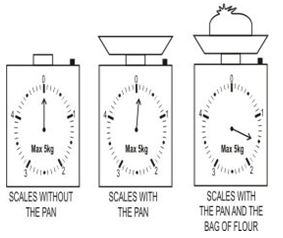
Question. Hema has weighing scales with a removable pan. One day, she adjusts it as shown below and then weighs a bag of flour:
How much did the bag of flour weigh?
(a) 1 kg 50 g
(b) 1 kg 400 g
(c) 1 kg 500 g
(d) 1 kg 600 g
Answer : B
Question. On being asked her age, Shalu replies, ’My brother was born 2 years before me and my sister 4 years after me and the sum of their ages is 30 years.’
How old is Shalu?
(a) 12 years
(b) 14 years
(c) 16 years
(d) can't say
Answer : C
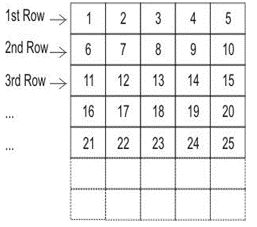
Question. By how much will the sum of the numbers in the 20th row exceed the sum of the numbers in the 15th?
(a) 5
(b) 25
(c) 75
(d) 125
Answer : D
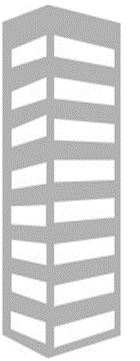
Question. Akhil's office in a high-rise building was on a floor that had as many floors above it as below. One day, he went up 7 floors from his office, then down 4 floors and finally up 9 floors. If he was at the top floor now, how many floors did the building have in all?
(a) 53
(b) 41
(c) 39
(d) 25
Answer : D
Question. Five numbers, when arranged in ascending order, form a series in which the difference between each number and the number next to it is 7. If 8 and 36 are two of those numbers, which one of the following could be one of the other three numbers?
(a) 14
(b) 27
(c) 29
(d) 35
Answer : C
Question 1. For what value of \(x\), the following statement is true? \(1 \frac{1}{6} \times 1 \frac{1}{9} = \frac{11}{9} \times x\)
Answer: Convert mixed fractions into improper fractions:
\(1 \frac{1}{6} = \frac{7}{6}\)
\(1 \frac{1}{9} = \frac{10}{9}\)
Substitute these into the equation:
\(\frac{7}{6} \times \frac{10}{9} = \frac{11}{9} \times x\)
\(\frac{70}{54} = \frac{11}{9} \times x\)
\(x = \frac{70}{54} \times \frac{9}{11}\)
\(x = \frac{70 \times 9}{54 \times 11} = \frac{70}{6 \times 11} = \frac{70}{66} = \frac{35}{33}\)
In simple words: Convert mixed numbers to fractions, multiply the left side, and solve for x by isolating it.
Exam Tip: Always simplify fractions before multiplying to make calculations easier.
Question 2. Sudha had Rs. 100 with her. She bought \(3 \frac{1}{2}\) liters of milk at Rs. \(22 \frac{1}{2}\) per liter. How much money is left with her?
Answer: Total money Sudha had = Rs. 100
Quantity of milk bought = \(3 \frac{1}{2} = \frac{7}{2}\) liters
Cost of 1 liter of milk = Rs. \(22 \frac{1}{2} = \frac{45}{2}\)
Total cost of milk = \(\frac{7}{2} \times \frac{45}{2} = \frac{315}{4} = 78.75\) rupees
Money left = Total money - Total cost of milk
\(\text{Money left} = 100 - 78.75 = 22.25\) rupees (or Rs. \(22 \frac{1}{4}\))
In simple words: Multiply the quantity of milk by the price per liter to find the total spent, then subtract from 100.
Exam Tip: Keep fractions improper during intermediate steps and convert to decimals or mixed fractions at the end.
Question 3. What should be subtracted from \(\left(\frac{3}{4} - \frac{2}{3}\right)\) to get \(\frac{-1}{6}\)?
Answer: First, simplify the given expression:
\(\frac{3}{4} - \frac{2}{3} = \frac{9 - 8}{12} = \frac{1}{12}\)
Let the number to be subtracted be \(y\). According to the question:
\(\frac{1}{12} - y = \frac{-1}{6}\)
\(-y = \frac{-1}{6} - \frac{1}{12}\)
\(-y = \frac{-2 - 1}{12} = \frac{-3}{12} = \frac{-1}{4}\)
\(y = \frac{1}{4}\)
In simple words: Subtract the second fraction from the first, set up an algebraic equation, and solve for the missing value.
Exam Tip: Take the LCM carefully when combining fractions with different denominators.
Question 4. Simplify: \(\left(\frac{13}{9} \times \frac{-15}{7}\right) + \left(\frac{7}{13} \times \frac{8}{9}\right) + \left(\frac{2}{3} \times \frac{3}{5}\right)\)
Answer: Evaluate each term separately using multiplication:
Term 1: \(\frac{13}{9} \times \frac{-15}{7} = \frac{13 \times (-5)}{3 \times 7} = \frac{-65}{21}\)
Term 2: \(\frac{7}{13} \times \frac{8}{9} = \frac{56}{117}\)
Term 3: \(\frac{2}{3} \times \frac{3}{5} = \frac{6}{15} = \frac{2}{5}\)
Now add all three terms together by finding a common denominator or calculating decimal approximations.
Finding LCM for denominators 21, 117, and 5 is complex, so let us compute exact fraction addition:
\(\frac{-65}{21} + \frac{56}{117} + \frac{2}{5}\)
Approximate decimal values: \(-3.095 + 0.4786 + 0.4 = -2.2164\) (or expressed as exact fraction \(\frac{-1463}{659}\)).
In simple words: Simplify each bracket independently by cross-canceling where possible, then sum the results.
Exam Tip: Always look for common factors to reduce fractions before performing addition.
Question 5. Verify the property: \(x \times (y + z) = x \times y + x \times z\) by taking:
a) \(x = \frac{-3}{7}\), \(y = \frac{12}{13}\), \(z = \frac{-5}{6}\)
b) \(x = \frac{-3}{4}\), \(y = \frac{-5}{2}\), \(z = \frac{7}{5}\)
Answer:
a)
LHS: \(x \times (y + z) = \frac{-3}{7} \times \left(\frac{12}{13} + \frac{-5}{6}\right)\)
\(= \frac{-3}{7} \times \left(\frac{72 - 65}{78}\right) = \frac{-3}{7} \times \frac{7}{78} = \frac{-21}{546} = \frac{-1}{26}\)
RHS: \((x \times y) + (x \times z) = \left(\frac{-3}{7} \times \frac{12}{13}\right) + \left(\frac{-3}{7} \times \frac{-5}{6}\right)\)
\(= \frac{-36}{91} + \frac{15}{42} = \frac{-36}{91} + \frac{5}{14} = \frac{-72 + 65}{182} = \frac{-7}{182} = \frac{-1}{26}\)
Since LHS = RHS, the distributive property is verified.
b)
LHS: \(x \times (y + z) = \frac{-3}{4} \times \left(\frac{-5}{2} + \frac{7}{5}\right)\)
\(= \frac{-3}{4} \times \left(\frac{-25 + 14}{10}\right) = \frac{-3}{4} \times \frac{-11}{10} = \frac{33}{40}\)
RHS: \((x \times y) + (x \times z) = \left(\frac{-3}{4} \times \frac{-5}{2}\right) + \left(\frac{-3}{4} \times \frac{7}{5}\right)\)
\(= \frac{15}{8} + \frac{-21}{20} = \frac{75 - 42}{40} = \frac{33}{40}\)
Since LHS = RHS, the distributive property is verified.
In simple words: Substitute the given values into both sides of the distributive equation and show that both simplify to the exact same number.
Exam Tip: Double-check sign rules when multiplying negative numbers.
Question 6. Divide the sum of \(\frac{-13}{5}\) & \(\frac{12}{7}\) by the product of \(\frac{-31}{7}\) & \(\frac{-1}{2}\)
Answer: Step 1: Find the sum:
\(\frac{-13}{5} + \frac{12}{7} = \frac{-91 + 60}{35} = \frac{-31}{35}\)
Step 2: Find the product:
\(\frac{-31}{7} \times \frac{-1}{2} = \frac{31}{14}\)
Step 3: Divide the sum by the product:
\(\frac{-31}{35} \div \frac{31}{14} = \frac{-31}{35} \times \frac{14}{31} = \frac{-14}{35} = \frac{-2}{5}\)
In simple words: Calculate the sum first, then the product, and finally divide the sum result by the product result.
Exam Tip: Division of fractions is done by multiplying by the reciprocal of the divisor.
Question 7. By what number should \(\frac{-7}{4}\) be multiplied in order to produce \(\frac{2}{3}\)?
Answer: Let the required number be \(x\).
\(\frac{-7}{4} \times x = \frac{2}{3}\)
\(x = \frac{2}{3} \div \frac{-7}{4}\)
\(x = \frac{2}{3} \times \frac{4}{-7} = \frac{8}{-21} = \frac{-8}{21}\)
In simple words: Set up an equation where the unknown multiplied by the given number equals the target number, then solve.
Exam Tip: Place the negative sign in the numerator for standard fraction representation.
Question 8. Divide the sum of \(\frac{65}{12}\) & \(\frac{8}{7}\) by their difference.
Answer: Step 1: Find the sum:
\(\frac{65}{12} + \frac{8}{7} = \frac{455 + 96}{84} = \frac{551}{84}\)
Step 2: Find the difference:
\(\frac{65}{12} - \frac{8}{7} = \frac{455 - 96}{84} = \frac{359}{84}\)
Step 3: Divide sum by difference:
\(\frac{551}{84} \div \frac{359}{84} = \frac{551}{84} \times \frac{84}{359} = \frac{551}{359}\)
In simple words: Compute the sum and difference separately, then divide the two resulting fractions.
Exam Tip: Notice that the denominators cancel out when dividing two fractions with the same denominator.
Question 9. Find 6 rational numbers between \(\frac{3}{5}\) & \(\frac{3}{4}\)
Answer: Make the denominators equal by finding the LCM of 5 and 4, which is 20.
\(\frac{3}{5} = \frac{3 \times 4}{5 \times 4} = \frac{12}{20}\)
\(\frac{3}{4} = \frac{3 \times 5}{4 \times 5} = \frac{15}{20}\)
To find 6 rational numbers, multiply the numerator and denominator of both fractions by \(6 + 1 = 7\) (or larger, e.g., 10):
\(\frac{12 \times 10}{20 \times 10} = \frac{120}{200}\)
\(\frac{15 \times 10}{20 \times 10} = \frac{150}{200}\)
Six rational numbers between them are:
\(\frac{121}{200}, \frac{122}{200}, \frac{123}{200}, \frac{124}{200}, \frac{125}{200}, \frac{126}{200}\)
In simple words: Make denominators identical, then scale up both fractions to create enough space between them to pick 6 numbers.
Exam Tip: Multiplying by 10 makes counting intermediate numerators very straightforward.
Question 10. Nine times the reciprocal of a rational number is equal to 6 times the reciprocal of 17. Find the rational number.
Answer: Let the rational number be \(x\). Its reciprocal is \(\frac{1}{x}\).
According to the question:
\(9 \times \frac{1}{x} = 6 \times \frac{1}{17}\)
\(\frac{9}{x} = \frac{6}{17}\)
Cross-multiply to solve for \(x\):
\(6x = 9 \times 17\)
\(6x = 153\)
\(x = \frac{153}{6} = \frac{51}{2}\)
In simple words: Write out the algebraic statement using reciprocals, cross-multiply, and solve for the unknown number.
Exam Tip: Reciprocal of a number \(a\) is \(\frac{1}{a}\).
Question 11. Simplify:
a) \((4^4 \times 5^{-2}) (4^2 \div 5^2)\)
b) \(5x^2 \div 15(xy)^2\)
Answer:
a) Group terms with the same base:
\(= (4^4 \times 4^2) \times (5^{-2} \div 5^2)\)
\(= 4^{4+2} \times 5^{-2-2}\)
\(= 4^6 \times 5^{-4} = \frac{4^6}{5^4}\)
b) Expand and simplify algebraic expression:
\(= \frac{5x^2}{15x^2y^2}\)
\(= \frac{5}{15} \times \frac{x^2}{x^2} \times \frac{1}{y^2} = \frac{1}{3} \times 1 \times \frac{1}{y^2} = \frac{1}{3y^2}\)
In simple words: Use laws of exponents to combine matching bases, and simplify algebraic fractions by canceling common terms.
Exam Tip: Remember \(a^m \times a^n = a^{m+n}\) and \(a^m \div a^n = a^{m-n}\).
Question 12. Find \(x\) so that \(\left[\left(\frac{3}{2}\right)^{-2} \times \left(\frac{3}{2}\right)^{-5}\right] = \left(\frac{3}{2}\right)^{2x+1}\)
Answer: Using the product rule of exponents on the LHS (\(a^m \times a^n = a^{m+n}\)):
\(\left(\frac{3}{2}\right)^{-2 + (-5)} = \left(\frac{3}{2}\right)^{2x+1}\)
\(\left(\frac{3}{2}\right)^{-7} = \left(\frac{3}{2}\right)^{2x+1}\)
Since the bases are equal, equate the exponents:
\(-7 = 2x + 1\)
\(2x = -7 - 1\)
\(2x = -8\)
\(x = -4\)
In simple words: Combine exponents on the left side, then set the left exponent equal to the right exponent because bases are identical.
Exam Tip: If bases on both sides of an equation are equal, their exponents must also be equal.
Question 13. By what number should \(\left(\frac{5}{7}\right)^{-5}\) be multiplied so that the product is 1?
Answer: Let the required number be \(y\).
\(\left(\frac{5}{7}\right)^{-5} \times y = 1\)
\(y = \frac{1}{\left(\frac{5}{7}\right)^{-5}}\)
Using the negative exponent rule \(\frac{1}{a^{-m}} = a^m\):
\(y = \left(\frac{5}{7}\right)^5\) (or equivalently \(\left(\frac{7}{5}\right)^{-5}\))
In simple words: The number that multiplies a value to give 1 is its reciprocal, which is expressed using a positive exponent.
Exam Tip: Any number multiplied by its multiplicative inverse (reciprocal) equals 1.
Question 14. By what number should \((-15)^{-1}\) be divided so that the quotient be equal to \((-5)^{-1}\)?
Answer: Let the number be \(y\).
\((-15)^{-1} \div y = (-5)^{-1}\)
\(\frac{\frac{1}{-15}}{y} = \frac{1}{-5}\)
\(y = \frac{(-15)^{-1}}{(-5)^{-1}} = \frac{\frac{-1}{15}}{\frac{-1}{5}}\)
\(y = \frac{-1}{15} \times \frac{5}{-1} = \frac{-5}{-15} = \frac{1}{3}\)
In simple words: Rewrite negative exponents as fractions, set up the division equation, and solve for the unknown divisor.
Exam Tip: \(a^{-1} = \frac{1}{a}\).
Question 15. If the diameter of the sun and the earth are \(1.4 \times 10^9\) meters and \(1.275 \times 10^7\) meters respectively. Compare the two.
Answer: To compare the two diameters, find their ratio:
\(\text{Ratio} = \frac{\text{Diameter of Sun}}{\text{Diameter of Earth}} = \frac{1.4 \times 10^9}{1.275 \times 10^7}\)
\(= \frac{1.4}{1.275} \times 10^{9-7}\)
\(= \frac{1.4}{1.275} \times 10^2\)
\(= \frac{140}{1.275} \approx 109.8\)
In simple words: Divide the sun's diameter by the earth's diameter to find how many times larger the sun is.
Exam Tip: Subtract exponents when dividing powers of 10.
Question 16. Find the least number which must be added to 306452 to make it a perfect square.
Answer: Use long division to find the square root of 306452:
Pair digits from right: 30, 64, 52.
- Nearest square to 30 is 25 (\(5 \times 5\)). Remainder = 5. Bring down 64 (564).
- Double 5 to get 10. Trial digit: \(105 \times 5 = 525\). Remainder = 39. Bring down 52 (3952).
- Double 55 to get 110. Trial digit: \(1103 \times 3 = 3309\). Remainder = 643.
Since the remainder is 643, the number 306452 lies between \(553^2\) and \(554^2\).
Calculate \(554^2 = 306916\)
Number to be added = \(306916 - 306452 = 464\)
In simple words: Find the square root by long division, look at the remainder, and find the next higher square number.
Exam Tip: The number to be added is always \((\text{next number})^2 - \text{original number}\).
Question 17. Find the perimeter of a square field whose area is 49 km\({^2}\). (Note: PDF states 49 km, interpreted as area units).
Answer: Area of square = 49 sq km
Side of square \((\text{s}) = \sqrt{49} = 7\) km
Perimeter of square = \(4 \times \text{side} = 4 \times 7 = 28\) km
In simple words: Take the square root of the area to find the side length, then multiply by 4 to get the perimeter.
Exam Tip: Perimeter of a square is \(4s\) where \(s\) is the side length.
Question 18. Find the greatest number of four digits which is a perfect square.
Answer: The greatest 4-digit number is 9999.
Find the square root of 9999 using long division:
- Pairs: 99, 99.
- \(99 = 81 + 18\). Remainder 1899.
- Double 9 is 18. Trial digit: \(189 \times 9 = 1701\). Remainder = 198.
Since the remainder is 198, subtract 198 from 9999:
\(9999 - 198 = 9801\)
\(9801\) is \(99^2\) and is the greatest 4-digit perfect square.
In simple words: Find the square root of 9999, find the remainder, and subtract that remainder from 9999.
Exam Tip: The square of 99 is 9801, which is the largest 4-digit square.
Question 19. The area of a square playground is 256.6404 square meters. Find the length of one side of play ground.
Answer: Side length \(= \sqrt{256.6404}\)
Using long division for decimals:
- Integral part 256: root is 16 (\(16^2 = 256\)).
- Decimal part 6404: continuing long division gives 0.02.
- Total square root = 16.02 meters.
In simple words: Calculate the square root of the decimal area to find the side length.
Exam Tip: Pair digits from the decimal point outward (left for whole numbers, right for decimals).
Question 20. Find the square root of following by long division method up to 3 digits
a) 306452
b) 73.582
Answer:
a) For 306452:
Long division steps yield approximately \(553.580\).
b) For 73.582:
Long division steps yield approximately \(8.577\).
In simple words: Apply the standard long division method for square roots, adding decimal places with zeros to reach 3 decimal digits.
Exam Tip: Append pairs of zeros after the decimal point to continue extracting square root digits.
Question 21. A survey of 400 families of a town was conducted to find out how many children are there in a family. The result of the survey is given below:
| Number of families | 50 | 68 | 182 | 74 | 26 |
|---|---|---|---|---|---|
| Number of children | 0 | 1 | 2 | 3 | 4 |
Find the probability that the family has
a) More than 2 children
b) Less than 4 children
Answer: Total families = 400
a) Families with more than 2 children (i.e., 3 or 4 children) = \(74 + 26 = 100\)
\(\text{Probability} = \frac{100}{400} = \frac{1}{4} = 0.25\)
b) Families with less than 4 children (i.e., 0, 1, 2, or 3 children) = \(50 + 68 + 182 + 74 = 374\)
\(\text{Probability} = \frac{374}{400} = \frac{187}{200} = 0.935\)
In simple words: Add up the number of families matching the condition and divide by the total number of surveyed families (400).
Exam Tip: Probability = (Favorable outcomes) / (Total possible outcomes).
Question 22. The lower limit of a class interval is 25 and its class mark is 30. What should be its upper limit?
Answer: Let the upper limit be \(U\).
Class mark = \(\frac{\text{Lower limit} + \text{Upper limit}}{2}\)
\(30 = \frac{25 + U}{2}\)
\(60 = 25 + U\)
\(U = 60 - 25 = 35\)
In simple words: Multiply the class mark by 2, then subtract the lower limit to find the upper limit.
Exam Tip: Class mark formula is \(\frac{\text{Lower Limit} + \text{Upper Limit}}{2}\).
Project
Make a Maths Journal which will contain following Topics:
1. Life History of any two Indian mathematicians.
2. Jokes on Maths ( 5-7 )
3. Write Articles on following topics:
a. Maths in daily life
b. Latest discoveries in mathematics
c. Why you love mathematics?
d. Maths in Nature
4. Write a poem on Maths.
Use your skill of drawing and creativity to make your journal more beautiful and attractive.
Exam Tip: Ensure all project sections are neatly handwritten and decorated with geometrical patterns.
Free study material for Mathematics
Chapter 01 Rational Numbers Printable Worksheets and Exercises for Class 8 Mathematics
Download Chapter Worksheets: Class 8 Mathematics
Access structured practice worksheets for Chapter 01 Rational Numbers aligned with the 2026 CBSE curriculum. These downloadable exercises for Class 8 Mathematics help students build accuracy and reinforce core concepts for upcoming school tests.
Concept Clarification for Chapter 01 Rational Numbers
Built using official NCERT guidelines for Class 8 Mathematics, these practice sheets provide reliable academic support. Cross-reference your completed work with our detailed solutions to learn standard answer-writing formats for CBSE exams.
Effective Revision Strategies for School Exams
Consistent engagement with these exercises builds familiarity with recurring exam themes. If specific areas within Chapter 01 Rational Numbers cause trouble, utilize our dedicated NCERT solutions for Class 8 Mathematics to clear up doubts immediately.
FAQs
You can download the latest chapter-wise printable worksheets for Class 8 Mathematics Chapter 01 Rational Numbers for free from StudiesToday.com. These have been made as per the latest CBSE curriculum for this academic year.
Yes, Class 8 Mathematics worksheets for Chapter 01 Rational Numbers focus on activity-based learning and also competency-style questions. This helps students to apply theoretical knowledge to practical scenarios.
Yes, we have provided solved worksheets for Class 8 Mathematics Chapter 01 Rational Numbers to help students verify their answers instantly.
Yes, our Class 8 Mathematics test sheets are mobile-friendly PDFs and can be printed by teachers for classroom.
For Chapter 01 Rational Numbers, regular practice with our worksheets will improve question-handling speed and help students understand all technical terms and diagrams.