

Class 8 Mathematics Practice Sheet: CBSE Class 8 Mathematics Introduction To Graphs Worksheet Set 02
Access comprehensive chapter-wise worksheets for Chapter 15 Introduction to Graphs using the CBSE Class 8 Mathematics Introduction To Graphs Worksheet Set 02. Designed to align with the 2026-27 academic syllabus for Class 8 Mathematics, these printable practice sets help students reinforce key concepts and improve their overall exam readiness.
Download Chapter 15 Introduction to Graphs Worksheet PDF with Answers
Navigate directly to the solved Mathematics worksheets using the digital viewer below. Each practice set includes detailed step-by-step solutions, allowing students to instantly cross-check their work and identify areas requiring further revision.
1 Which of the following statements is true?
(A) The X-a xis is a vertical line.
(B) TheY-a xi s is a horizontal line .
(C) The scale on both the axes must be the same in a Cartesian plane .
(D) The point of intersection between the X-a xis andY-axis is called the origin .
Answer : D
2 Which of t h e points given is a poi nt on the X-axis?
(A) (5, 0)
(B) (0, 5)
(C) (5, 3)
(D) (3, 5)
Answer : A
(3-7): The bar-graph provided gives the sales of books (in thousand numbers) by six branches of a publishing company during two consecutive years 2013 and 2014.
Sales of books (in thousand numbers) in different branches
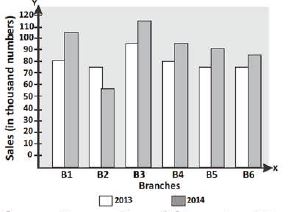
Answer the questions 5-9 based on this bar-graph.
3 What is the tota l sa l es of branc hes B1, B3 and B5 together for both the yea r s (i n thousand numbers) ?
(A) 250
(B) 310
(C) 435
(D) 565
Answer : D
4 What percent of the total sales of branch B3 for both the years is the total sales of branch B6 for both the years ?
(A) 68 .5 4%
(B) 71.11 %
(C) 76.19%
(D) 75 .55%
Answer : C
5 What is the average sale of all the branches (in thousand numbers) for the year 2013?
(A) 73
(B) 81
(C) 83
(D) 88
Answer : B
6 What is the ratio of the total sales of branch B2 for both yea rs to the total sales of branch B4 for both the years?
(A) 2: 3
(B) 3 : 5
(C) 4 : 5
(D) 13: 18
Answer : D
7 What percent of the average sa les of branches B1, B and B3 in 2014 is the average sales of branches B1, B3 and B6 in 20 13?
(A) 7 5%
(B) 77.5 %
(C) 91%
(D) 87.5%
Answer : C
(8-12): The following pie charts show the distribution of students of graduate and post-graduate levels in seven different institutes M, N, P, Q, R, S and T in a town.
Distribution of students at graduate and post-graduate levels in seven institutes M, N, P, Q, R, S, and T.
Total number of students of graduate level = 27300
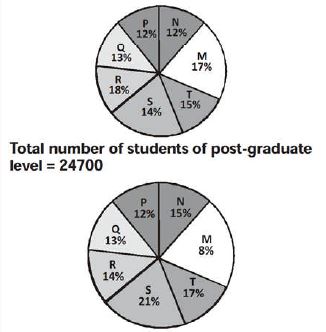
Note : Pie charts are not drawn to scale.
8 How many students of institutes M and S are studying at graduate level ?
(A) 75 16
(B) 8463
(C) 9127
(D) 9409
Answer : B
9 What is the total number of students studying at post-graduate level from institutes Nand P?
(A) 5601
(B) 5944
(C) 6669
(D) 7004
Answer : C
10 What is the total number of graduate and post-graduate level students in the instituteR ?
(A) 8320
(B) 7916
(C) 91 16
(D) 8372
Answer : D
11 What is the ratio of the number of students studying at post-graduate and graduate levels respectively in institute S ?
(A) 14 : 19
(B) 19 : 14
(C) 17 : 21
(D) 19: 21
Answer : B
12 What is the ratio of the number of students at post-graduate level in institute S and the number of students studying at graduate level in institute Q?
(A) 13:19
(B) 21:13
(C) 13:8
(D) 19:13
Answer : D
13 The bar chart shows the number of workers employed by a trading company in three years
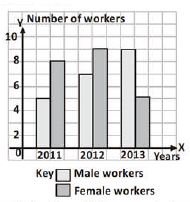
Calculate the difference between the total number of male and female workers employed over those three years.
(A) 1
(B) 2
(C) 4
(D) 6
Answer : A
14 The line graph shows the sale of dolls by Suhas from Monday to Saturday in a particular week.
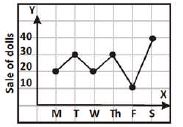
Given that the cost of one doll is~ 35, how much did Suhas receive from the sale of dolls on Saturday ?
(A) ₹ 200
(B) ₹ 700
(C) ₹ 1050
(D) ₹ 1400
Answer : D
15 The bar chart shows the number of 'Maruti' and 'Benz' cars sold by three dealers, A, B and C.
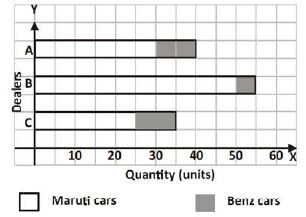
Which of the following statements is true?
(A) Dealer A sold 40 Maruti cars less than dealer B.
(B) Dealer B sold 50 Maruti cars more than dealer C.
(C) Dealer B sold the most number of Benz cars.
(D) The total number of Benz cars by dealers B and C is 15.
Answer : C
16 The line graph shows the price of chicken in towns M and N.
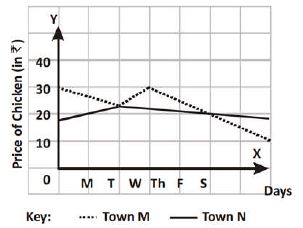
On which days are the price of chicken the same in both the towns ?
(A) Tuesday and Friday only
(B) Friday only
(C) Wednesday and Friday only
(D) Tuesday only
Answer : A
17 The line graph shows the sale of watches in a company.
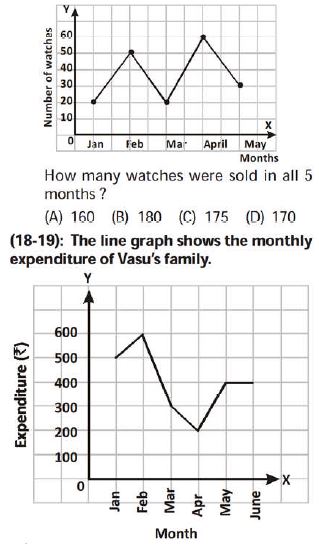
18 What is the total expenditure over the first 3 months ?
(A) ₹ 1400
(B) ₹ 600
(C) ₹ 1100
(D) ₹ 1320
Answer 17: B
Answer 18: A
19 Find the difference between their highest and lowest monthly expenditures.
(A) ₹ 100
(B) ₹ 400
(C) ₹ 300
(D) ₹ 200
Answer : B
20 Which of the following statements is correct?
(A) The coordinates of the origin are (0, 1).
(B) The point (5, 0) lies on theY-axis.
(C) The point (0, 7) lies on theY-axis.
(D) The point (3, 2) lies on the X-axis.
Answer : C
21 The line graph shows the number of road accidents over the first four months of a certain year.
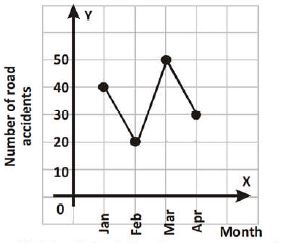
Which of the following statements is false?
(A) The number of accidents is the highest in March.
(B) The number of accidents fell by 50% in February compared to the number in January.
(C) The total number of accidents over the four months is 140.
(D) The number of accidents increased by 3 times in March as compared to the number in February.
Answer : D
(22-23): The graph given shows the simple interest given on deposits in a bank.
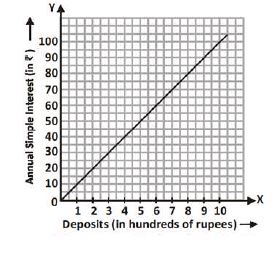
22 Find the amount to be deposited to earn an interest of '{ 45.
(A) ₹ 250
(B) ₹ 450
(C) ₹ 400
(C) ₹ 550
Answer : B
23 How much interest is paid on a deposit of ₹ 750?
(A) ₹ 7 5
(B) ₹ 65
(C) ₹ 70
(D) ₹ 80
Answer : A
(24-28): 1200 students wer e asked to choose a game for their CCA. The pie chart given represents their choices.
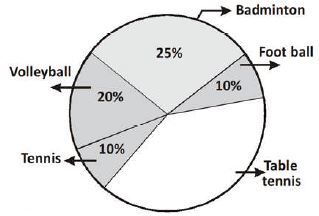
24 What percentage of the pupils chose table tennis ?
(A) 30%
(B) 40%
(C) 35%
(D) 45%
Answer : C
25 How many more pupils chose table tennis than foot ball?
(A) 120
(B) 30
(C) 250
(D) 300
Answer : D
26 The table-tennis group and the volley ball group should have the same number of pupils. How many pupils should be transferred from the table tennis group to the volleyball group?
(A) 50
(B) 27
(C) 90
(D) 11 2
Answer : C
27 What is the ratio of the number of pupils who chose tennis and table tennis to the number of pupils who chose the other games?
(A) 7 : 13
(B) 9 : 11
(C) 11 : 9
(D) 9 : 13
Answer : B
28 Which of the following is correct ?
| Game | No. of pupils | |
| (A) | Badm inton | 300 |
| (B) | Volley ball | 300 |
| (C) | Tennis | 240 |
| (D) | Soccer | 360 |
Answer : A
(29-33): The histogram shows the petrol consumption per week of a number of cars in a city.
29 What is the total number of cars ?
(A) 70
(B) 68
(C) 74
(D) 76
Answer : C
30 What is the frequency of the modal class?
(A) 16
(B) 14
(C) 4
(D) 10
Answer : A
31 How many cars consume less than 40.5 l of petrol per week ?
(A) 4
(B) 14
(C) 10
(D) 6
Answer : B
32 How many cars consume more than 50.5 l of petrol ?
(A) 28
(B) 14
(C) 16
(D) 30
Answer : D
33 How many litres of petrol do 1 0 cars consume?
(A) 45.5 - 50.5
(B) 30.5 - 35.5
(C) 40.5 - 45.5
(D) 35.5 - 40.5
Answer : D
(34-36): The line graph given shows the rate of the production of toys in a factory.
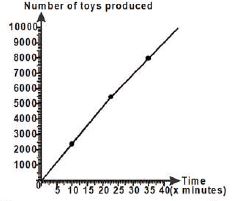
34 How many toys were produced in 10 minutes?
(A) 2100
(B) 2300
(C) 2200
(D) 2000
Answer : B
35 Find the time taken to produce 5400 toys.
(A) 35 minutes
(B) 30 minutes
(C) 23.5 minutes
(D) 20 minutes
Answer : C
36 Find the expected time to complete producing 8000 toys if the production starts at 3.45 p.m .
(A) 3 :50 p.m
(B) 4 : 20 p.m
(C) 4 : 15p.m
(D) 4 :35p.m
Answer : B
(37-38): The line graph shows the earning of a daily wage employee in a small firm.

37 By how much did his income fa ll on Wednesday from that on Monday ?
(A) ₹ 20
(B) ₹ 15
(C) ₹ 10
(D) ₹ 40
Answer : A
38 Between which two days was the increase in the income of the person the same as that between Monday and Tuesday?
(A) Wednesday and Thursday
(B) Wednesday and Friday
(C) Tuesday and Wednesday
(D) Fr iday and Saturday
Answer : A
Introduction to Graphs
Q 1 Find the distance covered in 3 seconds.
Answer: From the given distance-time graph, locate the value 3 on the horizontal time axis (x-axis), move vertically upwards to the straight line graph, and then read the corresponding value on the vertical distance axis (y-axis).
Distance covered = 15 metres
In simple words: Look at 3 seconds on the time axis and see that it matches 15 metres on the distance axis.
Exam Tip: Always use a ruler or trace dotted lines from the given axis value to the graph line and then to the other axis to avoid reading errors.
Q 2 Find the distance covered in 5 seconds.
Answer: Locate 5 on the time axis (x-axis). Move vertically upwards to meet the line graph, and then look horizontally across to the distance axis (y-axis).
Distance covered = 25 metres
In simple words: At 5 seconds on the x-axis, the graph reaches 25 on the y-axis.
Exam Tip: Check the units on both axes carefully before writing the final answer with units.
Q 3 Find the time taken by a body to cover 30 metres.
Answer: Locate 30 on the distance axis (y-axis). Move horizontally to the right to meet the straight line graph, and then look straight down to the time axis (x-axis).
Time taken = 6 seconds
In simple words: Find 30 metres on the vertical axis and trace across to find the corresponding time on the horizontal axis, which is 6 seconds.
Q 4 In which quadrant does the point \(P(-4, 1)\) lie?
Answer: The x-coordinate is negative (\(-4\)) and the y-coordinate is positive (\(1\)). In a Cartesian plane, points with negative x and positive y lie in the second quadrant.
Answer: (b) Second Quadrant
In simple words: Since x is negative and y is positive, the point is in Quadrant II.
Exam Tip: Remember the signs of quadrants: Quadrant I (\(+, +\)), Quadrant II (\(-, +\)), Quadrant III (\(-, -\)), Quadrant IV (\(+, -\)).
Q 5 In which quadrant does the point \(Q(-2, -6)\) lie?
Answer: Both the x-coordinate (\(-2\)) and the y-coordinate (\(-6\)) are negative. Points with both coordinates negative lie in the third quadrant.
Third Quadrant
In simple words: Both numbers are negative, so the point is in the third quadrant.
Exam Tip: Both coordinates negative always places a point in Quadrant III.
Q 6 On which axis does the point \((0, 5)\) lie?
Answer: The x-coordinate is 0, which means there is no horizontal displacement from the origin. The point lies entirely on the vertical axis.
y-axis
In simple words: When the x-coordinate is zero, the point is located directly on the y-axis.
Exam Tip: Any point of the form \((0, y)\) is on the y-axis, and any point of the form \((x, 0)\) is on the x-axis.
Q 7 Write the coordinate of point shown in cartesian plane.
Answer: Depending on the specific referenced diagram for single points, let us state the general rule: find the perpendicular distance from the y-axis for the x-coordinate and from the x-axis for the y-coordinate.
Coordinates = As read directly from the corresponding Cartesian grid point.
In simple words: Read straight down to the x-axis and straight across to the y-axis to find the coordinates \((x, y)\).
Exam Tip: Always write the x-coordinate first followed by the y-coordinate inside parentheses: \((x, y)\).
Q 8 Find the coordinates of the points A, B, C, D, E and F from the graph.
Answer: Observing the given graph grid:
Point A = \((-4, 0)\)
Point B = \((-2, 3)\)
Point C = \((-1, 3)\)
Point D = \((3, 1)\)
Point E = \((1, -1)\)
Point F = \((-2, -2)\)
In simple words: Trace each lettered point to the x-axis and y-axis to read its coordinates.
Exam Tip: Pay special attention to negative signs when points are located to the left of the y-axis or below the x-axis.
Q 9 The line graph shows the yearly sales figure for a manufacturing company. From the graph, what were the sales in 2004 and 2006?
Answer: Locate 2004 on the horizontal axis and trace to the vertical axis to find sales = Rs. 6 million.
Locate 2006 on the horizontal axis and trace to the vertical axis to find sales = Rs. 8 million.
Sales in 2004 = Rs. 6 million
Sales in 2006 = Rs. 8 million
In simple words: In 2004 sales were Rs. 6 million, and in 2006 sales were Rs. 8 million.
Exam Tip: Include the correct unit scale (Rs. million) as given on the vertical axis label.
Q 10 The line graph given shows the yearly sales figure for a manufacturing company. From the graph, what were the sales in 2003 and 2005?
Answer: Locate 2003 on the horizontal axis and trace vertically to the graph point, corresponding to Rs. 8 million.
Locate 2005 on the horizontal axis and trace vertically to the graph point, corresponding to Rs. 12 million.
Sales in 2003 = Rs. 8 million
Sales in 2005 = Rs. 12 million
In simple words: Sales in 2003 were Rs. 8 million and in 2005 were Rs. 12 million.
Q 11 From the given graph, compute the difference between the sales 2003 and 2005.
Answer: Sales in 2003 = Rs. 8 million
Sales in 2005 = Rs. 12 million
Difference = \(12 - 8 = 4\)<5br /> Difference in sales = Rs. 4 million
In simple words: Subtract the sales of 2003 from the sales of 2005 to get Rs. 4 million.
Exam Tip: The word 'difference' always implies subtraction between the larger and smaller value.
Q 12 From the graph write the coordinates of the A, B, C and D.
Answer: From the provided coordinate grid:
Point A = \((-3, -1)\)
Point B = \((2, 3)\)
Point C = \((0, -1)\)
Point D = \((-4, -4)\)
In simple words: Read the x and y positions for each point on the grid.
Exam Tip: Always double check your sign conventions for negative coordinates.
Q 13 Plot the following points on a graph. A(4, 3), B(2, 6) C(-2, -3), D (-3, 5)
Answer: To plot the points:
1. Draw horizontal x-axis and vertical y-axis intersecting at origin \((0, 0)\).
2. Point A\((4, 3)\): Move 4 units right along x-axis and 3 units up along y-axis.
3. Point B\((2, 6)\): Move 2 units right along x-axis and 6 units up along y-axis.
4. Point C\((-2, -3)\): Move 2 units left along x-axis and 3 units down along y-axis.
5. Point D\((-3, 5)\): Move 3 units left along x-axis and 5 units up along y-axis.
In simple words: Mark each point by moving horizontally first and then vertically according to the given coordinates.
Exam Tip: Label every plotted point clearly with its letter name and coordinates.
Q 14 Draw a graph for the following.
Distance in metres: 5, 10, 15, 20, 25, 30
Time in seconds: 1, 2, 3, 4, 5, 6
Is it a linear graph?
Answer: Plot time on the x-axis and distance on the y-axis, yielding points \((1, 5)\), \((2, 10)\), \((3, 15)\), \((4, 20)\), \((5, 25)\), and \((6, 30)\).
Since all points lie on a single straight line passing through the origin, it is a linear graph.
Answer: Yes, it is a linear graph.
In simple words: Because distance increases uniformly with time at a constant rate, the resulting graph is a straight line.
Exam Tip: A graph is linear if and only if all its plotted points can be connected by a single straight line.
Q 15 Make a table of values for the function P = 4a, where P is the perimeter and a is side of the square.
Answer: Let us calculate values for side \(a = 1, 2, 3, 4, 5\):
If \(a = 1\), \(P = 4(1) = 4\)
If \(a = 2\), \(P = 4(2) = 8\)
If \(a = 3\), \(P = 4(3) = 12\)
If \(a = 4\), \(P = 4(4) = 16\)
If \(a = 5\), \(P = 4(5) = 20\)
| Side \(a\) | 1 | 2 | 3 | 4 | 5 |
|---|---|---|---|---|---|
| Perimeter \(P = 4a\) | 4 | 8 | 12 | 16 | 20 |
In simple words: Multiply each side length by 4 to find the corresponding perimeter.
Exam Tip: Set up a clear two-row table with independent variable on top and dependent variable below.
Q 16 Plot the following points. Verify if they lie on a line. (1, 3), (2, 3), (3, 3), (4, 3)
Answer: Plot the points \((1, 3)\), \((2, 3)\), \((3, 3)\), and \((4, 3)\) on a Cartesian plane. Notice that all points have the exact same y-coordinate (\(y = 3\)). When connected, they form a horizontal straight line parallel to the x-axis.
Answer: Yes, they lie on a line parallel to the x-axis.
In simple words: Since all y-coordinates are equal to 3, the points form a horizontal straight line.
Exam Tip: Points with identical y-coordinates always form a horizontal line, while points with identical x-coordinates form a vertical line.
Q 17 Draw the line passing through (2, 3) and (3, 2). Find the coordinates of the points at which this line meets the x-axis and y-axis.
Answer: 1. Plot the points \(A(2, 3)\) and \(B(3, 2)\) and draw a straight line passing through them.
2. The equation of the line passing through \((x_1, y_1) = (2, 3)\) and \((x_2, y_2) = (3, 2)\) is found by first calculating the slope \(m = \frac{2 - 3}{3 - 2} = -1\).
3. Using point-slope form: \(y - 3 = -1(x - 2) \implies y - 3 = -x + 2 \implies x + y = 5\).
4. To find where it meets the x-axis, set \(y = 0\): \(x + 0 = 5 \implies x = 5\), so the point is \((5, 0)\).
5. To find where it meets the y-axis, set \(x = 0\): \(0 + y = 5 \implies y = 5\), so the point is \((0, 5)\).
In simple words: Find the line equation connecting the two points, then set y to zero for the x-intercept and x to zero for the y-intercept.
Exam Tip: To find an intercept on one axis, always set the coordinate of the other axis to zero.
Q 18 In which year was there the greatest difference between the sales as compared to its previous year?
Answer: Let us find the difference in sales for each consecutive year from the graph:
- 2002 to 2003: \(8 - 4 = 4\) million
- 2003 to 2004: \(8 - 6 = 2\) million
- 2004 to 2005: \(12 - 6 = 6\) million
- 2005 to 2006: \(12 - 8 = 4\) million
The greatest difference is 6 million, which occurred between 2004 and 2005.
Answer: Between 2004 and 2005 (or in 2005 compared to 2004).
In simple words: Calculate the change in sales for every year pair and find the largest change, which is 6 million between 2004 and 2005.
Exam Tip: Compare the vertical steepness of line segments; the steepest upward or downward slope indicates the greatest difference.
Q 19 Make a table of values for the function y = 3x. From the table find the values of y when x = 4 and x = 5.
Answer: Let us generate values for \(x = 1, 2, 3, 4, 5\):
If \(x = 1\), \(y = 3(1) = 3\)
If \(x = 2\), \(y = 3(2) = 6\)
If \(x = 3\), \(y = 3(3) = 9\)
If \(x = 4\), \(y = 3(4) = 12\)
If \(x = 5\), \(y = 3(5) = 15\)
| \(x\) | 1 | 2 | 3 | 4 | 5 |
|---|---|---|---|---|---|
| \(y = 3x\) | 3 | 6 | 9 | 12 | 15 |
From the table, when \(x = 4\), \(y = 12\); and when \(x = 5\), \(y = 15\).
In simple words: Multiply each x value by 3 to get the corresponding y value.
Exam Tip: Always show substitution steps clearly when evaluating functions for specific inputs.
Q 20 Reena deposited Rs. 12000 in a bank at the rate of 10% per annum. Draw a linear graph showing the relationship between the time and simple interest. Also, find the simple interest for 4 years.
Answer: Principal \(P = \text{Rs. } 12000\), Rate \(R = 10\%\) per annum.
Simple Interest formula: \(\text{S.I.} = \frac{P \times R \times T}{100} = \frac{12000 \times 10 \times T}{100} = 1200T\).
Let us calculate interest for different years \(T\):
- For \(T = 1\): \(\text{S.I.} = 1200(1) = \text{Rs. } 1200\)
- For \(T = 2\): \(\text{S.I.} = 1200(2) = \text{Rs. } 2400\)
- For \(T = 3\): \(\text{S.I.} = 1200(3) = \text{Rs. } 3600\)
- For \(T = 4\): \(\text{S.I.} = 1200(4) = \text{Rs. } 4800\)
Simple interest for 4 years = Rs. 4800.
In simple words: Calculate interest year by year using the formula and plot the straight line graph showing uniform growth.
Exam Tip: Simple interest grows at a constant rate every year, so its graph is always a straight line passing through the origin.
Q 21 A train is moving at a constant speed of 75 km/h. Draw a distance - time graph. (i) How far will it travel in 2 hours 30 minutes? (ii) Find the time required to cover a distance of 300 km.
Answer: Speed \(S = 75 \text{ km/h}\). Distance \(D = S \times T = 75T\).
(i) Time \(T = 2 \text{ hours } 30 \text{ minutes} = 2.5 \text{ hours}\).
Distance = \(75 \times 2.5 = 187.5 \text{ km}\).
(ii) Distance \(D = 300 \text{ km}\).
Time \(T = \frac{\text{Distance}}{\text{Speed}} = \frac{300}{75} = 4 \text{ hours}\).
In simple words: Multiply speed by time to get distance, and divide distance by speed to get time.
Exam Tip: Always convert minutes into decimal hours (e.g., 30 minutes = 0.5 hours) before multiplying with speed.
Q 22 A bank gives 10% simple interest on savings account. Draw a linear graph to show the relationship between the sum deposited and simple interest earned. Also, answer the following questions: (a) Find the interest earned on an investment of Rs. 300. (b) What investment should be made to earn Rs. 70 as interest?
Answer: Let principal be \(P\) and interest for 1 year be \(I\).
\(I = \frac{P \times 10 \times 1}{100} = \frac{P}{10}\).
(a) For an investment of \(P = \text{Rs. } 300\):
Interest \(I = \frac{300}{10} = \text{Rs. } 30\).
(b) To earn an interest of \(I = \text{Rs. } 70\):
\(70 = \frac{P}{10} \implies P = 70 \times 10 = \text{Rs. } 700\).
In simple words: The annual interest is one-tenth of the deposited principal amount.
Exam Tip: For 1 year at 10% per annum, simply divide the principal by 10 to find the interest.
Q 23 Mayank deposited Rs. 1400 in a bank at the rate of 10% per annum. Draw a linear graph which shows the relationship between time and the interest earned by Mayank.
Answer: Principal \(P = \text{Rs. } 1400\), Rate \(R = 10\%\).
Interest formula for time \(T\) years: \(\text{S.I.} = \frac{1400 \times 10 \times T}{100} = 140T\).
Let us calculate interest for 1 to 4 years:
- For \(T = 1\): \(\text{S.I.} = 140(1) = \text{Rs. } 140\)
- For \(T = 2\): \(\text{S.I.} = 140(2) = \text{Rs. } 280\)
- For \(T = 3\): \(\text{S.I.} = 140(3) = \text{Rs. } 420\)
- For \(T = 4\): \(\text{S.I.} = 140(4) = \text{Rs. } 560\)
Plot these points \((1, 140), (2, 280), (3, 420), (4, 560)\) and join them with a straight line.
In simple words: Multiply 140 by the number of years to find the interest and draw a straight line through the points.
Exam Tip: Label the axes clearly with Time (years) on the x-axis and Interest (Rs.) on the y-axis.
Q 24 If \(y = x^2\), then draw a graph.
Answer: Let us calculate coordinate values for \(x\) from \(-3\) to \(3\):
- If \(x = -3\), \(y = (-3)^2 = 9\)
- If \(x = -2\), \(y = (-2)^2 = 4\)
- If \(x = -1\), \(y = (-1)^2 = 1\)
- If \(x = 0\), \(y = (0)^2 = 0\)
- If \(x = 1\), \(y = (1)^2 = 1\)
- If \(x = 2\), \(y = (2)^2 = 4\)
- If \(x = 3\), \(y = (3)^2 = 9\)
Plot these points and smoothly connect them to form a U-shaped curve called a parabola.
In simple words: Square each x value to get y, and connect the plotted points with a smooth curve instead of straight lines.
Exam Tip: Quadratic equations of the form \(y = x^2\) always produce a curved parabolic graph, not a straight line.
Q 25 Parul is driving a car constantly at a speed of 30 km/h. Draw a distance-time graph in this case. Also, find the time taken by Parul to cover a distance of 120 km.
Answer: Speed \(S = 30 \text{ km/h}\). Distance \(D = 30T\).
To find time taken to cover 120 km:
Time \(T = \frac{\text{Distance}}{\text{Speed}} = \frac{120}{30} = 4 \text{ hours}\).
In simple words: Divide the total distance (120 km) by the speed (30 km/h) to get 4 hours.
Exam Tip: A constant speed always results in a straight line distance-time graph passing through the origin.
Q 26 Draw the graph for the following table of values. Interest on deposits for a year.
Deposit (Rs.): 1000, 2000, 3000, 4000, 5000
Interest (Rs.): 60, 120, 180, 240, 300
(1) Use the graph to find the interest on a deposit of Rs 4500 for a year.
(2) To get an interest of Rs 420, how much money should be deposited?
(3) Does the graph pass through origin?
Answer: (1) For Rs. 4500 deposit, trace from 4500 on the x-axis to the graph line, giving Interest = Rs. 270.
(2) For Rs. 420 interest, trace from 420 on the y-axis across to the graph line, giving Deposit = Rs. 7000.
(3) Yes, zero deposit yields zero interest, so the graph passes through the origin \((0, 0)\).
In simple words: Use the straight line graph to read values between or beyond the given table points.
Exam Tip: Always verify graph interpolations and extrapolations by checking the proportional rate (\(\text{Interest} = 0.06 \times \text{Deposit}\)).
Q 27 Draw the graph for a function \(A = x^2\) (Area of a square = \(\text{side}^2\)). Make a table when the side of a square is 2 cm, 3 cm, 4 cm, 5 cm, 6 cm and 7 cm. Is it a linear graph?
Answer: Let us calculate the area for each side length \(x\):
- If \(x = 2\), \(A = 2^2 = 4\)
- If \(x = 3\), \(A = 3^2 = 9\)
- If \(x = 4\), \(A = 4^2 = 16\)
- If \(x = 5\), \(A = 5^2 = 25\)
- If \(x = 6\), \(A = 6^2 = 36\)
- If \(x = 7\), \(A = 7^2 = 49\)
Since the points do not lie on a straight line (it is a curve representing \(y = x^2\)), it is not a linear graph.
Answer: No, it is not a linear graph.
In simple words: Squaring the side length creates a curved graph rather than a straight line.
Exam Tip: Any relationship involving powers greater than 1 (like squares or cubes) is non-linear.
Most Important Questions
Q 1 State true or false 1) A point whose x coordinate is zero and y coordinate is non-zero will lie on the y-axis. 2) The coordinates of the origin are (0,0). 3) A point whose y coordinate is zero and x coordinate is 4 will lie on y axis.
Answer: 1) True. A point with zero x-coordinate and non-zero y-coordinate lies on the vertical y-axis.
2) True. The intersection of the x-axis and y-axis is the origin, with coordinates \((0, 0)\).
3) False. A point with non-zero x-coordinate and zero y-coordinate lies on the x-axis, not the y-axis.
In simple words: 1) True, 2) True, 3) False.
Exam Tip: Remember that zero x means y-axis, and zero y means x-axis.
Q 2 The approximate speeds of some objects are given below. Draw a bar graph to represent them.
Name of objects: Bicycle, Scooter, Car, Bus, Train
Speed (in km/hr): 10, 40, 60, 50, 80
Answer: To represent this data on a bar graph:
1. Draw horizontal axis for objects (Bicycle, Scooter, Car, Bus, Train) and vertical axis for speed in km/hr (with a suitable scale like 1 unit = 10 km/hr).
2. Draw rectangular bars of uniform width for each object with heights corresponding to their speeds: Bicycle = 10, Scooter = 40, Car = 60, Bus = 50, Train = 80.
In simple words: Draw vertical bars of equal width with heights matching the given speeds for each vehicle.
Exam Tip: Leave equal spacing between all bars and keep bar widths uniform.
Q 3 Hundred students from a certain locality use different modes of traveling to school as given below. Draw a bar graph.
Bus: 32, Car: 16, Rickshaw: 24, Bicycle: 20, Walk: 8
Answer: 1. Choose horizontal categories: Bus, Car, Rickshaw, Bicycle, Walk.
2. Choose vertical scale for number of students (e.g., 1 unit = 4 students).
3. Draw bars with heights: Bus = 32, Car = 16, Rickshaw = 24, Bicycle = 20, Walk = 8.
In simple words: Construct bars representing the number of students for each mode of transport.
Exam Tip: Check that the sum of all frequencies equals 100 (\(32 + 16 + 24 + 20 + 8 = 100\)).
Q 4 The approximate speeds of some objects are given below. Draw a pie-chart.
Name of objects: Bicycle, Scooter, Car, Bus, Train
Speed (in km/hr): 10, 40, 60, 50, 80
Answer: Total speed sum = \(10 + 40 + 60 + 50 + 80 = 240\).
Calculate central angles (\(\frac{\text{Value}}{\text{Total}} \times 360^\circ\)):
- Bicycle: \(\frac{10}{240} \times 360^\circ = 15^\circ\)
- Scooter: \(\frac{40}{240} \times 360^\circ = 60^\circ\)
- Car: \(\frac{60}{240} \times 360^\circ = 90^\circ\)
- Bus: \(\frac{50}{240} \times 360^\circ = 75^\circ\)
- Train: \(\frac{80}{240} \times 360^\circ = 120^\circ\)
Draw a circle and use a protractor to mark these central angles.
In simple words: Convert each speed fraction into a corresponding angle out of 360 degrees and draw sectors in a circle.
Exam Tip: Always verify that the sum of all calculated sector angles equals exactly 360 degrees.
Q 5 Mr. Mirza's monthly income is Rs 7,200. He spends Rs 1,800 on rent, Rs. 2,700 on food, Rs 900 on education of his children, Rs 1,200 on others and saves the rest. Draw a pie-chart to represent it.
Answer: Total Income = Rs. 7200.
Savings = Total Income - Sum of expenses = \(7200 - (1800 + 2700 + 900 + 1200) = 7200 - 6600 = \text{Rs. } 600\).
Calculate central angle for each component (\(\frac{\text{Amount}}{7200} \times 360^\circ\)):
- Rent (Rs. 1800): \(\frac{1800}{7200} \times 360^\circ = 90^\circ\)
- Food (Rs. 2700): \(\frac{2700}{7200} \times 360^\circ = 135^\circ\)
- Education (Rs. 900): \(\frac{900}{7200} \times 360^\circ = 45^\circ\)
- Others (Rs. 1200): \(\frac{1200}{7200} \times 360^\circ = 60^\circ\)
- Savings (Rs. 600): \(\frac{600}{7200} \times 360^\circ = 30^\circ\)
In simple words: Find savings first, then calculate the angle for each expense and savings category to draw the pie chart.
Exam Tip: Double-check that all sector angles add up to 360 degrees (\(90 + 135 + 45 + 60 + 30 = 360\)).
Q 6 In a class of 40 students, the marks obtained (out of 50) are as given below:
Marks: 0-10, 10-20, 20-30, 30-40, 40-50
No. of students (frequency): 5, 10, 12, 8, 5
Draw a histogram to represent the given data.
Answer: 1. Represent class intervals along the horizontal x-axis and frequencies (number of students) along the vertical y-axis.
2. Draw adjacent rectangular bars for each class interval with heights corresponding to their frequencies: 5, 10, 12, 8, and 5.
3. Since class intervals are continuous, there are no gaps between the bars.
In simple words: Draw touching vertical rectangles whose heights represent the student frequencies for each mark range.
Exam Tip: Unlike bar graphs, histograms have no space between adjacent bars because the data is continuous.
Q 7 Draw the histogram to represent the following data:
Class-Interval: 50-60, 60-70, 70-80, 80-90
Frequency: 20, 30, 25, 10
Answer: 1. Mark class intervals (50-60, 60-70, 70-80, 80-90) on the x-axis.
2. Mark frequencies (up to 30) on the y-axis.
3. Draw continuous, touching rectangular bars with heights 20, 30, 25, and 10 respectively.
In simple words: Construct touching vertical bars corresponding to the given frequencies for each class interval.
Exam Tip: Ensure scale intervals on the y-axis are uniform and adequate to accommodate the highest frequency (30).
Q 8 The following table gives the marks scored by 100 students in an entrance examination.
Mark: 0-10, 10-20, 20-30, 30-40, 40-50, 50-60, 60-70, 70-80
No. of students (frequency): 4, 10, 16, 22, 20, 18, 8, 2
Represent this data in the form of a histogram.
Answer: 1. Plot class intervals on the x-axis and frequencies on the y-axis.
2. Draw touching bars for each interval with heights: 4, 10, 16, 22, 20, 18, 8, and 2.
In simple words: Draw a set of continuous connected bars matching the frequencies of the 100 students across the score intervals.
Exam Tip: Verify frequency totals: \(4 + 10 + 16 + 22 + 20 + 18 + 8 + 2 = 100\).
Q 9 The percentage of marks obtained, in different subjects by Ashok Sharma (in an examination) are given below. Draw a bar graph to represent it.
English: 85, Hindi: 60, Maths: 35, Science: 50, Social Science: 70
Answer: 1. Draw x-axis for subjects (English, Hindi, Maths, Science, Social Science) and y-axis for percentage marks (0 to 100).
2. Draw rectangular bars of uniform width with heights corresponding to: English = 85, Hindi = 60, Maths = 35, Science = 50, Social Science = 70.
In simple words: Draw separate vertical bars representing the percentage marks obtained in each subject.
Exam Tip: Label the vertical axis clearly with "% Marks" or "Marks Obtained".
Q 10 The following table shows the market position of different brand of tea-leaves. Draw a pie-chart to represent this information.
Brand: A, B, C, D, E
% Buyers: 35, 20, 20, 15, 10
Answer: Calculate central angles for each brand (\(\text{Percentage} \times 3.6^\circ\)):
- Brand A (35%): \(35 \times 3.6^\circ = 126^\circ\)
- Brand B (20%): \(20 \times 3.6^\circ = 72^\circ\)
- Brand C (20%): \(20 \times 3.6^\circ = 72^\circ\)
- Brand D (15%): \(15 \times 3.6^\circ = 54^\circ\)
- Brand E (10%): \(10 \times 3.6^\circ = 36^\circ\)
Draw a circle and divide it using these sector angles.
In simple words: Multiply each percentage by 3.6 to find its angle in a pie chart and draw the sectors.
Exam Tip: Since percentages total 100%, multiplying by 3.6 correctly gives 360 degrees in total.
Q 11 Draw a histogram to represent:
Age (in years): 20-28, 28-36, 36-44, 44-52, 52-60, 60-68
No. of pupils: 14, 18, 16, 24, 10, 20
Answer: 1. Plot age intervals on the horizontal x-axis.
2. Plot number of pupils on the vertical y-axis.
3. Construct touching rectangular bars with heights 14, 18, 16, 24, 10, and 20.
In simple words: Draw continuous touching vertical bars for each age group based on the number of pupils.
Exam Tip: Ensure equal class width (8 years for each interval) is maintained consistently across the axis.
Q 12 Choose the letters that indicate the location of the points given below: (i) (4,5) (ii) (3,3) (iii) (2,1)
Answer: Looking at the provided coordinate grid:
(i) For point \((4, 5)\), the corresponding letter is A.
(ii) For point \((3, 3)\), the corresponding letter is C.
(iii) For point \((2, 1)\), the corresponding letter is F.
In simple words: Match the given coordinate pairs to their respective letters on the grid map.
Exam Tip: Always trace carefully from both axes to confirm the exact intersection point.
Q 13 Plot the following points and verify if they lie on a line. If they lie on a line, Name it. (i) (0,2), (0,5), (0,6) (0,3.5) (ii) W(2,6), X(3,5), Y(5,3), Z(6,2)
Answer: (i) Points \((0, 2), (0, 5), (0, 6), (0, 3.5)\) all have an x-coordinate of 0. Thus, they lie on the y-axis.
(ii) Points \(W(2, 6), X(3, 5), Y(5, 3), Z(6, 2)\) satisfy the equation \(x + y = 8\). When plotted and connected, they form a straight line. Name of the line: \(x + y = 8\) (or line passing through the given coordinates).
In simple words: The first set lies on the y-axis, and the second set forms a downward-sloping straight line.
Exam Tip: If all points share a zero x-coordinate, they lie on the y-axis; if they share a constant sum or slope relation, they form an inclined straight line.
Q 14 State whether true or false. Correct the ones that are false. (i) A point whose x co-ordinate is 1 and y co-ordinate is 10 will lie on the y-axis. (ii) A point whose y co-ordinate is -2 and x co-ordinate is - 5 will lie in the third quadrant . (iii) The co-ordinates of the origin are (0,0).
Answer: (i) False. Correct statement: A point whose x-coordinate is 1 and y-coordinate is 10 lies in the first quadrant (or does not lie on the y-axis).
(ii) True. Both coordinates are negative, so it lies in the third quadrant.
(iii) True. The origin has coordinates \((0, 0)\).
In simple words: (i) False, (ii) True, (iii) True.
Exam Tip: Points on the y-axis must have an x-coordinate equal to zero.
Q 15 The following table gives the quantity of diesel and its cost. Plot a graph to show the data.
No. of liters of diesel: 10, 15, 20, 25
Cost of diesel in Rs: 500, 750, 1000, 1250
Answer: 1. Plot quantity of diesel (in liters) on the x-axis and cost (in Rs.) on the y-axis.
2. The plotted points are \((10, 500), (15, 750), (20, 1000), (25, 1250)\).
3. Connect the points with a straight line passing through the origin, showing a direct linear relationship.
In simple words: Plot the quantity versus cost pairs and join them to form a straight line graph.
Q 16 Ajit can ride a scooter constantly at a speed of 30 km/hr. Draw a distance-time graph for this situation. Use this information to find: (i) The time taken by Ajit to ride 75 km. (ii) The distance covered by Ajit in 3 \(\frac{1}{2}\) hours.
Answer: Speed \(S = 30 \text{ km/h}\). Distance \(D = 30T\).
(i) Time taken to ride 75 km: \(T = \frac{75}{30} = 2.5 \text{ hours}\) (or 2 hours 30 minutes).
(ii) Distance covered in 3 \(\frac{1}{2}\) hours (\(3.5\) hours): \(D = 30 \times 3.5 = 105 \text{ km}\).
In simple words: (i) Divide distance by speed to get 2.5 hours. (ii) Multiply speed by time to get 105 km.
Exam Tip: Always use consistent units for time (hours) and speed (km/h).
Q 17 On a set of co-ordinate axes, plot the points A(2,3), B(0,4), C(-2,3), D(-1, -2), E(-3,0), F(2,-4)
Answer: 1. Draw Cartesian axes with origin \((0, 0)\).
2. Plot A\((2, 3)\) in Quadrant I.
3. Plot B\((0, 4)\) on the positive y-axis.
4. Plot C\((-2, 3)\) in Quadrant II.
5. Plot D\((-1, -2)\) in Quadrant III.
6. Plot E\((-3, 0)\) on the negative x-axis.
7. Plot F\((2, -4)\) in Quadrant IV.
In simple words: Locate and mark each point accurately according to its x and y coordinates.
Exam Tip: Double-check axis intercepts and quadrant locations for each point before finishing.
Q 18 Identify the coordinates of the points A, B, C, D, E, F, G shown on the following grid:
Answer: From the coordinate grid provided:
Point A = \((3, 1)\)
Point B = \((0, 2)\)
Point C = \((-2, 2)\)
Point D = \((-3, 0)\)
Point E = \((-2, -5)\)
Point F = \((0, -2)\)
Point G = \((2, -3)\)
In simple words: Read the horizontal x-position and vertical y-position for each labeled letter on the grid.
Exam Tip: Points lying directly on axes will have either an x-coordinate or a y-coordinate equal to zero.
Q 19 Marc has ten square tiles this: [2 cm square tile]. Marc places all the square tiles in a row. He starts his row like this: The co-ordinates of the first corner are (2,2). (a) Write down the co-ordinates of the next five corners which have a* (b) Look at the numbers in the co-ordinates. Describe two things you notice. (c) Marc thinks that (17,2) are the coordinates of one of the corners which have a*. Explain why he is wrong. (d) Sam has some bigger square tiles, like this: [3 cm tile]. She places them next to each other in a row, like Marc's tiles. Write down the coordinates of the first two corners which have a*.
Answer: (a) Since each tile has a side length of 2 cm, the corners repeat horizontally every 2 units: \((4, 2), (6, 2), (8, 2), (10, 2), (12, 2)\).
(b) Two observations: 1) The y-coordinate remains constant at 2. 2) The x-coordinate increases by 2 for each successive corner.
(c) Marc is wrong because 17 is an odd number, whereas all x-coordinates for these corners are even multiples of 2.
(d) For 3 cm tiles, the corners increase by 3 units horizontally, starting from \((3, 3)\): First two corners are \((3, 3)\) and \((6, 3)\).
In simple words: (a) Add 2 to the x-coordinate each time. (b) y is always 2, x increases by 2. (c) 17 is odd, but x must be even. (d) For 3 cm tiles, x increases by 3.
Exam Tip: Pattern problems in coordinate geometry depend directly on the side length of the geometric shapes being placed.
Q 20 A bank gives 10% Simple Interest (S.I.) on deposits by senior citizens. Draw a graph to illustrate the relation between the sum deposited and simple interest earned. Find from your graph (a) The annual interest obtainable for an investment of Rs 250. (b) the investment one has to make to get an annual simple interest of Rs 70.
Answer: Principal \(P\) and Annual Interest \(I = \frac{P \times 10 \times 1}{100} = \frac{P}{10}\).
(a) For an investment of \(P = \text{Rs. } 250\):
Annual Interest \(I = \frac{250}{10} = \text{Rs. } 25\).
(b) To get an annual interest of \(I = \text{Rs. } 70\):
\(70 = \frac{P}{10} \implies P = 70 \times 10 = \text{Rs. } 700\).
In simple words: Divide the deposit by 10 to get the annual interest, or multiply the annual interest by 10 to find the required deposit.
Exam Tip: A 10% interest rate makes calculations simple by shifting the decimal point one place to the left.
Please refer to the link below for CBSE Class 8 Mathematics Worksheet - Introduction to Graphs
Free study material for Mathematics
Download Class 8 Mathematics Chapter 15 Introduction to Graphs Practice Worksheets
Download Chapter Worksheets: Class 8 Mathematics
Review targeted practice exercises for Class 8 Mathematics Chapter 15 Introduction to Graphs. Curated to match official CBSE guidelines, these printable problem sets support daily revision and improve overall test readiness.
Concept Clarification for Chapter 15 Introduction to Graphs
Designed around the official curriculum for Class 8 Mathematics, these practice sheets guarantee standard compliance. Reviewing step-by-step solutions after completion sharpens your accuracy and clarifies complex sub-topics within Chapter 15 Introduction to Graphs.
Effective Revision Strategies for School Exams
Follow up your worksheet practice by attempting the interactive online MCQ tests for Chapter 15 Introduction to Graphs to evaluate your execution speed. All printable assignments and revision sheets on our platform are updated for the 2026 session and available free of charge.
FAQs
You can download the latest chapter-wise printable worksheets for Class 8 Mathematics Chapter 15 Introduction to Graphs for free from StudiesToday.com. These have been made as per the latest CBSE curriculum for this academic year.
Yes, Class 8 Mathematics worksheets for Chapter 15 Introduction to Graphs focus on activity-based learning and also competency-style questions. This helps students to apply theoretical knowledge to practical scenarios.
Yes, we have provided solved worksheets for Class 8 Mathematics Chapter 15 Introduction to Graphs to help students verify their answers instantly.
Yes, our Class 8 Mathematics test sheets are mobile-friendly PDFs and can be printed by teachers for classroom.
For Chapter 15 Introduction to Graphs, regular practice with our worksheets will improve question-handling speed and help students understand all technical terms and diagrams.