

Download Class 8 Mathematics Practice Worksheets
Review targeted academic worksheets with the CBSE Class 8 Mathematics Square And Square Roots Worksheet Set 02. Built according to official educational standards for the 2026-27 term, these downloadable Class 8 Mathematics resources support effective daily practice and detailed self-evaluation for Chapter 06 Squares and Square Roots.
Access Chapter 06 Squares and Square Roots Practice Papers and Solutions
View or download the dedicated CBSE Class 8 Mathematics Square And Square Roots Worksheet Set 02 resource below. Engaging with these practice papers under focused study conditions ensures continuous academic progress and mastery of the 2026-27 curriculum for Chapter 06 Squares and Square Roots.
Question. What is the least perfect square which is divisible by 2, 4 and 6 ?
(A) 36
(B) 64
(C) 16
(D) 18
Answer : A
Question. What is the number of digits in the square root of 390625 ?
(A) 4
(B) 6
(C) 5
(D) 3
Answer : D
Question. Find the approximate value of 1 + √0.01 / 1-√0.1
(A) 0.6
(C) 1.6
(B) 1.1
(D) 1.7
Answer : C
Question. If x * y = √x2 + y2 , find the value of (1 * 2√2)(1 * -2√2)
(A) -7
(B) 0
(C) 2
(D) 9
Answer : D
Question. Evaluate
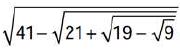
(A) 3
(B) 6
(C) 5
(D) 6.
Answer : B
Question. What is the least perfect square exactly divisible by each of the numbers 6, 9, 15 and 20?
(A) 3600
(B) 900
(C) 400
(D) 225
Answer : B
Question. The sides of a rectangular field are 80 m and 18 m respectively. What is the length of its diagonal ?
(A) 84 m
(B) 98 m
(C) 82m
(D) 86 m
Answer : C
Question. What is the value of (501)2- (500)2 ?
(A) 1
(B) 101
(C) 1001
(D) 100
Answer : C
Question. Which of the following is a Pythagorean triplet?
(A) (6, 8, 1 0)
(C) (5, 12, 18)
(B) (3, 4, 7)
(D) (2, 3, 6)
Answer : A
Question. What is the value of 1 + 3 + 5 + 7 + 9 +...............+ 25?
(A) 196
(B) 625
(C) 225
(D) 169
Answer : D
Question. What is the smallest number by which 396 must be multiplied so that the product is a perfect square ?
(A) 5
(C) 3
(B) 11
(D) 2
Answer : B
Question. Find the square root of 0.081/0.0064 x 0.484/6.25 x 2.5/12.1
(A) 0.45
(C) 0.95
(B) 0.75
(D) 0.99
Answer : A
Question. What is the least number which must be subtracted from 2509 to make it a perfect square ?
(A) 6
(B) 9
(C) 12
(D) 14
Answer : B
Question. What is the square root of 42(583/1369)?
(A) 6(19/37)
(B) 4(2/11)
(C) 7(2/121)
(D) 6(12/37)
Answer : A
Question. If √1 + 27/169 = 1 + x/13 , what is the value of 'X ' ?
(A) 1
(B) 14
(C) 10
(D) 12
Answer : A
Question. Find the perfect square numbers between
(i) 30 and 40
(ii) 50 and 60
Answer: (i) 36
(ii) There is not any perfect square number between 50 & 60.
Question. Check whether the following numbers can be perfect squares? Give reason.
(i) 1057
(ii) 23453
(iii) 7928
(iv) 222222
(v) 1089
(vi) 2061
Answer: (i) No, because it ends with 7.
(ii) No, because it ends with 3.
(iii) No, because it ends with 8.
(iv) No, because it ends with 2.
(v) Yes, it has 9 at unit place.
(vi) Yes, it has 1 at unit place.
Question. Write five numbers which you cannot decide just by looking at their unit's digit (or one's place) whether they are square numbers or not.
Answer: 169, 38126, 591, 100, 343795. Since 2, 3, 7, 8 are not at ones place, we cannot decide just by looking at the unit digit.
Question. Which of \( 123^2, 77^2, 82^2, 161^2, 109^2 \) would end with digit 1?
Answer: \( 161^2 \) and \( 109^2 \)
Question. Which of the following numbers would have digit 6 at unit place.
(i) \( 19^2 \)
(ii) \( 24^2 \)
(iii) \( 26^2 \)
(iv) \( 36^2 \)
(v) \( 34^2 \)
Answer: \( 24^2, 26^2, 36^2, 34^2 \)
Question. What will be the ‘‘one’s digit’’ in the square of the following numbers?
(i) 1234
(ii) 26387
(iii) 52698
(iv) 99880
(v) 21222
(vi) 9106
Answer: (i) 6
(ii) 9
(iii) 4
(iv) 0
(v) 4
(vi) 6
Question. The square of which of the following numbers would be an odd number/an even number? Why?
(i) 727
(ii) 158
(iii) 269
(iv) 1980
Answer: (i) Odd because the unit place will be 9.
(ii) Even because the unit place will be 4.
(iii) Odd because the unit place will be 1.
(iv) Even because the unit place will be 0.
Question. What will be the number of zeros in the square of the following numbers?
(i) 60
(ii) 400
Answer: (i) Two
(ii) Four
Question. How many natural numbers lie between \( 9^2 \) and \( 10^2 \)? Between \( 11^2 \) and \( 12^2 \)?
Answer: Between \( 9^2 \) and \( 10^2 \), there are 18 natural numbers.
Between \( 11^2 \) and \( 12^2 \), there are 22 natural numbers.
Question. How many non square numbers lie between the following pairs of numbers
(i) \( 100^2 \) and \( 101^2 \)
(ii) \( 90^2 \) and \( 91^2 \)
(iii) \( 1000^2 \) and \( 1001^2 \)
Answer: (i) 200
(ii) 180
(iii) 2000
Question. Find whether each of the following numbers is a perfect square or not?
(i) 121
(ii) 55
(iii) 81
(iv) 49
(v) 69
Answer: (i) Yes
(ii) No
(iii) Yes
(iv) Yes
(v) No
Question. Express the following as the sum of two consecutive integers.
(i) \( 21^2 \)
(ii) \( 13^2 \)
(iii) \( 11^2 \)
(iv) \( 19^2 \)
Answer: (i) \( 21^2 = 441 = 220 + 221 \)
(ii) \( 13^2 = 169 = 84 + 85 \)
(iii) \( 11^2 = 121 = 60 + 61 \)
(iv) \( 19^2 = 361 = 180 + 181 \)
Question. Is it possible that the sum of any two consecutive positive integers is perfect square of a number? Give example to support your answer.
Answer: Yes. Examples:
(i) \( 21^2 = 441 = 220 + 221 \)
(ii) \( 13^2 = 169 = 84 + 85 \)
(iii) \( 11^2 = 121 = 60 + 61 \)
(iv) \( 19^2 = 361 = 180 + 181 \)
Question. Write the square, by any pattern.
(i) 75
(ii) 95
Answer: (i) 5625
(ii) 9025
Question. Find the value of \( 17^2 - 12^2 + 15^2 - 10^2 \)
Answer: 270
Question. What will be the unit digit of the squares of the following numbers?
(i) 81
(ii) 272
(iii) 799
(iv) 3853
(v) 1234
(vi) 26387
(vii) 52698
(viii) 99880
(ix) 12796
(x) 55555
Answer: (i) 1
(ii) 4
(iii) 1
(iv) 9
(v) 6
(vi) 9
(vii) 4
(viii) 0
(ix) 6
(x) 5
Question. The following numbers are obviously not perfect squares. Give reason.
(i) 1057
(ii) 23453
(iii) 7928
(iv) 222222
(v) 64000
(vi) 89722
(vii) 222000
(viii) 505050
Answer: (i) Ends with 7
(ii) Ends with 3
(iii) Ends with 8
(iv) Ends with 2
(v) Contains an odd number of zeros (3 zeros)
(vi) Ends with 2
(vii) Contains an odd number of zeros (3 zeros)
(viii) Contains an odd number of zeros at the end
Question. The squares of which of the following would be odd numbers?
(i) 431
(ii) 2826
(iii) 7779
(iv) 82004
Answer: (i) and (iii)
Question. Observe the following pattern and find the missing digits.
\( 11^2 = 121 \)
\( 101^2 = 10201 \)
\( 1001^2 = 1002001 \)
\( 100001^2 = 1 \dots\dots 2 \dots\dots 1 \)
\( 10000001^2 = \dots\dots\dots\dots\dots\dots\dots \)
Answer: \( 100001^2 = 10000200001 \)
\( 10000001^2 = 100000020000001 \)
Question. Observe the following pattern and supply the missing numbers.
\( 11^2 = 121 \)
\( 101^2 = 10201 \)
\( 10101^2 = 102030201 \)
\( 1010101^2 = \dots\dots\dots\dots\dots\dots\dots^2 = 10203040504030201 \)
Answer: \( 1010101^2 = 10203040504030201 \)
Question. Using the given pattern, find the missing numbers.
\( 1^2 + 2^2 + 2^2 = 3^2 \)
\( 2^2 + 3^2 + 6^2 = 7^2 \)
\( 3^2 + 4^2 + 12^2 = 13^2 \)
\( 4^2 + 5^2 + \_\_^2 = 21^2 \)
\( 5^2 + \_\_^2 + 30^2 = 31^2 \)
\( 6^2 + 7^2 + \_\_^2 = \_\_^2 \)
Answer: 20, 6, 42, 43
Question. Without adding, find the sum.
(i) 1 + 3 + 5 + 7 + 9
(ii) 1 + 3 + 5 + 7 + 9 + 11 + 13 + 15 + 17 + 19
(iii) 1 + 3 + 5 + 7 + 9 + 11 + 13 + 15 + 17 + 19 + 21 + 23
Answer: (i) 25
(ii) 100
(iii) 144
Question. (i) Express 49 as the sum of first 7 odd numbers.
(ii) Express 121 as the sum of first 11 odd numbers.
Answer: (i) 1 + 3 + 5 + 7 + 9 + 11 + 13
(ii) 1 + 3 + 5 + 7 + 9 + 11 + 13 + 15 + 17 + 19 + 21
Question. How many numbers lie between squares of the following numbers?
(i) 12 and 13
(ii) 25 and 26
(iii) 99 and 100
Answer: (i) 24
(ii) 50
(iii) 198
MATHEMATICS VIII
1. RATIONAL NUMBERS
Question 1. Represent \(\frac{2}{7}\), \(2\frac{3}{4}\), \(-3\frac{1}{5}\) on number line.
Answer: To represent rational numbers on a number line, draw a straight line with points marked at equal intervals. For positive numbers, move to the right of zero; for negative numbers, move to the left.
1. For \(\frac{2}{7}\), divide the unit segment between 0 and 1 into 7 equal parts and take the 2nd part to the right of 0.
2. For \(2\frac{3}{4} = \frac{11}{4}\), the point lies between 2 and 3. Divide the segment between 2 and 3 into 4 equal parts and take the 3rd part.
3. For \(-3\frac{1}{5} = -\frac{16}{5}\), the point lies between -3 and -4 to the left of 0. Divide the segment between -3 and -4 into 5 equal parts and take the 1st part to the left of -3.
In simple words: Rational numbers are plotted by dividing the space between integers into equal fractions based on the denominator.
Exam Tip: Always convert mixed fractions into improper fractions before locating them on the number line to avoid counting errors.
Question 2. Find the sum of:
(a) \(\frac{4}{3} + \frac{3}{5} + \frac{-2}{3} + \frac{-11}{5}\)
(b) \(\left\{\frac{3}{4} + \left(\frac{-2}{3}\right)\right\} + \left(\frac{-7}{6}\right)\)
(c) \(\frac{-13}{20} + \frac{11}{14} + \frac{-5}{7} + 1\)
(d) \(\frac{4}{7} + \frac{-8}{9} + \frac{-5}{21} + \frac{1}{3}\)
Answer:
(a) Group terms with common denominators:
\(= \left(\frac{4}{3} + \frac{-2}{3}\right) + \left(\frac{3}{5} + \frac{-11}{5}\right)\)
\(= \frac{2}{3} + \left(\frac{-8}{5}\right)\)
Taking LCM of 3 and 5, which is 15:
\(= \frac{2 \times 5 + (-8) \times 3}{15} = \frac{10 - 24}{15} = \frac{-14}{15}\)
(b) Simplify the inner bracket first (LCM of 4 and 3 is 12):
\(= \left(\frac{9 - 8}{12}\right) + \frac{-7}{6}\)
\(= \frac{1}{12} + \frac{-7}{6}\)
Taking LCM of 12 and 6, which is 12:
\(= \frac{1 - 14}{12} = \frac{-13}{12}\)
(c) Taking LCM of denominators 20, 14, 7, and 1, which is 140:
\(= \frac{-13 \times 7 + 11 \times 10 + (-5) \times 20 + 1 \times 140}{140}\)
\(= \frac{-91 + 110 - 100 + 140}{140} = \frac{59}{140}\)
(d) Taking LCM of 7, 9, 21, and 3, which is 63:
\(= \frac{4 \times 9 + (-8) \times 7 + (-5) \times 3 + 1 \times 21}{63}\)
\(= \frac{36 - 56 - 15 + 21}{63} = \frac{-14}{63} = \frac{-2}{9}\)
In simple words: To add fractions, first find a common denominator (LCM), then add or subtract the numerators.
Exam Tip: Rearranging terms using commutative and associative properties to group like denominators saves time and reduces calculation errors.
Question 3. Find the additive inverse of:
\(\left(\frac{-1}{3}\right)\), \(\left(\frac{15}{4}\right)\), \((-8)\), \(\left(\frac{-42}{-7}\right)\), \(\frac{-3}{8}\)
Answer: The additive inverse of a number \(a\) is \(-a\) such that \(a + (-a) = 0\).
1. Additive inverse of \(\frac{-1}{3}\) is \(-\left(\frac{-1}{3}\right) = \frac{1}{3}\)
2. Additive inverse of \(\frac{15}{4}\) is \(-\frac{15}{4}\)
3. Additive inverse of \(-8\) is \(-(-8) = 8\)
4. For \(\frac{-42}{-7} = 6\), the additive inverse is \(-6\)
5. Additive inverse of \(\frac{-3}{8}\) is \(-\left(\frac{-3}{8}\right) = \frac{3}{8}\)
In simple words: The additive inverse is simply the number with the opposite sign.
Exam Tip: Always simplify fractions first (like \(\frac{-42}{-7}\) to \(6\)) before finding their additive or multiplicative inverse.
Question 4. Subtract \(0\) from \(\frac{4}{7}\) and \(\frac{4}{7}\) from \(0\). Are the two results the same?
Answer:
1. \(\frac{4}{7} - 0 = \frac{4}{7}\)
2. \(0 - \frac{4}{7} = \frac{-4}{7}\)
No, the two results are not the same because subtraction is not commutative.
In simple words: Changing the order in subtraction changes the sign of the result.
Exam Tip: Remember that subtraction does not possess the commutative property.
Question 5. What is the identity of addition and multiplication?
Answer:
1. The additive identity is \(0\), because adding 0 to any number leaves the number unchanged (\(a + 0 = a\)).
2. The multiplicative identity is \(1\), because multiplying any number by 1 leaves the number unchanged (\(a \times 1 = a\)).
In simple words: Additive identity is 0 and multiplicative identity is 1.
Exam Tip: Do not confuse additive identity (0) with multiplicative identity (1).
Question 6. What is the multiplicative inverse of \(1\)?
Answer: The multiplicative inverse (or reciprocal) of a number \(a\) is \(\frac{1}{a}\) such that \(a \times \frac{1}{a} = 1\).
The multiplicative inverse of \(1\) is \(\frac{1}{1} = 1\).
In simple words: 1 is its own multiplicative inverse because \(1 \times 1 = 1\).
Exam Tip: The numbers 1 and -1 are the only numbers that are their own multiplicative inverses.
Question 7. Find the reciprocal of:
\(\frac{3}{4}\), \(\frac{-7}{5}\), \(-9\), \(1\), \(-1\), \(0\)
Answer:
1. Reciprocal of \(\frac{3}{4}\) is \(\frac{4}{3}\)
2. Reciprocal of \(\frac{-7}{5}\) is \(\frac{5}{-7}\) or \(\frac{-5}{7}\)
3. Reciprocal of \(-9\) is \(\frac{-1}{9}\)
4. Reciprocal of \(1\) is \(1\)
5. Reciprocal of \(-1\) is \(-1\)
6. Reciprocal of \(0\) does not exist (undefined), as division by zero is not defined.
In simple words: To find a reciprocal, flip the fraction upside down.
Exam Tip: Zero has no reciprocal because \(\frac{1}{0}\) is undefined.
Question 8. Find 5 rational numbers between:
(i) \(-\frac{1}{3}\) and \(\frac{2}{5}\)
(ii) \(\frac{1}{4}\) and \(\frac{1}{3}\)
(iii) \(\frac{1}{2}\) and \(\frac{1}{4}\)
Answer:
(i) Convert \(-\frac{1}{3}\) and \(\frac{2}{5}\) to have a common denominator (LCM of 3 and 5 is 15):
\(-\frac{1}{3} = \frac{-5}{15}\) and \(\frac{2}{5} = \frac{6}{15}\)
Rational numbers between them are: \(\frac{-4}{15}, \frac{-3}{15}, \frac{-2}{15}, \frac{-1}{15}, 0, \frac{1}{15}, \dots\) (choose any 5).
(ii) Convert \(\frac{1}{4}\) and \(\frac{1}{3}\) with a common denominator (LCM of 12, multiply numerator and denominator by 6 to get a wider gap):
\(\frac{1}{4} = \frac{6}{24}\) and \(\frac{1}{3} = \frac{8}{24}\)
Multiplying further by 5: \(\frac{30}{120}\) and \(\frac{40}{120}\)
5 rational numbers are: \(\frac{31}{120}, \frac{32}{120}, \frac{33}{120}, \frac{34}{120}, \frac{35}{120}\)
(iii) First write \(\frac{1}{4}\) and \(\frac{1}{2}\) (= \(\frac{2}{4}\)). To get 5 numbers, multiply both by 6:
\(\frac{1}{4} = \frac{6}{24}\) and \(\frac{1}{2} = \frac{12}{24}\)
5 rational numbers are: \(\frac{7}{24}, \frac{8}{24}, \frac{9}{24}, \frac{10}{24}, \frac{11}{24}\)
In simple words: Make denominators equal, then adjust the size so you can pick numbers in between.
Exam Tip: If there are not enough integers between the numerators, multiply both fractions by a larger common multiplier (like 10 or 100).
Question 9. Write five rational numbers greater than \(-2\), less than \(2\).
Answer: Five rational numbers between \(-2\) and \(2\) are:
\(-1, -\frac{1}{2}, 0, 1, \frac{3}{2}\) (Any valid rational numbers in the open interval \((-2, 2)\) are correct).
In simple words: Any fractions or integers lying between -2 and 2 are valid answers.
Exam Tip: You can choose simple integers or fractions as long as they strictly lie between the given limits.
Question 10. Verify each of the following for \(x = \frac{-2}{4}, y = \frac{3}{5}, z = \frac{-4}{9}\):
(a) \(x \times (y + z) = x \times y + x \times z\)
(b) \((x + y) \times z = x \times z + y \times z\)
(c) \(x \times (y - z) = x \times y - x \times z\)
(d) \((x + y) + z = x + (z + y)\)
Answer: Note: \(x = \frac{-2}{4} = \frac{-1}{2}\).
(a) LHS: \(\frac{-1}{2} \times \left(\frac{3}{5} + \frac{-4}{9}\right) = \frac{-1}{2} \times \left(\frac{27 - 20}{45}\right) = \frac{-1}{2} \times \frac{7}{45} = \frac{-7}{90}\)
RHS: \(\left(\frac{-1}{2} \times \frac{3}{5}\right) + \left(\frac{-1}{2} \times \frac{-4}{9}\right) = \frac{-3}{10} + \frac{4}{18} = \frac{-3}{10} + \frac{2}{9} = \frac{-27 + 20}{90} = \frac{-7}{90}\)
LHS = RHS, verified.
(b) LHS: \(\left(\frac{-1}{2} + \frac{3}{5}\right) \times \frac{-4}{9} = \left(\frac{-5 + 6}{10}\right) \times \frac{-4}{9} = \frac{1}{10} \times \frac{-4}{9} = \frac{-4}{90} = \frac{-2}{45}\)
RHS: \(\left(\frac{-1}{2} \times \frac{-4}{9}\right) + \left(\frac{3}{5} \times \frac{-4}{9}\right) = \frac{4}{18} + \frac{-12}{45} = \frac{2}{9} + \frac{-4}{15} = \frac{10 - 12}{45} = \frac{-2}{45}\)
LHS = RHS, verified.
(c) LHS: \(\frac{-1}{2} \times \left(\frac{3}{5} - \frac{-4}{9}\right) = \frac{-1}{2} \times \left(\frac{3}{5} + \frac{4}{9}\right) = \frac{-1}{2} \times \left(\frac{27 + 20}{45}\right) = \frac{-1}{2} \times \frac{47}{45} = \frac{-47}{90}\)
RHS: \(\left(\frac{-1}{2} \times \frac{3}{5}\right) - \left(\frac{-1}{2} \times \frac{-4}{9}\right) = \frac{-3}{10} - \frac{4}{18} = \frac{-3}{10} - \frac{2}{9} = \frac{-27 - 20}{90} = \frac{-47}{90}\)
LHS = RHS, verified.
(d) LHS: \(\left(\frac{-1}{2} + \frac{3}{5}\right) + \frac{-4}{9} = \frac{1}{10} + \frac{-4}{9} = \frac{9 - 40}{90} = \frac{-31}{90}\)
RHS: \(\frac{-1}{2} + \left(\frac{-4}{9} + \frac{3}{5}\right) = \frac{-1}{2} + \left(\frac{-20 + 27}{45}\right) = \frac{-1}{2} + \frac{7}{45} = \frac{-45 + 14}{90} = \frac{-31}{90}\)
LHS = RHS, verified.
In simple words: Distributive and associative properties hold true for rational numbers.
Exam Tip: Simplify fractions like \(\frac{-2}{4}\) to \(\frac{-1}{2}\) at the very beginning to make calculations simpler.
SQUARE & SQUARE ROOT
Question 1. Find the sum of first 18 odd numbers.
Answer: The sum of the first \(n\) odd natural numbers is given by \(n^2\).
Sum = \(18^2 = 324\)
In simple words: The sum of the first n odd numbers is always equal to n squared.
Exam Tip: Memorize squares up to 30 to quickly answer properties of squares.
Question 2. What is the ones digit of the following numbers: (a) \(17^2\) (b) \(56^2\) (c) \(214^2\) (d) \(188^2\) (e) \(160^2\)?
Answer: The ones digit of the square of a number depends only on the ones digit of the original number.
(a) For \(17^2\), ones digit of 17 is 7. Since \(7^2 = 49\), the ones digit is 9.
(b) For \(56^2\), ones digit of 56 is 6. Since \(6^2 = 36\), the ones digit is 6.
(c) For \(214^2\), ones digit of 214 is 4. Since \(4^2 = 16\), the ones digit is 6.
(d) For \(188^2\), ones digit of 188 is 8. Since \(8^2 = 64\), the ones digit is 4.
(e) For \(160^2\), ones digit of 160 is 0. Since \(0^2 = 0\), the ones digit is 0.
In simple words: Just square the last digit of the number to find the last digit of its square.
Exam Tip: Save time by looking only at the units place digit instead of squaring the entire number.
Question 3. Which of the following numbers are not perfect squares: (a) 625 (b) 367 (c) 9108 (d) 3163 (e) 21572 (f) 2401?
Answer: Numbers ending in 2, 3, 7, or 8 at the units place are never perfect squares.
(a) 625 ends in 5 - It is a perfect square (\(25^2\)).
(b) 367 ends in 7 - Not a perfect square.
(c) 9108 ends in 8 - Not a perfect square.
(d) 3163 ends in 3 - Not a perfect square.
(e) 21572 ends in 2 - Not a perfect square.
(f) 2401 ends in 1 - It is a perfect square (\(49^2\)).
In simple words: If a number ends in 2, 3, 7, or 8, it can never be a perfect square.
Exam Tip: Use the units digit test (2, 3, 7, 8 rule) to quickly spot non-perfect squares.
Question 4. Find the smallest square number that is exactly divisible by 4, 9, 10.
Answer: First, find the LCM of 4, 9, and 10.
Prime factorization:
\(4 = 2^2\)
\(9 = 3^2\)
\(10 = 2 \times 5\)
LCM = \(2^2 \times 3^2 \times 5 = 4 \times 9 \times 5 = 180\)
To make 180 a perfect square, we prime factorize 180:
\(180 = 2^2 \times 3^2 \times 5^1\)
Since 5 does not have a pair, multiply 180 by 5.
Smallest square number = \(180 \times 5 = 900\).
In simple words: Find the LCM first, then multiply by any unpaired prime factors to make all exponents even.
Exam Tip: A number is a perfect square only when all the powers in its prime factorization are even numbers.
Question 5. Find the smallest number by which 3645 must be divided so that the quotient is a perfect square.
Answer: Find the prime factorization of 3645:
\(3645 = 5 \times 729 = 5 \times 3^6 = 3^6 \times 5^1\)
Since 5 has an odd exponent (1), dividing by 5 will remove the unpaired factor 5.
Smallest number to divide by = 5.
Quotient = \(\frac{3645}{5} = 729 = 27^2\).
In simple words: Prime factorize the number and divide by any factor that does not form a pair.
Exam Tip: For both multiplication and division to make a square, you inspect the prime factorization and target the unpaired factors.
Question 6. For each of the following numbers find the smallest whole number by which it should be multiplied so as to get a perfect square: (a) 252 (b) 396 (c) 1620 (d) 2800
Answer:
(a) \(252 = 2^2 \times 3^2 \times 7^1\). Unpaired factor is 7. Multiply by 7.
(b) \(396 = 2^2 \times 3^2 \times 11^1\). Unpaired factor is 11. Multiply by 11.
(c) \(1620 = 2^2 \times 3^4 \times 5^1\). Unpaired factor is 5. Multiply by 5.
(d) \(2800 = 2^4 \times 5^2 \times 7^1\). Unpaired factor is 7. Multiply by 7.
In simple words: Find prime factors and multiply by the factor that lacks a pair.
Exam Tip: Write prime factorization in exponential form to easily spot which prime factor has an odd exponent.
Question 7. Find the least number that must be subtracted from 5367 so as to get a perfect square.
Answer: Using long division method to find the square root of 5367:
\(73^2 = 5329\)
\(74^2 = 5476\)
Let us check division for 5367:
\(7 \times 7 = 49\), remainder 4. Bring down 67 to get 467.
Double of 7 is 14. \(143 \times 3 = 429\).
Remainder = \(467 - 429 = 38\).
Thus, \(73^2 = 5367 - 38 = 5329\).
The least number that must be subtracted is 38.
In simple words: Find the remainder using long division; that remainder is the number to subtract.
Exam Tip: When asked what to subtract, the remainder from the division method is your direct answer.
Question 8. Find the least number that must be added to 3475 to get a perfect square. Also, find the square root of the perfect square.
Answer: Using long division for 3475:
\(58^2 = 3364\)
\(59^2 = 3481\)
Since \(58^2 < 3475 < 59^2\), the next square number is \(59^2 = 3481\).
Number to be added = \(3481 - 3475 = 6\).
Square root of the new perfect square = \(\sqrt{3481} = 59\).
In simple words: Find the next integer's square and subtract the original number from it.
Exam Tip: For 'what must be added', find the square of the next immediate number and find the difference.
Question 9. Find the greatest 4-digit number which is a perfect square.
Answer: The greatest 4-digit number is 9999.
Using long division to find \(\sqrt{9999}\):
\(99^2 = 9801\)
\(100^2 = 10000\) (5-digit number)
Remainder when dividing 9999 by long division gives 198.
Greatest 4-digit square number = \(9999 - 198 = 9801\) (which is \(99^2\)).
In simple words: The largest 4-digit square is the square of 99, which is 9801.
Exam Tip: Always check near the square of 100 when dealing with 4-digit numbers.
Question 10. Find the smallest 4-digit number which is a perfect square.
Answer: The smallest 4-digit number is 1000.
We know \(31^2 = 961\) (3-digit number)
\(32^2 = 1024\) (smallest 4-digit square number)
Therefore, the smallest 4-digit perfect square is 1024.
In simple words: Test numbers starting from 31 until you hit the first 4-digit square.
Exam Tip: Remember that \(31^2 = 961\) and \(32^2 = 1024\).
Question 11. Find the square root by Division Method: (1) 2304 (2) 5776 (3) 7921 (4) 3136 (5) 390625
Answer:
(1) \(\sqrt{2304} = 48\)
(2) \(\sqrt{5776} = 76\)
(3) \(\sqrt{7921} = 89\)
(4) \(\sqrt{3136} = 56\)
(5) \(\sqrt{390625} = 625\)
In simple words: Group digits in pairs from right to left and apply long division.
Exam Tip: Always make pairs of digits from right to left starting from the decimal point for long division.
Question 12. How many non-square numbers lie between: (a) \(12^2\) and \(13^2\) (b) \(25^2\) and \(26^2\) (c) \(99\) and \(100^2\)?
Answer: Between \(n^2\) and \((n+1)^2\), there are \(2n\) non-square numbers.
(a) Here \(n = 12\), number of non-square numbers = \(2 \times 12 = 24\).
(b) Here \(n = 25\), number of non-square numbers = \(2 \times 25 = 50\).
(c) Here \(n = 99\), number of non-square numbers = \(2 \times 99 = 198\).
In simple words: Double the smaller number to find how many non-square numbers exist between two consecutive squares.
Exam Tip: Use the formula \(2n\) directly for consecutive squares \(n^2\) and \((n+1)^2\).
Question 13. Find the other members of the Pythagorean triplet if one of the number is: (a) 18 (b) 12 (c) 10 (d) 8 (e) 24
Answer: A Pythagorean triplet is given by \(2m, m^2 - 1, m^2 + 1\).
(a) Let \(2m = 18 \implies m = 9\). Other members: \(m^2 - 1 = 81 - 1 = 80\), \(m^2 + 1 = 81 + 1 = 82\). Triplet: (18, 80, 82).
(b) Let \(2m = 12 \implies m = 6\). Other members: \(6^2 - 1 = 35\), \(6^2 + 1 = 37\). Triplet: (12, 35, 37).
(c) Let \(2m = 10 \implies m = 5\). Other members: \(5^2 - 1 = 24\), \(5^2 + 1 = 26\). Triplet: (10, 24, 26).
(d) Let \(2m = 8 \implies m = 4\). Other members: \(4^2 - 1 = 15\), \(4^2 + 1 = 17\). Triplet: (8, 15, 17).
(e) Let \(2m = 24 \implies m = 12\). Other members: \(12^2 - 1 = 143\), \(12^2 + 1 = 145\). Triplet: (24, 143, 145).
In simple words: Equate the given even number to 2m, find m, then calculate \(m^2-1\) and \(m^2+1\).
Exam Tip: Always assume the given number is \(2m\) if it is even.
Question 14. Express the following as the sum of two consecutive integers: (a) \(21^2\) (b) \(13^2\) (c) \(19^2\)
Answer: The square of an odd number \(n^2\) can be expressed as the sum of two consecutive integers \(\frac{n^2 - 1}{2}\) and \(\frac{n^2 + 1}{2}\).
(a) \(21^2 = 441\). Consecutive integers: \(\frac{441 - 1}{2} = 220\) and \(\frac{441 + 1}{2} = 221\). (\(220 + 221 = 441\)).
(b) \(13^2 = 169\). Consecutive integers: \(\frac{169 - 1}{2} = 84\) and \(\frac{169 + 1}{2} = 85\). (\(84 + 85 = 169\)).
(c) \(19^2 = 361\). Consecutive integers: \(\frac{361 - 1}{2} = 180\) and \(\frac{361 + 1}{2} = 181\). (\(180 + 181 = 361\)).
In simple words: Subtract 1 and add 1 to the square, then divide both results by 2.
Exam Tip: This shortcut works specifically for the square of any odd number.
Question 15. Write the digit which is in the ones place of the following: (a) \(87^2\) (b) \(209^2\) (c) \(132^2\) (d) \(72^2\)
Answer:
(a) \(87^2\): Ones digit of 87 is 7. \(7^2 = 49\), so ones digit is 9.
(b) \(209^2\): Ones digit of 209 is 9. \(9^2 = 81\), so ones digit is 1.
(c) \(132^2\): Ones digit of 132 is 2. \(2^2 = 4\), so ones digit is 4.
(d) \(72^2\): Ones digit of 72 is 2. \(2^2 = 4\), so ones digit is 4.
In simple words: Square only the units digit of the number.
Exam Tip: Focus solely on the last digit to find the ones place of a square.
UNDERSTANDING QUADRILATERALS
Question 1. The sum of the exterior angles of a polygon is _____.
Answer: 360 degrees.
In simple words: The sum of all exterior angles of any convex polygon is always 360 degrees.
Exam Tip: This property applies to any polygon regardless of the number of sides.
Question 2. A polygon in which sum of interior angles is half the sum of its exterior angles is _____.
Answer: Triangle (3-sided polygon).
In simple words: Interior sum = 180 degrees, exterior sum = 360 degrees. 180 is half of 360.
Exam Tip: Remember formula: Interior sum = \((n-2) \times 180^\circ\) and exterior sum = \(360^\circ\).
Question 3. A polygon in which sum of the interior angles is twice the sum of its exterior angles is _____.
Answer: Quadrilateral (4-sided polygon).
In simple words: Interior sum = 360 degrees, which is twice 180 degrees.
Exam Tip: For a quadrilateral, interior sum equals exterior sum (\(360^\circ\)). Wait, twice exterior sum is \(720^\circ\), which means \((n-2) \times 180 = 720 \implies n-2 = 4 \implies n = 6\) (Hexagon).
Question 4. A polygon in which sum of the interior angles is equal to its sum of exterior angle is _____.
Answer: Quadrilateral (since \(360^\circ = 360^\circ\)).
In simple words: A quadrilateral has an interior and exterior angle sum of 360 degrees.
Exam Tip: Quadrilateral is the only polygon where interior and exterior angle sums are equal.
Question 5. A quadrilateral in which a pair of opposite sides are parallel is _____.
Answer: Trapezium.
In simple words: A quadrilateral with at least one pair of parallel sides is a trapezium.
Exam Tip: Distinguish between trapezium (one pair parallel) and parallelogram (both pairs parallel).
Question 6. _____ angles of a parallelogram are equal.
Answer: Opposite.
In simple words: Opposite angles of a parallelogram are always equal in measure.
Exam Tip: Adjacent angles of a parallelogram are supplementary (\(180^\circ\)).
Question 7. One of the angle of a Concave quadrilateral is _____.
Answer: Greater than \(180^\circ\) (reflex angle).
In simple words: A concave quadrilateral has at least one interior angle greater than 180 degrees.
Exam Tip: Concave polygons point inwards like a cave.
Question 8. The quadrilateral which is equilateral but not equiangular is _____.
Answer: Rhombus.
In simple words: All sides are equal, but angles are not all 90 degrees.
Exam Tip: A square is both equilateral and equiangular, whereas a rhombus is only equilateral.
Question 9. The quadrilateral which is equiangular but not equilateral is _____.
Answer: Rectangle.
In simple words: All angles are 90 degrees, but adjacent sides are not necessarily equal.
Exam Tip: Rectangles have equal angles but unequal adjacent side lengths.
Question 10. The quadrilateral which is equilateral and equiangular is _____.
Answer: Square.
In simple words: A square has all sides equal and all angles equal to 90 degrees.
Exam Tip: A square is a regular quadrilateral.
Question 11. Adjacent angles of a parallelogram are _____.
Answer: Supplementary (sum to \(180^\circ\)).
In simple words: Neighboring angles in a parallelogram add up to 180 degrees.
Exam Tip: Use supplementary property to find unknown adjacent angles easily.
Question 12. Opposite angles of a parallelogram are _____.
Answer: Equal.
In simple words: Angles facing each other in a parallelogram are equal.
Exam Tip: If one angle is 70 degrees, its opposite angle is also 70 degrees.
Question 13. In an isosceles trapezium the _____ sides are equal.
Answer: Non-parallel.
In simple words: An isosceles trapezium has equal non-parallel sides.
Exam Tip: Base angles of an isosceles trapezium are also equal.
Question 14. The sum of the interior angles of a polygon of \(n\) sides is _____.
Answer: \((n - 2) \times 180^\circ\).
In simple words: Multiply the number of sides minus two by 180 degrees.
Exam Tip: Standard formula for interior angle sum of any n-sided polygon.
Question 15. Three angles of a quadrilateral are \(34^\circ, 70^\circ, 126^\circ\). Find the measure of the fourth angle.
Answer: Sum of interior angles of a quadrilateral = \(360^\circ\).
Fourth angle = \(360^\circ - (34^\circ + 70^\circ + 126^\circ)\)
\(= 360^\circ - 230^\circ = 130^\circ\).
In simple words: Subtract the sum of the three given angles from 360 degrees.
Exam Tip: Always double check your addition of the given angles before subtracting from 360.
Question 16. The measures of two angles of a quadrilateral are \(105^\circ\) and \(45^\circ\) and the other two angles are equal. Find the measure of each of the equal angles.
Answer: Let each equal angle be \(x\).
Sum of all angles = \(360^\circ\)
\(105^\circ + 45^\circ + x + x = 360^\circ\)
\(150^\circ + 2x = 360^\circ\)
\(2x = 360^\circ - 150^\circ = 210^\circ\)
\(x = \frac{210^\circ}{2} = 105^\circ\).
In simple words: Subtract the known angles from 360 and divide the remaining sum by 2.
Exam Tip: Form a linear equation with variable x for the unknown equal angles.
Question 17. The diagonals of rhombus bisect each other at _____.
Answer: Right angles (\(90^\circ\)).
In simple words: Diagonals of a rhombus intersect perpendicularly.
Exam Tip: This property is frequently used in applying Pythagoras theorem to find side lengths of a rhombus.
SOLVE THE FOLLOWING
Question 1. The adjacent sides of a parallelogram differ by \(30\text{ cm}\). If its perimeter is \(160\text{ cm}\), find its sides.
Answer: Let the smaller side be \(x\).
Then the adjacent side = \(x + 30\).
Perimeter of parallelogram = \(2 \times (\text{side}_1 + \text{side}_2)\)
\(2(x + x + 30) = 160\)
\(2(2x + 30) = 160\)
\(2x + 30 = 80\)
\(2x = 50 \implies x = 25\text{ cm}\).
Sides are \(25\text{ cm}\) and \(25 + 30 = 55\text{ cm}\).
In simple words: Use the perimeter formula, set up an equation, and solve for the smaller side.
Exam Tip: Perimeter is twice the sum of adjacent sides, not just the sum of all four distinct sides.
Question 2. The measures of two adjacent angles of a parallelogram are in the ratio of \(4:5\). Find their measure.
Answer: Adjacent angles of a parallelogram are supplementary.
Let the angles be \(4x\) and \(5x\).
\(4x + 5x = 180^\circ\)
\(9x = 180^\circ \implies x = 20^\circ\)
The angles are \(4(20^\circ) = 80^\circ\) and \(5(20^\circ) = 100^\circ\).
In simple words: Adjacent angles add up to 180 degrees. Divide 180 according to the given ratio.
Exam Tip: Remember adjacent angles are supplementary, not equal (unless it is a rectangle or square).
Question 3. The ratio of two sides of a parallelogram is \(2:5\) and its perimeter is \(70\text{ cm}\). Find the sides of parallelogram.
Answer: Let the sides be \(2x\) and \(5x\).
Perimeter = \(2(2x + 5x) = 70\)
\(2(7x) = 70\)
\(14x = 70 \implies x = 5\text{ cm}\).
Sides are \(2(5) = 10\text{ cm}\) and \(5(5) = 25\text{ cm}\).
In simple words: Use the ratio to define sides with variable x, plug into perimeter formula, and solve.
Exam Tip: Always multiply the sum of ratio parts by 2 for perimeter calculations.
Question 4. In the following parallelograms find \(x, y, g, p\):
[Diagram 1: Triangle/Parallelogram problem with \(\angle Q = 50^\circ\), \(\angle PRS = 70^\circ\)]
[Diagram 2: Rectangle ABCD with diagonal intersection at \(O\) where \(\angle AOB = 80^\circ\)]
Answer:
1. For the first figure with angle properties: Using triangle angle sum property and alternate interior angles, \(x, y\) can be determined from the geometric relationships shown in the figure.
2. For Rectangle ABCD: Diagonals of a rectangle are equal and bisect each other, forming isosceles triangles at the center.
Given \(\angle AOB = 80^\circ\).
Since \(OA = OD\) (radii of circumcircle / halves of equal diagonals):
\(\angle OAD = \angle ODA = \frac{180^\circ - 80^\circ}{2} = \frac{100^\circ}{2} = 50^\circ\).
\(\angle ADO = 50^\circ\) and \(\angle DCO = 50^\circ\).
In simple words: Use angle sum property of triangles and properties of diagonals in rectangles.
Exam Tip: In a rectangle, the triangles formed by the intersecting diagonals at the center are always isosceles.
Question 5. Three angles of a quadrilateral are in the ratio of \(1:2:3\). The sum of the smallest and the greatest of these angles is equal to \(180^\circ\). Find all the angles.
Answer: Let the three angles be \(x, 2x, 3x\).
Smallest angle = \(x\), Greatest angle = \(3x\).
Given that their sum is \(180^\circ\):
\(x + 3x = 180^\circ\)
\(4x = 180^\circ \implies x = 45^\circ\)
The three angles are \(45^\circ, 2(45^\circ) = 90^\circ, 3(45^\circ) = 135^\circ\).
Let the fourth angle be \(y\).
Sum of all four angles = \(360^\circ\)
\(45^\circ + 90^\circ + 135^\circ + y = 360^\circ\)
\(270^\circ + y = 360^\circ \implies y = 90^\circ\).
Angles are \(45^\circ, 90^\circ, 135^\circ, 90^\circ\).
In simple words: Use the given ratio condition to find x, calculate the three angles, then subtract their sum from 360 to find the fourth.
Exam Tip: Carefully read which angles are mentioned in the ratio condition (here smallest and greatest).
Question 6. One of the diagonals of Rhombus is equal to its sides. Find the angles of the Rhombus.
Answer: Let the side of the rhombus be \(s\). One diagonal is equal to \(s\), dividing the rhombus into two equilateral triangles with side length \(s\).
In an equilateral triangle, each interior angle is \(60^\circ\).
Therefore, the acute angles of the rhombus are \(60^\circ\) each.
Since adjacent angles of a rhombus (or parallelogram) are supplementary, the obtuse angles are \(180^\circ - 60^\circ = 120^\circ\) each.
The angles of the rhombus are \(60^\circ, 120^\circ, 60^\circ, 120^\circ\).
In simple words: A diagonal equal to the side creates equilateral triangles, giving angle measures of 60 and 120 degrees.
Exam Tip: A rhombus with a diagonal equal to its side splits cleanly into two equilateral triangles.
Linear Equations in One Variable
Question 1. Solve the following equations:
(i) \(\frac{z}{z + 15} = \frac{4}{9}\)
(ii) \(\frac{7y + 4}{y + 2} = \frac{-4}{3}\)
(iii) \(\frac{x - 8}{3} = \frac{7 - 5x}{7}\)
(iv) \(\frac{x - 5}{2x + 1} = \frac{1}{13}\)
(v) \(\frac{x - 5}{3} = \frac{x - 3}{5}\)
(vi) \(\frac{x}{2} - \frac{1}{5} = \frac{x}{3} + \frac{1}{4}\)
(vii) \(\frac{6x + 1}{3} + 1 = \frac{x - 3}{6}\)
(viii) \(0.5x + 7.5 = 0.25x - 15\)
(ix) \(\frac{8x - 3}{3x} = 2\)
(x) \(2x - 3 = 9(x + 7) - 3\)
Answer:
(i) Cross-multiplying:
\(9z = 4(z + 15)\)
\(9z = 4z + 60\)
\(5z = 60 \implies z = 12\).
(ii) Cross-multiplying:
\(3(7y + 4) = -4(y + 2)\)
\(21y + 12 = -4y - 8\)
\(25y = -20 \implies y = \frac{-20}{25} = \frac{-4}{5}\).
(iii) Cross-multiplying:
\(7(x - 8) = 3(7 - 5x)\)
\(7x - 56 = 21 - 15x\)
\(22x = 77 \implies x = \frac{77}{22} = \frac{7}{2}\).
(iv) Cross-multiplying:
\(13(x - 5) = 1(2x + 1)\)
\(13x - 65 = 2x + 1\)
\(11x = 66 \implies x = 6\).
(v) Cross-multiplying:
\(5(x - 5) = 3(x - 3)\)
\(5x - 25 = 3x - 9\)
\(2x = 16 \implies x = 8\).
(vi) Rearranging terms (LCM of denominators 2, 5, 3, 4 is 60):
\(\frac{x}{2} - \frac{x}{3} = \frac{1}{4} + \frac{1}{5}\)
\(\frac{3x - 2x}{6} = \frac{5 + 4}{20}\)
\(\frac{x}{6} = \frac{9}{20} \implies x = \frac{9 \times 6}{20} = \frac{27}{10}\).
(vii) Multiply entire equation by 6 to clear denominators:
\(2(6x + 1) + 6 = x - 3\)
\(12x + 2 + 6 = x - 3\)
\(12x + 8 = x - 3\)
\(11x = -11 \implies x = -1\).
(viii) Multiply by 100 to remove decimals:
\(50x + 750 = 25x - 1500\)
\(25x = -2250 \implies x = -90\).
(ix) Cross-multiplying:
\(8x - 3 = 2(3x)\)
\(8x - 3 = 6x\)
\(2x = 3 \implies x = \frac{3}{2}\).
(x) Expanding brackets:
\(2x - 3 = 9x + 63 - 3\)
\(2x - 3 = 9x + 60\)
\(-7x = 63 \implies x = -9\).
In simple words: Clear fractions by cross-multiplying, simplify, and isolate the variable.
Exam Tip: Always cross-multiply carefully when denominators contain expressions with variables.
Question 2. The number of boys and girls are in the ratio \(7:5\). The number of boys is 8 more than number of girls. What is the total number of children in the class.
Answer: Let the number of boys be \(7x\) and girls be \(5x\).
Given: Number of boys = Number of girls + 8
\(7x = 5x + 8\)
\(2x = 8 \implies x = 4\)
Number of boys = \(7(4) = 28\)
Number of girls = \(5(4) = 20\)
Total children = \(28 + 20 = 48\).
In simple words: Set up expressions using ratio variable x, solve for x, find boys and girls, then add them up.
Exam Tip: Do not forget to sum both quantities to find the total number of children at the end.
Question 3. The ages of Hari and Ram are in the ratio of \(5:7\). Four years from now, the ratio of their ages will be \(3:4\). Find their present ages.
Answer: Let Hari's present age be \(5x\) and Ram's present age be \(7x\).
After 4 years, their ages will be \(5x + 4\) and \(7x + 4\).
Given ratio after 4 years = \(3:4\):
\(\frac{5x + 4}{7x + 4} = \frac{3}{4}\)
Cross-multiplying:
\(4(5x + 4) = 3(7x + 4)\)
\(20x + 16 = 21x + 12\)
\(x = 4\)
Hari's present age = \(5(4) = 20\) years.
Ram's present age = \(7(4) = 28\) years.
In simple words: Add 4 to both ages, set up the ratio fraction equal to 3/4, and solve for x.
Exam Tip: 'From now' means addition (+), while 'ago' means subtraction (-).
Question 4. The numerator of a rational number is 6 less than its denominator. If 3 is added to the numerator, the fraction is equal to \(\frac{2}{3}\). Find the original fraction.
Answer: Let the denominator be \(x\).
Then the numerator is \(x - 6\).
Original fraction = \(\frac{x - 6}{x}\)
If 3 is added to the numerator: new numerator = \(x - 6 + 3 = x - 3\).
Given that the new fraction is \(\frac{2}{3}\):
\(\frac{x - 3}{x} = \frac{2}{3}\)
Cross-multiplying:
\(3(x - 3) = 2x\)
\(3x - 9 = 2x \implies x = 9\)
Denominator = 9, Numerator = \(9 - 6 = 3\).
Original fraction = \(\frac{3}{9}\).
In simple words: Define numerator in terms of denominator x, apply the condition, and solve for x.
Exam Tip: Always write out the final fraction clearly after finding x.
Question 5. The length of a rectangular room is six metres longer than its width. If each dimension is increased by 2m, the area of the floor increases by 64 sq m. Find the original dimension of the room.
Answer: Let the width of the room be \(x\) metres.
Length = \(x + 6\) metres.
Original Area = \(x(x + 6)\)
New dimensions: Width = \(x + 2\), Length = \(x + 6 + 2 = x + 8\).
New Area = \((x + 2)(x + 8)\)
Given that new area exceeds original area by 64 sq m:
\((x + 2)(x + 8) - x(x + 6) = 64\)
\((x^2 + 10x + 16) - (x^2 + 6x) = 64\)
\(4x + 16 = 64\)
\(4x = 48 \implies x = 12 \text{ m}\).
Original width = 12 m, Original length = \(12 + 6 = 18 \text{ m}\).
In simple words: Set up original and new areas, subtract them to equal 64, and solve for width x.
Exam Tip: Notice that \(x^2\) terms cancel out, turning the quadratic equation into a simple linear equation.
Question 6. The digits of a two-digit number differ by 3. If the digits are interchanged and the resulting number is added to the original number, we get 143. What is the original number.
Answer: Let the units digit be \(x\).
Then the tens digit can be \(x + 3\).
Original number = \(10(x + 3) + x = 10x + 30 + x = 11x + 30\).
Interchanged number = \(10x + (x + 3) = 11x + 3\).
Given sum of original and interchanged number = 143:
\((11x + 30) + (11x + 3) = 143\)
\(22x + 33 = 143\)
\(22x = 110 \implies x = 5\)
Units digit = 5, Tens digit = \(5 + 3 = 8\).
Original number = 85 (or 58).
In simple words: Represent the number in expanded form (10t + u), interchange digits, add them, and solve for x.
Exam Tip: Both 85 and 58 work since the difference between digits is 3 and their sum condition holds.
Question 7. A positive number is 5 times another number. If 21 is added to both the numbers, then one of the new numbers becomes twice the other new number. What are the numbers.
Answer: Let the two numbers be \(x\) and \(5x\).
After adding 21 to both: \(x + 21\) and \(5x + 21\).
Given that one new number is twice the other:
\(5x + 21 = 2(x + 21)\)
\(5x + 21 = 2x + 42\)
\(3x = 21 \implies x = 7\)
The numbers are 7 and \(5(7) = 35\).
In simple words: Set numbers as x and 5x, add 21 to both, set up the equation according to the given condition, and solve.
Exam Tip: Ensure you multiply the smaller expression by 2 since the larger expression becomes twice of it.
Question 8. Fifteen years from now Ravi's age will be 4 times his present age. What is Ravi's present age.
Answer: Let Ravi's present age be \(x\) years.
After 15 years, his age will be \(x + 15\).
Given that his age then will be 4 times his present age:
\(x + 15 = 4x\)
\(3x = 15 \implies x = 5 \text{ years}\).
Ravi's present age is 5 years.
In simple words: Set up the equation \(x + 15 = 4x\) and solve for x.
Exam Tip: Simple age problems can be solved directly by translating the sentence word for word into an algebraic equation.
Question 9. If two complementary angles differ by \(20^\circ\), find the measure of each angle.
Answer: Complementary angles sum to \(90^\circ\).
Let one angle be \(x\). The other angle is \(x + 20^\circ\).
\(x + (x + 20^\circ) = 90^\circ\)
\(2x + 20^\circ = 90^\circ\)
\(2x = 70^\circ \implies x = 35^\circ\)
The angles are \(35^\circ\) and \(35^\circ + 20^\circ = 55^\circ\).
In simple words: Complementary angles add up to 90 degrees. Set up their sum equal to 90 and solve.
Exam Tip: Do not confuse complementary angles (\(90^\circ\)) with supplementary angles (\(180^\circ\)).
Question 10. A piggy bank contains Rs. 370. If the number of Rs. 10 notes is one more than that of Rs. 50 notes. Find the number of notes of each type.
Answer: Let the number of Rs. 50 notes be \(x\).
Then the number of Rs. 10 notes = \(x + 1\).
Total value from Rs. 50 notes = \(50x\)
Total value from Rs. 10 notes = \(10(x + 1)\)
Total amount = Rs. 370:
\(50x + 10(x + 1) = 370\)
\(50x + 10x + 10 = 370\)
\(60x = 360 \implies x = 6\)
Number of Rs. 50 notes = 6.
Number of Rs. 10 notes = \(6 + 1 = 7\).
In simple words: Multiply the count of each note by its denomination, sum them to equal 370, and solve for x.
Exam Tip: Total money is always calculated as \(\text{Denomination} \times \text{Number of notes}\).
Question 11. The sum of three consecutive multiples of 5 is 180. Find these multiples.
Answer: Let the three consecutive multiples of 5 be \(5x, 5(x + 1), 5(x + 2)\).
Sum = 180:
\(5x + 5(x + 1) + 5(x + 2) = 180\)
Divide entire equation by 5:
\(x + (x + 1) + (x + 2) = 36\)
\(3x + 3 = 36\)
\(3x = 33 \implies x = 11\)
The multiples are \(5(11) = 55\), \(5(12) = 60\), and \(5(13) = 65\).
In simple words: Take numbers as 5x, 5x+5, 5x+10, add them up to 180, and solve.
Exam Tip: Dividing by the common factor (here 5) early simplifies the arithmetic significantly.
Question 12. In a class there are 49 students. If the number of girls is \(\frac{2}{5}\) the number of boys. Find the number of boys and girls.
Answer: Let the number of boys be \(x\).
Number of girls = \(\frac{2}{5}x\).
Total students = 49:
\(x + \frac{2}{5}x = 49\)
\(\frac{7}{5}x = 49\)
\(x = \frac{49 \times 5}{7} = 35\) (Number of boys).
Number of girls = \(\frac{2}{5}(35) = 14\).
In simple words: Express girls in terms of boys x, sum them to 49, and solve for x.
Exam Tip: Check your answer by adding boys and girls to ensure the total equals 49.
Question 13. The difference of two numbers is 50. If the smaller number is divided by the greater number the fraction obtained is \(\frac{3}{8}\). Find the numbers.
Answer: Let the greater number be \(x\).
Then the smaller number is \(x - 50\).
Given that smaller divided by greater equals \(\frac{3}{8}\):
\(\frac{x - 50}{x} = \frac{3}{8}\)
Cross-multiplying:
\(8(x - 50) = 3x\)
\(8x - 400 = 3x\)
\(5x = 400 \implies x = 80\)
Greater number = 80, Smaller number = \(80 - 50 = 30\).
In simple words: Let greater be x, smaller be x-50, set up the ratio fraction, and solve.
Exam Tip: Ensure you place the smaller number in the numerator as stated in the problem.
Question 14. Amina thinks of a number and subtracts \(\frac{5}{2}\) from it. She multiplies the result by 8. The result now obtained is 3 times the same number she thought. What is the number.
Answer: Let the thought number be \(x\).
Subtract \(\frac{5}{2}\): \(x - \frac{5}{2}\)
Multiply by 8: \(8\left(x - \frac{5}{2}\right)\)
Result is 3 times the number: \(3x\)
Equation: \(8\left(x - \frac{5}{2}\right) = 3x\)
\(8x - 20 = 3x\)
\(5x = 20 \implies x = 4\).
The number is 4.
In simple words: Translate each step of the sentence into math operations and equate to 3x.
Exam Tip: Read word problems sentence by sentence to build the equation accurately without missing operations.
Question 15. Lakshmi is a cashier in a bank. She has currency notes of Rs. 100, Rs. 50, Rs. 10 respectively. The ratio of the number of notes is \(2:3:5\). The total cash with Lakshmi is Rs. 400000. How many notes of each denomination does she have.
Answer: Let the number of Rs. 100, Rs. 50, and Rs. 10 notes be \(2x, 3x,\) and \(5x\) respectively.
Total value of Rs. 100 notes = \(100 \times 2x = 200x\)
Total value of Rs. 50 notes = \(50 \times 3x = 150x\)
Total value of Rs. 10 notes = \(10 \times 5x = 50x\)
Total cash = Rs. 400,000:
\(200x + 150x + 50x = 400000\)
\(400x = 400000 \implies x = 1000\)
Number of Rs. 100 notes = \(2(1000) = 2000\)
Number of Rs. 50 notes = \(3(1000) = 3000\)
Number of Rs. 10 notes = \(5(1000) = 5000\).
In simple words: Multiply each ratio part by its note value, sum them up to 400,000, solve for x, and multiply back.
Exam Tip: Always multiply the ratio quantities by their respective face value before equating to total cash.
Free study material for Mathematics
Download Class 8 Mathematics Chapter 06 Squares and Square Roots Practice Worksheets
Download Chapter Worksheets: Class 8 Mathematics
Access structured practice worksheets for Chapter 06 Squares and Square Roots aligned with the 2026 CBSE curriculum. These downloadable exercises for Class 8 Mathematics help students build accuracy and reinforce core concepts for upcoming school tests.
Concept Clarification for Chapter 06 Squares and Square Roots
Designed around the official curriculum for Class 8 Mathematics, these practice sheets guarantee standard compliance. Reviewing step-by-step solutions after completion sharpens your accuracy and clarifies complex sub-topics within Chapter 06 Squares and Square Roots.
Effective Revision Strategies for School Exams
Wrap up your chapter revision by testing your knowledge against standard objective question formats. Explore our full library of free, up-to-date printable assignments to maximize your academic results in upcoming CBSE evaluations.
FAQs
You can download the latest chapter-wise printable worksheets for Class 8 Mathematics Chapter 06 Squares and Square Roots for free from StudiesToday.com. These have been made as per the latest CBSE curriculum for this academic year.
Yes, Class 8 Mathematics worksheets for Chapter 06 Squares and Square Roots focus on activity-based learning and also competency-style questions. This helps students to apply theoretical knowledge to practical scenarios.
Yes, we have provided solved worksheets for Class 8 Mathematics Chapter 06 Squares and Square Roots to help students verify their answers instantly.
Yes, our Class 8 Mathematics test sheets are mobile-friendly PDFs and can be printed by teachers for classroom.
For Chapter 06 Squares and Square Roots, regular practice with our worksheets will improve question-handling speed and help students understand all technical terms and diagrams.