

Class 9 Social Science Practice Set: Economics Chapter 01 The Story of Village Palampur
Explore reliable practice materials for Economics Chapter 01 The Story of Village Palampur tailored for Class 9 learners. Utilizing these Social Science worksheets ensures thorough preparation and strengthens problem-solving speed for upcoming school assessments.
Download Economics Chapter 01 The Story of Village Palampur Worksheet PDF
Access the complete worksheet PDF for Economics Chapter 01 The Story of Village Palampur below. Regular practice with these targeted questions builds familiarity with standard exam patterns and helps secure higher marks in final Social Science evaluations.
Let's Discuss
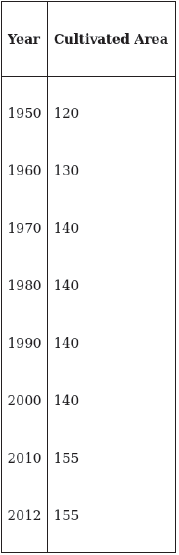
Question. The following table 1.1 shows the land under cultivation in India in units of million hectares. Plot this on the graph, provided. What does the graph show?
Discuss in the class.
Table 1.1: Cultivated area over the years
Answer :
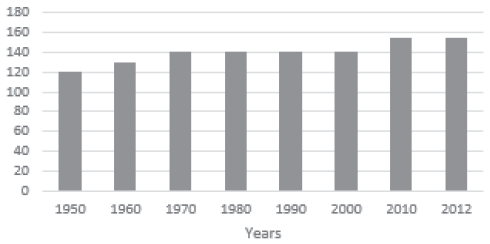
The graph shows that the cultivated area increased regularly till 1970 and became constant for the next four decades. There was some increase between 2000 and 2010 but then again stagnated.
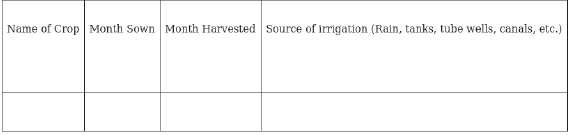
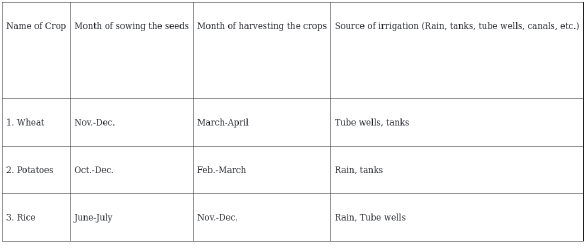
Question. You have read about the crops grown in Palampur. Fill the following table based on information on the crops grown in your region.
Answer :
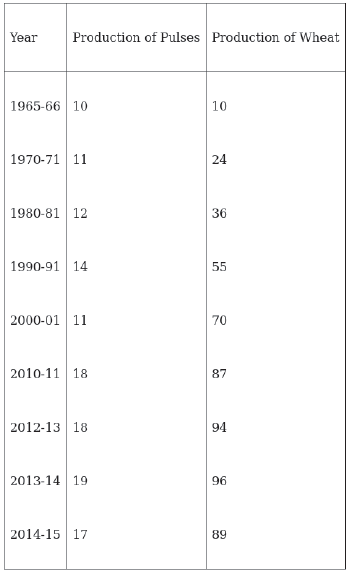
Question. The following table shows the production of wheat and pulses in India after the Green Revolution in units of million tones. Plot this on a graph. Was the Green Revolution equally successful for both the crops? Discuss.
Production of pulses and wheat
Answer :
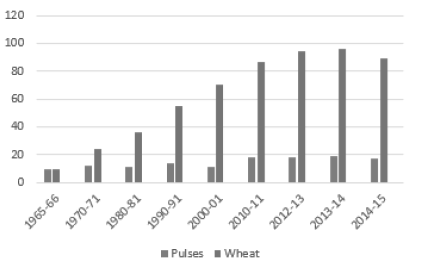
For both crops, Green Revolution was not equally successful. We can look at the graph and analyse that in 1965-66, the production of both crops was 10 million tonnes, but after a long gap of 35 years in 2000-01, production of pulses raised to 11 million tonnes and the other crop wheat’s production raised to 70 million tonnes. So it can be said that Green revolution has seen more success in the production of wheat.
Question. Modern farming methods require the farmer to start with more cash than before. Why?
Answer : The working capital is more in case of modern farming because one needs to employ costly farming techniques and the costs of the modern fertilizers, other chemicals and seeds are also higher than the conventional equipments.
Question. Compare the production of wheat by the three farmers over 3 years.
Answer : On comparing the production of wheat by the three farmers over 3 years, we observe that:
(i)The continuous increase in all the three years in the production of wheat of the farmer-1.
(ii) The production of wheat of farmer-2 has been constant in three years. It neither increased nor decreased.
(iii) The continuous decrease in the all the three years in the production of farmer-3.
Question. Read the following descriptions and answer the questions that follow:
Kareem has opened a computer class centre in the village. In recent years, a large number of students have been attending college in Shahpur town. Kareem found that a number of students from the village are also attending computer classes in the town. There were two women in the village having a degree in computer applications. He decided to employ them. He bought computers and set up the classes in the front room of their house overlooking the market. High class students have started attending them in good numbers.
1) In what ways is Kareem's capital and labour different from Mishrilal’s?
2) Why didn't someone start a computer centre earlier? Discuss the possible reasons.
Answer : 1) Kareem’s capital is computer which is fixed capital when on the other side Mishrilal’s capital is sugarcane crushing machine which is his fixed capital. Kareem has hired two women as labourer where Mishrilal’s labour is his own family members, he didn’t need to hire any labour, and he is self-employed.
2) Someone didn’t start a computer centre earlier because of the lack of education and electricity facilities. The other possible reasons could be non-availability of persons of having a degree especially in computer education, less students etc.
Very Short Answer
Short Answer
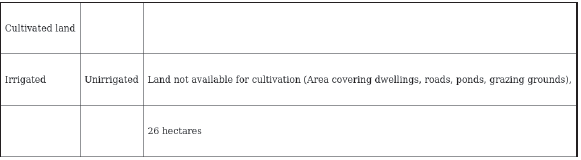
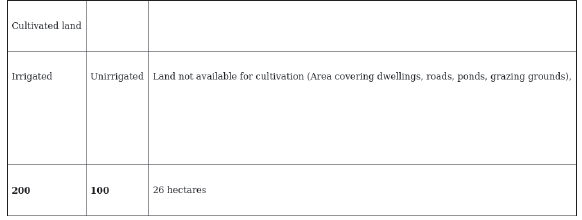
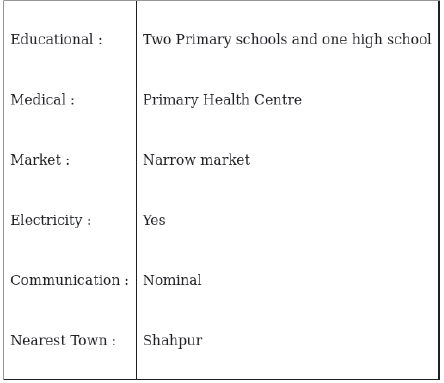
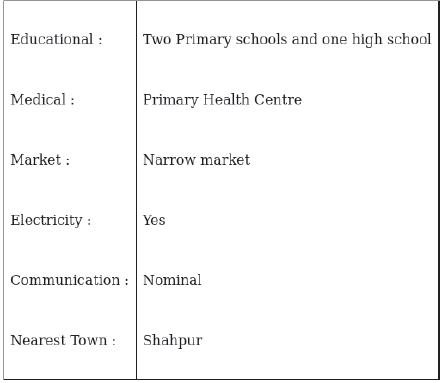
Question. Every village in India is surveyed once in ten years during the Census some of details are presented in the following format. Fill up the following based on information on Palampur.
(a) Location
(b) Total Area of the Village.
(c) Land Use (In Hectares)
(d) FACILITIES

Answer : (a) Location : Palampur
(b) Total area of village: 800 hectares
(c) Land used (in hectares): 700
(d) FACILITIES
Question. How did the spread of electricity help farmers in Palampur?
Answer : The spread of electricity has been helpful for the farmers of Palampur in various ways:
(i) Now irrigation of lands can be done in far more better ways. Before Persian wheels were used for the irrigation which was a prolonged process and was not so effective.
So, irrigation with the help of electricity will be useful for much larger areas of land and too quite quickly and effectively.
(ii) Because of the better irrigation facilities more and more crops can be grown for one year.
(iii) Electric connection not only helped in improving agriculture but also in running small businesses..
Question. Construct a table on the distribution of land among 450 families of Palampur.
Answer : Distribution of land among 450 families of Palampur:
Question. In your region, talk to two labourers. Choose either farm labourers or labourers working at construction sites. What wages do they get? Are they paid in cash or kind? Do they get work regularly? Are they in debt?
Answer : After having communication with two labourers working at construction sites, we got following information:
1. Their per day earning as wages is Rs. 90.
2. They get their payment in cash.
3. No. their work is not permanent; they don’t have work for every day.
4. They have debts as they take loans from moneylenders in case of any emergencies like illness of family members.
Question. Describe the work of a farmer with 1 hectare of land.
Answer : Owning a land of 1 hectare and doing agriculture on it is not enough for the sustenance of the farmer and the family, which makes it mandatory for him/her to try and find extra sources of income. Generally, this stratum of farmers work on their own plot of land and when they are finished with it, they work as labourers on construction sites or fields of the bigger farmers in order to supplement their meagre income from farming own fields.
Question. On what terms did Savita get a loan from Tejpal Singh? Would Savita's condition would be different if she could get a loan from the bank at a low rate of interest?
Answer : Savita got a loan from Tejpal Singh on the following terms:
1. Rate of interest is 24% on the loan for four months.
2. She will have to work as a farm labourer during the harvest season at Rs. 35 per day in Tejpal Singh’s field.
Yes, if she applies for the loan from bank then her condition may differ, she could get loan from the bank at a low rate of interest and no other conditions like extra labor on low wages. This could help in improving her financial condition.
Question. What are the non-farm production activities taking place in your region?
Make a short list.
Answer : The list of non-farm production activities in our region:
1. Small scale manufacturing of shoes
2. Readymade garments
3. Some grocery shops are there
4. Cyber café has recently inaugurated
5. People also sells vegetables in market.
Free study material for Social Science
Exam Preparation Worksheet for Class 9 Social Science Economics Chapter 01 The Story of Village Palampur
CBSE Practice Material: Class 9 Social Science Economics Chapter 01 The Story of Village Palampur
Explore reliable practice questions for Economics Chapter 01 The Story of Village Palampur tailored for Class 9 Social Science learners. Use these structured worksheets to evaluate preparedness and strengthen problem-solving skills.
NCERT-Aligned Questions and Solutions
Cross-reference your completed exercises with comprehensive NCERT solutions for Class 9 Social Science to ensure absolute clarity across all sub-topics in this chapter.
Next Steps in Your Exam Preparation
Follow up your worksheet practice by attempting the interactive online Social Science MCQ test for this chapter to evaluate your execution speed. All platform resources are free to access.
FAQs
You can download the teacher-verified PDF for CBSE Class 9 Economics The Story of Village Palampur Worksheet Set 02 from StudiesToday.com. These practice sheets for Class 9 Social Science are designed as per the latest CBSE academic session.
Yes, our CBSE Class 9 Economics The Story of Village Palampur Worksheet Set 02 includes a variety of questions like Case-based studies, Assertion-Reasoning, and MCQs as per the 50% competency-based weightage in the latest curriculum for Class 9.
Yes, we have provided detailed solutions for CBSE Class 9 Economics The Story of Village Palampur Worksheet Set 02 to help Class 9 and follow the official CBSE marking scheme.
Daily practice with these Social Science worksheets helps in identifying understanding gaps. It also improves question solving speed and ensures that Class 9 students get more marks in CBSE exams.
All our Class 9 Social Science practice test papers and worksheets are available for free download in mobile-friendly PDF format. You can access CBSE Class 9 Economics The Story of Village Palampur Worksheet Set 02 without any registration.