
CBSE Class 9 Social Science Physical Features Worksheet Set C

Access the latest CBSE Class 9 Social Science Physical Features Worksheet Set C. We have provided free printable Class 9 Social Science worksheets in PDF format, specifically designed for Contemporary India Chapter 2 Physical Features of India. These practice sets are prepared by expert teachers following the 2025-26 syllabus and exam patterns issued by CBSE, NCERT, and KVS.

Contemporary India Chapter 2 Physical Features of India Social Science Practice Worksheet for Class 9

Students should use these Class 9 Social Science chapter-wise worksheets for daily practice to improve their conceptual understanding. This detailed test papers include important questions and solutions for Contemporary India Chapter 2 Physical Features of India, to help you prepare for school tests and final examination. Regular practice of these Class 9 Social Science questions will help improve your problem-solving speed and exam accuracy for the 2026 session.

Download Class 9 Social Science Contemporary India Chapter 2 Physical Features of India Worksheet PDF

DEPARTMENT OF SOCIAL SCIENCE

CLASS: IX : GEOGRAPHY

TOPIC/CHAPTER: CHAPTER: 2 – PHYSICAL FEATURES

 
Summary:-
 
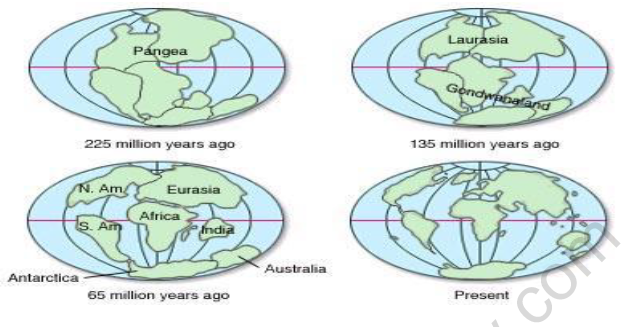
• Tectonic Plate Theory:- This theory is based on continental drift which explains the formation of various continents over millions of years; as we see them today.
 
• Plate Boundaries:-Convergent Boundary, Divergent Boundary and Transform Boundary
 
• MAJOR PHYSIOGRAPHIC DIVISIONS:a.The Himalayan Mountains b.The Northern Plains c.The Peninsular Plateau
 
• d. The Indian Desert e. The Coastal Plainsf.The Islands
 
• The Himalayan Mountain. The Himalayas run along the northern border of India. The Himalayas form an arc which is about 2,400 km long.
 
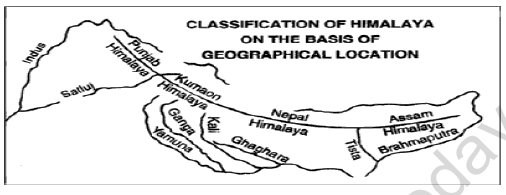
• Himalayan Regions from East to West:
 
• a)Punjab Himalayas:- This part lies between the Indus and Sutlej.
 
• b)Kumaon Himalayas: This part lies between Sutlej and Kali rivers.
 
• c)Nepal Himalayas: This part lies between the Kali and Tista rivers.
 
• d)Assam Himalayas: This part lies between the Tista and Dihang rivers.
 
• The Northern Plain :The northern plain of India is formed by three river systems, viz. the Indus, the Ganga and the Brahmaputra; along with their tributaries. This plain is composed of alluvial soil which has been deposited over millions of years.
 
a)Bhabar    b)Terai     c)Bhangar:    d)Khadar:
 
• The peninsular plateau is a tableland. It is composed of the oldest rocks because it was formed from the drifted part of the Gondwana land.
 
• The Western and the Eastern Ghats:- They make the western and eastern edges of the Deccan Plateau. The average elevation of Western Ghats is 900 – 1600 metres; compared to 600 metres in case of Eastern Ghats. The Eastern Ghats stretch from Mahanadi
Valley to the Nilgiris in the south. The Western Ghats cause orographic rains as they face the rain-laden winds from west.
 
•The Indian Desert:-The Indian desert lies towards the western margins of the Aravali Hills. This region gets scanty rainfall which is less than 150 mm in a year
 
• The Coastal Plains. The Konkan,The Kannada Plain the Malabar coast & the Northern Circar.
 
• The IslandsThe Lakshadweep Islands and The Andaman and Nicobar Islands
 
 Question
 
1 What are Lithospheric plates? Name the seven major Tectonic plates.
 
2. What does the movement of the plates result in? 

3. Classify the plate movements into three types and explain each briefly with suitable diagrams.
CBSE Class 9 Social Science Physical Features Worksheet Set C 1


4. Explain the formation of the Himalayas and the mountain system of Western Asia.
 
5. Describe the formation of the Northern plains of India. 
 
6. ‘The land of India displays great physical variation.’ Explain the above statement with examples.
 
7. Name the major physiographic divisions of India. 
 
8. Explain the Himalayan mountains under the following headings:i) Extent of the range ii) Shape iii) Length iv) Width v) Altitudinal variations.
Ans i) Extent of the range: These mountain ranges run in a west-east direction from the Indus to the Brahmaputra.ii) Shape : form an arciii) Length:2,400 Km.iv) Width: Their width varies from 400 Km in Kashmir to 150 Km in Arunachal Pradesh.v) Altitudinal variations: The altitudinal variations are greater in the eastern half than those in the western half.
 
9. Name the three parallel ranges of the Himalayas. 
 
10. Explain Himadri range under the following headings:
 
Ans 1) Other name : the Great or Inner Himalayas 2) Location : The northern most range 3) Average altitude: an average height of 6,000 metres. 4) Prominent peaks : Mt. Everest Nepal 8848 ,Kanchenjunga India 8598,Makalu Nepal 8481,Dhaulagiri Nepal 8172 5) Folds: asymmetrical in nature. 6) Core of this part: composed of granite.
 
11. Explain the characteristics of the Himachal under the following headings:
 
i) Location : lies to the south of the Himadri ii) Other name : Himachal or lesser Himalaya. iii) Rocks: compressed and altered rocks. iv) Altitude: between 3,700 and 4,500 metres v) Average width: width is of 50 Km. vi) Important ranges :PirPanjal ,DhaulaDhar&Mahabharat vii) Famous valleys: the Kashmir ,Kangra&Kullu valley viii) Hill Stations: Mussoori ,Nainital&Ranikhet.
 
12. Explain the Outer Himalayas under the following: a) Other name b) Location c) Average width iv) Altitude v) Sediments
 
13. What are Duns? Give examples. 
 
14. Explain the divisions of the Himalayas on the basis of regions from west to east. How have these regions been demarcated?
CBSE Class 9 Social Science Physical Features Worksheet Set C 2
 
15. What marks the eastern-most boundary of the Himalayas? 
 
16. What are Purvanchals? Name the hills comprising it. 
 
17. Name the three river systems that have led to the formation of the northern plains.
 
18. Explain the characteristic features of Northern Plains on the basis of the following:1) Formation 2) Area covered 3) Extension 4) Width 5) Other
characteristic features
 
19. What are the characteristics of the rivers in its lower course? 
 
20. What do you mean by distributaries? 
 
21. What is Doab? 
 
22. Describe the three sections into which the northern plains have been divided.
 
23. Explain the divisions of the northern plains according to the variations in the relief features.


Please click on below link to download CBSE Class 9 Social Science Physical Features Worksheet Set C

India and Contemporary I Chapter 05 Pastoralists in the Modern World
CBSE Class 9 History Pastoralists in The Modern World Worksheet Set A

Contemporary India Chapter 2 Physical Features of India CBSE Class 9 Social Science Worksheet

Students can use the Contemporary India Chapter 2 Physical Features of India practice sheet provided above to prepare for their upcoming school tests. This solved questions and answers follow the latest CBSE syllabus for Class 9 Social Science. You can easily download the PDF format and solve these questions every day to improve your marks. Our expert teachers have made these from the most important topics that are always asked in your exams to help you get more marks in exams.

NCERT Based Questions and Solutions for Contemporary India Chapter 2 Physical Features of India

Our expert team has used the official NCERT book for Class 9 Social Science to create this practice material for students. After solving the questions our teachers have also suggested to study the NCERT solutions  which will help you to understand the best way to solve problems in Social Science. You can get all this study material for free on studiestoday.com.

Extra Practice for Social Science

To get the best results in Class 9, students should try the Social Science MCQ Test for this chapter. We have also provided printable assignments for Class 9 Social Science on our website. Regular practice will help you feel more confident and get higher marks in CBSE examinations.

Where can I download the latest PDF for CBSE Class 9 Social Science Physical Features Worksheet Set C?

You can download the teacher-verified PDF for CBSE Class 9 Social Science Physical Features Worksheet Set C from StudiesToday.com. These practice sheets for Class 9 Social Science are designed as per the latest CBSE academic session.

Are these Social Science Class 9 worksheets based on the 2026 competency-based pattern?

Yes, our CBSE Class 9 Social Science Physical Features Worksheet Set C includes a variety of questions like Case-based studies, Assertion-Reasoning, and MCQs as per the 50% competency-based weightage in the latest curriculum for Class 9.

Do you provide solved answers for CBSE Class 9 Social Science Physical Features Worksheet Set C?

Yes, we have provided detailed solutions for CBSE Class 9 Social Science Physical Features Worksheet Set C to help Class 9 and follow the official CBSE marking scheme.

How does solving CBSE Class 9 Social Science Physical Features Worksheet Set C help in exam preparation?

Daily practice with these Social Science worksheets helps in identifying understanding gaps. It also improves question solving speed and ensures that Class 9 students get more marks in CBSE exams.

Is there any charge for the Class 9 Social Science practice test papers?

All our Class 9 Social Science practice test papers and worksheets are available for free download in mobile-friendly PDF format. You can access CBSE Class 9 Social Science Physical Features Worksheet Set C without any registration.