SENIOR SECTION
DEPARTMENT OF SOCIAL SCIENCE
CLASS: IX: GEOGRAPHY
CHAPTER: 4 – CLIMATE
Q. No. Questions
1. Name the elements of a) Weather b) Climate
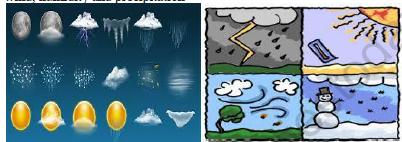
The elements of weather and climate are the same, i.e. temperature, atmospheric pressure, wind, humidity and precipitation
2. Define the terms: Weather and Climate
Climate refers to the sum total of weather conditions and variations over alarge area for a long period of time (more than thirty years). Weather refers to the state of the atmosphere over an area at any point oftime.
3. What does the term “Monsoon” refer to? How is the word Monsoon derived?
4. Describe the regional variations in temperature conditions as observed in various parts of India.
1. In summer, the mercury occasionally touches 50°C in some parts of the Rajasthan desert, whereas it may be around 20°C in Pahalgam in Jammu and Kashmir.
2. On a winter night, temperature at Drass in Jammu and Kashmir may be as low as minus 45°C.
3. Thiruvananthapuram, on the other hand, may have a temperature of 20°C.
4. In the Thar Desert the day temperature may rise to 50°C, and drop downto near 15°C the same night.
5. On the other hand, there is hardly any difference in day and night temperatures in the Andaman and Nicobar islands or in Kerala.
5. Describe the variations in the form, type, amount and seasonal distribution of rainfall as observed in various parts of India.
1. While precipitation is mostly in the form of snowfall in the upper partsof Himalayas, it rains over the rest of the country.
2. The annual precipitation varies from over 400 cm in Meghalaya to lessthan 10 cm in Ladakh and western Rajasthan.
3. Most parts of the country receive rainfall from June to September.
4. But some parts like the Tamil Nadu coast get most of its rain during October and
6. Which part of India experiences the highest range of temperature in a day? What is the November. range of temperature there?
In certain places there is a wide difference between day and night temperatures. In the Thar Desert,the day temperature may rise to 50°C, and drops downto near 15°C the same night.
7. Briefly describe the six major controls of the climate of any place. ( 2 points each)
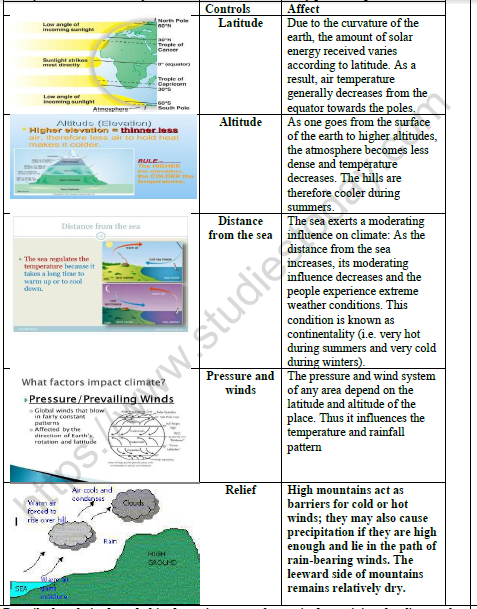
8. Describe how latitude and altitude are important factors in determining the climate of India. Latitude: The Tropic of Cancer passes through the middle of the country from the Rann of Kuchchh in the west to Mizoram in the east. Almost half of the country, lying south of the Tropic of Cancer, belongs to the tropical area. All the remaining area, north of the Tropic, lies in the sub-tropics. Therefore, India’s climate has characteristics of tropical as well as subtropical climates.
Altitude :India has mountains to the north, which have an average height of about 6,000 metres. India also has a vast coastal area where the maximum elevation is about 30 metres. The Himalayas prevent the cold winds from Central Asia from entering the subcontinent. It is because of these mountains that this subcontinent experiences comparatively milder winters as compared to central Asia.
9. Describe the pressure and wind conditions over India during winter. During winter, there is a high-pressure area north of the Himalayas. Cold dry winds blow from this region to the low-pressure areas over the oceans to the south.
10. Describe the pressure and wind conditions over India during summer. In summer, a low-pressure area develops over interior Asia, as well as, over northwestern India. This causes a complete reversal of the direction of winds during summer. Air moves
from the high-pressure area over the southern Indian Ocean, in a south-easterly direction, crosses the equator, and turns right towards the low-pressure areas over the Indian subcontinent. These are known as the Southwest Monsoon winds. These winds blow over the warm oceans, gather moisture and bring widespread rainfall over the mainland of India.
11. Seasonal reversal of wind direction takes place over the Indian sub-continent. Give reasons. (Ans. 9 +Ans. 10)
12. What is Coriolis force and Ferrel’s Law?
13. What are Jet Streams?
14. What are Western Cyclonic Disturbances? How do they influence the weather of India?
Meaning : Refer textbook
Influence: a) Snowfall in upper Himalayas b) Rainfall in northern plains c) Lowering the temperature during winters leading to cold wave.
15. Where is the sub-tropical westerly jet stream and the easterly jet stream located during summer?
16. Where is the westerly jet stream located during winter? How does it influence the weather of India?
17. Explain the facts to understand the mechanism of monsoon.
18. What is ITCZ? Give its location .What phenomenon is associated with this?
(Phenomenon): It causes heavy rainfall wherever ITCZ shifts/located.
19. Explain the concept of Southern Oscillation.
20. How can we predict the intensity of monsoon?
21. What is El –Nino?
22. Explain the phenomena of the ‘Burst’ of the monsoon.
23. Name the two branches of the Indian monsoon.
24. How many seasons can be recognized in India? State their names.
25. Give an account of the Cold weather season in India on the basis of:
1. Period/ Duration: Begins in mid-November till February
2. Temperature conditions: a) December and Jan are the coldest months in the northern part of India. The temperature in the northern plains ranges between 10ºC to 15ºC. b) The temperature decreases from south to the north. The average temperature of
Chennai is between 24ºC to 25ºC.
3. Pressure and Wind conditions: I)In northern part of the country, a feeble highpressure region develops, with light winds moving outwards from this area. II) Influenced by the relief, these winds blow through the Ganga valley from the west and
northwest. III) During this season northeast trade winds prevail over the country. They blow from land to sea hence for most part of the country it is a dry season.
Please click on below link to download CBSE Class 9 Social Science Climate Worksheet Set B