
CBSE Class 9 Social Science Physical Features Worksheet Set 02

Download Class 9 Social Science Worksheets for Contemporary India Chapter 02 Physical Features of India

Access printable practice worksheets for Contemporary India Chapter 02 Physical Features of India designed to align with the 2026-27 academic syllabus for Class 9 Social Science. These structured exercises help students evaluate their conceptual understanding and improve exam readiness.

Access Contemporary India Chapter 02 Physical Features of India Questions and Exercises

View or download the dedicated Contemporary India Chapter 02 Physical Features of India practice resource below. Engaging with these objective and subjective questions daily ensures continuous academic progress and mastery of the 2026-27 curriculum.
SENIOR SECTION

DEPARTMENT OF SOCIAL SCIENCE

CLASS: IX GEOGRAPHY

CHAPTER: 2 – PHYSICAL FEATURES
 
MULTIPLE CHOICE QUESTIONS
 
1) Which of the following is a plausible theory presented by Earth scientists to explain the formation of continents and oceans and the various landforms?
 
(a) Theory of Motion
 
(b) Theory of Plate Tectonics
 
(c) Theory of Evolution
 
(d) Theory of Relativity
 
2) According to the ‘Theory of Plate Tectonics,’ when some plates come towards each other, which of the following is formed?
 
(a) Convergent boundary       (b) Divergent boundary
 
(c) Transform boundary         (d) Colliding boundary
 
3) A landmass bounded by sea on three sides is referred to as
 
(a) Coast                         (b) Island                  (c) Peninsula                  (d) None of the above
 
4) Which of the following are young-fold mountains?
 
(a) The Aravalis                (b) The Nilgiris           (c) The Himalayas            (d) The Sahyadri
 
5) Which of the following physical features forms a natural barrier to the north of India?
 
(a) Kunlun Mountains        (b) Plateau of Tibet     (c) River Brahamaputra    (d) The Himalayas
 
6) The Himalayas consist of three parallel ranges in its longitudinal extent. Which of the following is the name of the northern-most range?
 
(a) The Himadri               (b) The Himachal          (c) The Shivaliks              (d) The Purvanchal
 
7) Which part of the Himalayas is perennially snowbound?
 
(a) Great Himalayas         (b) Lesser Himalayas     (c) Shivaliks                    (d) Purvanchal
 
8) Which of the following is the highest peak in India?
 
(a) Mt. Everest                (b) Kanchenjunga          (c) Nanga Parbat              (d) Nandadevi
 
9) Which islands of India are called Coral Islands?
 
(a) Lakshdeep                (b) Andaman and Nicobar       (c) both          (d) None of these
 
10) The wet and swampy belt of the Northern Region is known locally as …… …. ( Terai)
 
1 What are Lithospheric plates? Name the seven major Tectonic plates. 
 
 
The outer crust of the earth (the lithosphere) is broken into several small pieces known as tectonic plates. The seven major plates are the African plate, Antarctic plate, Eurasian plate, Indo-Australian plate, North American plate, Pacific plate and South American plate.
 
2. What does the movement of the plates result in? 
 
3. Classify the plate movements into three types and explain them briefly 
 
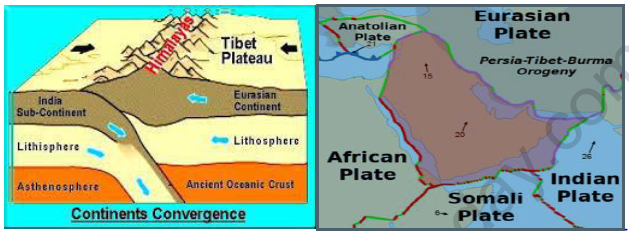
4. Explain the formation of the Himalayas and the mountain system of Western Asia.
 
CBSE Class 9 Social Science Physical Features Worksheet Set B 1
 
5. Describe the formation of the Northern plains of India. 
 
6. ‘The land of India displays great physical variation.’ Explain the above statement with examples.
 
7. Name the major physiographic divisions of India. 
 
8.Explain the Himalayan mountains under the following headings:i) Extent of the range ii) Shape iii) Length iv) Width v) Altitudinal variations.
 
Ans i) Extent of the range: These mountain ranges run in a west-east direction from the Indus to the Brahmaputra. ii) Shape : form an arc iii) Length:2,400 Km.iv) Width: Their width varies from 400 Km in Kashmir to 150 Km in Arunachal Pradesh.v) Altitudinal variations: The altitudinal variations are greater in the eastern half than those in the western half.
 
9. Name the three parallel ranges of the Himalayas. 
 
10. Explain Himadri range under the following headings:
 
1) Other name : the Great or Inner Himalayas 2) Location : The northern most range 3) Average altitude: an average height of 6,000 metres. 4) Prominent
peaks : Mt. Everest Nepal 8848 ,Kanchenjunga India 8598,Makalu Nepal 8481,Dhaulagiri Nepal 8172 5) Folds: asymmetrical in nature. 6) Core of this part: composed of granite.
 
11. Explain the characteristics of the Himachal under the following headings:
 
i) Location : lies to the south of the Himadri ii) Other name : Himachal or lesser Himalaya. iii) Rocks: compressed and altered rocks. iv) Altitude: between 3,700 and 4,500 metres v) Average width: width is of 50 Km. vi) Important ranges : Pir Panjal ,Dhaula Dhar &Mahabharat vii) Famous valleys: the Kashmir ,Kangra &Kullu valley viii) Hill Stations: Mussoori ,Nainital & Ranikhet.
 
12. Explain the Outer Himalayas under the following: a) Other name b) Location
 
c) Average width iv) Altitude v) Sediments
 
13. What are Duns? Give examples. 


Please click on below link to download CBSE Class 9 Social Science Physical Features Worksheet Set B

Contemporary India Chapter 02 Physical Features of India Practice Sheet and Solutions for Class 9 Social Science

CBSE Practice Material: Class 9 Social Science Contemporary India Chapter 02 Physical Features of India

Access structured practice worksheets for Contemporary India Chapter 02 Physical Features of India designed in alignment with the latest CBSE curriculum for Class 9 Social Science. These printable problem sets help students build accuracy and prepare effectively for school tests.

NCERT-Aligned Questions and Solutions

Built using the official NCERT book for Class 9 Social Science, these practice materials provide reliable academic guidance. Pair your practice with our recommended NCERT solutions to master optimal problem-solving approaches.

Next Steps in Your Exam Preparation

Explore our broader library of printable assignments, chapter notes, and mock tests designed to support continuous revision and secure higher marks in CBSE assessments.

FAQs

Where can I download the latest PDF for CBSE Class 9 Social Science Physical Features Worksheet Set 02?

You can download the teacher-verified PDF for CBSE Class 9 Social Science Physical Features Worksheet Set 02 from StudiesToday.com. These practice sheets for Class 9 Social Science are designed as per the latest CBSE academic session.

Are these Social Science Class 9 worksheets based on the 2026-27 competency-based pattern?

Yes, our CBSE Class 9 Social Science Physical Features Worksheet Set 02 includes a variety of questions like Case-based studies, Assertion-Reasoning, and MCQs as per the 50% competency-based weightage in the latest curriculum for Class 9.

Do you provide solved answers for CBSE Class 9 Social Science Physical Features Worksheet Set 02?

Yes, we have provided detailed solutions for CBSE Class 9 Social Science Physical Features Worksheet Set 02 to help Class 9 and follow the official CBSE marking scheme.

How does solving CBSE Class 9 Social Science Physical Features Worksheet Set 02 help in exam preparation?

Daily practice with these Social Science worksheets helps in identifying understanding gaps. It also improves question solving speed and ensures that Class 9 students get more marks in CBSE exams.

Is there any charge for the Class 9 Social Science practice test papers?

All our Class 9 Social Science practice test papers and worksheets are available for free download in mobile-friendly PDF format. You can access CBSE Class 9 Social Science Physical Features Worksheet Set 02 without any registration.