

Download Class 9 Social Science Worksheets for Economics Chapter 01 The Story of Village Palampur
Explore reliable practice materials for Economics Chapter 01 The Story of Village Palampur tailored for Class 9 learners. Utilizing these Social Science worksheets ensures thorough preparation and strengthens problem-solving speed for upcoming school assessments.
Access Economics Chapter 01 The Story of Village Palampur Questions and Exercises
View or download the dedicated Economics Chapter 01 The Story of Village Palampur practice resource below. Engaging with these objective and subjective questions daily ensures continuous academic progress and mastery of the 2026-27 curriculum.
Let's Discuss
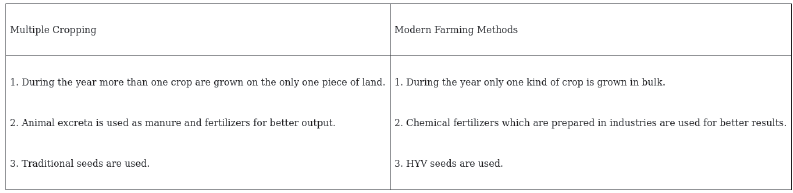
Question. What is the difference between multiple cropping and modern farming methods?
Answer : Difference between multiple cropping and modern farming methods:
Question. Is it important to increase the area under irrigation? Why?
Answer : Yes, it is important to increase the area under irrigation because the increase in area under irrigation will be helpful for more and more production which will help to feed the rising population of India.
Question. What is the working capital required by the farmer using modern farming methods?
Answer : HYV seeds, chemical fertilizers, diesel, insecticides and pesticides are required working capital by the farmer using modern farming methods.
Question. What happens to farmer-3 in year 3? Can he continue production? What will he have to do to continue production?
Answer : (i) In 3rd year, farmer 3 could not produce wheat anymore in accordance with the trends of the three years.
(ii) Yes, production can be continued by him but it would require additional capital input from the farmer’s end.
(iii) The farmer will have to arrange for working capital by borrowing money from the moneylender, banks or some other source, if he wishes to continue production.
Question. Read the following descriptions and answer the questions that follow:
Mishrilal has purchased a mechanical sugarcane crushing machine run on electricity and has set it up on his field. Sugarcane crushing was earlier done with the help of bullocks but people prefer to do it by machines these days. Mishrilal also buys sugarcane from other farmers and processes it into jaggery. The jaggery is then sold to traders at Shahpur. In the process, Mishrilal makes a small profit.
1) What capital did Mishrilal need to set up his jaggery manufacturing unit?
2) Who provides the labour in this case?
3) Can you guess why Mishrilal is unable to increase his profit?
4) Could you think of any reasons when he might face a loss?
5) Why does Mishrilal sell his jaggery to traders in Shahpur and not in his village?
Answer : 1) Sugarcane crushing machine is needed by Mishrilal to set up his jaggery manufacturing unit.
2) His family members and he himself provides the labour in this case.
3) Because of the limited production of sugarcane in his village, he is unable to raise his profit.
4) He might face losses when the price of jaggery falls.
5) Mishrilal sells his jaggery to traders in Shahpur and not in his village because he can earn more in Shahpur comparatively because of the big market of jaggery over there.
Question. Read the following descriptions and answer the questions that follow:
Kishora is a farm labourer. Like other such labourers, Kishora found it difficult to meet his family's needs from the wages that he received. A few years back, Kishora took a loan from the bank. This was under a government programme which was giving cheap loans to poor landless households. Kishora bought a buffalo with this money. He now sells the buffalo's milk. Further he has attached a wooden cart to his buffalo and uses it to transport various items. Once a week he goes to the river Ganga to bring back clay for the potter. Or sometimes he goes to Shahpur with a load of jaggery or other commodities. Every month he gets some work in transport. As a result, Kishora is able to earn more than what he used to do some years back.
1) What is Kishora's fixed capital?
2) What do you think would be his working capital?
3) In how many production activities is Kishora involved?
4). Would you say that Kishora has benefited from better roads in Palampur ?
Answer : 1) Buffalo and wooden cart is Kishora’s fixed capital.
2) Money that is being spent on the maintenance of the bullock and the cart is his working capital.
3) Kishora’s involvement is now in three production activities.
4) Yes, Kishora has benefitted from better roads because of better roads in Palampur; he is able to transport different items which will increase his income.
Very Short Answer
Short Answer
Question. Modern farming methods require more inputs which are manufactured in industry. Do you agree?
Answer : Yes, we do agree that modern farming methods require more inputs which are manufactured in industries. The types of tools and inputs required for agriculture are:
1) Machines used in farming, 2) Motors used in tube wells, 3) Electricity, 4) Chemical Fertilizers, 5) Pesticides, 6) petrol and diesel, 7) Tractors, etc.
Question. Is it important to increase the area under irrigation? Why?
Answer : Yes, it is important to increase the area under irrigation.
Increasing the area under cultivation is important for following reasons:
1. Because the rainfall is neither certain nor adequate.
2. Crops such as rice, wheat, sugarcane require adequate and regular supply of water.
3. Plenty of water is needed for HYV seeds.
4. Increase in irrigation facilities will increase the productivity as it will be helpful in growing multiple crops.
Question. Why are the wages for farm labourers in Palampur less than minimum wages?
Answer : The wages of the farm labourers are less than minimum wages because the land is fixed and population is increasing day by day which leads to increase in labour force. As more labour is available, there is an apparent sense of competition amongst the laborers which leads to many of them accepting even the low wages if it guarantees them continued employment.
Question. What are the different ways of increasing production on the same piece of land? Use examples to explain.
Answer : There are two different ways of increasing production on the same piece of land. E.g.
1. Multiple Cropping Method: This method refers to the cropping method in which more than two crops are grown on a piece of land during a year. This is the most common way of raising production. This method of cropping is possible if there are good facilities for irrigation are available.
2. Modern Farming Methods: This method refers that farming method HYV (high yielding variety) seeds are used instead of traditional seeds. Chemical fertilizers are used instead of animal excreta as manure and other natural fertilizers. In this method irrigation is done with the help of tube wells, tractors are used for ploughing, threshers are also used. At last before harvesting, pesticides and insecticides are sprayed once.
Question. How do the medium and large farmers obtain capital for farming? How is it different from the Small farmers?
Answer : Medium and large farmers obtain capital for farming from their past savings.
The production of medium and large farmers is usually more than their consumption; this is how they save for their next round of farming. They sell the extra output in the market and earn money. However, small farmers do not have savings because in the very first round of farming, they do not have sufficient land to cultivate, thus extra yielding and savings are not quite possible for them. Their arrangement of capital is done by taking loans from moneylenders or large farmers at a very high-interest rate.
Question. Talk to some old residents in your region and write a short report on the changes in irrigation and changes in production methods during the last 30 years.
Answer : I talked to two old residents in my region related to irrigation and method of farming 30 years back. Many changes in irrigation and production methods can be found.
1. Irrigation: The method of irrigation was a very laborious work 30 years back, because Persian wheels were used by the farmers to draw water from the wells and irrigate small fields. But now after 30 years, the tube wells run by electricity could irrigate much larger areas of land and too effectively and quickly. Tube wells were first set up by government, but now farmers have started setting up their private tube wells.
2. Production Method: 30 years back, production activities like sugarcane crushing was done with the help of bullock, but now people prefer to do it by mechanical sugarcane crushing machine which is run on electricity. This has not only increased the efficiency of the process but also helped the farmers in making more profits out of the process.
Question. What can be done so that more non-farm production activities can be started in villages?
Answer : Following are the steps which can be taken to start non-farm activities in villages:
1. Villagers must be made aware of various non-farm production activities.
2. Loans should be provided by the government at a low rate of interest to start or expand nonfarm production activities.
3. Transport facilities which are provided in villages should be cheap so that people can easily carry goods to and from the nearby markets.
4. Providing education and skills to the young population can also help to increase the non-farm activities.
Free study material for Social Science
Download CBSE Practice Material: Class 9 Social Science Economics Chapter 01 The Story of Village Palampur
CBSE Practice Material: Class 9 Social Science Economics Chapter 01 The Story of Village Palampur
Review targeted practice exercises for Class 9 Social Science Economics Chapter 01 The Story of Village Palampur. Curated to match official CBSE guidelines, these downloadable PDF sheets support daily revision and core concept reinforcement.
NCERT-Aligned Questions and Solutions
Built using the official NCERT book for Class 9 Social Science, these practice materials provide reliable academic guidance. Pair your practice with our recommended NCERT solutions to master optimal problem-solving approaches.
Next Steps in Your Exam Preparation
Explore our broader library of printable assignments, chapter notes, and mock tests designed to support continuous revision and secure higher marks in CBSE assessments.
FAQs
You can download the teacher-verified PDF for CBSE Class 9 Economics The Story of Village Palampur Worksheet Set 01 from StudiesToday.com. These practice sheets for Class 9 Social Science are designed as per the latest CBSE academic session.
Yes, our CBSE Class 9 Economics The Story of Village Palampur Worksheet Set 01 includes a variety of questions like Case-based studies, Assertion-Reasoning, and MCQs as per the 50% competency-based weightage in the latest curriculum for Class 9.
Yes, we have provided detailed solutions for CBSE Class 9 Economics The Story of Village Palampur Worksheet Set 01 to help Class 9 and follow the official CBSE marking scheme.
Daily practice with these Social Science worksheets helps in identifying understanding gaps. It also improves question solving speed and ensures that Class 9 students get more marks in CBSE exams.
All our Class 9 Social Science practice test papers and worksheets are available for free download in mobile-friendly PDF format. You can access CBSE Class 9 Economics The Story of Village Palampur Worksheet Set 01 without any registration.