

Social Science Concept Notes for Class 8: Structure Of Colonial Administration In India
Review targeted revision notes for Class 8 Social Science with the CBSE Class 8 Social Science Structure Of Colonial Administration In India Notes. Built according to official educational guidelines for the 2026-27 academic year, these downloadable summaries for Structure Of Colonial Administration In India support daily study and last-minute exam readiness.
Download Structure Of Colonial Administration In India Revision Notes PDF
Navigate directly to the revision notes for Structure Of Colonial Administration In India using the digital viewer below. Each summary is structured to highlight high-weightage sections, allowing students to instantly access critical definitions and focus on core exam topics.
CBSE Class 8 Social Science Structure of Colonial Administration in India Notes. Learning the important concepts is very important for every student to get better marks in examinations. The concepts should be clear which will help in faster learning. The attached concepts made as per NCERT and CBSE pattern will help the student to understand the chapter and score better marks in the examinations.
STRUCTURE OF COLONIAL ADMINISTRATION IN INDIA
Initially British in India had come as traders and gradually acquired new territories in India started collecting Land revenues. In order to consolidate British rule in India, it formulated some policies. The main objective of all British policy was to generate more & more profits and not public welfare.
The Regulating Act of 1773 :
*The company servants had made huge profits from the land revenues of Bengal, Bihar & Orissa.
*Every official had gathered huge wealth & returned to England where they were called Nabobs because of their luxurious style of living & spending where as poor people of India were being drained of wealth even the East India company had become Bankrupt.
* The company servants begged for a loan of $ 10,00,000 from Britain Parliament while their employees were living in an utter luxurious life.
* Inorder & control corruption & keep vigil on the company's affairs, the regulating Act was passed.
The main Provisions of Regulating act 1773 :
*The Governor of Bengal was made the Governor General of British India. [Warren Hasting become the first Governor General of Bengal.
*The Governor General was to be assisted by a council of 4 members & had to accept the decisions taken by the majority members councils.
*The Governor General supervised the Governors of Bombay & Madras presidencies. For the administration of justice a Supreme Court was set up at Calcutta.
Result : The regulating act failed to regulate the activities of the East India Company as the powers of the Governor General & council more not defined properly.
The Pitts India Act of 1784
* It is by British Prime Minister William Pitt, the younger, Pitts India Act was introduced to remove the defects of Regulating Act.
*This Act was passed to enhance British Parliaments Control over India.
The main Provisions of the Act were :-
1. The political & Commercial functions of the company were seperated.
2. The Board of Directors was to only look after the commercial activities of the company.
3. The Board of Control was created to control and supervise, direct & control the political affairs of the company.
4. The Board of Control was to consist of 6 members. They were to be appointed by king & were to hold office during his pleasure.
5. They were the secretary for finance the secretary of state for India & Four Privy Councillor of State of India.
6. The Board of Control appointed the Governor General.
7. The Governor General had to take permission from the Board of Control before entering into any treaty or declaring war against Native King.
Thus there was dual governence in the country which continue till 1958.
The Charter Acts :
* The charter acts were passed after every 20 years which defined the role of the company.
1. The Charter Act of 1813 : According to this act ;
* Monopoly of the company over the Indian trade was abolished.
* The Indian trade was open to all English people excepting tea in which the company was allowed to retain its monopoly.
* The company was asked to spend 1 lac rupees on education in India.
2. The Charter Act of 1833 :
* It empowered the Governor General in council to have full authority over the civil & Military affairs of the company's territories in India.
*This act ended the company's monopoly in tea trade in India.
* The Governor of Bengal was made the Governor General of India & Presidencies of Bombay, Madras & Calcutta came under his control.
3. The Charter Act of 1853 :
* This act drastically cut down the powers of the company.
* This act allowed the company to rule over Indian territories but only in the name crown.
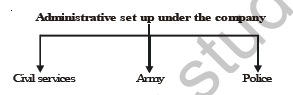
* To Consolidate British rule in India, to maintain law and order, the British created 3 main pillars.
Civil service :
(i) Lord Cornwallis was the founder of civil service in India.
(ii) The civil servants paid very handsome salary.
(iii) This Prestigious job & high salaries attracted the Young Men of British Families.
(iv) Initially only British families were given jobs civil servants, Indians were not allowed to enter civil service.
(v) In fact in 1793, a rule was made that no Indian would be eligible for post above $ 500.
(vi) The Charter act of 1853 introduced a system of open competition through exams.
(vii) The civil service exams were not held in India. They were held in England.
Army :
(i) Army was another important pillar of British administration.
(ii) Army played 3 important roles in the expansion of British Empire.
It saved the company from its European rivals conquered the dominions of native rulers & crushed revolts when they broke out
(iii) Indian were appointed in army on large scale on low posts and low salaries.
Police :
* British wanted police to maintain law and order.
* Lord Cornwallis gave shape to police force in 1791, Superintendent of Police was appointed Darogas were Incharge of Thanas or sub-division of districts.
* The hereditary village policemen became Chowkidars.
Conclusion :- Indians were not appointed for high post and all high post in civil services Police and Army were occupied by Englishmen only.
KEY TERMS
1. Nabobs :- The name given to the officials of the English East India Co. in the 18th century because they followed the style of Indian Nawabs.
2. Charter :- A written grant from the sovereign power of a country giving rights & privileges on a person.
3. Rule of law :- It means administration should be carried in accordance with the law.
4. Civil Services :- The permanent professional branches of the state administration excluding judiciary and army.
5. Sepoy :- A native of India employed as a soldier in British Army.
Please click the link below to download pdf file for CBSE Class 8 Social Science Structure of Colonial Administration in India Notes.
Free study material for Social Science
Download CBSE Revision Notes: Class 8 Social Science Structure Of Colonial Administration In India
About Structure Of Colonial Administration In India Revision Notes
Access structured revision notes for Structure Of Colonial Administration In India designed in alignment with the latest CBSE curriculum for Class 8 Social Science. These summaries help clarify core themes and support effective daily study.
How to Use These Revision Notes
Each chapter summary is structured around standard CBSE textbooks, allowing students to check their understanding and clarify complex ideas early in their revision.
Enhance Practice with MCQs and Worksheets
Explore our broader library of printable assignments, chapter notes, and mock tests designed to support continuous revision and secure higher marks in CBSE assessments.
FAQs
You can download the teacher prepared revision notes for CBSE Class 8 Social Science Structure Of Colonial Administration In India Notes from StudiesToday.com. These notes are designed as per 2026-27 academic session to help Class 8 students get the best study material for Social Science.
Yes, our CBSE Class 8 Social Science Structure Of Colonial Administration In India Notes include 50% competency-based questions with focus on core logic, keyword definitions, and the practical application of Social Science principles which is important for getting more marks in 2026 CBSE exams.
Yes, our CBSE Class 8 Social Science Structure Of Colonial Administration In India Notes provide a detailed, topic wise breakdown of the chapter. Fundamental definitions, complex numerical formulas and all topics of CBSE syllabus in Class 8 is covered.
These notes for Social Science are organized into bullet points and easy-to-read charts. By using CBSE Class 8 Social Science Structure Of Colonial Administration In India Notes, Class 8 students fast revise formulas, key definitions before the exams.
No, all study resources on StudiesToday, including CBSE Class 8 Social Science Structure Of Colonial Administration In India Notes, are available for immediate free download. Class 8 Social Science study material is available in PDF and can be downloaded on mobile.