

Official CBSE VBQs for Class 12 English
Access comprehensive Value Based Questions (VBQs) for Flamingo Poetry Chapter 02 Keeping Quiet using the CBSE Class 12 English Keeping Quiet VBQs Set 01. Designed to align with the 2026-27 CBSE academic guidelines, these competency-based resources help Class 12 English students apply theoretical knowledge to real-world scenarios.
Competency-Based Practice for English
Access the complete VBQ PDF for Class 12 English below. Regular practice with these targeted competency-based questions builds familiarity with expected application-level question patterns to help secure higher marks.
Question. “What I want should not be confused with total inactivity.”
Choose the option that draws the most accurate parallel.
keeping quiet: total inactivity = ______ : ______
a) reflection and death
b) silence and chaos
c) stagnation and introspection
d) mindfulness and fear
Answer : A
Question. What statement does Neruda make about wars?
a) Wars are of varied kinds – internal, green wars, wars with gas, with fire etc.
b) Wars are wasteful and cause irrecoverable loss and damage to property and life.
c) Wars never yield any winners, and the loss is far greater than what can be measured.
d) Wars are unavoidable in the enduring struggle for human dignity and power.
Answer : C
Question. Read the statements given below carefully. Choose the option that best describes these statements, with reference to the poem.
Statement I – The poem ‘Keeping Quiet’ calls for change as much in the individual as human society at large.
Statement II – The poem ‘Keeping Quiet’ implies that individual change will lead to bigger societal change.
Statement III – Neruda believes that when people come together as a community, they will be able to bring a transformation in each person.
a) Statement I is True, Statement II is False, and Statement III cannot be inferred.
b) Statement I and II cannot be inferred, Statement III is True.
c) Statement I is True, Statements II and III cannot be inferred.
d) Statement I cannot be inferred, Statement II cannot be inferred, Statement III is False.
Answer : A
Question. “Now I’ll count up to twelve and you keep quiet and I will go.” Why does the poet wish to go at the end of the poem?
a) The poet does not believe people will be quiet.
b) The poet has already invested enough time.
c) The poet will move on and seek to inspire others.
d) The poet is marking the end of the poem by leaving.
Answer : C
Read the given passage and answer the questions that follow:
For once on the face of the Earth
let’s not speak in any language,
let’s stop for one second,
and not move our arms so much.
It would be an exotic moment
without rush, without engines,
we would all be together
in a sudden strangeness.
Question. Why do you think the poet employs words like “exotic” and “strangeness”?
a) To highlight the importance of everyone being together suddenly for once.
b) To emphasize the frenetic activity and chaos that usually envelops human life.
c) To indicate the unfamiliarity of a sudden moment without rush or without engine.
d) To direct us towards keeping quiet and how we would all be together in that silence.
Answer : B
Question. The poet uses the word “let’s” to _______
a) initiate a conversation between the poet and the readers.
b) invite readers as part of the poem’s larger call to humanity.
c) welcome readers into the world of the poem and its subject.
d) address readers as fellow members of the human race.
Answer : B
Question. Margaret Atwood said, “Language divides us into fragments, I wanted to be whole.”
Choose the option that correctly comments on the relationship between Margaret Atwood’s words and the line from the above extract – “let’s not speak in any language”
a) Atwood endorses Neruda’s call to not speak in any language.
b) Atwood justifies Neruda’s request to not engage in any speaking.
c) Atwood undermines Neruda’s intent to stop and not speak in any language.
d) Atwood surrenders to Neruda’s desire for silence and not speak in any language.
Answer : A
Question. Choose the option that correctly matches the idioms given in Column A with their meanings in Column B. 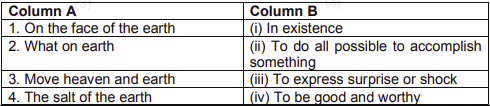
a) 1 – (i); 2 – (iv); 3 – (iii); 4 – (ii)
b) 1 – (i); 2 – (iii); 3 – (ii); 4 – (iv)
c) 1 – (ii); 2 – (i); 3 – (iv); 4 – (iii)
d) 1 – (iv); 2 – (ii); 3 – (iii); 4 – (i)
Answer : B
Read the given passage and answer the questions that follow:
If we were not so single-minded
about keeping our lives moving,
and for once could do nothing,
perhaps a huge silence
might interrupt this sadness
of never understanding ourselves
and of threatening ourselves with
death.
Question. Look at the images given below. Choose the image to which the above extract can be seen as an appropriate response.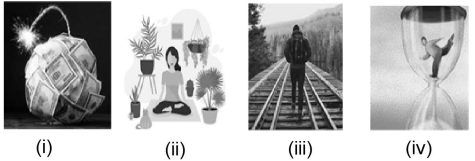
a) Option (i)
b) Option (ii)
c) Option (iii)
d) Option (iv)
Answer : D
Question. What might the “huge silence” signify?
a) melancholy
b) understanding
c) discomfort
d) flexibility
Answer : B
Question. What do you think is the mood of the poet in the above extract?
a) gloomy, cynical
b) reflective, inspired
c) introspective, aware
d) critical, demotivated
Answer : C
Question. Pick the option that DOES NOT complete the given sentence suitably, as per the extract.
Threatening ourselves with death __________
a) feeds on the fear of death.
b) challenges finiteness of life.
c) keeps us rushing through life.
d) makes us restless and impatient.
Answer : B
Stanza 1
Those who prepare green was,
wars with gas, wars with fire,
victory with no survivors,
would put on clean clothes
and walk about with their
brothers
in the shade, doing nothing.
Question. Who are ‘those’ who prepare green wars?
(a) politicians
(b) scientists
(c) statesmen
(d) all of the above
Answer : D
Question. What do you mean by ‘green wars’?
(a) wars against environment
(b) wars against humanity
(c) wars against animals
(d) none of the above
Answer : A
Question. Name other wars mentioned in the stanza.
(a) nuclear wars
(b) chemical wars
(c) both a & b
(d) green wars
Answer : C
Question. Which poetic device is used in the line- ‘victory with no survivors’?
(a) simile
(b) metaphor
(c) paradox
(d) oxymoron
Answer : C
Stanza 2
It would be an exotic moment
without rush, without engines,
we would all be together
in a sudden strangeness.
Question. Name the poem
(a) A Thing of beauty
(b) Keeping quiet
(c) My Mother at Sixty Six
(d) A Roadside Stand
Answer : B
Question. What does ‘It’ refers to?
(a) making a noise
(b) scolding men
(c) To be silent
(d) none of the above
Answer : C
Question. How can man achieve this exotic moment?
(a) by stopping all activities
(b) by making noises
(c) by keeping quiet
(d) both a & c
Answer : D
Question. Who is the poet speaking to?
(a) readers
(b) all human beings
(c) not known
(d) both a & b
Answer : D
Read the extracts given below and answer the questions that follow.
1. For once on the face of the Earth
let’s not speak in any language,
let’s stop for one second,
and not move our arms so much.
It would be an exotic moment
without rush, without engines,
we would all be together
in a sudden strangeness.
Question. The poet uses the word “let’s” to _______.
(i) initiate a conversation between the poet and the readers.
(ii) invite readers as part of the poem’s larger call to humanity.
(iii) welcome readers into the world of the poem and its subject.
(iv) address readers as fellow members of the human race.
Answer. C
Question. Margaret Atwood said, “Language divides us into fragments, I wanted to be whole.”
Choose the option that correctly comments on
the relationship between Margaret Atwood’s
words and the line from the above extract – “let’s
not speak in any language”
(i) Atwood endorses Neruda’s call to not speak in any language.
(ii) Atwood justifies Neruda’s request to not engage in any speaking.
(iii) Atwood undermines Neruda’s intent to stop and not speak in any language.
(iv) Atwood surrenders to Neruda’s desire for silence and not speak in any language.
Answer. A
Question. Why do you think the poet employs words like “exotic” and “strangeness”?
(i) To highlight the importance of everyone being together suddenly for once.
(ii) To emphasize the frenetic activity and chaos that usually envelops human life.
(iii) To indicate the unfamiliarity of a sudden moment without rush or without engine.
(iv) To direct us towards keeping quiet and how we would all be together in that silence.
Answer. B
Question. Choose the option that correctly matches the idioms given in Column A with their meanings in Column B.
Column - A Column - B
1. On the face of the (a) In existence
earth
2. What on earth (b) To do all possible to
accomplish something
3. Move heaven and (c) To express surprise or
earth shock
4. The salt of the (d) To be good and
earth worthy
(a) 1-a, 2-d, 3-c, 4-b
(b) 1-a, 2-c, 3-b, 4-d
(c) 1-b, 2-a, 3-d, 4-c
(d) 1-d, 2-b, 3-c, 4-a
Answer. B
2. Those who prepare green wars,
wars with gas, wars with fire,
Victory with no survivors,
would put on clean clothes
and walk about with their brothers
in the shade, doing nothing.
Question. Who are ‘those’ in line 1?
(i) politicians
(ii) scientists
(iii) statesman
(iv) all of these
Answer. D
Question. What are ‘green wars’?
(i) war with the trees
(ii) war with the vegetables
(iii) war against nature
(iv) war for nature
Answer. C
Question. Identify the figure of speech used in ‘clean clothes’
(i) personification
(ii) alliteration
(iii) metaphor
(iv) hyperbole
Answer. B
Question. What does the poet expect from the men?
(i) to indulge in Chemical wars rather than fire arms
(ii) to fight harmoniously
(iii) co-exist in peaceful atmosphere
(iv) to spare atmosphere and then fight
Answer. C
3. If we were not so single-minded
about keeping our lives moving,
and for once could do nothing,
perhaps a huge silence
might interrupt this sadness
of never understanding ourselves
and of threatening ourselves with death.
Question. Whom does ‘we’ refer to in the above lines?
(i) army men
(ii) human beings
(iii) citizens of US
(iv) men
Answer. B
Question. Why does the poet want us to ‘do nothing’ for once?
(i) to give rest to our body
(ii) to experience the freedom
(iii) to enjoy the leisure time
(iv) to analyse our actions
Answer. D
Question. Which figure of speech is used in the first line?
(i) personification
(ii) allegory
(iii) alliteration
(iv) repetition
Answer. C
Question. How can a huge silence do good to us?
(i) we can achieve peace in this silence only
(ii) it helps us in analysing ourselves
(iii) interrupts the sadness of threatening ourselves with death.
(iv) all of these
Answer. D
4. Perhaps the Earth can teach us
as when everything seems dead
and later proves to be alive
Now I’ll count upto twelve
and you keep quiet and I will go.
Question. What does the Earth teach us?
(i) that people should live in harmony
(ii) that there is life under stillness
(iii) that people should not indulge in war
(iv) that all people are its children
Answer. B
Question. What does the poet mean to achieve by counting up to twelve?
(i) peace by introspecting
(ii) experience happiness
(iii) knowledge of controlling anger
(iv) achieving power
Answer. A
Question. From the above lines, what do you guess about the poet’s thought process?
(i) he is hypothetical
(ii) he is practical
(iii) he is philosophical
(iv) he is emotional
Answer. B
Question. What is always alive, even when everything seems to be dead?
(i) our deeds
(ii) our memories
(iii) people’s behaviour
(iv) activities beneath the earth’s surface
Answer. D
Question. What is the pen name of the poet of the poem ‘Keeping Quiet’?
(a) Neruda
(b) Pable
(c) Pablo
(d) Pablo Neruda
Answer. D
Question. What does the poem ‘Keeping Quiet’ speak about?
(a) the necessity to be happy
(b) the necessity to introspect , understand and have feelings of brotherhood
(c) the necessity to work quietly
(d) None of above
Answer. D
Question. What is the essence or message of the poem ?
(a) introspection and retrospection to be more peaceful and be in harmony
(b) to prosper
(c) to be happier
(d) to reach out more people
Answer. A
Question. What is the rhyming scheme used in the poem ‘Keeping Quite’?
(a) enclosed rhyme
(b) Monorhyme
(c) Sonnet
(d) Free verse
Answer. D
Question. What does the poet feel is needed to be at peace?
(a) meeting with people
(b) talking with people
(c) interaction with the people
(d) soul searching
Answer. D
Question. How will counting upto 12 help?
(a) improve our maths
(b) helps in knowing months of a year
(c) it will help to create peace and harmony
(d) All of the above
Answer. D
Question. According to the poet what creates barriers?
(a) interactions
(b) reactions
(c) fighting
(d) languages
Answer. D
Question. What does the style of the poem symbolise?
(a) desires
(b) happiness
(c) hope
(d) desire and hope
Answer. D
Question. How is keeping quiet related to life and can change attitude?
(a) it helps to think and search soul
(b) helps to scratch one’s soul
(c) helps to develop new thinking process
(d) All of the above
Answer. D
Question. What does the poem ‘Keeping Quiet’ teach us?
(a) how to maintain silence
(b) not to make noise
(c) speaking creates noise
(d) to be peaceful, thoughtful and have feelings of brotherhood
Answer. D
Question. Why is silence treated as a big issue?
(a) it helps to search our soul
(b) helps us to analyse our actions
(c) helps us to be thoughtful and find our true self
(d) All of the above
Answer. D
Question. What is the sadness in the poem that the poet speaks about ?
(a) violence because of unthoughtfulness of the people
(b) unnecessary movements
(c) speaking aloud
(d) fighting
Answer. A
Question. What does the poet want people to do for one second?
(a) to sing
(b) to close eyes
(c) to stand quietly
(d) to be silent and motionless
Answer. D
Free study material for English
Moral and Ethical Questions: Class 12 English Flamingo Poetry Chapter 02 Keeping Quiet
Download VBQs for Class 12 English Flamingo Poetry Chapter 02 Keeping Quiet
Review important VBQs for Flamingo Poetry Chapter 02 Keeping Quiet tailored for Class 12 learners. These structured exercises highlight core values and practical concepts essential for high-scoring exam performance.
Expert Guidance for Flamingo Poetry Chapter 02 Keeping Quiet VBQs
Pair your practice with our comprehensive NCERT solutions for Class 12 English to review detailed responses and master the underlying themes of this chapter.
Enhance Analytical Depth for Class 12 English
Wrap up your preparation by testing your critical thinking against standard English question formats. All resources on our platform are free to access.
FAQs
The latest collection of Value Based Questions for Class 12 English Flamingo Poetry Chapter 02 Keeping Quiet is available for free on StudiesToday.com. These questions are as per 2026 academic session to help students develop analytical and ethical reasoning skills.
Yes, all our English VBQs for Flamingo Poetry Chapter 02 Keeping Quiet come with detailed model answers which help students to integrate factual knowledge with value-based insights to get high marks.
VBQs are important as they test student's ability to relate English concepts to real-life situations. For Flamingo Poetry Chapter 02 Keeping Quiet these questions are as per the latest competency-based education goals.
In the current CBSE pattern for Class 12 English, Flamingo Poetry Chapter 02 Keeping Quiet Value Based or Case-Based questions typically carry 3 to 5 marks.
Yes, you can download Class 12 English Flamingo Poetry Chapter 02 Keeping Quiet VBQs in a mobile-friendly PDF format for free.