

Official Class 12 Physics Worksheets: Chapter 08 Electromagnetic Waves
Explore reliable practice materials for Chapter 08 Electromagnetic Waves tailored for Class 12 learners. Utilizing these Physics worksheets ensures thorough preparation and strengthens problem-solving speed for upcoming school assessments.
Chapter-wise Practice Material: Chapter 08 Electromagnetic Waves
Access the complete worksheet PDF for Chapter 08 Electromagnetic Waves below. Regular practice with these targeted questions builds familiarity with standard exam patterns and helps secure higher marks in final Physics evaluations.
CBSE Class 12 Physics Electromagnetic Waves Worksheet Set A
Question. If E and B represent electric and magnetic field vectors of the electromagnetic wave, the direction of propagation of electromagnetic wave is along
(a) E
(b) B
(c) B × E
(d) E × B
Answer: D
Question. In an electromagnetic wave, the electric and magnetic fields are 100 V m–1 and 0.265 A m–1. The maximum energy flow is
(a) 26.5 W/m2
(b) 36.5 W/m2
(c) 46.7 W/m2
(d) 765 W/m2
Answer: A
Question. A TV tower has a height of 100m. How much population is covered by the TV broadcast if the average population density around the tower is 100 km–2 (radius of the earth = 6.37 × 10⁶ m)
(a) 4 lakh
(b) 4 billion
(c) 40,000
(d) 40 lakh
Answer: D
Question. The oscillating electric and magnetic vectors of an electromagnetic wave are oriented along
(a) the same direction but differ in phase by 90°
(b) the same direction and are in phase
(c) mutually perpendicular directions and are in phase
(d) mutually perpendicular directions and differ in phase by 90°
Answer: C
Question. To double the covering range of a T.V. transmitter tower, its height should be made
(a) 2 times
(b) 4 times
(c) √2 times
(d) 8 times
Answer: B
Question. A plane electromagnetic wave travels in free space along x-axis. At a particular point in space, the electric field along y-axis is 9.3V m–1. The magnetic induction (B) along z-axis is
(a) 3.1 × 10⁻⁸ T
(b) 3 × 10⁻⁵ T
(c) 3 × 10⁻⁶ T
(d) 9.3 × 10⁻⁶ T
Answer: A
Question. Biological importance of ozone layer is
(a) it stops ultraviolet rays
(b) ozone layer reduce green house effect
(c) ozone layer reflects radio waves
(d) ozone layer controls O2 / H2 radio in atmosphere
Answer: A
Question. A radiation of energy ‘E’ falls normally on a perfectly reflecting surface. The momentum transferred to the surface is (C = Velocity of light)
(a) 2E/C
(b) 2E/C2
(c) E/C2
(d) E/C
Answer: A
Question. Which of the following has/have zero average value in a plane electromagnetic wave ?
(a) Both magnetic and electric field
(b) Electric field only
(c) Magnetic energy
(d) Electric energy
Answer: A
Question. For sky wave propagation of a 10 MHz signal, what should be the maximum electron density in ionosphere?
(a) ~1.2 × 10¹²m–3
(b) ~106m–3
(c) ~1014 m–3
(d) ~1022m–3
Answer: A
Question. A new system of unit is evolved in which the values of μ0 and ∈0 are 2 and 8 respectively. Then the speed of light in this system will be
(a) 0.25
(b) 0.5
(c) 0.75
(d) 1
Answer: A
Question. Light wave is travelling along y-direction. If the corresponding E̅ vector at any time is along the x-axis, the direction of B̅ vector at that time is along
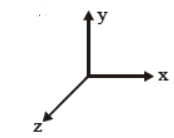
(a) y-axis
(b) x-axis
(c) + z-axis
(d) – z-axis
Answer: C
Question. If E̅ and B̅ represent electric and magnetic field vectors of the electromagnetic waves, then the direction of propagation of the waves will be along
(a) B̅ x E̅
(b) E̅
(c) B̅
(d) E̅ x B̅
Answer: D
Question. The transmitting antenna of a radiostation is mounted vertically. At a point 10 km due north of the transmitter the peak electric field is 10–3 Vm–1. The magnitude of the radiated magnetic field is
(a) 3.33 × 10⁻¹⁰ T
(b) 3.33 × 10⁻¹² T
(c) 10–3 T
(d) 3 × 10⁵ T
Answer: B
Question. A linearly polarised electromagnetic wave given as E = E0îcos kz -ωt is incident normally on a perfectly reflecting infinite wall at z = a. Assuming that the material of the wall is optically inactive, the reflected wave will be given as
(a) Er = E0î(kz - ωt)
(b) Er = E0îcos(kz + ωt)
(c) Er = E0îcos(kz + ωt)
(d) Er = E0îsin(kz - ωt)
Answer: B
Question. Which of the following statement is false for the properties of electromagnetic waves?
(a) Both electric and magnetic field vectors attain the maxima and minima at the same place and same time.
(b) The energy in electromagnetic wave is divided equally between electric and magnetic vectors
(c) Both electric and magnetic field vectors are parallel to each other and perpendicular to the direction of propagation of wave
(d) These waves do not require any material medium for propagation.
Answer: C
Question. The ratio of electric field vector E and magnetic field vector H i.e., (E/H) has the dimensions of
(a) resistance
(b) inductance
(c) capacitance
(d) product of inductance and capacitance
Answer: A
Question. Out of the following options which one can be used to produce a propagating electromagnetic wave ?
(a) A charge moving at constant velocity
(b) A stationary charge
(c) A chargeless particle
(d) An accelerating charge
Answer: D
Question. In an electromagnetic wave in free space the root mean square value of the electric field is Erms = 6V/m. The peak value of the magnetic field is :-
(a) 2.83 × 10⁻⁸ T
(b) 0.70 × 10⁻⁸ T
(c) 4.23 × 10⁻⁸ T
(d) 1.41 × 10⁻⁸ T
Answer: A
Question. The condition under which a microwave oven heats up a food item containing water molecules most efficiently is
(a) the frequency of the microwaves has no relation with natural frequency of water molecules.
(b) microwaves are heat waves, so always produce heating.
(c) infra-red waves produce heating in a microwave oven.
(d) the frequency of the microwaves must match the resonant frequency of the water molecules.
Answer: D
Question. In which one of the following regions of the electromagnetic spectrum will the vibrational motion of molecules give rise to absorption ?
(a) Ultraviolet
(b) Microwaves
(c) Infrared
(d) Radio waves
Answer: B
Question. An electromagnetic wave is made up of joint electric (E) and magnetic (B) fields. Its direction of propagation is
(a) parallel to E
(b) perpendicular to E but parallel to B
(c) parallel to B
(d) perpendicular to both E and B
Answer: A
Question. Which of the following shows green house effect ?
(a) Ultraviolet rays
(b) Infrared rays
(c) X-rays
(d) None of these
Answer: B
Question. The electric field associated with an e.m. wave in vacuum is given by E̅ = î 40 cos (kz – 6 × 10⁸t), where E, z and t are in volt/m, meter and seconds respectively. The value of wave vector k is
(a) 2 m–1
(b) 0.5 m–1
(c) 6 m–1
(d) 3 m–1
Answer: C
ONE MARK QUESTIONS
Question. What physical quantity is same for X-rays of wavelength 10-10 m, red light of wavelength 6800A0 and radio wave of wavelength 500m.
Answer: Velocity
Question. To which part of the electromagnetic spectrum does a wave of frequency 5x10¹⁹ Hz belong?
Answer: Gamma rays.
Question. Name the electromagnetic waves, which (i) maintain Earth’s warmth and (ii) are used in aircraft navigation.
Answer: (i) Infrared rays.
(ii)Microwaves
Question. The speed of an electromagnetic wave in a material medium is given by v = 1/√µε, µ being the permeability of the medium and € its permittivity. How does its frequency change?
Answer: No change
Question. What are the directions of electric and magnetic field vectors relative to each other and relative to the direction of propagation of electromagnetic waves?
Answer: They are perpendicular to each other and also perpendicular to the direction of propagation.
TWO MARKS
Question.The oscillating electric field of an electromagnetic wave is given by
Ey =30 sin(2x10¹¹ t+ 300πx)v/m
a) Obtain the value of wavelength of the electromagnetic wave.
b) Write down the expression for oscillating magnetic field.
Answer: k=300π
2π/ƛ=300π
ƛ=1/150m
E/B=3X108
B=10-7
BZ=10-7sin(2x10¹¹ t+ 300πx) T
Question. What do electromagnetic waves consist of? Explain as what factors does its velocity in vacuum depend?
Answer: Electromagnetic waves consist of mutually perpendicular electric and magnetic field vectors. Its velocity in vacuum is given by
C= (1/√µ0ε0) = same for electromagnetic waves.
In other words its velocity in vacuum does not depend on any factor.
Question. Give two characteristics of electromagnetic waves. Write the expression for velocity of electromagnetic waves in terms of permittivity and permeability of the medium.
Answer: Characteristics of electromagnetic waves:
(i)Electromagnetic waves travel in free space with speed of light c= 3X 10⁸m/s.
(ii) Electromagnetic waves are transverse in nature.
Expression for velocity of em waves in vacuum, c= (1/√µ0ε0)
Question.(a)How are electromagnetic waves produced by oscillating charges?
(b)State clearly how a microwave oven works to heat up a food item containing water molecules.
(c)Why microwaves are found useful for the radar systems in aircraft navigation?
Answer: (a) if a charge particle oscillates with some frequency, produces an oscillating electric field in space, which produces an oscillating magnetic field, which in turn is a source of electric field, and so on. Thus oscillating electric fields and magnetic fields regenerate each other, and an electromagnetic wave propagates in the space.
(b) In microwave oven, the frequency of the microwaves is selected to match the resonant frequency water molecules so that energy from the waves get transferred efficiently to the kinetic energy of the molecules. This kinetic energy raises the temperature of any food containing water.
(c)Microwaves are short wave length radio waves with frequency of order GHz. Due to short wave length, they have high penetrating power with respect to atmosphere and less diffraction in the atmospheric layers. So these waves are suitable for the radar systems used in aircraft navigation.
Very Short Answer
Q1) What is the speed of propagation of the wave?
Q2) On what kind of properties the velocity of light depends?
Q3) What is the use of UV lamps?
Q4) What is conduction current?
Q5) Who discovered the photoelectric effect?
Short Answer
Q6) What happens when the sun shines on our hands?
Q7) What is the nature of the electromagnetic waves?
Q8) What do you mean by the radiation pressure?
Q9) Define displacement current?
Q10) What do you mean by the Ampere-Maxwell law?
Long Answer
Q11) Explain the different types of the electromagnetic waves?
Q12) Write short note on electromagnetic waves?
Q13) State the difference between magnetism and electricity?
Q14) State the difference between electromagnetic waves and sound waves?
Q15) Write short note on electromagnetic spectrum?
Free study material for Physics
Chapter 08 Electromagnetic Waves Practice Sheet and Solutions for Class 12 Physics
Download Practice Sheet: Chapter 08 Electromagnetic Waves (Class 12 Physics)
Review targeted practice exercises for Class 12 Physics Chapter 08 Electromagnetic Waves. Curated to match official CBSE guidelines, these downloadable PDF sheets support daily revision and core concept reinforcement.
Concept Clarification for Chapter 08 Electromagnetic Waves
Built using the official NCERT book for Class 12 Physics, these practice materials provide reliable academic guidance. Pair your practice with our recommended NCERT solutions to master optimal problem-solving approaches.
Additional Study Resources for Class 12 Physics
Wrap up your chapter revision by testing your knowledge against standard question formats. Everything on our platform is provided free of charge.
FAQs
You can download the teacher-verified PDF for CBSE Class 12 Physics Electromagnetic Waves Worksheet from StudiesToday.com. These practice sheets for Class 12 Physics are designed as per the latest CBSE academic session.
Yes, our CBSE Class 12 Physics Electromagnetic Waves Worksheet includes a variety of questions like Case-based studies, Assertion-Reasoning, and MCQs as per the 50% competency-based weightage in the latest curriculum for Class 12.
Yes, we have provided detailed solutions for CBSE Class 12 Physics Electromagnetic Waves Worksheet to help Class 12 and follow the official CBSE marking scheme.
Daily practice with these Physics worksheets helps in identifying understanding gaps. It also improves question solving speed and ensures that Class 12 students get more marks in CBSE exams.
All our Class 12 Physics practice test papers and worksheets are available for free download in mobile-friendly PDF format. You can access CBSE Class 12 Physics Electromagnetic Waves Worksheet without any registration.