

Download Class 12 Physics Worksheets for Chapter 09 Ray Optics and Optical Instruments
Explore reliable practice materials for Chapter 09 Ray Optics and Optical Instruments tailored for Class 12 learners. Utilizing these Physics worksheets ensures thorough preparation and strengthens problem-solving speed for upcoming school assessments.
Access Chapter 09 Ray Optics and Optical Instruments Questions and Exercises
Access the complete worksheet PDF for Chapter 09 Ray Optics and Optical Instruments below. Regular practice with these targeted questions builds familiarity with standard exam patterns and helps secure higher marks in final Physics evaluations.
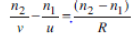
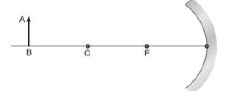

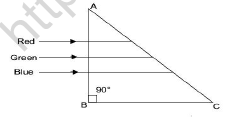
Question. Which of the following is not the case with the image formed by a concave lens?
(a) It may be erect or inverted
(b) It may be magnified or diminished
(c) It may be real or virtual
(d) Real image may be between the pole and focus or beyond focus
Answer: D
Question. A beam of light consisting of red, green and blue colours is incident on a right-angled prism as shown. The refractive index of the material of the prism for the above red, green and blue wavelengths are 1.39, 1.44 and 1.47 respectively. The prism will
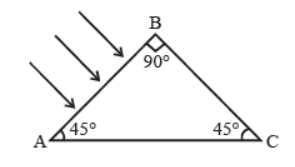
(a) separate part of the red colour from the green and blue colours.
(b) separate part of the blue colour from the red and green colours.
(c) separate all the three colours from one another.
(d) not separate even partially any colour from the other two colours.
Answer: A
Question. A concave mirror of focal length f. in vacuum is placed in a medium of refractive index 2. Its focal length in the medium is
(a) f/2
(b) f
(c) 2 f
(d) 4 f
Answer: B
Question. A lamp is hanging along the axis of a circular table of radius r. At what height should the lamp be placed above the table, so that the illuminance at the edge of the table is 1/8 of that at its centre?
(a) r/2
(b) r /√2
(c) r/3
(d) r /√3
Answer: D
Question. The maximum and minimum distance between a convex lens and an object, for the magnification of a real image to be greater than one are
(a) 2f and f
(b) f and zero
(c) ∞ and 2f
(d) 4f and 2f
Answer: A
Question. An astronomical telescope has a large aperture to
(a) reduce spherical aberration
(b) have high resolution
(c) increase span of observation
(d) have low dispersion
Answer: B
Question. A lamp of 250 candle power is hanging at a distance of 6 m from a wall. The illuminance at a point on the wall at a minimum distance from lamp will be
(a) 9.64 lux
(b) 4.69 lux
(c) 6.94 lux
(d) None of these
Answer: C
Question. A real image is formed by a convex lens. If we put a concave lens in contact with it, the combination again forms a real image. The new image
(a) is closer to the lens system.
(b) is farther form the lens system.
(c) is at the original position.
(d) may be anywhere depending on the focal length of the concave lens.
Answer: B
Question. A convex lens is dipped in a liquid whose refractive index is equal to the refractive index of the lens. Then its focal length will
(a) remain unchanged
(b) become zero
(c) become infinite
(d) become small, but non-zero
Answer: C
Question. A plano-convex lens of focal length 30 cm has its plane surface silvered. An object is placed 40 cm from the lens on the convex side. The distance of the image from the lens is
(a) 18 cm
(b) 24 cm
(c) 30 cm
(d) 40 cm
Answer: B
Question. Air has refractive index 1.0003. The thickness of air column, which will have one more wavelength of yellow light (6000 Å) than in the same thickness of vacuum is
(a) 2 mm
(b) 2 cm
(c) 2 m
(d) 2 km.
Answer: A
Question. Monochromatic light of wavelength λ1 travelling in a medium of refractive index μ1 enters a denser medium of refractive index μ2. The wavelength in the second medium is
(a) λ1 (μ1/μ2)
(b) λ1 (μ2/μ1)
(c) λ1 (μ2 – μ1)/μ2
(d) λ1 (μ2 – μ1)/μ1
Answer: A
Question. The radius of curvature of a thin plano-convex lens is 10 cm (of curved surface) and the refractive index is 1.5. If the plane surface is silvered, then it behaves like a concave mirror of focal length
(a) 10 cm
(b) 15 cm
(c) 20 cm
(d) 5 cm
Answer: C
Question. For a normal eye, the cornea of eye provides a converging power of 40D and the least converging power of the eye lens behind the cornea is 20D. Using this information, the distance between the retina and the eye lens of the eye can be estimated to be
(a) 2.5 cm
(b) 1.67 cm
(c) 1.5 cm
(d) 5 cm
Answer: B
Question. Two thin lenses are in contact and the focal length of the combination is 80 cm. If the focal length of one lens is 20 cm, then the power of the other lens will be
(a) 1.66 D
(b) 4.00 D
(c) – 100 D
(d) – 3.75 D
Answer: D
Question. The refractive indices of glass and water with respect to air are 3/2 and 4/3 respectively. Then the refractive index of glass with respect to water is
(a) 8/9
(b) 9/8
(c) 7/6
(d) 2
Answer: B
Question. The distance between an object and its real image formed by a convex lens cannot be
(a) greater than 2 f
(b) less than 2 f
(c) greater than 4 f
(d) less than 4 f
Answer: D
Question. The focal length of the objective of a telescope is 60 cm. To obtain a magnification of 20, the focal length of the eye piece should be
(a) 2 cm
(b) 3 cm
(c) 4 cm
(d) 5 cm
Answer: B
Question. The frequency of a light wave in a material is 2 × 10¹⁴ Hz and wavelength is 5000 Å. The refractive index of material will be
(a) 1.50
(b) 3.00
(c) 1.33
(d) 1.40
Answer: B
Question. A normal eye is not able to see objects closer than 25 cm because
(a) the focal length of the eye is 25 cm
(b) the distance of the retina from the eye-lens is 25 cm
(c) the eye is not able to decrease the distance between the eye-lens and the retina beyond a limit
(d) the eye is not able to decrease the focal length beyond a limit
Answer: D
Please click on below link to download CBSE Class 12 Physics Ray Optics And Optical Instruments Worksheet Set B
Free study material for Physics
Chapter 09 Ray Optics and Optical Instruments Practice Sheet and Solutions for Class 12 Physics
Download Practice Sheet: Chapter 09 Ray Optics and Optical Instruments (Class 12 Physics)
Review targeted practice exercises for Class 12 Physics Chapter 09 Ray Optics and Optical Instruments. Curated to match official CBSE guidelines, these downloadable PDF sheets support daily revision and core concept reinforcement.
Concept Clarification for Chapter 09 Ray Optics and Optical Instruments
Cross-reference your completed exercises with comprehensive NCERT solutions for Class 12 Physics to ensure absolute clarity across all sub-topics in this chapter.
Additional Study Resources for Class 12 Physics
Explore our broader library of printable assignments, chapter notes, and mock tests designed to support continuous revision and secure higher marks in CBSE assessments.
FAQs
You can download the teacher-verified PDF for CBSE Class 12 Physics Ray Optics And Optical Instruments Worksheet Set 03 from StudiesToday.com. These practice sheets for Class 12 Physics are designed as per the latest CBSE academic session.
Yes, our CBSE Class 12 Physics Ray Optics And Optical Instruments Worksheet Set 03 includes a variety of questions like Case-based studies, Assertion-Reasoning, and MCQs as per the 50% competency-based weightage in the latest curriculum for Class 12.
Yes, we have provided detailed solutions for CBSE Class 12 Physics Ray Optics And Optical Instruments Worksheet Set 03 to help Class 12 and follow the official CBSE marking scheme.
Daily practice with these Physics worksheets helps in identifying understanding gaps. It also improves question solving speed and ensures that Class 12 students get more marks in CBSE exams.
All our Class 12 Physics practice test papers and worksheets are available for free download in mobile-friendly PDF format. You can access CBSE Class 12 Physics Ray Optics And Optical Instruments Worksheet Set 03 without any registration.