

Download Class 12 Physics Worksheets for Chapter 09 Ray Optics and Optical Instruments
Review targeted practice sets for Class 12 Physics Chapter 09 Ray Optics and Optical Instruments. Built according to official educational guidelines for the 2026-27 academic year, these downloadable worksheets support daily revision and core concept reinforcement.
Access Chapter 09 Ray Optics and Optical Instruments Questions and Exercises
View or download the dedicated Chapter 09 Ray Optics and Optical Instruments practice resource below. Engaging with these objective and subjective questions daily ensures continuous academic progress and mastery of the 2026-27 curriculum.
CBSE Class 12 Physics Ray Optics and Optical Instruments Worksheet Set B
Question. A concave mirror of focal length f produces an image n times the size of object. If image is real, then distance of object from mirror, is
(a) (n – 1) f
(b) { (n – 1)/n} f
(c) { (n + 1)/n} f
(d) (n + 1) f
Answer: C
Question. A rectangular block of glass is placed on a mark made on the surface of the table and it is viewed from the vertical position of eye. If refractive index of glass be μ and its thickness d, then the mark will appear to be raised up by
(a) (μ +1)d/μ
(b) (μ -1)d/μ
(c) (μ +1)/μd
(d) (μ -1)μ/d
Answer: B
Question. Two thin lenses of focal lengths f1 and f2 are in contact and coaxial. Its power is same as power of a single lens given by

Answer: A
Question. A lens of power + 2 diopter is placed in contact with a lens of power –1 diopter. The combination will behave like
(a) a convergent lens of focal length 50 cm
(b) a divergent lens of focal length 100 cm
(c) a convergent lens of focal length 100 cm
(d) a convergent lens of focal length 200 cm
Answer: C
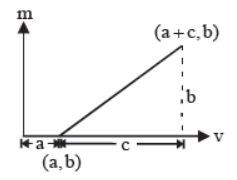
Question. The graph shows the variation of magnification m produced by a convex lens with the image distance v. The focal length of the lens is
(a) b/c
(b) c/b
(c) b
(d) ab/c
Answer: B
Question. A double convex lens of focal length 6 cm is made of glass of refractive index 1.5. The radius of curvature of one surface is double that of other surface. The value of small radius of curvature is
(a) 6 cm
(b) 4.5 cm
(c) 9 cm
(d) 4 cm
Answer: B
Question. A prism has a refracting angle of 60º. When placed in the position of minimum deviation, it produces a deviation of 30º. The angle of incidence is
(a) 30º
(b) 45º
(c) 15º
(d) 60º
Answer: B
Question. A ray of light passes through an equilateral prism such that the angle of incidence is equal to the angle of emergence and the latter is equal to 3/4th of the angle of prism. The angle of deviation is
(a) 45º
(b) 39º
(c) 20º
(d) 30º
Answer: D
Question. A ray of light passes through an equilateral prism (μ = 1.5). The angle of minimum deviation is
(a) 45º
(b) 37º 12'
(c) 20º
(d) 30º
Answer: B
Question. An achromatic convergent doublet of two lenses in contact has a power of + 2D. The convex lens has power + 5D. What is the ratio of dispersive powers of convergent and divergent lenses ?
(a) 2 : 5
(b) 3 : 5
(c) 5 : 2
(d) 5 : 3
Answer: B
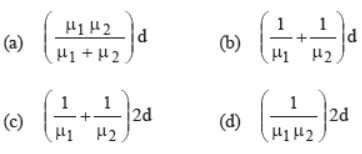
Question. A vessel of depth 2d cm is half filled with a liquid of refractive index μ1 and the upper half with a liquid of refractive index μ2.
The apparent depth of the vessel seen perpendicularly is
Answer: B
Question. If D is the deviation of a normally falling light beam on a thin prism of angle A and δ is the dispersive power of the same prism then
(a) D is independent of A.
(b) D is independent of refractive Index.
(c) δ is independent of refractive index.
(d) δ is independent of A.
Answer: D
Question. What will be the colour of the sky as seen from the earth if there were no atmosphere?
(a) Black
(b) Blue
(c) Orange
(d) Red
Answer: A
Question. The magnifying power of a telescope is 9. When it is adjusted for parallel rays, the distance between the objective and the eye piece is found to be 20 cm. The focal length of lenses are
(a) 18 cm, 2 cm
(b) 11 cm, 9 cm
(c) 10 cm, 10 cm
(d) 15 cm, 5 cm
Answer: A
Question. A ray of light traveling in water is incident on its surface open to air. The angle of incidence is q, which is less than the critical angle. Then there will be
(a) only a reflected ray and no refracted ray
(b) only a refracted ray and no reflected ray
(c) a reflected ray and a refracted ray and the angle between them would be less than 180°–2θ
(d) a reflected ray and a refracted ray and the angle between them would be greater than 180°–2θ
Answer: C
Question. Two convex lenses of focal lengths 0.3 m and 0.05 m are used to make a telescope. The distance kept between the two in order to obtain an image at infinity is
(a) 0.35 m
(b) 0.25 m
(c) 0.175 m
(d) 0.15 m
Answer: A
Question. An electric bulb illuminates a plane surface. The intensity of illumination on the surface at a point 2 m away from the bulb is 5 × 10⁻⁴ phot (lumen/cm2). The line joining the bulb to the point makes an angle of 60º with the normal to the surface. The luminous intensity of the bulb in candela (candle power) is
(a) 40 √3
(b) 40
(c) 20
(d) 40 × 10–4
Answer: B
Question. A plane mirror reflects a beam of light to form a real image.
The incident beam is
(a) parallel
(b) convergent
(c) divergent
(d) any one of the above
Answer: B
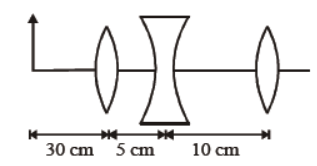
Question. The position of final image formed by the given lens combination from the third lens will be at a distance of (f1 = + 10 cm, f2 = – 10 cm and f3 = + 30 cm).
(a) 15 cm
(b) infinity
(c) 45 cm
(d) 30 cm
Answer: D
Question. A convex lens of focal length f1 and a concave lens of focal length f2 are placed in contact. The focal length of the combination is
(a) (f1 + f2)
(b) (f1 – f2)
(c) f1 f2/f2 - f1
(d) f1 f2/f1 + f2
Answer: C
Very Short Answer
Q1) What is principal axis?
Q2) Define ray of light and beam of light?
Q3) What are corpuscles?
Q4) What is light?
Q5) What is pole and optical centre?
Short Answer
Q6) What are the laws of refraction?
Q7) What is the reason between the actual sunset and apparent sunset?
Q8) What do you mean by the sign convention?
Q9) What does Snell’s law of refraction state?
Q10) What do you understand by the focal length of spherical mirrors?
Long Answer
Q11) Explain total internal reflection and its technological applications?
Q12) Write short note on photometry?
Q13) State the difference between reflection of light and refraction of light?
Q14) Write short note on refraction by a lens?
Q15) Explain the term power of a lens?
Free study material for Physics
Download CBSE Practice Material: Class 12 Physics Chapter 09 Ray Optics and Optical Instruments
Chapter 09 Ray Optics and Optical Instruments Printable Worksheet for Class 12 Physics
Review targeted practice exercises for Class 12 Physics Chapter 09 Ray Optics and Optical Instruments. Curated to match official CBSE guidelines, these downloadable PDF sheets support daily revision and core concept reinforcement.
How to Use These Practice Sheets
Built using the official NCERT book for Class 12 Physics, these practice materials provide reliable academic guidance. Pair your practice with our recommended NCERT solutions to master optimal problem-solving approaches.
Enhance Speed with Online Practice
Explore our broader library of printable assignments, chapter notes, and mock tests designed to support continuous revision and secure higher marks in CBSE assessments.
FAQs
You can download the teacher-verified PDF for CBSE Class 12 Physics Ray Optics and Optical Instruments Worksheet Set 02 from StudiesToday.com. These practice sheets for Class 12 Physics are designed as per the latest CBSE academic session.
Yes, our CBSE Class 12 Physics Ray Optics and Optical Instruments Worksheet Set 02 includes a variety of questions like Case-based studies, Assertion-Reasoning, and MCQs as per the 50% competency-based weightage in the latest curriculum for Class 12.
Yes, we have provided detailed solutions for CBSE Class 12 Physics Ray Optics and Optical Instruments Worksheet Set 02 to help Class 12 and follow the official CBSE marking scheme.
Daily practice with these Physics worksheets helps in identifying understanding gaps. It also improves question solving speed and ensures that Class 12 students get more marks in CBSE exams.
All our Class 12 Physics practice test papers and worksheets are available for free download in mobile-friendly PDF format. You can access CBSE Class 12 Physics Ray Optics and Optical Instruments Worksheet Set 02 without any registration.