

Download Class 12 Physics Worksheets for Chapter 02 Electrostatic Potential and Capacitance
Review targeted practice sets for Class 12 Physics Chapter 02 Electrostatic Potential and Capacitance. Built according to official educational guidelines for the 2026-27 academic year, these downloadable worksheets support daily revision and core concept reinforcement.
Access Chapter 02 Electrostatic Potential and Capacitance Questions and Exercises
View or download the dedicated Chapter 02 Electrostatic Potential and Capacitance practice resource below. Engaging with these objective and subjective questions daily ensures continuous academic progress and mastery of the 2026-27 curriculum.
Question. The ratio of charge to potential of a body is known as
(a) capacitance
(b) inductance
(c) conductance
(d) resistance
Answer: A
Question. On moving a charge of 20 C by 2 cm, 2 J of work is done. Then the potential difference between the points is
(a) 0.1 V
(b) 8 V
(c) 2 V
(d) 0.5 V
Answer: A
Question. In brining an electron towards another electron, the electrostatic potential energy of the system
(a) increases
(b) decreases
(c) remains unchanged
(d) becomes zero
Answer: A
Question. Electric potential of earth is taken to be zero, because earth is a good
(a) insulator
(b) conductor
(c) semi-conductor
(d) dielectric
Answer: B
Question. Some charge is being given to a conductor. Then, its potential
(a) is maximum at surface.
(b) is maximum at centre.
(c) remains the same throughout the conductor.
(d) is maximum somewhere between surface and centre.
Answer: C
Question. Equipotential surface associated with an electric field, which is increasing in magnitude along the X-direction, are
(a) planes parallel to YZ-plane.
(b) planes parallel to XZ-plane.
(c) planes parallel to XY-plane.
(d) coaxial cylinder of increasing radii around the X-axis.
Answer: A
Question. What is angle between electric field and equipotential surface?
(a) 90° always
(b) 0° always
(c) 0° to 90°
(d) 0° to 180°
Answer: A
Question. A positively charged particle is released from rest in an uniform electric field. The electric potential energy of the charge
(a) remains a constant because the electric field is uniform.
(b) increases because the charge moves along the electric field.
(c) decreases because the charge moves along the electric field.
(d) decreases because the charge moves opposite to the electric field.
Answer: C
Question. The electrostatic potential on the surface of a charged conducting sphere is 100 V. Two statements are made in this regard:
S1 : At any point inside the sphere, electric intensity is zero.
S2 : At any point inside the sphere, the electrostatic potential is 100 V.
Which of the following is a correct statement?
(a) S1 is true but S2 is false.
(b) Both S1 and S2 are false.
(c) S1 is true, S2 is also true and S1 is the cause of S2.
(d) S1 is true, S2 is also true but the statements are independent.
Answer: C
Question. Equipotentials at a great distance from a collection of charges whose total sum is not zero are approximately
(a) spheres
(b) planes
(c) paraboloids
(d) ellipsoids
Answer: A
Question. Equipotential surfaces
(a) are closer in regions of large electric fields compared to regions of lower electric fields.
(b) will be more crowded near sharp edges of a conductor.
(c) will be more crowded near regions of large charge densities.
(d) All of the options
Answer: D
Question. A 2 mF capacitor is charged to 200 volt and then the battery is disconnected. When it is connected in parallel to another uncharged capacitor, the potential difference between the plates of both is 40 volt. The capacitance of the other capacitor is
(a) 2 mF
(b) 4 mF
(c) 8 mF
(d) 16 mF
Answer: C
Question. Two identical metal plates, separated by a distance d form a parallel-plate capacitor. A metal sheet of thickness d/2 is inserted between the plates. The ratio of the capacitance after the insertion of the sheet to that before insertion is
(a) 2 :1
(b) 2 : 1
(c) 1 : 1
(d) 1 : 2
Answer: B
Question. n identical capacitors joined in parallel are charged to a common potential V. The battery is disconnected. Now, the capacitors are separated and joined in series. For the new combination:
(a) energy and potential difference both will remain unchanged
(b) energy will remain same, potential difference will become nV
(c) energy and potential both will become n times
(d) energy will become n times, potential difference will remain V.
Answer: B
Question. The capacitance of a capacitor becomes 7/6 times its original value if a dielectric slab of thickness t = (2/3) d is introduced in between the plates, where d is the separation between the plates. The dielectric constant of the slab is
(a) 14/11
(b) 11/14
(c) 7/11
(d) 11/7
Answer: A
Question. Two capacitors of capacitances 3 mF and 6 mF are charged to a potential of 12 V each. They are now connected to each other, with the positive plate of each joined to the negative plate of the other. The potential difference across 3 mF will be
(a) 3 V
(b) zero
(c) 6 V
(d) 4 V
Answer: D
Question. The plates of a parallel plate capacitor are 4 cm apart, the first plate is at 300 V and the second plate at – 100 V. The voltage at 3 cm from the second plate is
(a) 200 V
(b) 400 V
(c) 250 V
(d) 500 V
Answer: A
Question. Three capacitors of capacitance 1mF, 2 mF and 3 mF are connected in series and a p.d. of 11 V is applied across the combination. Then, the p.d. across the plates of 1 mF capacitor is
(a) 2 V
(b) 4 V
(c) 1 V
(d) 6 V
Answer: D
Question. A conducting sphere of radius R is given a charge Q. The electric potential and the electric field at the centre of the sphere respectively are
(a) zero and Q/4π∈0R2
(b) Q/4π∈0R and zero
(c) Q/π∈0R and Q/4π∈0R2
(d) both are zero
Answer: B
Question. Four point charges – Q, – q, 2q and 2Q are placed, one at each corner of the square. The relation between Q and q for which the potential at the centre of the square is zero is
(a) Q = (1/2)q
(b) Q = – q
(c) Q = – (1/2)q
(d) Q = q
Answer: B
Fill in the Blanks
Question. The magnitude of electric field is given by the change in the magnitude of potential per unit __________ normal to the equipotential surface at the point.
Answer: displacement
Question. For linear isotropic dielectrics, P = XeE who Xe is a constant characteristic of the dielectric and is known as the __________ of the dielectric medium.
Answer: susceptibility
Question. The potential energy of two like charged (q1q2 > 0) is __________.
Answer: positive
Question. The potential energy of two unlike charges (q1q2 < 0) is __________.
Answer: negative
Question. The maximum electric field that a dielectric medium can withstand without break-down of its insulting property is called its __________.
Answer: dielectric strength
Question. The dielectric constant of a substance is a factor (>1) by which the capacitance __________ from its vacuum value, when the dielectric is inserted fully between the plates of a capacitor.
Answer: increases
Question. It is safer to be inside the car rather than standing outside under a tree during lightening is based on __________ concept.
Answer: electrostatic shielding
Question. Equipotential surfaces due to long linear change distribution will be __________ in shape.
Answer: cylindrical
Question. Two capacitors each of capacitance 2 mF are connected in series. Equivalent capacitance will be ___________.
Answer: 1 mF
Question. Electric field is in the direction in which the potential ___________ steepest.
Answer: decreases
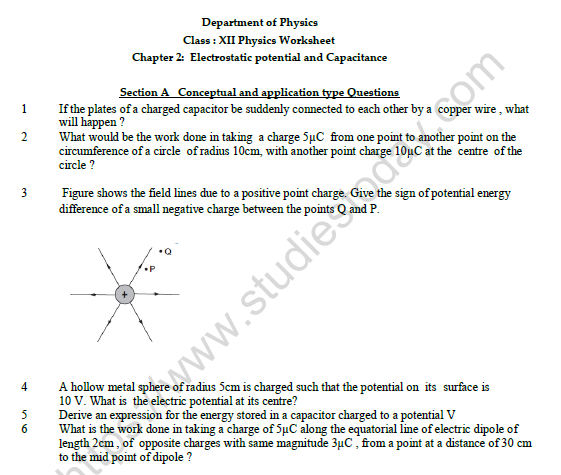
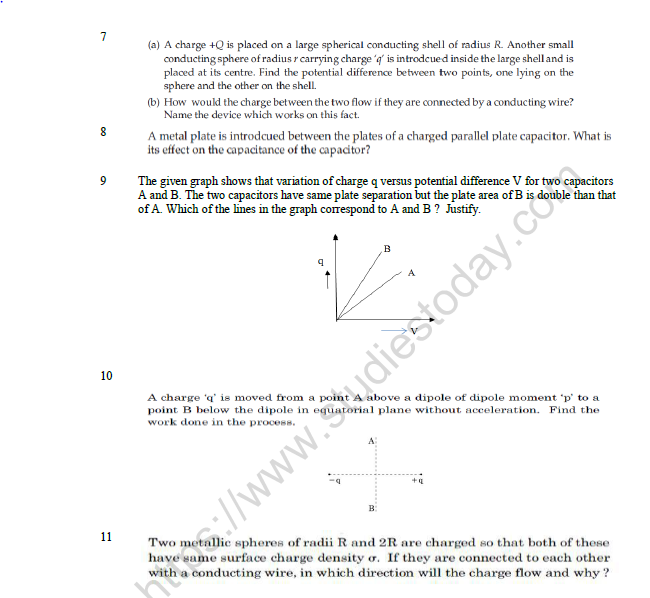
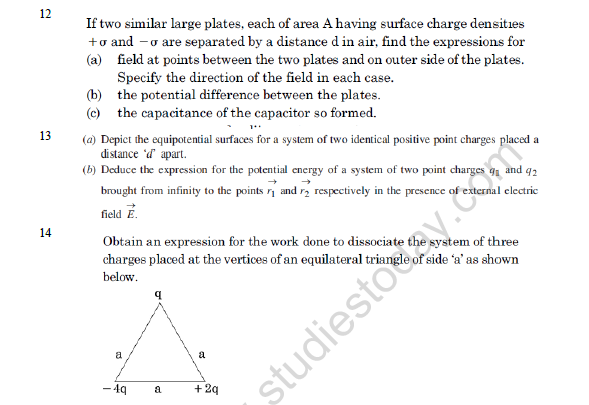
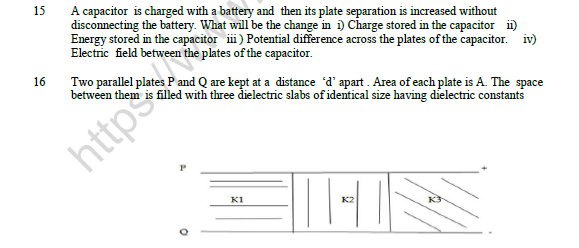

Please click on below link to download CBSE Class 12 Physics Electrostatic Potential And Capacitance Worksheet Set C
Free study material for Physics
Practice Worksheet and Study Resources for Class 12 Physics Chapter 02 Electrostatic Potential and Capacitance
Chapter 02 Electrostatic Potential and Capacitance Printable Worksheet for Class 12 Physics
Review targeted practice exercises for Class 12 Physics Chapter 02 Electrostatic Potential and Capacitance. Curated to match official CBSE guidelines, these downloadable PDF sheets support daily revision and core concept reinforcement.
How to Use These Practice Sheets
Built using the official NCERT book for Class 12 Physics, these practice materials provide reliable academic guidance. Pair your practice with our recommended NCERT solutions to master optimal problem-solving approaches.
Enhance Speed with Online Practice
Explore our broader library of printable assignments, chapter notes, and mock tests designed to support continuous revision and secure higher marks in CBSE assessments.
FAQs
You can download the teacher-verified PDF for CBSE Class 12 Physics Electrostatic Potential And Capacitance Worksheet Set 03 from StudiesToday.com. These practice sheets for Class 12 Physics are designed as per the latest CBSE academic session.
Yes, our CBSE Class 12 Physics Electrostatic Potential And Capacitance Worksheet Set 03 includes a variety of questions like Case-based studies, Assertion-Reasoning, and MCQs as per the 50% competency-based weightage in the latest curriculum for Class 12.
Yes, we have provided detailed solutions for CBSE Class 12 Physics Electrostatic Potential And Capacitance Worksheet Set 03 to help Class 12 and follow the official CBSE marking scheme.
Daily practice with these Physics worksheets helps in identifying understanding gaps. It also improves question solving speed and ensures that Class 12 students get more marks in CBSE exams.
All our Class 12 Physics practice test papers and worksheets are available for free download in mobile-friendly PDF format. You can access CBSE Class 12 Physics Electrostatic Potential And Capacitance Worksheet Set 03 without any registration.