

Practice Worksheets for Class 12 Physics: Chapter 02 Electrostatic Potential and Capacitance
Explore reliable practice materials for Chapter 02 Electrostatic Potential and Capacitance tailored for Class 12 learners. Utilizing these Physics worksheets ensures thorough preparation and strengthens problem-solving speed for upcoming school assessments.
Practice Chapter 02 Electrostatic Potential and Capacitance Worksheets for Class 12 Physics
Navigate directly to the printable exercises for Chapter 02 Electrostatic Potential and Capacitance using the digital viewer below. Each practice set allows students to isolate specific topics for thorough review and uninterrupted practice alongside standard textbooks.
Question. In the given circuit if point C is connected to the earth and a potential of +2000V is given to the point A, the potential at B is
(a) 1500V
(b) 1000 V
(c) 500 V
(d) 400 V
Answer: C
Question. A network of four capacitors of capacity equal to C1 = C, C2 = 2C, C3 = 3C and C4 = 4C are conducted to a battery as shown in the figure. The ratio of the charges on C2 and C4 is
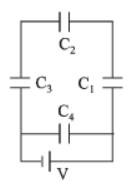
(a) 4/7
(b) 3/22
(c) 7/4
(d) 22/3
Answer: B
Question. Two capacitors of capacitance C are connected in series. If one of them is filled with dielectric substance k, what is the effective capacitance ?
(a) kC/(1+k)
(b) C(k + 1)
(c) 2kC/1+k
(d) None of these
Answer: A
Question. Two identical particles each of mass m and having charges – q and +q are revolving in a circle of radius r under the influence of electric attraction. Kinetic energy of each particle is (k = 1/4πε0)
(a) kq2/4r
(b) kq2/2r
(c) kq2/8r
(d) kq2/r
Answer: C
Question. Figure shows three circular arcs, each of radius R and total charge as indicated. The net electric potential at the centre of curvature is
(a) Q/4πε0R
(b) Q/2πε0R
(c) 2Q/πε0R
(d) Q/πε0R
Answer: A
Question. A condenser of capacity C is charged to a potential difference of V1. The plates of the condenser are then connected to an ideal inductor of inductance L. The current through the inductor when the potential difference across the condenser reduces to V2 is
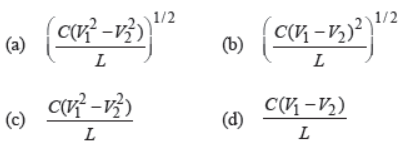
Answer: A
Question. A 4 mF capacitor, a resistance of 2.5 MW is in series with 12V battery. Find the time after which the potential difference across the capacitor is 3 times the potential diference across the resistor. [Given In (b) = 0.693]
(a) 13.86s
(b) 6.93 s
(c) 7s
(d) 14 s
Answer: A
Question. Two charges q1 and q2 are placed 30 cm apart, as shown in the figure. A third charge q3 is moved along the arc of a circle of radius 40 cm from C to D. The change in the potential energy of the system is q3/4π∈0 k , where k is
(a) 8q1
(b) 6q1
(c) 8q2
(d) 6q2
Answer: C
Question. In the given circuit with steady current, the potential drop across the capacitor must be
(a) 2V/3
(b) V/3
(c) V/2
(d) V
Answer: B
Question. A one microfarad capacitor of a TV is subjected to 4000 V potential difference. The energy stored in capacitor is
(a) 8 J
(b) 16 J
(c) 4 × 10⁻³ J
(d) 2 × 10⁻³ J
Answer: A
Question. Figure shows some equipotential lines distributed in space.
A charged object is moved from point A to point B.
(a) The work done in Fig. (i) is the greatest
(b) The work done in Fig. (ii) is least
(c) The work done is the same in Fig. (i), Fig.(ii) and Fig. (iii)
(d) The work done in Fig. (iii) is greater than Fig. (ii) but equal to that in (3)
Answer: C
Question. The diagrams below show regions of equipotentials.

A positive charge is moved from A to B in each diagram.
(a) In all the four cases the work done is the same
(b) Minimum work is required to move q in figure (a)
(c) Maximum work is required to move q in figure (b)
(d) Maximum work is required to move q in figure (c)
Answer: A
Question. Two thin dielectric slabs of dielectric constants K1 and K2 (K1 < K2) are inserted between plates of a parallel plate capacitor, as shown in the figure. The variation of electric field ‘E’ between the plates with distance ‘d’ as measured from plate P is correctly shown by
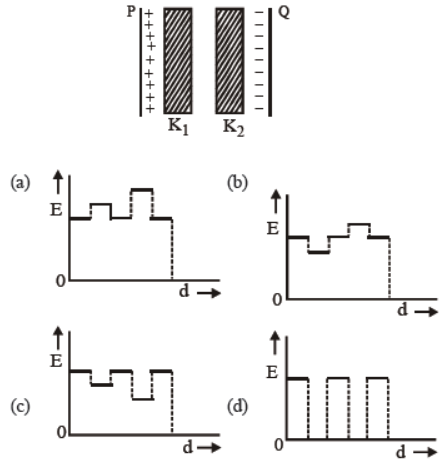
Answer: C
Question. A parallel plate capacitor is made of two dielectric blocks in series. One of the blocks has thickness d1 and dielectric constant K1 and the other has thickness d2 and dielectric constant K2 as shown in figure. This arrangement can be thought as a dielectric slab of thickness d (= d1 + d2) and effective dielectric constant K. The K is

Answer: C
Question. A, B and C are three points in a uniform electric field. The electric potential is
(a) maximum at B
(b) maximum at C
(c) same at all the three points A, B and C
(d) maximum at A
Answer: A
Question. A capacitor is charged by a battery. The battery is removed and another identical uncharged capacitor is connected in parallel. The total electrostatic energy of resulting system:
(a) decreases by a factor of 2
(b) remains the same
(c) increases by a factor of 2
(d) increases by a factor of 4
Answer: A
Question. A conducting sphere of radius R is given a charge Q. The electric potential and the electric field at the centre of the sphere respectively are:
(a) Zero and Q/4πε0R2
(b) Q/4πε0R and Zero
(c) Q/4πε0R and Q/4πε0R2
(d) Both are zero
Answer: B
Question. A capacitor of 4 μF is connected as shown in the circuit. The internal resistance of the battery is 0.5W. The amount of charge on the capacitor plates will be
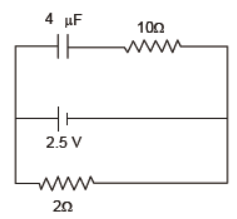
(a) 0 μC
(b) 4 μC
(c) 16 μC
(d) 8 μC
Answer: D
Question. A parallel plate air capacitor of capacitance C is connected to a cell of emf V and then disconnected from it. A dielectric slab of dielectric constant K, which can just fill the air gap of the capacitor, is now inserted in it. Which of the following is incorrect ?
(a) The energy stored in the capacitor decreases K times.
(b) The chance in energy stored is 1/2 CV2(1/K-1)
(c) The charge on the capacitor is not conserved.
(d) The potential difference between the plates decreases K times.
Answer: C
Question. The electrostatic potential on the surface of a charged conducting sphere is 100V. Two statements are made in this regard S1 at any point inside the sphere, electric intensity is zero. S2 at any point inside the sphere, the electrostatic potential is 100V. Which of the following is a correct statement?
(a) S1 is true but S2 is false
(b) Both S1 and S2 are false
(c) S1 is true, S2 is also true and S1 is the cause of S2
(d) S1 is true, S2 is also true but the statements are independant
Answer: C
Question. Equipotentials at a great distance from a collection of charges whose total sum is not zero are approximately
(a) spheres
(b) planes
(c) paraboloids
(d) ellipsoids
Answer: A
Question. If potential (in volts) in a region is expressed as V(x, y, z) = 6 xy – y + 2yz, the electric field (in N/C) at point (1, 1, 0) is :
(a) -(6î + 5ĵ + 2k̂)
(b) -(2î + 3ĵ + k̂)
(c) -(6î + 9ĵ + k̂)
(d) -(3î + 5ĵ + 3k̂)
Answer: A
Question. A parallel plate air capacitor has capacity 'C' distance of separation between plates is 'd' and potential difference 'V' is applied between the plates. Force of attraction between the plates of the parallel plate air capacitor is :
(a) CV2/2d
(b) CV2/d
(c) C2V2/2d2
(d) C2V2/2d2
Answer: A
Question. A capacitor of 2mF is charged as shown in the diagram. When the switch S is turned to position 2, the percentage of its stored energy dissipated is :
(a) 0%
(b) 20%
(c) 75%
(d) 80%
Answer: D
Question. A positively charged particle is released from rest in an uniform electric field. The electric potential energy of the charge
(a) remains a constant because the electric field is uniform
(b) increases because the charge moves along the electric field
(c) decreases because the charge moves along the electric field
(d) decreases because the charge moves opposite to the electric field
Answer: C
Question. In a region, the potential is represented by V(x, y, z) = 6x – 8xy – 8y + 6yz, where V is in volts and x, y, z are in metres. The electric force experienced by a charge of 2 coulomb situated at point (1, 1, 1) is :
(a) 6 √5 N
(b) 30 N
(c) 24 N
(d) 4 √35 N
Answer: D
DIRECTIONS : Each question contains
STATEMENT-1 and STATEMENT-2. Choose the correct answer from the following-
(a) Statement -1 is false, Statement-2 is true
(b) Statement -1 is true, Statement-2 is true; Statement -2 is a correct explanation for Statement-1
(c) Statement -1 is true, Statement-2 is true; Statement -2 is not a correct explanation for Statement-1
(d) Statement -1 is true, Statement-2 is false
Question. Statement I : Two equipotential surfaces cannot cut each other.
Statement II : Two equipotential surfaces are parallel to each other.
Answer: D
Question. Statement 1 : Each of the plates of a parallel-plate capacitor is given equal positive charge Q. The charges on the facing surfaces will be same.
Statement 2 : A negative charge (–Q) will be induced on each of the facing surfaces.
Answer: D
Question. Statement 1 : Electric potential and electric potential energy are different quantities.
Statement 2 : For a system of positive test charge and point charge electric potential energy = electric potential.
Answer: D
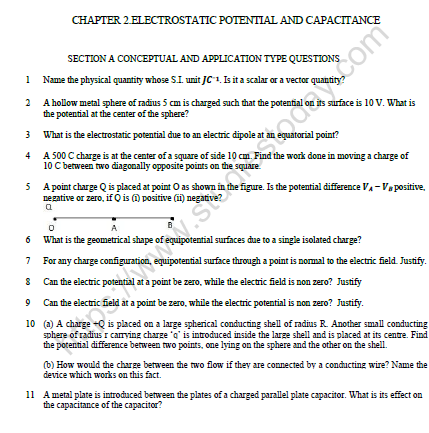
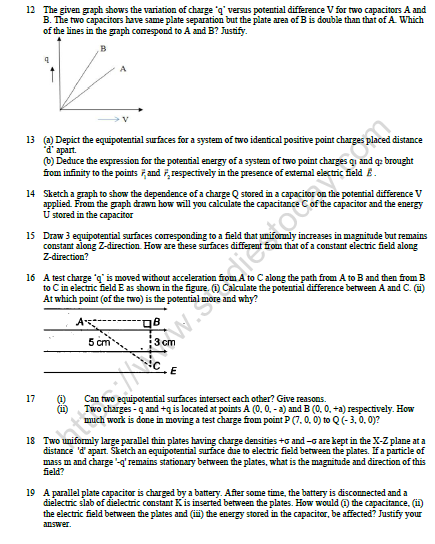

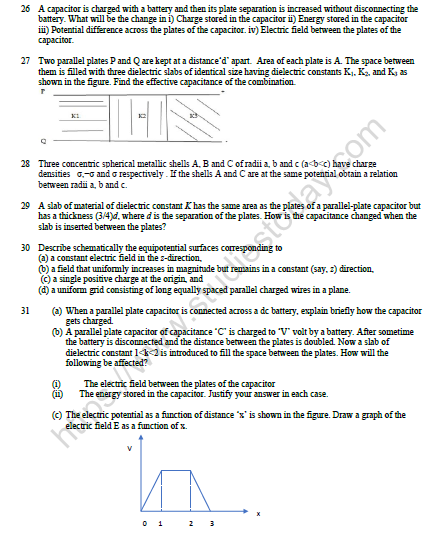
Please click on below link to download CBSE Class 12 Physics Electrostatic Potential And Capacitance Worksheet Set D
Free study material for Physics
Exam Preparation Worksheet for Class 12 Physics Chapter 02 Electrostatic Potential and Capacitance
Chapter 02 Electrostatic Potential and Capacitance Printable Worksheet for Class 12 Physics
Review targeted practice exercises for Class 12 Physics Chapter 02 Electrostatic Potential and Capacitance. Curated to match official CBSE guidelines, these downloadable PDF sheets support daily revision and core concept reinforcement.
How to Use These Practice Sheets
Built using the official NCERT book for Class 12 Physics, these practice materials provide reliable academic guidance. Pair your practice with our recommended NCERT solutions to master optimal problem-solving approaches.
Enhance Speed with Online Practice
Wrap up your chapter revision by testing your knowledge against standard question formats. Everything on our platform is provided free of charge.
FAQs
You can download the teacher-verified PDF for CBSE Class 12 Physics Electrostatic Potential And Capacitance Worksheet Set 04 from StudiesToday.com. These practice sheets for Class 12 Physics are designed as per the latest CBSE academic session.
Yes, our CBSE Class 12 Physics Electrostatic Potential And Capacitance Worksheet Set 04 includes a variety of questions like Case-based studies, Assertion-Reasoning, and MCQs as per the 50% competency-based weightage in the latest curriculum for Class 12.
Yes, we have provided detailed solutions for CBSE Class 12 Physics Electrostatic Potential And Capacitance Worksheet Set 04 to help Class 12 and follow the official CBSE marking scheme.
Daily practice with these Physics worksheets helps in identifying understanding gaps. It also improves question solving speed and ensures that Class 12 students get more marks in CBSE exams.
All our Class 12 Physics practice test papers and worksheets are available for free download in mobile-friendly PDF format. You can access CBSE Class 12 Physics Electrostatic Potential And Capacitance Worksheet Set 04 without any registration.