

Class 12 Physics Practice Set: Chapter 04 Moving Charges and Magnetism
Review targeted practice sets for Class 12 Physics Chapter 04 Moving Charges and Magnetism. Built according to official educational guidelines for the 2026-27 academic year, these downloadable worksheets support daily revision and core concept reinforcement.
Download Chapter 04 Moving Charges and Magnetism Worksheet PDF
Navigate directly to the printable exercises for Chapter 04 Moving Charges and Magnetism using the digital viewer below. Each practice set allows students to isolate specific topics for thorough review and uninterrupted practice alongside standard textbooks.
Question. What is the magnitude of the force experienced by a stationary charge in a uniform magnetic field?
Answer. Zero ( Reason ,v=0 )
Question. A moving neutron enters a uniform magnetic field perpendicularly. What is the force on the neutron due to the magnetic field?
Answer. Zero ( reason q=0)
Question. An electron beam is moving vertically upwards. It passes through a magnetic field directed from south to north in a horizontal plane. In which direction the beam will be deflected?
Answer. South ( Hint , Fleming’s left hand rule)
Question. Does a current carrying coil produce a uniform magnetic field?
Answer. No, however at the centre of the coil, the magnetic field is nearly uniform.
Question. There are two identical galvanometers. One is converted into an ammeter and the other into a milliammeter. Which of the shunts will be larger resistance?
Answer. Milli ammeter.(Reason: It need to measure only less current and hence its resistance can be higher.)
Question. A body is suspended from the lower end of a vertical spring. A direct current is passed through the spring. What will happen?
Answer. The body will be lifted upwards.
(Reason: The direction of current through each turn of the coil is same. Parallel currents in the same direction attract each other. Hence the coils contract.)
Question. A charge of 3C is moving with a velocity 𝑣⃗=(4𝑖̂+3𝑗̂)𝑚𝑠−1in a magnetic field
𝐵⃗⃗=(4𝑖̂+3𝑗̂)𝑇.
What is the force acting on the charge?
Answer. 𝐹𝑜𝑟𝑐𝑒,𝐹⃗=𝑞(𝑣⃗ × 𝐵⃗⃗)=0
Cross product of two equal vectors is zero.
Question. An 𝛼 particle and a 𝛽 particle are projected with the same velocity perpendicular to a magnetic field. Which one will experience more force?
Answer. 𝐹⃗=𝑞(𝑣⃗×𝐵⃗)
𝐹⃗∞𝑞
𝛼 particle has more charge than 𝛽particle. Hence 𝛼 particle will experience more force.
Question. An electron travelling west to east enters a chamber having a uniform electrostatic field in a north to south direction. Specify the direction in which a uniform magnetic field should be set up to prevent the electron from its straight line path.
Answer.
Magnetic field must act in vertically down ward direction.
(Hint: Apply Fleming’s left hand rule)
Question. A solenoid 1.5cm long and 0.4cm in diameter possesses 10 turns per cm of length. A current of 5A flows through it. Find the magnetic field at the axis inside the solenoid.
Answer. 2𝜋×10−3𝑇
3 Marks
Question. A circular coil, having 100 turns of wire, of radius 20cm each, lies in the XY plane with its centre at the origin of co-ordinates. Find the magnetic field, at the point (𝑜,𝑜,20√3 𝑐𝑚), when the coil carries a current of (2/𝜋) 𝐴.
Answer. 𝐵=25𝜇𝑇
Question. The horizontal component of the earth’s magnetic field at a certain place is 5×10⁻⁵𝑇 and the direction of the field from the geographic south to north. A very long straight conductor is carrying a steady current of 2A. What is the force per unit length on it when it is placed on a horizontal table and the direction of the current is (a) east to west (b) south to north?
Answer. (𝑎), 𝑓=10−4𝑁𝑚−1, (𝑏)𝑧𝑒𝑟𝑜. 𝐻𝑖𝑛𝑡:𝑓=𝐹/𝑙=𝐼𝐵 𝑠𝑖𝑛𝜃
Question. What is the magnitude of the force on a wire of length 0.05m paced inside a solenoid near its centre, making an angle of 30𝑜 with its axis? The wire carries a current of 8A and the magnetic field due to the solenoid is of magnitude 0.50T.sensitivity of the modified meter greater or less than the original meter?
Answer. 𝐹=0.1𝑁, 𝐻𝑖𝑛𝑡: 𝐹=𝐼𝑙𝐵 𝑠𝑖𝑛𝜃
MCQ
Question. A and B are two concentric coils of centre O and carry currents 𝐼1 𝑎𝑛𝑑 𝐼2 as shown in fig. If the ratio of their radii is 1:2 and ratio of the flux densities at O due to A and B is 1:3, then value of 𝐼1 𝐼2 is
𝑎) 1 /4
𝑏) 1 /3
𝑐) 1 /6
𝑑) 1 /2
Answer. C
Question. A current carrying coil is subjected to a uniform magnetic field. The coil will orient so that its plane becomes
a) Inclined at 45𝑜 to the magnetic field.
b) Inclined at 30𝑜 to the magnetic field.
c) Parallel to the magnetic field.
d) Perpendicular to the magnetic field.
Answer. D
Question. To make the magnetic field radial in a moving coil galvanometer
a) Poles are cylindrically cut.
b) The number of turns in the coil is increased.
c) Coil is wound on Aluminium frame.
d) Phosphor bronze spring is used.
Answer. A
Question. To convert a galvanometer into an ammeter of given range, a _____ resistance is connected in ____ with the galvanometer.
𝑎) 𝑙𝑜𝑤,𝑠𝑒𝑟𝑖𝑒𝑠
𝑏) 𝑙𝑜𝑤,𝑝𝑎𝑟𝑎𝑙𝑙𝑒𝑙
𝑐) ℎ𝑖𝑔ℎ ,𝑠𝑒𝑟𝑖𝑒𝑠
𝑑) ℎ𝑖𝑔ℎ ,𝑝𝑎𝑟𝑎𝑙𝑙𝑒𝑙
Answer. B
Question. A certain electric motor wire that carries a current of 4A is perpendicular to a magnetic field of 0.8T. What is the force on each cm of the wire?
𝑎) 0.08𝑁
𝑏) 0.06𝑁
𝑐) 0.03𝑁
𝑑) 0.01𝑁
Answer. C
Question. Two parallel wires of 9m each are separated by a distance of 0.15m. If they carry equal currents in the same direction and exert a total force of 30×10−7𝑁 on each other, then the value of current must be
𝑎) 2.5𝐴
𝑏) 3.5𝐴
𝑐) 1.5𝐴
𝑑) 0.5𝐴
Answer. D
Question. In a certain region of space, the electric field 𝐸⃗ and magnetic field 𝐵⃗ are perpendicular to each other. An electron enters perpendicularly to both the fields and moves undeflected. The velocity of the electron is
𝑎) (𝐸 )/𝐵
𝑏) (𝐵 )/𝐸
𝑐) 𝐸⃗×𝐵⃗
𝑑) 𝐸 .⃗𝐵⃗
Answer. A
Question. An electron is moving in a region of electric field and magnetic field, it will gain energy from,
𝑎) 𝑚𝑎𝑔𝑛𝑒𝑡𝑖𝑐 𝑓𝑖𝑒𝑙𝑑
𝑏) 𝑒𝑙𝑒𝑐𝑡𝑟𝑖𝑐 𝑓𝑖𝑒𝑙𝑑
𝑐) 𝑏𝑜𝑡ℎ 𝑓𝑖𝑒𝑙𝑑𝑠
𝑑) 𝑛𝑜𝑛𝑒 𝑜𝑓 𝑡ℎ𝑒𝑠𝑒
Answer. B

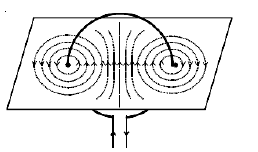

Biot - Savart law
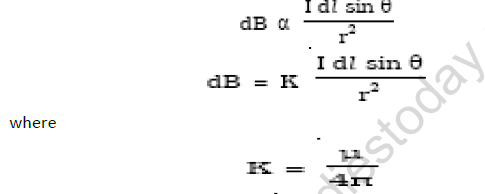
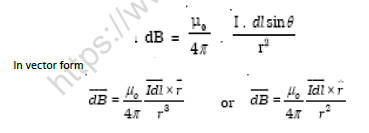
Please click on below link to download CBSE Class 12 Physics Moving Charges And Magnetic Force Worksheet
Free study material for Physics
Download CBSE Practice Material: Class 12 Physics Chapter 04 Moving Charges and Magnetism
CBSE Practice Material: Class 12 Physics Chapter 04 Moving Charges and Magnetism
Access structured practice worksheets for Chapter 04 Moving Charges and Magnetism designed in alignment with the latest CBSE curriculum for Class 12 Physics. These printable problem sets help students build accuracy and prepare effectively for school tests.
NCERT-Aligned Questions and Solutions
Built using the official NCERT book for Class 12 Physics, these practice materials provide reliable academic guidance. Pair your practice with our recommended NCERT solutions to master optimal problem-solving approaches.
Next Steps in Your Exam Preparation
Follow up your worksheet practice by attempting the interactive online Physics MCQ test for this chapter to evaluate your execution speed. All platform resources are free to access.
FAQs
You can download the teacher-verified PDF for CBSE Class 12 Physics Moving Charges And Magnetic Force Worksheet from StudiesToday.com. These practice sheets for Class 12 Physics are designed as per the latest CBSE academic session.
Yes, our CBSE Class 12 Physics Moving Charges And Magnetic Force Worksheet includes a variety of questions like Case-based studies, Assertion-Reasoning, and MCQs as per the 50% competency-based weightage in the latest curriculum for Class 12.
Yes, we have provided detailed solutions for CBSE Class 12 Physics Moving Charges And Magnetic Force Worksheet to help Class 12 and follow the official CBSE marking scheme.
Daily practice with these Physics worksheets helps in identifying understanding gaps. It also improves question solving speed and ensures that Class 12 students get more marks in CBSE exams.
All our Class 12 Physics practice test papers and worksheets are available for free download in mobile-friendly PDF format. You can access CBSE Class 12 Physics Moving Charges And Magnetic Force Worksheet without any registration.