

Download Class 12 Physics Worksheets for Chapter 01 Electric Charges And Fields
Access printable practice worksheets for Chapter 01 Electric Charges And Fields designed to align with the 2026-27 academic syllabus for Class 12 Physics. These structured exercises help students evaluate their conceptual understanding and improve exam readiness.
Access Chapter 01 Electric Charges And Fields Questions and Exercises
View or download the dedicated Chapter 01 Electric Charges And Fields practice resource below. Engaging with these objective and subjective questions daily ensures continuous academic progress and mastery of the 2026-27 curriculum.
CBSE Class 12 Physics Electric Charges and Fields Worksheet Set B
Question. A cylinder of radius R and length l is placed in a uniform electric field E parallel to the axis of the cylinder. The total flux over the curved surface of the cylinder is
(a) zero
(b) πR2E
(c) 2πR2E
(d) E / πR2
Answer: A
Question. Two particle of equal mass m and charge q are placed at a distance of 16 cm. They do not experience any force. The value of q/m is
(a) l
(b) √πε0/G
(c) √G/4πε0
(d) √4πε0G
Answer: D
Question. The spatial distribution of electric field due to charges (A, B) is shown in figure. Which one of the following statements is correct ?
(a) A is +ve and B –ve, |A| > |B|
(b) A is –ve and B +ve, |A| = |B|
(c) Both are +ve but A > B
(d) Both are –ve but A > B
Answer: A
Question. If a dipole of dipole moment P̅ is placed in a uniform electric field E̅ , then torque acting on it is given by

Answer: B
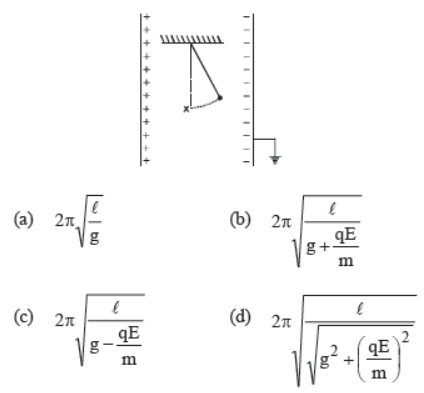
Question. A simple pendulum has a length l , mass of bob m. The bob is given a charge q. The pendulum is suspended between the vertical plates of the charged parallel plate capacitor. If E is the field strength between the plates, then time period T equal to
Answer: D
Question. Two identical thin rings, each of radius a meter, are coaxially placed at a distance R meter apart. If Q1 coulomb and Q2 coulomb are respectively the charges uniformly spread on the two rings, the work done in moving a charge q coulomb from the centre of one ring to that of the other is
(a) Zero
(b) q(Q1-Q2)(√2 - 1)/4√πε0a
(c) q√2(Q1 + Q2)/4πε0a
(d) q(Q1 + Q2)(√2+1)/4√2πε0a
Answer: B
Question. A metallic sphere is placed in a uniform electric field. The line of force follow the path (s) shown in the figure as (21 EX 2)
(a) 1
(b) 2
(c) 3
(d) 4
Answer: D
Question. A soap bubble is given negative charge, its radius will
(a) increase
(b) decrease
(c) remain unchanged
(d) fluctuate
Answer: A
Question. A and B are two identically spherical charged bodies which repel each other with force F, kept at a finite distance. A third uncharged sphere of the same size is brought in contact with sphere B and removed. It is then kept at mid point of A and B. Find the magnitude of force on C.
(a) F/2
(b) F/8
(c) F
(d) Zero
Answer: C
Question. An electric dipole of moment P̅ is placed in a uniform electric field E̅ such that P̅ points along E̅ . If the dipole is slightly rotated about an axis perpendicular to the plane containing E̅ and P̅ and passing through the centre of the dipole, the dipole executes simple harmonic motion. Consider I to be the moment of inertia of the dipole about the axis of rotation. What is the time period of such oscillation?
(a) √(πE/ I)
(b) 2π √(I / πE)
(c) 2π √(I / 2πE)
(d) None of these
Answer: B
Question. The electric field in a certain region is acting radially outward and is given by E = Aa. A charge contained in a sphere of radius 'a' centred at the origin of the field, will be given by
(a) A ε0 a2
(b) 4 pε0 Aa3
(c) ε0 Aa3
(d) 4 πε0 Aa2
Answer: B
Question. There exists a non-uniform electric field along x-axis as shown in the figure below. The field increases at a uniform rate along +ve x-axis. A dipole is placed inside the field as shown. Which one of the following is correct for the dipole?
(a) Dipole moves along positive x-axis and undergoes a clockwise rotation
(b) Dipole moves along negative x-axis and undergoes a clockwise rotation
(c) Dipole moves along positive x-axis and undergoes a anticlockwise rotation
(d) Dipole moves along negative x-axis and undergoes a anticlockwise rotation
Answer: D
Question. The electric field strength at a distance r from a charge q is E. What will be electric field strength if the distance of the observation point is increased to 2 r?
(a) E/2
(b) E/4
(c) E/6
(d) None of these
Answer: B
Question. A drop of oil of density ρ and radius r carries a charge q when placed in an electric field E, it moves upwards with a velocity v. If ρ0 is the density of air, η be the viscosity of the air, then which of the following force is directed upwards?
(a) q E
(b) 6π ηr v
(c) 4/3 πr3(ρ - ρ0)g
(d) None of these
Answer: A
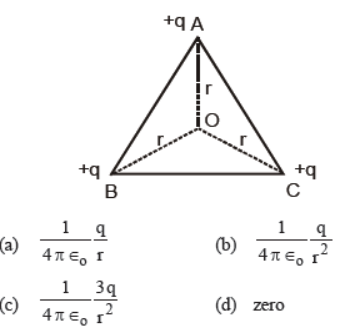
Question. ABC is an equilateral triangle. Charges +q are placed at each corner as shown as fig. The electric intensity at centre O will be
Answer: D
Question. An electric dipole is placed along the x-axis at the origin O. A point P is at a distance of 20 cm from this origin such that OP makes an angle π/3 with the x-axis. If the electric field at P makes an angle θ with the x-axis, the value of θ would be
(a) π/3
(b) π/3 + tan-1(√3/2)
(c) 2π/3
(d) tan-1(√3/2)
Answer: B
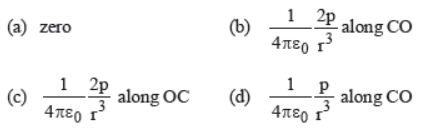
Question. A short electric dipole of dipole moment P̅ is placed at a distance r from the centre of a solid metallic sphere of radius a (<< r) as shown in the figure. The electric field intensity at the centre of sphere C due to induced charge on the sphere is
Answer: B
Question. The electrostatic potential (Φr) of a spherical symmetric system kept at origin, is shown in the figure, and given as
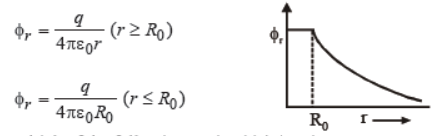
Which of the following option(s) is/are incorrect
(a) For spherical region r ≤ R0 total electrostatic energy stored is zero
(b) Within r = 2R0 total charge is q.
(c) There will be no charge anywhere except at r = R0
(d) All of these
Answer: D
Question. A solid sphereical conductor of radius R has a spherical cavity of radius a (a < R) at its centre. A charge + Q is kept at the centre. The cahrge at the inner surface, outer and at a position r (a < r < R) are respectively
(a) + Q, – Q, 0
(b) – Q, + Q, 0
(c) 0, – Q, 0
(d) + Q , 0, 0
Answer: B
Question. A charge Q is enclosed by a Gaussian spherical surface of radius R. If the radius is doubled, then the outward electric flux will
(a) increase four times
(b) be reduced to half
(c) remain the same
(d) be doubled
Answer: C
Question. Suppose the charge of a proton and an electron differ slightly. One of them is – e, the other is (e + Δe). If the net of electrostatic force and gravitational force between two hydrogen atoms placed at a distance d (much greater than atomic size) apart is zero, then Δe is of the order of [Given mass of hydrogen mh = 1.67 × 10⁻²⁷ kg]
(a) 10–23C
(b) 10–37 C
(c) 10–47 C
(d) 10–20 C
Answer: B
Question. A glass rod rubbed with silk is used to charge a gold leaf electroscope and the leaves are observed to diverge. The electroscope thus charged is exposed to X-rays for a short period. Then
(a) the divergence of leaves will not be affected
(b) the leaves will diverge further
(c) the leaves will collapse
(d) the leaves will melt
Answer: B
Question. The surface density on the copper sphere is s. The electric field strength on the surface of the sphere is
(a) σ
(b) σ/2
(c) Q / 2εo
(d) Q / εo
Answer: D
Question. When air is replaced by a dielectric medium of force constant K, the maximum force of attraction between two charges, separated by a distance
(a) decreases K-times
(b) increases K-times
(c) remains unchanged
(d) becomes 1/K2
Answer: A
Question. Two point charges q1 = 4μC and q2 = 9 μC are placed 20 cm apart. The electric field due to them will be zero on the line joining them at a distance of
(a) 8 cm from q1
(b) 8 cm form q2
(c) 80/13 cm from q1
(d) 80/13 cm from q2
Answer: A
Question. An uncharged sphere of metal is placed in between charged plates as shown. The lines of force look like

(a) A
(b) B
(c) C
(d) D
Answer: C
Question. Force between two identical charges placed at a distance of r in vacuum is F. Now a slab of dielectric of dielectric contrant 4 is inserted between these two charges. If the thickness of the slab is r/2, then the force between the charges will become
(a) F
(b) 3/5 F
(c) 4/9 F
(d) F/2
Answer: C
Very Short Answer
Q1) Who found the inverse square law of force between unlike and like magnetic fields?
Q2) What is additive property?
Q3) What is torsion balance?
Q4) What is charging by contact?
Q5) What is line of force?
Short Answer
Q6) What is the physical significance of the electric dipole?
Q7) What do you mean by the force between the multiple charges?
Q8) What do you mean by the superposition principle?
Q9) What is the physical significance of the electric field?
Q10) What are the general important properties of the electric field lines?
Long Answer
Q11) What do you mean by Gauss’s Law and what are its applications?
Q12) Write short note on electric dipole?
Q13) State the difference between electric field and magnetic field?
Q14) Explain electric field and electric field lines?
Q15) What are the important points to remember Gauss’s Law?
Free study material for Physics
Practice Worksheet and Study Resources for Class 12 Physics Chapter 01 Electric Charges And Fields
Chapter 01 Electric Charges And Fields Printable Worksheet for Class 12 Physics
Explore reliable practice questions for Chapter 01 Electric Charges And Fields tailored for Class 12 Physics learners. Use these structured worksheets to evaluate preparedness and strengthen problem-solving skills.
How to Use These Practice Sheets
Each worksheet is structured around standard CBSE textbooks, allowing students to check their working steps and correct mistakes early in their revision.
Enhance Speed with Online Practice
Explore our broader library of printable assignments, chapter notes, and mock tests designed to support continuous revision and secure higher marks in CBSE assessments.
FAQs
You can download the teacher-verified PDF for CBSE Class 12 Physics Electric Charges and Fields Worksheet Set 02 from StudiesToday.com. These practice sheets for Class 12 Physics are designed as per the latest CBSE academic session.
Yes, our CBSE Class 12 Physics Electric Charges and Fields Worksheet Set 02 includes a variety of questions like Case-based studies, Assertion-Reasoning, and MCQs as per the 50% competency-based weightage in the latest curriculum for Class 12.
Yes, we have provided detailed solutions for CBSE Class 12 Physics Electric Charges and Fields Worksheet Set 02 to help Class 12 and follow the official CBSE marking scheme.
Daily practice with these Physics worksheets helps in identifying understanding gaps. It also improves question solving speed and ensures that Class 12 students get more marks in CBSE exams.
All our Class 12 Physics practice test papers and worksheets are available for free download in mobile-friendly PDF format. You can access CBSE Class 12 Physics Electric Charges and Fields Worksheet Set 02 without any registration.