

Practice Worksheets for Class 12 Physics: Chapter 01 Electric Charges And Fields
Access printable practice worksheets for Chapter 01 Electric Charges And Fields designed to align with the 2026-27 academic syllabus for Class 12 Physics. These structured exercises help students evaluate their conceptual understanding and improve exam readiness.
Practice Chapter 01 Electric Charges And Fields Worksheets for Class 12 Physics
Access the complete worksheet PDF for Chapter 01 Electric Charges And Fields below. Regular practice with these targeted questions builds familiarity with standard exam patterns and helps secure higher marks in final Physics evaluations.
CBSE Class 12 Physics Electric Charges and Fields Worksheet Set A
Question. An electric dipole when placed in a uniform electric field E will have minimum potential energy if the dipole moment makes the following angle with E.
(a) π
(b) π/2
(c) zero
(d) 3 π/2
Answer: C
Question. The charge given to any conductor resides on its outer surface, because
(a) the free charge tends to be in its minimum potential energy state
(b) the free charge tends to be in its minimum kinetic energy state
(c) the free charge tends to be in its maximum potential energy state.
(d) the free charge tends to be in its maximum kinetic energy state
Answer: A
Question. Identify the wrong statement in the following. Coulomb's law correctly describes the electric force that
(a) binds the electrons of an atom to its nucleus
(b) binds the protons and neutrons in the nucleus of an atom
(c) binds atoms together to form molecules
(d) binds atoms and molecules together to form solids
Answer: B
Question. What is the angle between the electric dipole moment and the electric field due to it on the axial line?
(a) 0º
(b) 90º
(c) 180º
(d) None of these
Answer: A
Question. Two thin infinite parallel sheets have uniform surface densities of charge + σ and – σ. Electric field in the space between the two sheets is
(a) σ/εo
(b) σ/2εo
(c) 2σ/εo
(d) zero
Answer: A
Question. What is the value of E in the space outside the sheets?
(a) σ/εo
(b) σ/2εo
(c) E ≠ 0
(d) 2σ/εo
Answer: C
Question. A point Q lies on the perpendicular bisector of an electrical dipole of dipole moment p. If the distance of Q from the dipole is r (much larger than the size of the dipole), then the electric field at Q is proportional to
(a) p–1 and r–2
(b) p and r–2
(c) p2 and r–3
(d) p and r–3
Answer: D
Question. In a medium of dielectric constant K, the electric field is E̅ . If ε0 is permittivity of the free space, the electric displacement vector is
(a) KE̅/ε0
(b) E̅/Kε0
(c) ε0 E̅/K
(d) K ε0 E̅
Answer: D
Question. Two conducting spheres of radii r1 and r2 are charged to the same surface charge density. The ratio of electric fields near their surface is
(a) r12/r22
(b) r22/r12
(c) r1 / r2
(d) 1 : 1
Answer: D
Question. From a point charge, there is a fixed point A. At A, there is an electric field of 500 V/m and potential difference of 3000 V. Distance between point charge and A will be
(a) 6 m
(b) 12 m
(c) 16 m
(d) 24 m
Answer: A
Question. An electric dipole is placed at an angle of 30° with an electric field of intensity 2 × 10⁵ NC–1, It experiences a torque of 4 Nm. Calculate the charge on the dipole if the dipole length
is 2 cm.
(a) 8 μC
(b) 4 μC
(c) 8 μC
(d) 2 μC
Answer: D
Question. A charge q is placed at the centre of the open end of a cylindrical vessel. The flux of the electric field through the surface of the vessel is
(a) zero
(b) q/εo
(c) q/2εo
(d) 2q/εo
Answer: A
Question. A particle of mass m and charge q is placed at rest in a uniform electric field E and then released. The kinetic energy attained by the particle after moving a distance y is
(a) q E y2
(b) q E2 y
(c) q E y
(d) q2 E y
Answer: C
Question. The insulation property of air breaks down when the electric field is 3 × 10⁶ Vm–1. The maximum charge that can be given to a sphere of diameter 5 m is approximately
(a) 2 × 10⁻² C
(b) 2 × 10⁻³ C
(c) 2 × 10⁻⁴ C
(d) 2 × 10⁻⁵ C
Answer: B
Question. At the centre of a cubical box + Q charge is placed. The value of total flux that is coming out a wall is
(a) Q / εo
(b) Q / 3εo
(c) Q / 4εo
(d) Q / 6εo
Answer: D
Question. If a charge is moved against the coulomb force of an electric field, then
(a) work is done by the electric field
(b) energy is used from some outside source
(c) the strength of the field is decreased
(d) the energy of the system is decreased
Answer: B
Question. In a region of space having a uniform electric field E, a hemispherical bowl of radius r is placed. The electric flux f through the bowl is
(a) 2πRE
(b) 4πR2E
(c) 2πR2E
(d) πR2E
Answer: C
Question. Two charges are at a distance d apart. If a copper plate of thickness d/2 is kept between them, the effective force will be
(a) F/2
(b) zero
(c) 2F
(d) √2 F
Answer: B
Question. If electric field in a region is radially outward with magnitude E = Ar, the charge contained in a sphere of radius r centred at the origin is
(a) 1/4πεo Ar3
(b) 4πεoAr3
(c) 1/4πεo A/r3
(d) 4πεoA/r3
Answer: B
Question. A hollow insulated conduction sphere is given a positive charge of 10 mC. What will be the electric field at the centre of the sphere if its radius is 2 metres?
(a) Zero
(b) 5 μCm–2
(c) 20 μCm–2
(d) 8 μCm–2
Answer: A
Question. An electric dipole has the magnitude of its charge as q and its dipole moment is p. It is placed in uniform electric field E. If its dipole moment is along the direction of the field, the force on it and its potential energy are respectively.
(a) q.E and max.
(b) 2 q.E and min.
(c) q.E and min
(d) zero and min.
Answer: D
Question. If the dipole of moment 2.57 × 10⁻¹⁷ cm is placed into an electric field of magnitude 3.0 × 10⁴ N/C such that the fields lines are aligned at 30° with the line joining P to the dipole, what torque acts on the dipole?
(a) 7.7 × 10⁻¹³ Nm
(b) 3.855 × 10⁻¹³ Nm
(c) 3.855 × 10⁻¹⁵ Nm
(d) 7.7 × 10⁻¹⁵ Nm
Answer: B
Question. There is an electric field E in X-direction. If work done in moving a charge 0.2 C through a distance of 2m along a line making an angle of 60 degree with X-axis is 4.0 joule, what is the value of E?
(a) √3 newton per coulomb
(b) 4 netwon per coulomb
(c) 5 newton per coulomb
(d) None of these
Answer: D
Question. Two identical charged spheres suspended from a common point by two massless strings of lengths l, are initially at a distance d (d << l ) apart because of their mutual repulsion.
The charges begin to leak from both the spheres at a constant rate. As a result, the spheres approach each other with a velocity v. Then v varies as a function of the distance x between the spheres, as :
(a) v ∝ x1/2
(b) v ∝ x
(c) v ∝ x1/2
(d) v ∝ x-1
Answer: C
Question. The E-r curve for an infinite linear charge distribution will be
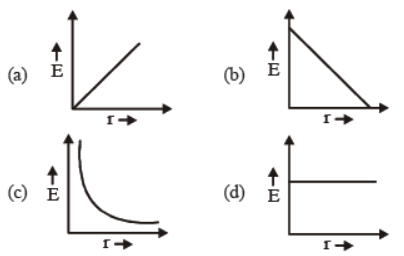
Answer: C
Question. Intensity of an electric field (E) depends on distance r, due to a dipole, is related as
(a) E ∝ 1/r
(b) E ∝ 1/r2
(c) E ∝ 1/r3
(d) E ∝ 1/r4
Answer: C
Question. The formation of a dipole is due to two equal and dissimilar point charges placed at a
(a) short distance
(b) long distance
(c) above each other
(d) none of these
Answer: A
Question. The electric field intensity just sufficient to balance the earth’s gravitational attraction on an electron will be: (given mass and charge of an electron respectively are 9.1x10⁻³¹kg and 1.6 x10⁻¹⁹C.)
(a) –5.6 × 10⁻¹¹ N/C
(b) –4.8 × 10⁻¹⁵ N / C
(c) –1.6 × 10⁻¹⁹ N/C
(d) –3.2 × 10⁻¹⁹ N / C
Answer: A
Question. Charge Q is distributed to two different metallic spheres having radii R and 2R such that both spheres have equal surface charge density, then charge on large sphere is
(a) 4Q/5
(b) Q/5
(c) 3Q/5
(d) 5Q/4
Answer: A
Question. An infinite parallel plane sheet of a metal is charged to charge density σ coulomb per square metre in a medium of dielectric constant K. Intensity of electric field near the metallic surface will be
(a) E = σ/εo K
(b) E = σ/2εo2
(c) E = σ/2εo K
(d) E = Kσ/2εo
Answer: C
Very Short Answer
Q1) Which force is the fundamental force of nature?
Q2) Who named the charges as positive and negative?
Q3) What is an indicator of the amount of charge?
Q4) What is polarity of charges?
Q5) What is the foundation for the modern technological civilization?
Short Answer
Q6) Why comb attracts hair?
Q7) What do you mean by the term earthing?
Q8) Define electric charges?
Q9) What happens when live wire touches to metal body?
Q10) What is Coulomb’s law?
Long Answer
Q11) Explain charging by induction?
Q12) Difference between conductors and semi-conductors?
Q13) Difference between electricity and magnetism?
Q14) Explain basic properties of electric charges?
Q15) Difference between conductors and insulators?
Free study material for Physics
Practice Worksheet and Study Resources for Class 12 Physics Chapter 01 Electric Charges And Fields
Download Practice Sheet: Chapter 01 Electric Charges And Fields (Class 12 Physics)
Explore reliable practice questions for Chapter 01 Electric Charges And Fields tailored for Class 12 Physics learners. Use these structured worksheets to evaluate preparedness and strengthen problem-solving skills.
Concept Clarification for Chapter 01 Electric Charges And Fields
Cross-reference your completed exercises with comprehensive NCERT solutions for Class 12 Physics to ensure absolute clarity across all sub-topics in this chapter.
Additional Study Resources for Class 12 Physics
Wrap up your chapter revision by testing your knowledge against standard question formats. Everything on our platform is provided free of charge.
FAQs
You can download the teacher-verified PDF for CBSE Class 12 Physics Electric Charges and Fields Worksheet Set 01 from StudiesToday.com. These practice sheets for Class 12 Physics are designed as per the latest CBSE academic session.
Yes, our CBSE Class 12 Physics Electric Charges and Fields Worksheet Set 01 includes a variety of questions like Case-based studies, Assertion-Reasoning, and MCQs as per the 50% competency-based weightage in the latest curriculum for Class 12.
Yes, we have provided detailed solutions for CBSE Class 12 Physics Electric Charges and Fields Worksheet Set 01 to help Class 12 and follow the official CBSE marking scheme.
Daily practice with these Physics worksheets helps in identifying understanding gaps. It also improves question solving speed and ensures that Class 12 students get more marks in CBSE exams.
All our Class 12 Physics practice test papers and worksheets are available for free download in mobile-friendly PDF format. You can access CBSE Class 12 Physics Electric Charges and Fields Worksheet Set 01 without any registration.