

Official Class 12 Physics Worksheets: Chapter 09 Ray Optics and Optical Instruments
Review targeted practice sets for Class 12 Physics Chapter 09 Ray Optics and Optical Instruments. Built according to official educational guidelines for the 2026-27 academic year, these downloadable worksheets support daily revision and core concept reinforcement.
Chapter-wise Practice Material: Chapter 09 Ray Optics and Optical Instruments
Navigate directly to the printable exercises for Chapter 09 Ray Optics and Optical Instruments using the digital viewer below. Each practice set allows students to isolate specific topics for thorough review and uninterrupted practice alongside standard textbooks.
Question. A plane convex lens of focal length 16 cm, is to be made of glass of refractive index 1.5. The radius of curvature of the curved surface should be
(a) 8 cm
(b) 12 cm
(c) 16 cm
(d) 24 cm
Answer: A
Question. Critical angle of light passing from glass to water is minimum faor
(a) red colour
(b) green colour
(c) yellow colour
(d) violet colour
Answer: D
Question. An object is placed at a distance 2f from the pole of a convex mirror of focal length f. The linear magnification is
(a) 1/3
(b) 2/3
(c) 3/4
(d) 1
Answer: A
Question. A vessel is half filled with a liquid of refractive index μ. The other half of the vessel is filled with an immiscible liquid of refrative index 1.5 μ. The apparent depth of the vessel is 50% of the actual depth. Then μ is
(a) 1.4
(b) 1.5
(c) 1.6
(d) 1.67
Answer: D
Question. An electromagnetic radiation of frequency n, wavelength λ, travelling with velocity v in air enters in a glass slab of refractive index (μ). The frequency, wavelength and velocity of light in the glass slab will be respectively
(a) n , λ/μ and v/μ
(b) n , 2λ and v/μ
(c) n/μ , λ/μ and v/μ
(d) 2π/μ , λ/μ and v
Answer: A
Question. The wavelength of a monochromatic light in vacuum is λ. It travels from vacuum to a medium of absolute refractive index μ. The ratio of wavelength of the incident and refracted wave is
(a) μ2 : 1
(b) 1 : 1
(c) μ : 1
(d) 1 : μ
Answer: C
Question. A man 160 cm high stands in front of a plane mirror. His eyes are at a height of 150 cm from the floor. Then the minimum length of the plane mirror for him to see his full length image is
(a) 85 cm
(b) 170 cm
(c) 80 cm
(d) 340 cm
Answer: C
Question. It is desired to photograph the image of an object placed at a distance of 3 m from plane mirror. The camera, which is at a distance of 4.5 m from mirror should be focussed for a distance of
(a) 3 m
(b) 4.5 m
(c) 6 m
(d) 7.5 m
Answer: D
Question. The focal lengths of objective and eye lens of an astronomical telelscope are respectively 2 meter and 5 cm. Final image is formed at
(i) least distance of distinct vision
(ii) infinity Magnifying power in two cases will be
(a) – 48, – 40
(b) – 40, – 48
(c) – 40, + 48
(d) – 48, + 40
Answer: A
Question. The layered lens as shown is made of two types of transparent materials-one indicated by horizontal lines and the other by vertical lines. The number of images formed of an object will be

(a) 1
(b) 2
(c) 3
(d) 6
Answer: B
Question. A thin convergent glass lens (μg = 1.5) has a power of + 5.0 D. When this lens is immersed in a liquid of refractive index m, it acts as a divergent lens of focal length 100 cm. The value of μ must be
(a) 4/3
(b) 5/3
(c) 5/4
(d) 6/5
Answer: B
Question. In an astronomical telescope in normal adjustment a straight black line of lenght L is drawn on inside part of objective lens. The eye-piece forms a real image of this line. The length of this image is l. The magnification of the telescope is :
(a) L/I - 1
(b) L+1/L-1
(c) L/I
(d) L/I + 1
Answer: C
Question. A diver inside water sees the setting sun at
(a) 41° to the horizon
(b) 49° to the horizon
(c) 0° to the horizon
(d) 45° to the horizon
Answer: A
Question. A ray of light travelling in a transparent medium of refractive index μ , falls on a surface separating the medium from air at an angle of incidence of 45°. For which of the following value of m the ray can undergo total internal reflection?
(a) μ = 1.33
(b) μ = 1.40
(c) μ = 1.50
(d) μ = 1.25
Answer: C
Question. Two convex lenses of focal lengths f1 and f2 are mounted coaxially separated by a distance. If the power of the combination is zero, the distance between the lenses is
(a) | f1 - f2 |
(b) f1 + f2
(c) f1 f2/| f1 - f2 |
(d) f1 f2/f1 + f2
Answer: B
Question. A ray incident at 15° on one refracting surface of a prism of angle 60° suffers a deviation of 55°. What is the angle of emergence ?
(a) 95°
(b) 45°
(c) 30°
(d) None of these
Answer: D
Question. A thin prism of angle 15º made of glass of refractive index μ1 = 1.5 is combined with another prism of glass of refractive index μ2 = 1.75. The combination of the prism produces dispersion without deviation. The angle of the second prism should be
(a) 7°
(b) 10°
(c) 12°
(d) 5°
Answer: B
Question. A combination is made of two lenses of focal length f and f' in contact, the dispersive powers of the materials of the lenses are w and w'. The combination is achromatic, when
(a) ω = ω0, ω' = 2ω0 f' = 2f
(b) ω = ω0, ω' = 2ω0 f' = f/2
(c) ω = ω0, ω' = 2ω0 f' = –f/2
(d) ω = ω0, ω' = 2ω0 f' = –2f
Answer: D
Question. If two mirrors are kept at 60º to each other, then the number of images formed by them is
(a) 5
(b) 6
(c) 7
(d) 8
Answer: A
Question. We wish to see inside an atom. Assume the atom to have a diameter of 100 pm. This means that one must be able to resolve a width of say 10 pm. If an electron microscope is used the energy required should be
(a) 1.5 keV
(b) 50 keV
(c) 150 keV
(d) 1.5 MeV
Answer: B
Short Answer Type Questions - I
Question. Which characteristic of light changes when it travels from one medium to another?
Answer: The wavelength of light is modified as it passes from one medium to another.
In simple words: The wavelength of light alters when it crosses into a different medium.
Exam Tip: Remember that while wavelength and speed of light change during refraction, the frequency remains constant because it depends solely on the light source.
Question. Which phenomenon of light demonstrates its particle nature?
Answer: The particle nature of light is demonstrated by the photoelectric effect.
In simple words: The photoelectric effect shows that light acts like particles.
Exam Tip: To show the particle properties of light, mention the photoelectric effect or Compton scattering, whereas wave nature is shown by interference or diffraction.
Question. What is the formula for the speed of sound in a resonance tube experiment neglecting end correction?
Answer: The speed of sound is given by the expression \( 4nL \).
In simple words: The velocity of sound equals four times the frequency times the air column length.
Exam Tip: In sound resonance tube questions, ensure you write \( 4nL \) where \( n \) represents the tuning fork's frequency and \( L \) is the resonating length.
Question. If a star emitting yellow light is moving away from the earth, how will its color appear to change to an observer on earth?
Answer: The color of the light will progressively shift toward the blue end of the spectrum.
In simple words: The light will slowly change to a blue color.
Exam Tip: A shift towards shorter wavelengths due to relative motion is called blue shift, whereas a shift to longer wavelengths is a red shift.
Question. What is the path difference between two interfering waves at the central maximum in an interference pattern?
Answer: The path difference between the waves at the central maximum is zero.
In simple words: At the center, the path difference between the two light waves is zero.
Exam Tip: For the central bright fringe, always remember that both the path difference and phase difference are zero.
Question. What is the angle between the reflected ray and refracted ray when light is incident at the polarizing angle?
Answer: The angle between the reflected and refracted rays under polarization conditions is \( 90^\circ \).
In simple words: The reflected light ray and the refracted light ray are at a right angle of \( 90^\circ \) to each other.
Exam Tip: At the polarizing angle, the reflected and refracted rays are always mutually perpendicular.
Question. What is the relationship between the ordinary refractive index \( \mu_o \) and extraordinary refractive index \( \mu_e \) along the optic axis of a uniaxial crystal?
Answer: Along the direction of the optic axis, the ordinary and extraordinary refractive indices are equal, so \( \mu_o = \mu_e \).
In simple words: The refractive index is the same for both rays along the crystal's optic axis.
Exam Tip: State that double refraction does not occur along the optic axis, meaning both refractive indices are identical.
Question. What is the angle between the plane of polarization and the plane of vibration?
Answer: The plane of polarization is oriented at an angle of \( 90^\circ \) to the plane of vibration.
In simple words: The plane of vibration and the plane of polarization are perpendicular to each other.
Exam Tip: Remember that the plane of polarization contains no vibrations and is perpendicular to the plane of vibration.
Question. Which color of light suffers maximum deviation when passing through a glass prism?
Answer: The violet component of white light experiences the maximum deviation.
In simple words: Violet light bends the most when it passes through a prism.
Exam Tip: Deviation is inversely proportional to wavelength, so violet light with the shortest wavelength deviates the most.
Question. If Young's double-slit experiment is immersed in water, what happens to the fringe width?
Answer: The width of the interference fringes shrinks.
In simple words: The size of the bright and dark bands on the screen becomes smaller.
Exam Tip: When Young's double-slit experiment is conducted in a medium of refractive index \( \mu \), the fringe width decreases by a factor of \( \mu \).
Question. A person sees their image in a three-part magic mirror: the face appears smaller, the middle of the body appears larger, and the legs appear of normal size. What are the types of mirrors in each section?
Answer:
(i) The top section of the mirror is convex because it makes the face look smaller.
(ii) The center section is concave as it produces a larger image of the body.
(iii) The bottom section is plane because the legs appear of normal size.
In simple words: The mirror is convex at the top, concave in the middle, and flat at the bottom.
Exam Tip: Relate the mirror type directly to the magnification: convex reduces, concave magnifies, and plane keeps the size same.
Question. How does a ray of light bend when it travels from an optically denser medium to an optically rarer medium?
Answer: The light ray deviates away from the normal line.
In simple words: The light bends further away from the vertical line as it enters the rarer medium.
Exam Tip: When going from denser to rarer medium, the angle of refraction is greater than the angle of incidence.
Question. Three media A, B, and C have angles of refraction \( 15^\circ \), \( 25^\circ \), and \( 35^\circ \) respectively for a given angle of incidence. In which of these media is the velocity of light minimum?
Answer: From Snell's law, we have \( \mu = \frac{\sin i}{\sin r} = \frac{c}{v} \), which gives \( v = \frac{\sin r}{\sin i} \cdot c \). For a constant angle of incidence \( i \), the velocity \( v \) is directly proportional to \( \sin r \). Here, \( v_A \propto \sin 15^\circ \), \( v_B \propto \sin 25^\circ \), and \( v_C \propto \sin 35^\circ \). Since \( \sin 15^\circ < \sin 25^\circ < \sin 35^\circ \), it follows that \( v_A < v_B < v_C \). Consequently, the speed of light is lowest in medium A.
In simple words: The speed of light is directly related to the sine of the angle of refraction. Since medium A has the smallest angle of refraction, light travels slowest in it.
Exam Tip: Show the step-by-step proportionality \( v \propto \sin r \) to get full marks for such comparative questions.
Question. Under what condition is the lateral shift produced by a glass slab maximum, and what is its value?
Answer: The lateral shift is given by \( d = \frac{t \sin(i - r)}{\cos r} \). For an angle of incidence \( i = 90^\circ \), the lateral shift reaches its maximum value, which equals the thickness of the slab: \( d_{\max} = \frac{t \sin(90^\circ - r)}{\cos r} = \frac{t \cos r}{\cos r} = t \).
In simple words: The greatest possible sideways shift of a light ray happens when light strikes the slab at \( 90^\circ \), and this shift is equal to the slab's thickness.
Exam Tip: Write down the general expression for lateral shift before substituting \( i = 90^\circ \) to show the derivation clearly.
Question. A plane glass slab is placed over letters of different colors. Which letters appear to be raised the most and why?
Answer: The normal shift produced by a refracting slab of thickness \( t \) is defined by \( d = t\left(1 - \frac{1}{\mu}\right) \). Since the refractive index of glass depends on the color of light, different colored letters appear raised by different heights.
In simple words: Because the glass slab refracts different colors by different amounts, the letters of various colors appear raised to different levels.
Exam Tip: Mention the formula for apparent shift and state that the refractive index varies with wavelength or color.
Question. Does a water tank appear equally deep at all points when viewed from above? Explain.
Answer: No, the depth does not look uniform. The apparent depth is greatest for the region of the tank viewed directly from above (along the normal). As the viewing angle becomes more slanted (higher obliquity), the apparent depth decreases. This uneven refraction causes the flat bottom of the tank to appear curved upwards like a concave surface.
In simple words: No, the tank bottom looks curved. It seems deepest when you look straight down, and shallower when looked at from an angle.
Exam Tip: Explain both normal viewing and oblique viewing to justify why the bottom appears concave instead of flat.
Question. The critical angle for a glass-air interface is \( i_c \). Will the critical angle for a glass-water interface be greater than or less than \( i_c \)?
Answer: The critical angle \( i_c \) for a glass-air boundary is given by \( \sin i_c = \frac{1}{{^a}\mu_g} \). For a glass-water boundary, the critical angle \( i_c' \) is \( \sin i_c' = \frac{1}{{^w}\mu_g} \). Since the relative refractive index of glass with respect to water is less than that with respect to air (\( {^w}\mu_g < {^a}\mu_g \)), we have \( \sin i_c' > \sin i_c \), which means \( i_c' > i_c \). Therefore, the critical angle is larger for the glass-water interface.
In simple words: The critical angle is larger when glass is in contact with water than when it is in contact with air because the difference in optical density is smaller.
Exam Tip: Clearly write the expressions for both cases and show the inequality \( {^w}\mu_g < {^a}\mu_g \) to secure full marks.
Question. Why does an air bubble inside a water tank shine brightly?
Answer: Light rays in the water strike the surface of the air bubble at an angle greater than the critical angle, undergoing total internal reflection. To an observer, this reflected light seems to originate from the bubble itself, making it look highly reflective and shiny.
In simple words: Light gets trapped and bounces off the surface of the air bubble because of total internal reflection, which makes the bubble look very bright.
Exam Tip: Identify "total internal reflection" as the key physical phenomenon responsible for this effect.
Question. What happens to the brilliance of a diamond when it is immersed in a transparent oil?
Answer: The critical angle for a diamond-oil boundary is larger than the critical angle for a diamond-air boundary. As a result, fewer light rays undergo total internal reflection inside the diamond when it is submerged in oil, which decreases its sparkle.
In simple words: Submerging a diamond in oil increases its critical angle, so less light is trapped inside, causing it to lose some of its brilliant shine.
Exam Tip: Relate the refractive index of the surrounding medium to the critical angle and explain how a larger critical angle reduces total internal reflection.
Question. How does a liquid lens formed on a horizontal glass plate behave?
Answer: It acts as a biconvex lens.
In simple words: The liquid lens acts just like a double convex lens, focusing light rays.
Exam Tip: Confirm that a drop of liquid on a glass plate forms a curved surface on both sides, behaving as a biconvex lens.
Question. Why does an air bubble inside water behave like a concave lens?
Answer: An air bubble possesses spherical boundaries and is embedded in water, which has a higher refractive index than the air inside. When light rays travel from the denser water into the rarer air of the bubble, they bend away from the normal, causing them to diverge. Hence, the bubble acts as a diverging or concave lens.
In simple words: Since the bubble contains air and is surrounded by denser water, it spreads out incoming light rays, making it act like a concave lens.
Exam Tip: Always contrast the refractive indices of the lens medium (air) and the surrounding medium (water) to explain the diverging behavior.
Question. Under what condition will a glass lens immersed in a liquid become completely invisible?
Answer: If the refractive index of the liquid matches the refractive index of the lens material, no refraction or reflection of light occurs at the lens interfaces. Consequently, the lens becomes completely invisible.
In simple words: When the lens and the liquid have the same refractive index, light passes straight through without bending or reflecting, so you cannot see the lens.
Exam Tip: Use the term "matching refractive indices" to explain why no light is scattered, reflected, or refracted.
Question. Will the position of the image change if we turn a lens around, thereby interchanging its two surfaces of radii of curvature \( R_1 \) and \( R_2 \)? Explain.
Answer: No, the image position remains unchanged. According to the lens maker's equation, \( \frac{1}{f} = (\mu - 1)\left(\frac{1}{R_1} - \frac{1}{R_2}\right) \). Interchanging the values of \( R_1 \) and \( R_2 \) merely changes the sign of the focal length depending on the direction of light, but the absolute magnitude of \( f \) remains identical. Thus, the focal length is the same in both directions, and the image is formed at the same spot.
In simple words: No, flipping the lens does not change where the image forms because the lens has the same focal length from both sides.
Exam Tip: Use the lens maker's formula to prove that the focal length of a thin lens is independent of the side from which light enters.
Question. How does the focal length of a convex lens change when it is immersed in water?
Answer: The focal length \( f \) of a convex lens is inversely proportional to \( (\mu - 1) \). Since the refractive index of glass with respect to water (\( {^w}\mu_g \)) is less than its refractive index with respect to air (\( {^a}\mu_g \)), the term \( (\mu - 1) \) becomes smaller when the lens is in water. Therefore, the focal length of the lens increases upon immersion in water.
In simple words: Water has a higher refractive index than air, which reduces the light-bending power of the glass lens, thus increasing its focal length.
Exam Tip: Show that \( {^w}\mu_g = \frac{\mu_g}{\mu_w} \), making it smaller than \( \mu_g \), which leads directly to an increased focal length.
Question. How does the focal length of a convex lens change when red light is used instead of violet light?
Answer: The focal length of a lens is given by \( f \propto \frac{1}{\mu - 1} \). Since the refractive index of glass is lower for red light than for violet light (\( \mu_R < \mu_V \)), the denominator \( (\mu - 1) \) is smaller for red light. As a result, the focal length of the convex lens is longer when red light is used.
In simple words: Glass bends red light less than violet light, so red light focuses further away, giving the lens a longer focal length.
Exam Tip: Recall Cauchy's formula to state how refractive index decreases as wavelength increases from violet to red.
Question. An equiconvex lens of focal length \( f \) has one of its surfaces ground to make it flat. How do its focal length and power change?
Answer: For the initial equiconvex lens with \( R_1 = +R \) and \( R_2 = -R \), the focal length \( f \) is given by: \( \frac{1}{f} = (\mu - 1)\left(\frac{1}{R} - \left(-\frac{1}{R}\right)\right) = \frac{2(\mu - 1)}{R} \). If one surface is ground flat, we have \( R_1 = +R \) and \( R_2 = -\infty \). The new focal length \( f' \) is: \( \frac{1}{f'} = (\mu - 1)\left(\frac{1}{R} - \frac{1}{-\infty}\right) = \frac{\mu - 1}{R} \). Dividing the two equations yields \( \frac{f'}{f} = 2 \), or \( f' = 2f \). Consequently, the focal length is doubled, while the optical power (\( P = 1/f \)) is halved.
In simple words: Making one side of a double convex lens flat turns it into a plano-convex lens. This cuts its bending power in half, doubling its focal length.
Exam Tip: Clearly write the values of the radii of curvature before and after grinding, especially noting that the flat surface has \( R = \infty \).
Question. What happens to the angle of minimum deviation of a glass prism when it is immersed in water?
Answer: When a prism is placed in water, its refractive index is represented by \( {^w}\mu_g = \frac{\sin\left(\frac{A + \delta_m}{2}\right)}{\sin\left(\frac{A}{2}\right)} \). Because the relative refractive index of glass with respect to water is lower than that with respect to air (\( {^w}\mu_g < {^a}\mu_g \)), the angle of minimum deviation (\( \delta_m \)) must decrease when the prism is in water.
In simple words: Because water is denser than air, the relative refractive index of the glass prism decreases, which reduces how much it can deviate light.
Exam Tip: Relate the decrease in relative refractive index directly to a decrease in the value of the numerator \( \sin((A + \delta_m)/2) \).
Question. Which optical phenomenon is responsible for the working of optical fibers?
Answer: This phenomenon is total internal reflection.
In simple words: Light is guided through optical fibers using total internal reflection.
Exam Tip: Always state the two conditions for total internal reflection to occur: light must travel from denser to rarer medium, and the angle of incidence must exceed the critical angle.
Question. Why would the sky appear dark to an astronaut in space where there is no atmosphere?
Answer: Without an atmosphere, there are no air molecules or dust particles to scatter sunlight. Consequently, no scattered light reaches the observer's eyes, and the sky appears completely black.
In simple words: Since space has no air to scatter light, the sky looks completely dark except for the direct light from stars and the Sun.
Exam Tip: Explain that scattering is what gives the sky its color, and its absence results in darkness.
Question. Why do clouds generally appear white?
Answer: Clouds contain relatively large particles, such as water droplets and dust, which are much larger than the wavelength of visible light. These large particles scatter all wavelengths (colors) of light equally, and the combination of all scattered colors produces a white appearance.
In simple words: Clouds are made of large water drops that scatter all colors of sunlight equally, making them look white.
Exam Tip: Differentiate this from Rayleigh scattering, pointing out that for large particles, the scattering intensity is independent of wavelength.
Question. Why do bright rings or halos appear around the sun or moon when viewed through high, thin clouds?
Answer: When looking at the Sun or Moon through a thin layer of high-altitude clouds, bright rings or halos can be seen. These rings are created by the reflection and refraction of light passing through hexagonal ice crystals suspended in the upper atmosphere.
In simple words: Bright halos around the Sun or Moon are caused by light reflecting off tiny ice crystals in high clouds.
Exam Tip: Explain that high clouds (like cirrus clouds) contain ice crystals which act like tiny prisms and mirrors.
Question. Why can bees see in ultraviolet light while human beings are unable to do so?
Answer: Ultraviolet light has a shorter wavelength than visible violet light. The eyes of bees contain specialized photoreceptor cells (retinal cones) that can detect ultraviolet wavelengths, enabling them to see in this range. In contrast, human retinas lack cones sensitive to ultraviolet radiation, making humans blind to these wavelengths.
In simple words: Bees have special sensors in their eyes that detect ultraviolet light, which humans cannot see because our eyes lack those sensors.
Exam Tip: Explain the biological difference in terms of the presence or absence of specific retinal cones sensitive to ultraviolet wavelengths.
Question. Why is a chicken unable to see in dim light and why does it sleep at sunset and wake up at sunrise?
Answer: A chicken's retina is populated with many cone cells but very few rod cells. Since rod cells are necessary for vision in low-light conditions, chickens struggle to see in the dark. Consequently, they require bright daylight to navigate, prompting them to wake up at dawn and sleep at dusk.
In simple words: Chickens have very few light-sensitive rod cells in their eyes, so they cannot see in the dark and must sleep when the sun goes down.
Exam Tip: Clearly distinguish the roles of rod cells (low-light vision) and cone cells (color and bright-light vision) in your explanation.
Question. For a simple microscope, is the magnifying power greater in red light or violet light? Explain.
Answer: The magnifying power of a simple microscope is given by the formula \( m = 1 + \frac{D}{f} \). Since the focal length of a lens is shorter for violet light than for red light (\( f_V < f_R \)), the term \( \frac{D}{f} \) is larger for violet. Thus, the microscope achieves a higher magnifying power when violet light is used.
In simple words: A microscope magnifies more in violet light because violet light has a shorter focal length than red light.
Exam Tip: State the formula for magnifying power and explain how the variation of focal length with color affects the magnification.
Question. Why is the objective of a microscope designed to have a small focal length?
Answer: A small focal length for the objective lens ensures that the real, inverted image it produces is formed very close to, and just within, the focal length of the eyepiece, which then acts as a simple magnifier.
In simple words: This allows the first lens to form an image close enough to the second lens so that the second lens can magnify it enormously.
Exam Tip: Focus on the relative placement of the intermediate image with respect to the focal point of the eyepiece.
Question. Given focal lengths of 1 cm, 3 cm, and 100 cm, which ones would you choose for: (i) a microscope, and (ii) a telescope?
Answer:
(i) For a microscope, we should select \( f_0 = 1 \) cm and \( f_e = 3 \) cm, as both lenses need short focal lengths, with the objective being shorter.
(ii) For a telescope, we should choose \( f_0 = 100 \) cm and \( f_e = 1 \) cm, since the objective must have a very long focal length to collect distant light, while the eyepiece has a short focal length.
In simple words: A microscope uses two short lenses (1 cm and 3 cm), while a telescope needs one very long lens (100 cm) and one short lens (1 cm).
Exam Tip: Justify the choice by stating that microscope magnification \( m \propto \frac{1}{f_0 f_e} \), while telescope magnification \( m \propto \frac{f_0}{f_e} \).
Question. Does increasing the aperture of the objective lens of an astronomical telescope improve its performance? Explain.
Answer: Yes, a larger aperture increases the light-gathering capability of the objective lens. This allows more light from distant, dim astronomical bodies to enter the telescope, making faint objects clearly visible.
In simple words: Yes, a wider lens collects more light, which helps us see very dim and distant stars much better.
Exam Tip: Remember that light-gathering power is directly proportional to the square of the aperture's diameter.
Question. How must the distance between the objective and the eyepiece of a telescope be altered when shifting from normal adjustment (relaxed eye) to focusing for the near point?
Answer: For a relaxed eye (normal adjustment), the tube length of the telescope is \( L = f_0 + f_e \). When focusing at the near point (least distance of distinct vision), the eyepiece-to-intermediate-image distance is \( u_e \), which is less than \( f_e \) (\( u_e < f_e \)). The new tube length becomes \( L' = f_0 + u_e \). Since \( u_e < f_e \), we have \( L' < L \), meaning the distance between the objective and the eyepiece must be reduced.
In simple words: To look at a close image instead of a distant one, the telescope tube must be made slightly shorter.
Exam Tip: Use equations for both cases to mathematically demonstrate that \( L' < L \) to secure full marks.
Short Answer Type Questions - II
Question. If the object and image distances from the principal focus of a concave mirror are \( a \) and \( b \) respectively, show that \( f^2 = ab \).
Answer: The object distance is \( u = -(f + a) \), the image distance is \( v = -(f + b) \), and the focal length is \( -f \). Applying the mirror formula: \( \frac{1}{f} = \frac{1}{u} + \frac{1}{v} \) Substituting the values: \( -\frac{1}{f} = \frac{1}{-(f + a)} + \frac{1}{-(f + b)} \) \( \frac{1}{f} = \frac{1}{f + a} + \frac{1}{f + b} \) \( \frac{1}{f} = \frac{(f + b) + (f + a)}{(f + a)(f + b)} \) \( (f + a)(f + b) = f(2f + a + b) \) \( f^2 + f(a + b) + ab = 2f^2 + f(a + b) \) Simplifying this equation gives: \( f^2 = ab \)
In simple words: By using the standard mirror formula and measuring distances from the focus rather than the pole, we get the relation \( f^2 = ab \), which is Newton's formula.
Exam Tip: This is Newton's formula for mirrors. Make sure to apply the sign conventions properly at the beginning of your proof.
Question. A ray of light traveling in medium 1 is incident at an angle \( \theta \) and refracts into medium 2 at an angle \( \theta/2 \). (i) Which medium is optically denser? (ii) Find the angle of incidence in terms of the wave velocities \( c_1 \) and \( c_2 \).
Answer:
(i) The angle of refraction (\( \theta/2 \)) in medium 2 is smaller than the angle of incidence (\( \theta \)) in medium 1. This indicates that the light ray bends toward the normal upon entering medium 2, making medium 2 optically denser than medium 1.
(ii) Applying Snell's law: \( \mu = \frac{\sin\theta}{\sin(\theta/2)} \) Using the identity \( \sin\theta = 2\sin(\theta/2)\cos(\theta/2) \): \( \mu = \frac{2\sin(\theta/2)\cos(\theta/2)}{\sin(\theta/2)} = 2\cos(\theta/2) \) Since \( \mu = \frac{c_1}{c_2} \), we can equate: \( 2\cos(\theta/2) = \frac{c_1}{c_2} \) \( \cos(\theta/2) = \frac{c_1}{2c_2} \) Taking the inverse cosine: \( \frac{\theta}{2} = \cos^{-1}\left(\frac{c_1}{2c_2}\right) \)
\( \implies \theta = 2\cos^{-1}\left(\frac{c_1}{2c_2}\right) \)
In simple words: Because the light bends toward the normal, the second medium is denser. By using trigonometry and Snell's law, we find the incidence angle \( \theta \) in terms of the light speeds in both media.
Exam Tip: Remember that \( \sin\theta = 2\sin(\theta/2)\cos(\theta/2) \) is a key trigonometric identity needed to solve this problem.
Question. A convergent beam of light is incident on a plane glass slab. How does the point of convergence shift, and in which direction should a screen be moved to capture it?
Answer: Inserting the glass slab causes the convergent rays to undergo refraction, shifting the point of convergence further away from the slab. To capture this newly shifted point of convergence, the screen must be shifted to the right.
In simple words: The glass slab pushes the focal point further away, so you need to move the screen to the right to see the sharp spot again.
Exam Tip: A parallel-sided glass plate always shifts the focus of a convergent beam in the direction of light propagation.
Question. An ink spot on paper is viewed through a layer of oil of thickness \( y \) cm. If the spot appears raised by \( x \) cm, write the expression for the refractive index of the oil.
Answer: The real depth of the oil layer is \( y \) cm, and the apparent depth is \( y - x \) cm. The refractive index \( \mu \) is calculated as: \( \mu = \frac{\text{Real Depth}}{\text{Apparent Depth}} \) \( \mu = \frac{y}{y - x} \)
In simple words: We find the refractive index by dividing the actual height of the oil by its apparent height.
Exam Tip: Remember that the shift \( x = y\left(1 - \frac{1}{\mu}\right) \), which rearranges directly to \( \mu = \frac{y}{y - x} \).
Question. Derive the expression for the critical angle of a glass-air interface in terms of the velocity of light in glass and in air.
Answer: According to Snell's law for light refracting from glass to air at the critical angle of incidence: \( \frac{\sin i_c}{\sin r} = {^g}\mu_a \) At the critical angle, \( i = i_c \) and the angle of refraction \( r = 90^\circ \). Since \( {^g}\mu_a = \frac{v}{c} \), where \( v \) is the speed of light in glass and \( c \) is the speed of light in air: \( \frac{\sin i_c}{\sin 90^\circ} = \frac{v}{c} \) \( \sin i_c = \frac{v}{c} \)
\( \implies i_c = \sin^{-1}\left(\frac{v}{c}\right) \)
In simple words: Using Snell's law at the critical point where the light grazes the boundary at \( 90^\circ \), the critical angle is simply the inverse sine of the ratio of light speeds.
Exam Tip: Always define the terms \( v \) and \( c \) clearly in your derivation to ensure full marks.
Question. Explain why stars twinkle while planets do not.
Answer: Stars appear as point sources of light because they are extremely far away. Their light passes through different layers of the Earth's atmosphere, which undergo constant changes in temperature, density, and refractive index. This atmospheric turbulence causes the path of the light rays to continuously shift, changing the apparent position and intensity of the star rapidly. This creates the twinkling effect. On the other hand, planets are much closer to Earth and act as extended sources of light (a collection of many point sources). The individual fluctuations from different points of the planet average out, making the overall light intensity stable and preventing them from twinkling.
In simple words: Stars twinkle because they are tiny points of light shifted by moving air layers in our atmosphere. Planets are larger and closer, so their light averages out and stays steady.
Exam Tip: Contrast "point sources" for stars with "extended sources" for planets as this is the core point examiners look for.
Question. Why do stars near the horizon twinkle more than stars directly overhead?
Answer: Light from stars near the horizon travels a much longer and more oblique path through the atmosphere to reach the observer. This makes it highly susceptible to refraction and atmospheric disturbances, resulting in strong twinkling. Conversely, light from stars directly overhead enters the atmosphere normally (perpendicularly), meaning it suffers minimal refraction and path deviation, leading to little or no twinkling.
In simple words: Stars near the horizon twinkle more because their light travels through a thicker layer of moving air. Overhead stars shine straight down, so their light is not bent as much.
Exam Tip: Explain that normal incidence (\( i = 0^\circ \)) results in zero bending of light rays, which prevents the twinkling of overhead stars.
Question. A lens of power \( +2.5 \) D produces an image of magnification 4. Find the two possible object distances.
Answer: The magnification \( m \) of a lens is expressed as: \( m = \frac{v}{u} = \frac{f}{f + u} \) Thus, \( \pm N = \frac{f}{f + u} \), which gives: \( f + u = \pm \frac{f}{N} \implies u = -f \pm \frac{f}{N} \) Taking the magnitude of the object distance: \( |u| = f \pm \frac{f}{N} \) Given the power of the lens \( P = +2.5 \) D: \( f = \frac{1}{2.5} = 0.4 \text{ m} = 40 \text{ cm} \) Since \( N = 4 \): \( |u| = 40 \pm \frac{40}{4} = 40 \pm 10 \) This yields two possible object distances: \( |u| = 50 \text{ cm} \) or \( |u| = 30 \text{ cm} \).
In simple words: By using the lens magnification formula and the given power, we find the focal length is 40 cm. Solving for both real and virtual image cases gives object distances of 50 cm and 30 cm.
Exam Tip: Always account for both positive and negative values of magnification (\( \pm N \)) since the image can be real or virtual.
Question. Using the lens formula, show that: (a) a convex lens produces an enlarged virtual image when the object is within the focus, and (b) a concave lens always produces a diminished virtual image.
Answer:
(a) For a convex lens, \( f > 0 \) and the object is on the left (\( u < 0 \)). When the object lies within the focal length: \( 0 < |u| < f \implies \frac{1}{|u|} > \frac{1}{f} \) Using the lens formula: \( \frac{1}{v} = \frac{1}{f} + \frac{1}{u} = \frac{1}{f} - \frac{1}{|u|} < 0 \) Since \( \frac{1}{v} < 0 \), we have \( v < 0 \), meaning a virtual image forms on the left. We can express the relation as: \( -\frac{1}{|v|} = \frac{1}{f} - \frac{1}{|u|} \implies \frac{1}{|u|} - \frac{1}{|v|} = \frac{1}{f} \) Since \( f > 0 \), we get: \( \frac{1}{|u|} - \frac{1}{|v|} > 0 \implies \frac{1}{|u|} > \frac{1}{|v|} \)
\( \implies |v| > |u| \) The magnification is \( |m| = \frac{|v|}{|u|} > 1 \), proving the image is enlarged.
(b) For a concave lens, \( f < 0 \) and \( u < 0 \). Using the lens formula: \( \frac{1}{v} = \frac{1}{f} + \frac{1}{u} = -\frac{1}{|f|} - \frac{1}{|u|} = -\left(\frac{1}{|f|} + \frac{1}{|u|}\right) < 0 \) Since \( \frac{1}{v} < 0 \), the image distance \( v \) is always negative, forming a virtual image on the left. Also: \( \frac{1}{|v|} = \frac{1}{|f|} + \frac{1}{|u|} \implies \frac{1}{|v|} > \frac{1}{|u|} \)
\( \implies |v| < |u| \) Therefore, the magnification \( |m| = \frac{|v|}{|u|} < 1 \), showing the image is always diminished.
In simple words: Using algebra with the lens formula, we prove that for a convex lens, a close object creates a larger virtual image, while a concave lens always yields a smaller virtual image.
Exam Tip: Using absolute values (\( |u|, |v|, |f| \)) along with sign conventions is a highly structured way to mathematically prove lens properties.
Question. Why does a hollow prism filled with air not produce any dispersion when white light passes through it?
Answer: A hollow prism is filled with air, which does not disperse light. Its glass sides AB and AC act as parallel-sided glass plates rather than refracting prism faces. While the light rays experience a slight lateral displacement at each boundary, the different colors emerge parallel to one another. Consequently, no angular dispersion occurs.
In simple words: Because the inside of the prism is just air, the glass walls act like flat windows that slide the light sideways but do not split it into a rainbow.
Exam Tip: Explain that dispersion requires a refracting medium of non-uniform thickness where different wavelengths emerge at different angles.
Question. Explain the following phenomena regarding the Moon: (i) Sunrise and sunset are abrupt. (ii) The sky appears black during the day. (iii) A rainbow is never observed.
Answer:
(i) The Moon has no atmosphere to refract or scatter sunlight. Sunlight travels in straight lines directly to the surface, making sunrise and sunset sudden and abrupt rather than gradual.
(ii) Due to the absence of an atmosphere, there are no air molecules to scatter sunlight. Consequently, no sky light is produced, and the sky appears pitch black even during the day.
(iii) There is no water vapor on the Moon's surface, preventing the formation of clouds and rain. Without water droplets to disperse sunlight, rainbows can never occur.
In simple words: Without air, the Moon has no light-scattering sky, causing abrupt sunrises, a black daytime sky, and no rainbows due to the lack of rain.
Exam Tip: Address each of the three sub-parts separately with clear, concise reasoning based on the lack of atmosphere and water vapor.
Numerical Problems
Question. A container is filled with three layers of different liquids of thicknesses 4.0 cm, 6.0 cm, and 8.0 cm having refractive indices 1.5, 1.4, and 1.3 respectively. Calculate the total apparent shift of an object at the bottom.
Answer: The total normal shift due to multiple layers of different media is given by: \( d = t_1\left(1 - \frac{1}{\mu_1}\right) + t_2\left(1 - \frac{1}{\mu_2}\right) + t_3\left(1 - \frac{1}{\mu_3}\right) \) Given: \( t_1 = 4.0 \text{ cm}, \quad \mu_1 = 1.5 \) \( t_2 = 6.0 \text{ cm}, \quad \mu_2 = 1.4 \) \( t_3 = 8.0 \text{ cm}, \quad \mu_3 = 1.3 \) Substituting these values: \( d = 4.0\left(1 - \frac{1}{1.5}\right) + 6.0\left(1 - \frac{1}{1.4}\right) + 8.0\left(1 - \frac{1}{1.3}\right) \) \( d = 4.0(0.333) + 6.0(0.285) + 8.0(0.231) \) \( d = 1.33 + 1.71 + 1.85 = 4.89 \text{ cm} \)
In simple words: We calculate the upward shift caused by each liquid layer individually and sum them up to find the total apparent shift of 4.89 cm.
Exam Tip: Remember that shift is additive, so simply sum the shifts of individual layers to find the total displacement.
Question. A fish looking up through water (refractive index 4/3) sees the outside world contained in a circular horizon. Find the semi-vertical angle of the cone of vision.
Answer: A fish can view the outside world through a cone whose semi-vertical angle equals the critical angle \( i_c \). The relation for critical angle is: \( \sin i_c = \frac{1}{\mu} = \frac{1}{4/3} = \frac{3}{4} = 0.75 \) Therefore, the semi-vertical angle of the cone is: \( \frac{\theta}{2} = i_c = \sin^{-1}(0.75) \approx 48.6^\circ \)
In simple words: The fish sees the outside world through a circular window because of total internal reflection. The half-angle of this vision cone is the critical angle, which is about \( 48.6^\circ \).
Exam Tip: Be careful with basic values: the refractive index of water is \( 4/3 \) (not \( 3 \)), so the critical angle sine value is \( 3/4 = 0.75 \).
Question. From the \( u \)-\( v \) graph of a spherical lens: (i) Identify the type of lens if it forms a real image. (ii) If the graph shows \( v = 20 \) cm when \( u = 20 \) cm, calculate the focal length of the lens.
Answer:
(i) Since the lens forms a real image on a screen, it must be a convex (converging) lens.
(ii) From the given graph, when the object distance \( u = -20 \) cm, the image distance is \( v = +20 \) cm. Using the lens formula: \( \frac{1}{f} = \frac{1}{v} - \frac{1}{u} \) \( \frac{1}{f} = \frac{1}{20} - \frac{1}{-20} = \frac{1}{20} + \frac{1}{20} = \frac{2}{20} = \frac{1}{10} \) \( \implies f = +10 \text{ cm} \)
In simple words: Since the image is real, the lens is convex. When the object is at 20 cm, the image is at 20 cm, which is the \( 2f \) position, meaning the focal length is half of that, or 10 cm.
Exam Tip: For a convex lens, when \( u = -2f \), the image is formed at \( v = +2f \). This shortcut can help you verify your calculations instantly.
Question. For a glass prism of refracting angle \( 60^\circ \), the angle of minimum deviation is \( 30^\circ \). Find the refractive index of the glass if the angle of incidence equals the angle of emergence.
Answer: Given: Angle of prism \( A = 60^\circ \), angle of minimum deviation \( \delta_m = 30^\circ \). Since the angle of incidence equals the angle of emergence (\( i = e \)), we have: \( A + \delta_m = i + e = 2i \) \( 60^\circ + 30^\circ = 2i \implies 2i = 90^\circ \implies i = 45^\circ \) The refractive index \( \mu \) is given by: \( \mu = \frac{\sin\left(\frac{A + \delta_m}{2}\right)}{\sin\left(\frac{A}{2}\right)} \) \( \mu = \frac{\sin\left(\frac{60^\circ + 30^\circ}{2}\right)}{\sin\left(\frac{60^\circ}{2}\right)} = \frac{\sin 45^\circ}{\sin 30^\circ} \) \( \mu = \frac{1/\sqrt{2}}{1/2} = \sqrt{2} \approx 1.414 \)
In simple words: Using the prism formula with the given angles, we find the refractive index of the prism material is \( \sqrt{2} \), which is approximately 1.414.
Exam Tip: Remember that under minimum deviation condition, the angle of incidence \( i = \frac{A + \delta_m}{2} \) and the angle of refraction \( r = \frac{A}{2} \).
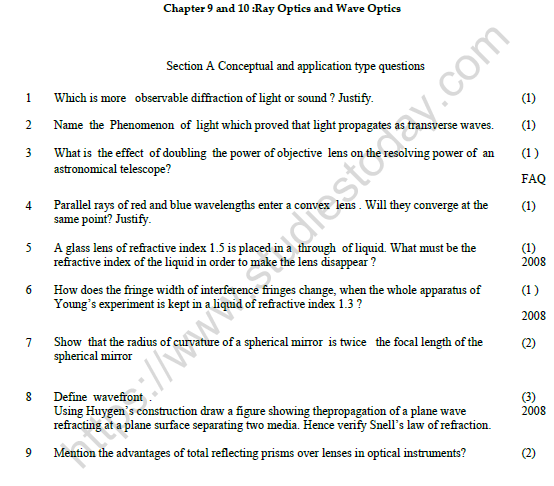
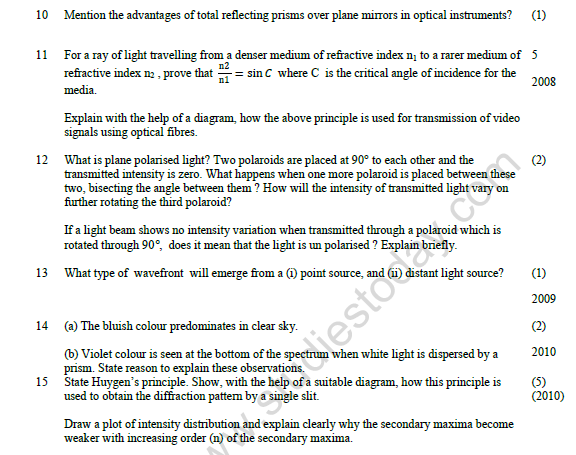
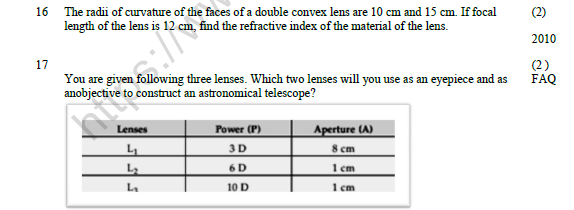


Please click on below link to download CBSE Class 12 Physics Ray Optics And Wave Optics Worksheet
Free study material for Physics
Download CBSE Practice Material: Class 12 Physics Chapter 09 Ray Optics and Optical Instruments
Download Practice Sheet: Chapter 09 Ray Optics and Optical Instruments (Class 12 Physics)
Explore reliable practice questions for Chapter 09 Ray Optics and Optical Instruments tailored for Class 12 Physics learners. Use these structured worksheets to evaluate preparedness and strengthen problem-solving skills.
Concept Clarification for Chapter 09 Ray Optics and Optical Instruments
Each worksheet is structured around standard CBSE textbooks, allowing students to check their working steps and correct mistakes early in their revision.
Additional Study Resources for Class 12 Physics
Follow up your worksheet practice by attempting the interactive online Physics MCQ test for this chapter to evaluate your execution speed. All platform resources are free to access.
FAQs
You can download the teacher-verified PDF for CBSE Class 12 Physics Ray Optics And Wave Optics Worksheet from StudiesToday.com. These practice sheets for Class 12 Physics are designed as per the latest CBSE academic session.
Yes, our CBSE Class 12 Physics Ray Optics And Wave Optics Worksheet includes a variety of questions like Case-based studies, Assertion-Reasoning, and MCQs as per the 50% competency-based weightage in the latest curriculum for Class 12.
Yes, we have provided detailed solutions for CBSE Class 12 Physics Ray Optics And Wave Optics Worksheet to help Class 12 and follow the official CBSE marking scheme.
Daily practice with these Physics worksheets helps in identifying understanding gaps. It also improves question solving speed and ensures that Class 12 students get more marks in CBSE exams.
All our Class 12 Physics practice test papers and worksheets are available for free download in mobile-friendly PDF format. You can access CBSE Class 12 Physics Ray Optics And Wave Optics Worksheet without any registration.