

Class 12 Physics Practice Set: Chapter 11 Dual Nature of Radiation and Matter
Review targeted practice sets for Class 12 Physics Chapter 11 Dual Nature of Radiation and Matter. Built according to official educational guidelines for the 2026-27 academic year, these downloadable worksheets support daily revision and core concept reinforcement.
Download Chapter 11 Dual Nature of Radiation and Matter Worksheet PDF
Navigate directly to the printable exercises for Chapter 11 Dual Nature of Radiation and Matter using the digital viewer below. Each practice set allows students to isolate specific topics for thorough review and uninterrupted practice alongside standard textbooks.
Question. The photoelectric work function for a metal surface is 4.125 eV. The cut-off wavelength for this surface is
(a) 4125 Å
(b) 3000 Å
(c) 6000 Å
(d) 2062 Å
Answer: B
Question. The energy of a photon of green light of wavelength 5000Å is
(a) 3.459 × 10⁻¹⁹ joule
(b) 3.973 × 10⁻¹⁹ joule
(c) 4.132 × 10⁻¹⁹ joule
(d) 8453 × 10–19 joule
Answer: B
Question. The photoelectric threshold of Tungsten is 2300Å. The energy of the electrons ejected from the surface by ultraviolet light of wavelength 1800Å is
(a) 0.15 eV
(b) 1.5 eV
(c) 15 eV
(d) 150 eV
Answer: A
Question. Which of the following when falls on a metal will emit photoelectrons ?
(a) UV radiations
(b) Infrared radiation
(c ) Radio waves
(d) Microwaves
Answer: A
Question. A light having wavelength 300 nm fall on a metal surface.
The work function of metal is 2.54 eV, what is stopping potential ?
(a) 2.3 V
(b) 2.59 V
(c) 1.59 V
(d) 1.29 V
Answer: C
Question. A and B are two metals with threshold frequencies 1.8 × 10¹⁴ Hz and 2.2 × 10¹⁴ Hz. Two identical photons of energy 0.825 eV each are incident on them. Then photoelectrons are emitted in (Take h = 6.6 × 10⁻³⁴ Js)
(a) B alone
(b) A alone
(c) neither A nor B
(d) both A and B.
Answer: B
Question. The photoelectric threshold wavelength of silver is 3250 × 10–10m. The velocity of the electron ejected from a silver surface by ultraviolet light of wavelength 2536 × 10–10 m is (Given h = 4.14 × 10⁻¹⁵ eVs and c = 3 × 10⁸ ms–1)
(a) ≈ 0.6 × 10⁶ ms–1
(b) ≈ 61 × 103 ms–1
(c) ≈ 0.3 × 10⁶ ms–1
(d) ≈ 6 × 10⁵ ms–1
Answer: A,D
Question. An ionisation chamber, with parallel conducting plates as anode and cathodes has singly charged positive ions per cm3. The electrons are moving toward the anode with velocity 0.4 m/s. The current density from anode to cathode is X104 m A/m2. The velocity of positive ions moving towards cathode is
(a) 0.1 m/s
(b) 0.4 m/s
(c) zero
(d) 1.6 m/s
Answer: A
Question. The threshold frequency for photoelectric effect on sodium corresponds to a wavelength of 5000 Å. Its work function is
(a) 4 × 10–19 J
(b) 1 J
(c) 2 × 10–19 J
(d) 3 × 10–19 J
Answer: A
Question. A particle is dropped from a height H. The de-Broglie wavelength of the particle as a function of height is proportional to
(a) H
(b) H1/2
(c) H0
(d) H–1/2
Answer: D
Question. Hard X-rays for the study of fractures in bones should have a minimum wavelength of 10–11 m. The accelerating voltage for electrons in X-ray machine should be
(a) < 124 kV
(b) > 124 kV
(c) between 60 kV and 70 kV
(d) = 100 kV
Answer: A
Question. A parallel beam of light is incident normally on a plane surface absorbing 40% of the light and reflecting the rest. If the incident beam carries 60 watt of power, the force exerted by it on the surface is
(a) 3.2 × 10⁻⁸ N
(b) 3.2 × 10⁻⁷ N
(c) 5.12 × 10⁻⁷ N
(d) 5.12 × 10⁻⁸ N
Answer: B
Question. Radiations of two photon’s energy, twice and ten times the work function of metal are incident on the metal surface successsively. The ratio of maximum velocities of photoelectrons emitted in two cases is
(a) 1 : 2
(b) 1 : 3
(c) 1 : 4
(d) 1 : 1
Answer: B
Question. The momentum of a photon of wavelength λ is
(a) hλ
(b) h/λ
(c) λ/h
(d) h/cλ
Answer: B
Question. A photocell is illuminated by a small bright source placed 1 m away. When the same source of light is placed 2 m away, the number of electrons emitted by photocathode are reduced by a factor of
(a) 1/8
(b) 1/16
(c) 1/2
(d) 1/4
Answer: D
Question. The wavelength of Kα-line characteristic X-rays emitted by an element is 0.32 Å. The wavelength of Kβ-line emitted by the same element will be
(a) 0.32 Å
(b) 0.39 Å
(c) 0.49 Å
(d) 0.27 Å
Answer: D
Question. Which metal will be suitable for a photoelectric cell using light of wavelength 4000Å. The work functions of sodium and copper are respectively 2.0 eV and 4.0 eV.
(a) Sodium
(b) Copper
(c) Both
(d) None of these
Answer: A
Question. Which one of the following graphs represents the variation of maximum kinetic energy (EK) of the emitted electrons with frequency u in photoelectric effect correctly ?
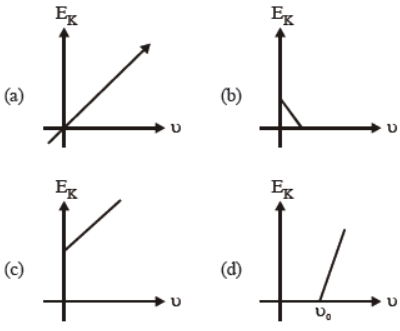
Answer: D
Question. The X-rays of wavelength 0.5 Å are scattered by a target.
What will be the energy of incident X-rays, if these are scattered at an angle of 72º ?
(a) 12.41 keV
(b) 6.2 keV
(c) 18.6 keV
(d) 24.82 keV
Answer: D
Question. In which of the following, emission of electrons does not take place?
(a) Thermionic emission
(b) X-rays emission
(c) Photoelectric emission
(d) Secondary emission
Answer: B
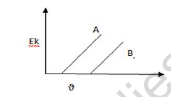
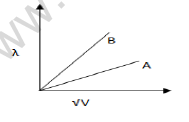
Please click on below link to download CBSE Class 12 Physics Dual Nature of Radiation Worksheet Set A
Free study material for Physics
Download CBSE Practice Material: Class 12 Physics Chapter 11 Dual Nature of Radiation and Matter
Chapter 11 Dual Nature of Radiation and Matter Printable Worksheet for Class 12 Physics
Review targeted practice exercises for Class 12 Physics Chapter 11 Dual Nature of Radiation and Matter. Curated to match official CBSE guidelines, these downloadable PDF sheets support daily revision and core concept reinforcement.
How to Use These Practice Sheets
Each worksheet is structured around standard CBSE textbooks, allowing students to check their working steps and correct mistakes early in their revision.
Enhance Speed with Online Practice
Explore our broader library of printable assignments, chapter notes, and mock tests designed to support continuous revision and secure higher marks in CBSE assessments.
FAQs
You can download the teacher-verified PDF for CBSE Class 12 Physics Dual Nature of Radiation Worksheet Set 01 from StudiesToday.com. These practice sheets for Class 12 Physics are designed as per the latest CBSE academic session.
Yes, our CBSE Class 12 Physics Dual Nature of Radiation Worksheet Set 01 includes a variety of questions like Case-based studies, Assertion-Reasoning, and MCQs as per the 50% competency-based weightage in the latest curriculum for Class 12.
Yes, we have provided detailed solutions for CBSE Class 12 Physics Dual Nature of Radiation Worksheet Set 01 to help Class 12 and follow the official CBSE marking scheme.
Daily practice with these Physics worksheets helps in identifying understanding gaps. It also improves question solving speed and ensures that Class 12 students get more marks in CBSE exams.
All our Class 12 Physics practice test papers and worksheets are available for free download in mobile-friendly PDF format. You can access CBSE Class 12 Physics Dual Nature of Radiation Worksheet Set 01 without any registration.