

Practice Worksheets for Class 12 Physics: Chapter 07 Alternating Current
Explore reliable practice materials for Chapter 07 Alternating Current tailored for Class 12 learners. Utilizing these Physics worksheets ensures thorough preparation and strengthens problem-solving speed for upcoming school assessments.
Practice Chapter 07 Alternating Current Worksheets for Class 12 Physics
Access the complete worksheet PDF for Chapter 07 Alternating Current below. Regular practice with these targeted questions builds familiarity with standard exam patterns and helps secure higher marks in final Physics evaluations.
Question. The r.m.s value of an a.c. of 50 Hz is 10 amp. The time taken by the alternating current in reaching from zero to maximum value and the peak value of current will be
(a) 2 × 10⁻² sec and 14.14 amp
(b) 1 × 10⁻² sec and 7.07 amp
(c) 5 × 10⁻³ sec and 7.07 amp
(d) 5 × 10⁻³ sec and 14.14 amp
Answer: D
Question. The primary winding of transformer has 500 turns whereas its secondary has 5000 turns. The primary is connected to an A.C. supply of 20 V, 50 Hz. The secondary will have an output of
(a) 2 V, 5 Hz
(b) 200 V, 500 Hz
(c) 2V, 50 Hz
(d) 200 V, 50 Hz
Answer: D
Question. The primary winding of transformers has 500 turns whereas its secondary has 5000 turns. The primary is connected to an A.C. supply of 20 V, 50 Hz. The secondary will have an output of
(a) 2V, 5Hz
(b) 200 V, 500 Hz
(c) 2V, 50 Hz
(d) 200 V, 50Hz
Answer: D
Question. An alternating current generator has an internal reactance Rg and an internal reactance Xg. It is used to supply power to a passive load consisting of a resistance Rg and a reactance XL. For maximum power to be delivered from the generator to the load, the value of XL is equal to
(a) zero
(b) Xg
(c) –Xg
(d) Rg
Answer: C
Question. An alternating voltage E (in volts) = 200√2 sin 100 t is connected to one micro farad capacitor through an a.c. ammeter. The reading of the ammeter shall be
(a) 100 mA
(b) 20 mA
(c) 40 mA
(d) 80 mA
Answer: B
Question. A small signal voltage V(t) = V0 sin wt is applied across an ideal capacitor C :
(a) Current I (t), lags voltage V(t) by 90°.
(b) Over a full cycle the capacitor C does not consume any energy from the voltage source.
(c) Current I (t) is in phase with voltage V(t).
(d) Current I (t) leads voltage V(t) by 180°.
Answer: B
Question. In a circuit inductance L and capacitance C are connected as shown in figure. A1 and A2 are ammeters.
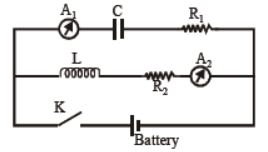
When key K is pressed to complete the circuit, then just after closing key (K), the readings of A1 and A2 will be
(a) zero in both A1 and A2
(b) maximum in both A1 and A2
(c) zero in A1 and maximum in A2
(d) maximum in A1 and zero in A2
Answer: D
Question. The frequency of A.C. mains in India is
(a) 30 c/s
(b) 50 c/s
(c) 60 c/s
(d) 120 c/s
Answer: B
Question. The time constant of C–R circuit is
(a) 1/CR
(b) C/R
(c) CR
(d) R/C
Answer: C
Question. An inductor of reactance 1W and a resistor of 2Ω are connected in series to the terminals of a 6V (rms) AC source.
The power dissipated in the circuit is
(a) 8 Ω
(b) 12 Ω
(c) 14.4 Ω
(d) 18 Ω
Answer: C
Question. In the circuit shown, when the switch is closed, the capacitor charges with a time constant

(a) RC
(b) 2RC
(c) 1/2 RC
(d) RC ln 2
Answer: A
Question. In an experiment, 200 V A.C. is applied at the ends of an LCR circuit. The circuit consists of an inductive reactance (XL ) = 50 Ω, capacitive reactance (XC ) = 50 W and ohmic resistance (R) = 10 Ω. The impedance of the circuit is
(a) 10Ω
(b) 20Ω
(c) 30Ω
(d) 40Ω
Answer: A
Question. When a voltage measuring device is connected to AC mains, the meter shows the steady input voltage of 220 V. This means
(a) input voltage cannot be AC voltage, but a DC voltage
(b) maximum input voltage is 220 V
(c) the meter reads not v but < v2 > and is calibrated to read √< v2 >
(d) The pointer of the meter is stuck by some mechanical defect
Answer: C
Question. A step-up transformer has transformation ratio of 3 : 2. What is the voltage in secondary, if voltage in primary is 30 V?
(a) 45 V
(b) 15 V
(c) 90 V
(d) 300 V
Answer: A
Question. A transformer has an efficiency of 80%. It works at 4 kW and 100 V. If secondary voltage is 240 V, the current in primary coil is
(a) 0.4 A
(b) 4 A
(c) 10 A
(d) 40 A
Answer: D
Question. An inductance L having a resistance R is connected to an alternating source of angular frequency w. The Quality factor Q of inductance is
(a) R/ ωL
(b) (ωL/R)2
(c) (R /VL)1/2
(d) ωL/R
Answer: D
Question. The core of any transformer is laminated so as to
(a) reduce the energy loss due to eddy currents
(b) make it light weight
(c) make it robust and sturdy
(d) increase secondary voltage
Answer: A
Question. The primary of a transformer when connected to a dc battery of 10 volt draws a current of 1 mA. The number of turns of the primary and secondary windings are 50 and 100 respectively. The voltage in the secondary and the current drawn by the circuit in the secondary are respectively
(a) 20 V and 0.5 mA
(b) 20 V and 2.0 mA
(c) 10 V and 0.5 mA
(d) Zero and therefore no curren
Answer: D
Question. A transformer having efficiency of 90% is working on 200V and 3kW power supply. If the current in the secondary coil is 6A, the voltage across the secondary coil and the current in the primary coil respectively are :
(a) 300 V, 15A
(b) 450 V, 15A
(c) 450V, 13.5A
(d) 600V, 15A
Answer: B
Question. To reduce the resonant frequency in an L-C-R series circuit with a generator
(a) the generator frequency should be reduced
(b) another capacitor should be added in parallel to the first
(c) the iron core of the inductor should be removed
(d) dielectric in the capacitor should be removed
Answer: B
Question. The instantaneous voltage through a device of impedance 20 Ω is e = 80 sin 100 pt. The effective value of the current is
(a) 3 A
(b) 2.828 A
(c) 1.732 A
(d) 4 A
Answer: B
Question. In an LR circuit f = 50 Hz, L=2H, E=5 volts, R=1 Ω then energy stored in inductor is
(a) 50 J
(b) 25 J
(c) 100 J
(d) None of these
Answer: D
Directions for : Each question contains STATEMENT-1 and STATEMENT-2. Choose the correct answer from the following-
(a) Statement -1 is false, Statement-2 is true
(b) Statement -1 is true, Statement-2 is true; Statement -2 is a correct explanation for Statement-1
(c) Statement -1 is true, Statement-2 is true; Statement -2 is not a correct explanation for Statement-1
(d) Statement -1 is true, Statement-2 is false
Question. Statement - 1 : In the purely resistive element of a series LCR, AC circuit the maximum value of rms current increases with increase in the angular frequency of the applied emf.

Answer: C
Question. Statement - 1 : A capacitor blocks direct current in the steady state.
Statement - 2 : The capacitive reactance of the capacitor is inversely proportional to frequency f of the source of emf.
Answer: B
1 Mark Questions:
Question. The peak value of emf in ac is E0. Write its (i) rms (ii) average value over a complete cycle.
Answer. peak value of emf in ac = E0
(i) Erms = E0/√2
(ii) Eavg= 0
Question. The power factor of an a.c. circuit 0.5. What is the phase difference between voltage and current in the circuit?
Answer. Power factor= cos ϕ =0.5 =1/2
ϕ =60°
There is a phase difference of 60°
Question. An inductor is connected in series with a bulb to an a.c. source. What happens to brightness of bulb when number of turns in the inductor is reduced?
Answer.
Current through the bulb
Irms = Vrms/ Z
Z= [R2 +ω2 L2]1/2
When the no. of turns n in the inductor increases, L will increase as L∝n2 so Z will increase which will lead to decrease in the current flowing through the bulb, so the brightness of the bulb will decrease
3 Mark Questions:
Question. A circuit containing an 80 mH inductor and a 250 μF capacitor connected in series connected to a 240 V, 100 rad/s supply. The resistance of the circuit is negligible. Obtain (i) rms value of the current (ii) What is the total average power consumed by the circuit?
Answer.
(i) L= 80 mH = 80 × 10-3 H, C= 250 μF, Vrms = 240 V, ω=100 rad/s
Irms XC- Irms XL = 240, Irms =240 / XC-XL
= 240 / [(1/ 100 × 250 × 10-6)- (100 × 80 × 10-3 )]
Irms = 240/ (40-8) = 240/32= 7.5 A
(ii) Total average power consumed by the circuit is zero.
Question. A resistor of 200 ohm and a capacitor of 15 μF are connected in series to a 220 V, 50 Hz ac source. Calculate the current in the circuit and rms voltage across the resistor and the capacitor. Is the algebraic sum of these voltages more than the source voltage? If yes, resolve the paradox.
Answer.
Given R= 200 ohm , C= 15 ×10-6 F , V=220 V, f=50 Hz
Capacitive reactance, XC = 1/ (2 ×3.14 ×50 × 15 ×10-6) = 212 ohm
Impedance of circuit, Z= [R2 + XC 2]1/2 = [(200)2 + (212) 2]1/2 = 291.5 ohm
Irms = Vrms /Z = 220/ 291.5 = 0.75 A
Voltage across resistance, VR = IR = 200 × 0.75= 150 V
Voltage across capacitor, VC = IXC = 212 × 0.75= 159 V
Algebraic sum of VR and VC = VR+ VC = 150+159= 309 V > 212 V
This is because these voltage are not in same phase but VC lags behind VR by an angle 𝝅/2
So V= [VR 2 + VC 2]1/2 = [(150) 2 + (159) 2]1/2 =220 V
Case Study
1. An AC source of emf E = Em sinωt is connected in series with an inductor of inductance L. The instantaneous current in the circuit is I = Im sin (ωt−π/2). The inductive reactance is XL = Lω.
Question. A 50 Hz AC is flowing in a 14 mH coil. The reactance of the circuit is
(a) 15 Ω
(b) 7.5 Ω
(c) 8.8 Ω
(d) 4.4 Ω
Answer. D
Question. In a pure inductive circuit, the resistance offered to current is called
(a) Resistance
(b) Inductive reactance
(c) Capacitive reactance
(d) Resistance and reactance
Answer. B
Question. In a pure inductive circuit, the phase angle between current and emf.
(a) 120o
(b) 90o
(c) 45o
(d) 60o
Answer. B
Question. How much inductance should be connected to 100V, 50Hz AC supply so that a maximum current of 0.45A flows through it
(a) 5 H
(b) 15 H
(c) 1 H
(d) 10 H
Answer. C
Question. Find the maximum value of current when inductance of 2 H is connected to 300V, 50 Hz supply.
(a) 0.337 V
(b) 0.676 V
(c) 1.512 V
(d) 2.224 V
Answer. B
2. Transformer is a device which works only in AC not in DC, it working principle is mutual induction. It changes AC voltage and current but does not alter the frequency of AC. A transformer consists of two coils wounded over a soft iron core.
The number of turns in the primary and secondary coils of a transformer are 1000 and 100 respectively. The primary coil is connected to a main supply of 12 V and secondary is connected to a resistor of resistance 6 Ω.
Question. The value of output voltage in the secondary coil is
(a) 1.2 V
(b) 3 V
(c) 12 V
(d) 6 V
Answer. A
Question. The value of current flowing through the resistor connected in the secondary
(a) 0.6 A
(b) 0.2 A
(c) 2 A
(d) 3A
Answer. B
Question. The value of current in the primary coil is
(a) 2 A
(b) 0.2 A
(c) 0.02 A
(d) 0.4 A
Answer. C
Question. The power dissipated in the primary coil is
(a) 12 W
(b) 0.24 W
(c) 24 W
(d) 6 W
Answer. B
Question. The power dissipated in the primary coil is
(a) 12 W
(b) 24 W
(c) 0.24 W
(d) 6 W
Answer. C

Please click on below link to download CBSE Class 12 Physics Alternating Current Worksheet Set B
Free study material for Physics
Practice Worksheet and Study Resources for Class 12 Physics Chapter 07 Alternating Current
Download Practice Sheet: Chapter 07 Alternating Current (Class 12 Physics)
Explore reliable practice questions for Chapter 07 Alternating Current tailored for Class 12 Physics learners. Use these structured worksheets to evaluate preparedness and strengthen problem-solving skills.
Concept Clarification for Chapter 07 Alternating Current
Each worksheet is structured around standard CBSE textbooks, allowing students to check their working steps and correct mistakes early in their revision.
Additional Study Resources for Class 12 Physics
Explore our broader library of printable assignments, chapter notes, and mock tests designed to support continuous revision and secure higher marks in CBSE assessments.
FAQs
You can download the teacher-verified PDF for CBSE Class 12 Physics Alternating Current Worksheet Set 02 from StudiesToday.com. These practice sheets for Class 12 Physics are designed as per the latest CBSE academic session.
Yes, our CBSE Class 12 Physics Alternating Current Worksheet Set 02 includes a variety of questions like Case-based studies, Assertion-Reasoning, and MCQs as per the 50% competency-based weightage in the latest curriculum for Class 12.
Yes, we have provided detailed solutions for CBSE Class 12 Physics Alternating Current Worksheet Set 02 to help Class 12 and follow the official CBSE marking scheme.
Daily practice with these Physics worksheets helps in identifying understanding gaps. It also improves question solving speed and ensures that Class 12 students get more marks in CBSE exams.
All our Class 12 Physics practice test papers and worksheets are available for free download in mobile-friendly PDF format. You can access CBSE Class 12 Physics Alternating Current Worksheet Set 02 without any registration.