

Download NEET MCQs for NEET Chemistry: S Block Elements
Access targeted multiple-choice questions for S Block Elements designed to align with the latest NEET academic syllabus for NEET Chemistry. These objective practice sets help students evaluate their conceptual understanding and improve exam readiness.
Chapter-wise Objective Questions: S Block Elements
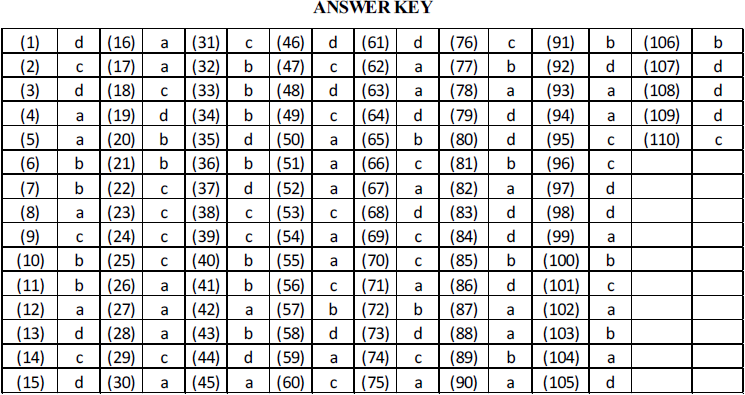
Navigate directly to the 50 objective questions for S Block Elements using the digital viewer below. Each practice set includes verified answer keys, allowing students to instantly cross-check their work and identify areas requiring further revision.
Important Points
Group-1 (alkali metals) and group-2 (alkaline earth me als) are included in the sblock elements of the periodic table. They are known like this because their oxides and hydroxides are alkaline in nature. Alkali metals possess one and alkaline earth metals possess two s-electrons. They are highly electropositive metals and form monovalent cations (M+) and divalent cations (M2+) respectively.
With the increase in atomic number, the physical and chemical properties of alkali metals show regular trend. The atomic and ionic sizes increase on going down in the group and ionization enthalpies decrease in alkali metals. The same type of trend is observed in alkaline earth metals. The first element of each of these two groups, namely, lithium in group-1 and beryllium in group-2 show similarities with the element of the next group viz. Li-Mg and Be- Al. This is called diagonal relationship. In fact, the first element of each group shows difference with other elements in the same group i.e their behaviour is anomalous. Alkali elements are bright white, soft metals melting at low temperatures. Li and Na are obtained by electrolysis. They are very active and their compounds are ionic. Their oxides and hydroxides are soluble in water and give strong alkaline solution. Amongst important compounds of sodium are sodium carbonate, sodium hydrogencarbonate, sodium hydroxide, NaOH is produced by Castner Kellner process and sodium carbonate by Solvay ammonia soda process.
The chemistry of alkaline earth metals is similar to that of alkali metals. Even then some differences are there, because the atomic and ionic sizes of alkaline earth metals decrease and the charge of the cation increases. Their oxides are less basic than those of alkali metals.
Amongst the industrially important compounds of sodium are caustic soda, washing soda and those of calcium are calcium oxide, calcium hydroxide, plaster of Paris, calcium carbonate and Portland cement. The production of cement can be carried out by grinding the mixture of lime stone and clay and heating it in rotary kiln. The clinker obtained is mixed with gypsum (2-3%) which gives fine powder of cement. All these substances have many uses.
Monovalent sodium and potassium ions and divalent magnesium and calcium ions are found in larger proportion in biological fluid in a human being. These ions carry out important biological functions like maintenance of ionic equilibrium and nerve impulse conduction which is known as sodium-potassium pump.
M.C.Q.
(1) The alkali metals are low melting. Which of the following alkali metal is expected to melt if the room tempreature rises to 30°c ?
(a) Na (b) K (c) Rb (d) Cs
(2) The reducing power of a metal depends on various factors. Suggest the factor which makes Li, the strongest reducing agent in aqueous solution.
(a) Sublimation enthalpy (b) Ionisation enthalpy
(c) Hydration enthalpy (d) Electron - gain enthalpy
(3) Metal carbonates decompose on heating to give metal oxide and carbondioxide. Which of the metal carbonates is most stable thermally ?
(a) MgCO3 (b) CaCO3 (c) SrCO3 (d) BaCO3
(4) Which of the following metal hydroxide is the least basic ?
(a) Mg(OH)2 (b) Ca(OH)2 (c) Sr(OH)2 (d) Ba(OH)2
(5) Some of the group - 2 metal halides are covalent and soluble in organic solvents. Among the following metal halides, the one which is soluble in ethanol is ___
(a) BeCl2 (b) MgCl2 (c) CaCl2 (d) SrCl2
(6) The order of decreasing ionisation enthalpy in alkali metal is
(a) Na > Li > K > Rb (b) Li > Na > K > Rb
(c) Rb > Na > K > Li (d) K < Li < Na < Rb
(7) The solubility of metal halides depends on their nature, lattice enthalpy and hydration enthalpy of the individual ions. Among the fluorides of alkali metals, the lowest solubility of LiF in water is due to___
(a) Ionic nature of lithium fluoride (b) High lattice enthalpy
(c) High hydration enthalpy for lithium ion. (d) Low ionisation enthalpy of lithium atom.
(8) Amphoteric hydroxides react with both alkalies and acids. Which of the following Group - 2 metal hydroxides is soluble in sodium hydroxide ?
(a) Be(OH)2 (b) Mg(OH)2 (c) Ca(OH)2 (d) Ba(OH)2
(9) In the synthesis of sodium carbonate, the recovery of ammonia is done by treating NH4Cl with Ca(OH)2.The by product obtained in this process is___
(a) NaCl (b) NaOH (c) CaCl2 (d) NaHCO3
(10) When sodium is dissolved in liquid ammonia, a solution of deep blue colour is obtained. The colour of the solution is due to ___
(a) sodium ion (b) ammoniated electron (c) sodium amide (d) ammoniated sodium ion
(11) By adding gypsum to cement ____
(a) setting time of cement becomes less. (b) setting time of cement increases
(c) colour of cement becomes light (d) shining surface is obtained
(12) Dead burnt plaster is ___
(a) CaSO4 (b) CaSO4 ×H2O (c) CaSO4 × ½ H2O (d) CaSO4 ×2H2O
(13) A substance which gives crimson red flame and breaks on heating to give oxygen and a brown gas is ___
(a) Magnesium nitrate (b) Calcium nitrate (c) Barium nitrate (d) Strontium nitrate
(14) The formula of sodash is ___
(a) Na2CO3 ×10H2O (b) Na2CO3 × 2 H2O (c) Na2CO3 (d) Na2CO3 × H2O
(15) Which of the following compounds are readily soluble in water ?
(a) BeSO4 (b) MgSO4 (c) BaSO4 (d) both (a) and (b)
(16) Identify the correct formula of halides of alkaline earth metals from the following.
(a) BaCl2 • 2H2O (b) BaCl2 • 4H2O (c) CaCl2 • 4H2O (d) SrCl2 • 4H2O
(17) Which of the following statement is true about Ca(OH)2 ?
(a) It is used in the preparation of bleaching powder.
(b) It is a light blue solid.
(c) It does not possess disinfectant property.
(d) It is used in the manufacture of cement.
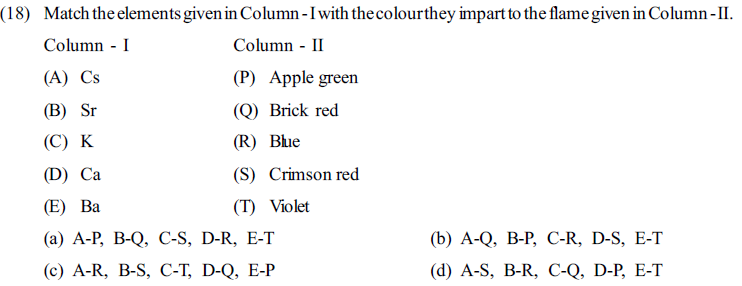
(19) When water is added to compound (A) of calcium, solution of compound (B) is formed. When CO2 is passed into the solution, it turns milky due to the formation of compound (C). If excess of carbon dioxide is passed into the solution, milkiness disappears due to the formation of compound (D). Identify the compound (D).
(a) CaO (b) Ca(OH)2 (c) CaCO3 (d) Ca(HCO3)2
(20) Which alkali metal emits longest wavelength light in Flame test ?
(a) Na (b) K (c) Cs (d) Li
(21) Which of the following is not known ?
(a) KO3 (b) KO4 (c) KO2 (d) K2O2
(22) Which of the following acts as reducing as well as oxidising agent ?
(a) NaNO3 (b) Na2O2 (c) Na2O (d) KNO3
(23) The salt that is added to table salt to make it flow freely in rainy season is ___
(a) KCl (b) KI (c) Ca3(PO4)2 (d) Na3PO4
(24) Which of the following alkaline earth metal sulphates is least soluble in water ?
(a) MgSO4 (b) CaSO4 (c) BaSO4 (d) SrSO4
(25) The hydration energy of Mg2+ is greater than that of ___
(a) Al3+ (b) Be2+ (c) Na+ (d) Mg3+
(26) The active constituent of bleaching powder is ___
(a) Ca(OCl)2 (b) Ca(OCl)Cl (c) Ca(ClO2)2 (d) Ca(ClO2)Cl
(27) KO2 is used in oxygen cylinders in space and submarines because it___
(a) absorbs CO2 and increases O2 content (b) eliminates moisture
(c) produces ozone (d) None of the above
(28) A metal M readily forms water soluble sulphate MSO4, water insoluble hydroxide and oxide MO which becomes inert on heating. The hydroxide is soluble in NaOH. The metal M is___
(a) Be (b) Ca (c) Mg (d) Sr
(29) Which of the following is sparingly soluble in water ?
(a) NaOH (b) KOH (c) LiOH (d) RbOH
(30) Photo electric effect is maximum in____
(a) Cs (b) K (c) Na (d) Li
(31) Among the following compounds of cement which is present in the highest amount ?
(a) Ca2SiO4 (b) Al2O3 (c) Ca3SiO5 (d) Ca3Al2O6
(32) Which pair of the following chlorides do not impart colour to the flame ?
(a) BeCl2 and SrCl2 (b) BeCl2 and MgCl2
(c) BaCl2 and CaCl2 (d) MgCl2 and CaCl2
(33) The sequence of hydration enthalpy in following ion is ____
(a) Rb+ > K+ > Cs+ > Na+ > Li+ (b) Li+ > Na+ > K+ > Rb+ > Cs+
(c) K+ >Na+ > Rb+ > Cs+ > Li+ (d) Cs+ >Rb+ > K+ > Na+ > Li+
(34) In case of alkali metals, the covalent character increases in the order :
(a) MI > MBr > MCl < MF (b) MF < MCl < MBr < MI
(c) MBr < MCl < MI < MF (d) MF < MBr < MCl < MI
(35) Among the following the least thermally stable is ?
(a) K2CO3 (b) Na2CO3 (c) BaCO3 (d) Li2CO3
(36) Which of the following oxides is amphoteric in nature ?
(a) MgO (b) BeO (c) CaO (d) BaO
(37) Which of the following characteristics is not related to alkali metals ?
(a) Their ions are iso electronic with noble gases.
(b) low melting point (c) low electronegativity (d) high ionisation energy
(38) Fill in the blanks with proper option given below for the following statement.
“All the halides of alkaline earth metals with exception of ‘‘______ ’’ are ionic in nature.”
(a) Barium halide (b) Strontium halide (c) Beryllium halide (d) Calcium halide
(39) K2CO3 can not be prepared by solvay ammonia process because ___
(a) K2CO3 is fairly soluble in water. (b) It has no water of crystallization.
(c) KHCO3 is highly soluble in water. (d) K2CO3 decomposes in H2O.
(40) The reaction of Cl2 with X gives bleaching powder X is____
(a) CaO (b) Ca(OH)2 (c) Ca(OCl)2 (d) Ca(O3Cl)2
(41) Which of the following alkaline earth metal sulphates has hydration enthalpy higher than the lattice enthalpy ?
(a) SrSO4 (b) MgSO4 (c) CaSO4 (d) BaSO4
(42) A compound (A) on heating gives a colourless gas and a residue that is dissolved in water to obtain (B). Excess of CO2 is bubbled through aqueous solution of B, (C) is formed, which is recovered in the solid form. Solid (C) on gentle heating gives back (A). The compound is ___
(a) CaCO3 (b) K2CO3 (c) Na2CO3 (d) CaSO4 × 2H2O
(43) For alkaline metal, which of the following trends is incorrect ?
(a) Hydration enthalpy : Be > Mg > Ca > Sr
(b) Second Ionization enthalpy: Be > Mg > Ca > Sr
(c) Density : Sr > Be > Mg > Ca
(d) Atomic size : Sr > Ca > Mg > Be
(44) Which of the following compounds is most stable ?
(a) LiCl (b) LiI (c) LiBr (d) LiF
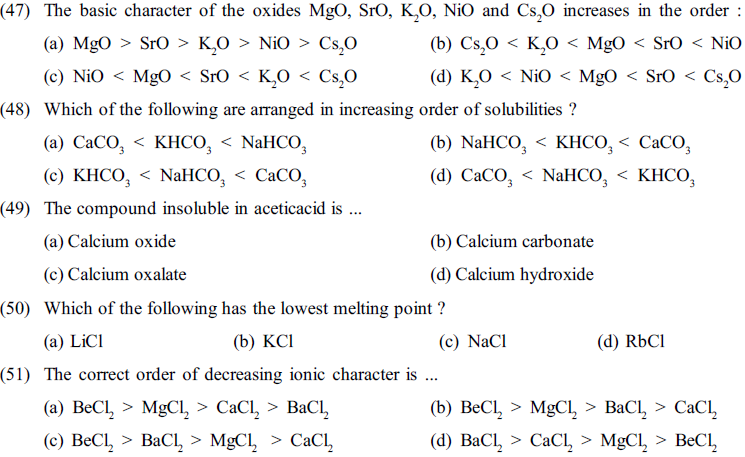
(45) Flame test is not given by___
(a) Be (b) Sr (c) K (d) Ca
(46) The alkaline earth metals forming ionic oxides are___
(a) MgO (b) BeO (c) CaO (d) (a) and (c)
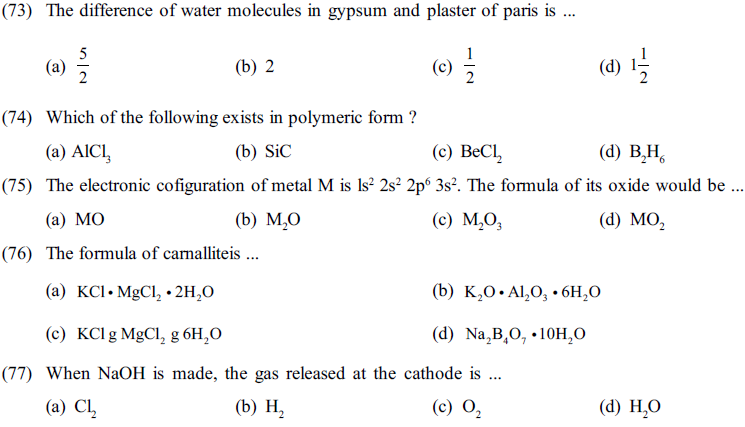
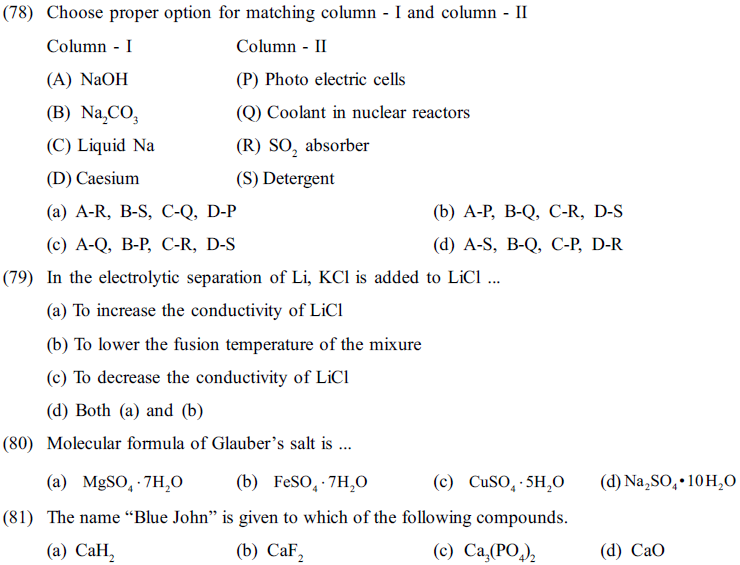
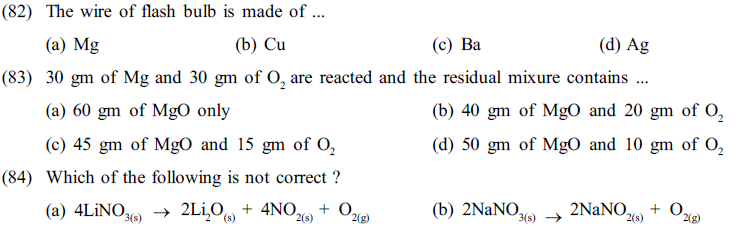
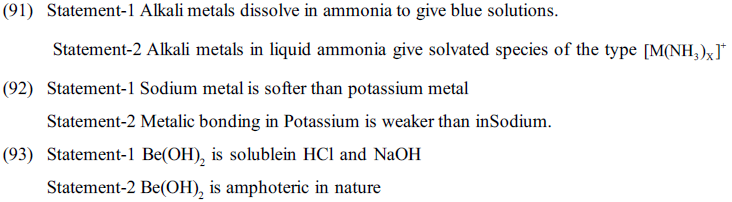
Download Chapter MCQs: NEET Chemistry S Block Elements
Download Multiple Choice Questions: S Block Elements (NEET Chemistry)
Test your conceptual understanding of S Block Elements with these targeted multiple-choice questions. Designed in alignment with the latest NEET curriculum for NEET Chemistry, these problem sets build accuracy and prepare students for objective exams.
Concept Clarification for S Block Elements
Built using the official NCERT book for NEET, these Chemistry objective sets provide reliable academic guidance. Pair your practice with our recommended NCERT solutions to master optimal problem-solving approaches.
Additional Study Resources for NEET Chemistry
Explore our broader library of printable assignments, chapter notes, and mock tests designed to support continuous revision and secure higher marks in NEET assessments.
FAQs
You can get most exhaustive NEET UG Chemistry S Block Elements MCQs for free on StudiesToday.com. These MCQs for NEET Chemistry are updated for the 2026-27 academic session as per NEET examination standards.
Yes, our NEET UG Chemistry S Block Elements MCQs include the latest type of questions, such as Assertion-Reasoning and Case-based MCQs. 50% of the NEET paper is now competency-based.
By solving our NEET UG Chemistry S Block Elements MCQs, NEET students can improve their accuracy and speed which is important as objective questions provide a chance to secure 100% marks in the Chemistry.
Yes, Chemistry MCQs for NEET have answer key and brief explanations to help students understand logic behind the correct option as its important for 2026 competency-focused NEET exams.
Yes, you can also access online interactive tests for NEET UG Chemistry S Block Elements MCQs on StudiesToday.com as they provide instant answers and score to help you track your progress in Chemistry.