

Practice MCQs for NEET Chemistry Redox Reactions
Access targeted multiple-choice questions for Redox Reactions designed to align with the latest NEET academic syllabus for NEET Chemistry. These objective practice sets help students evaluate their conceptual understanding and improve exam readiness.
Access Redox Reactions Questions and Solutions
Access the complete set of multiple-choice questions for Redox Reactions below. This focused format allows students to isolate specific topics for thorough review and uninterrupted practice alongside official NEET textbooks.
Question: The number of moles of KMnO4 that will be needed to react with one mole of sulphite ion in acidic solution is
- a) 1
- b) 3/5
- c) 4/5
- d) 2/5
Answer: 2/5
Question: Standard reduction potentials of the half reactions are given below
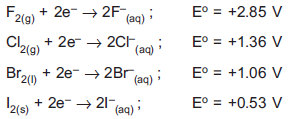
The strongest oxidising and reducing agents respectively are
- a) F2and I–
- b) Br2 and Cl–
- c) Cl2 and Br–
- d) Cl2 and I2
Answer: F2and I–
Question: Standard electrode potential for Sn4+ / Sn2+ couple is +0.15 V and that for the Cr3+ / Cr couple is –0.74 V. These two couples in their standard state are connected to make a cell. The cell potential will be
- a) +1.83 V
- b) +1.19 V
- c) +0.89 V
- d) +0.18 V
Answer: +0.89 V
Question: Standard reduction electrode potential of three metals X, Y and Z are –1.2 V, +0.5 V and –3.0 V respectively. The reducing power of these metals will be
- a) X > Y > Z
- b) Y > Z > X
- c) Y > X > Z
- d) Z > X > Y
Answer: Z > X > Y
Question: In the reaction

- a) Oxygen is oxidised only
- b) Oxygen is reduced only
- c) Oxygen is neither oxidised nor reduced
- d) Oxygen is both oxidised and reduced
Answer: Oxygen is both oxidised and reduced
Question: Which change requires an oxidising agent?
- a)
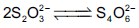
- b)

- c)

- d)
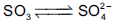
Answer:
Question: Given the following reactions involving A, B, C and D
(i) C + B+ → C+ + B (ii) A+ + D → No reaction
(iii) C+ + A → No reaction (iv) D + B+ → D+ + B
The correct arrangement of A, B, C, D in order of their decreasing ability as reducing agent
- a) D > B > C > A
- b) A > C > D > B
- c) C > A > B > D
- d) C > A > D > B
Answer: C > A > D > B
Question: Which element undergoes disproportionation in water?
- a) Cl2
- b) F2
- c) K
- d) Cs
Answer: Cl2
Question: Standard reduction potentials at 25°C of Li+ / Li, Ba2+ / Ba, Na+ / Na and Mg2+ / Mg are –3.05, –2.90, –2.71 and –2.37 volt respectively. Which one of the following is the strongest oxidizing agent?
- a) Ba2+
- b) Mg2+
- c) Na+
- d) Li+
Answer: Mg2+
Question: Which substance is serving as a reducing agent in the following reaction?
14H+ + Cr2O72– + 3Ni → 7H2O + 3Ni2+ + Cr3+
- a) H+
- b) Cr2O72–
- c) H2O
- d) Ni
Answer: Ni
Question: Oxidation state of Fe in Fe3O4 is
- a) 5/4
- b) 4/5
- c) 3/2
- d) 8/3
Answer: 8/3
More Questions........................................................
Question: The oxide, which cannot act as a reducing agent, is
- a) CO2
- b) ClO2
- c) NO2
- d) SO2
Answer: CO2
Question: Oxidation numbers of A, B, C are +2, +5 and –2 respectively. Possible formula of compound is
- a) A2(BC2)2
- b) A3(BC4)2
- c) A2(BC3)2
- d) A3(B2C)2
Answer: A3(BC4)2
Question: The oxidation states of sulphur in the anions SO32–, S2O42– and S2O62– follow the order
- a) S2O42– < SO32– < S2O62–
- b) SO32– < S2O42– < S2O62–
- c) S2O42– < S2O62– < SO32–
- d) S2O62– < S2O42– < SO32–
Answer: S2O42– < SO32– < S2O62–
Question: Electrode potential for the following half-cell reactions are

The EMF for the cell reaction Fe2+ + Zn → Zn2+ + Fe will be
- a) – 0.32 V
- b) + 1.20 V
- c) – 1.20 V
- d) + 0.32 V
Answer: + 0.32 V
Question: In acidic medium, H2O2 changes  bonds. Oxidation state of Cr in CrO5 is
- a) +5
- b) +3
- c) +6
- d) –10
Answer: +6
Question: Standard reduction electrode potential of three metals X, Y and Z are –1.2 V, +0.5 V and –3.0 V respectively. The reducing power of these metals will be
- a) X > Y > Z
- b) Y > Z > X
- c) Y > X > Z
- d) Z > X > Y
Answer: Z > X > Y
Question: In which of the following compounds, nitrogen exhibits highest oxidation state?
- a) N3H
- b) NH2OH
- c) N2H4
- d) NH3
Answer: N3H
Question: Which of the following processes does not involve oxidation of iron?
- a) Liberation of H2 from steam by iron at high temperature
- b) Rusting of iron sheets
- c) Decolourization of blue CuSO4 solution by iron
- d) Formation of Fe(CO)5 from Fe
Answer: Formation of Fe(CO)5 from Fe
Question: The number of moles of H2O2 required to completely react with 400 ml of 0.5 N KMnO4 in acidic medium are
- a) 0.1
- b) 0.2
- c) 1.0
- d) 0.5
Answer: 0.1
Question: When benzaldehyde is oxidised to give benzoic acid then the oxidation state of carbon of aldehydic group is changed from
- a) +2 to +3
- b) +1 to +3
- c) Zero to +2
- d) No change
Answer: +1 to +3
Question: Which of the following is incorrect regarding salt bridge solution?
- a) Solution must be a strong electrolyte
- b) Solution should be inert towards both electrodes
- c) Size of cations and anions of salt should be much different
- d) Salt bridge solution is prepared in gelatin or agar-agar to make it semi-solid
Answer: Size of cations and anions of salt should be much different
Question: The average oxidation state of chlorine in bleaching powder is
- a) –1
- b) +1
- c) Zero
- d) –2 as well as +2
Answer: Zero
Question: Which compound acts as oxidising agent only?
- a) SO2
- b) H2S
- c) H2SO4
- d) HNO2
Answer: H2SO4
Question: In case of CH3COOH, the oxidation number of carbon of carboxylic group is
- a) –3
- b) Zero
- c) +1
- d) +3
Answer: +3
Question: When an alkali metal is reacted with hydrogen then metallic hydride is formed. In this reaction
- a) Hydrogen is oxidised
- b) Hydrogen is reduced
- c) Hydrogen is neither oxidised nor reduced
- d) Hydrogen is oxidised as well as reduced
Answer: Hydrogen is reduced
Question: Three metals A, B and C are arranged in increasing order of standard reduction electrode potential, hence their chemical reactivity order will be
- a) A < B < C
- b) A > B > C
- c) B > C > A
- d) A = B = C
Answer: A > B > C
Question: Number of electrons involved in the reaction when 0.1 mol NH3 dissolved in water
- a) 2
- b) 0.4
- c) 0.9
- d) Zero
Answer: Zero
Question: Electrode potential depends upon
- a) Size of electrode
- b) Surface area of electrode
- c) Temperature
- d) Shape of electrode
Answer: Temperature
Question: In the process of photosynthesis, which takes place in green plants which undergoes reduction?
- a) Water
- b) CO2
- c) Protons
- d) Photons
Answer: CO2
Download Chapter MCQs: NEET Chemistry Redox Reactions
NEET Chemistry Redox Reactions Objective Test Questions
Test your conceptual understanding of Redox Reactions with these targeted multiple-choice questions. Designed in alignment with the latest NEET curriculum for NEET Chemistry, these problem sets build accuracy and prepare students for objective exams.
NCERT-Aligned Objective Questions and Solutions
Cross-reference your completed choices with comprehensive NCERT solutions for NEET Chemistry to ensure absolute clarity across all sub-topics in this chapter.
Next Steps in Your Exam Preparation
Wrap up your chapter revision by testing your knowledge against standard question formats. Everything on our platform is provided free of charge.
FAQs
You can get most exhaustive NEET Chemistry Redox Reactions MCQs Set 02 for free on StudiesToday.com. These MCQs for NEET Chemistry are updated for the 2026-27 academic session as per NEET examination standards.
Yes, our NEET Chemistry Redox Reactions MCQs Set 02 include the latest type of questions, such as Assertion-Reasoning and Case-based MCQs. 50% of the NEET paper is now competency-based.
By solving our NEET Chemistry Redox Reactions MCQs Set 02, NEET students can improve their accuracy and speed which is important as objective questions provide a chance to secure 100% marks in the Chemistry.
Yes, Chemistry MCQs for NEET have answer key and brief explanations to help students understand logic behind the correct option as its important for 2026 competency-focused NEET exams.
Yes, you can also access online interactive tests for NEET Chemistry Redox Reactions MCQs Set 02 on StudiesToday.com as they provide instant answers and score to help you track your progress in Chemistry.