

Chemistry Objective Questions and Answers: Biomolecule
Review structured MCQ sets for NEET Chemistry Biomolecule. Built according to official NEET guidelines, these downloadable questions support daily revision and core concept reinforcement.
Download Biomolecule MCQs with Answers
Access the complete set of multiple-choice questions for Biomolecule below. This focused format allows students to isolate specific topics for thorough review and uninterrupted practice alongside official NEET textbooks.
1) _____is a biomolecule.
(A) protein (B) enzyme (C) lipid (D) all of above
2) _____is not a biomolecule.
(A) vitamin (B) nucleic acid (C) formic acid (D) carbohydrate
3) What is the proportion of hydrogen and oxygen in molecule of all member of carbohydrate ?
(A) 2:1 (B) 1:1 (C) 1:2 (D) no certain ratio
4) Which carbohydrate isn’t soluble in water and tasteless ?
(A) monosaccharide (B) trisaccharide (C) oligosaccharide (D) none of above
5) Which carbohydrate isn’t soluble in water and tasteless ?
(A) lactose (B) dextrin (C) fructose (D) melitriose
6) General formula for________ carbohydrate is Cn H2n-6 On-3
(A) Disaccharide (B) Trisaccharide (C) tetrasaccharide (D) polysaccharide
7) Cyclic configuration for glucose is called Glucopyranose , because its cyclic chain contains __________carbons & __________oxygens.
(A) 6,1 (B) 6,2 (C) 5,1 (D) 4,1
8) Solubility of glucose in alcohol is
(A) not soluble (B) soluble (C) more soluble (D) soluble in more alcohol
9) When rotation of an optically active organic compound is measured as anticlockwise then if is know as
(A) lewrotation (B) levoratatory (C) (-) (D) ail of above
10) which carbon is anomeric carbon in cyclic structure of glucose?
(A) C1 (B) C2 (C) C3 (D) C4
11) Which carbon is anomeric carbon in cyclic structure of fructose ?
(A) C1 (B) C2 (C) C3 (D) C4
12) What is the specific rotation of aqueous Solution of sucrose ? [before hydrolysis]
(A) +19° (B) +52.50 (C) +66.50 (D) 1120
13) What’s the name of phenomenon when rotation of sucrose solution reversed ?
(A) conversion (B) inversion (C) diversion (D) reversion
14) Which optical rotation has been obtained by aqueous solution of sucrose mixture , which is produced before hydrolysis of and after hydrolysis of sucrose ?
(A) Dextrorotatory , levorotatory (B) levorotatory , Dextrorotatory
(C) levorotatory , levorotatory (D) Dextrorotatory , Dextrorotatory
15) Two monosaccharide units of sucrose are linked by which carbon chain ?
(A) Cl-O-Cl (B) C2-O-C2 (C) C1-O-C6 (D) C1-O-C2
16) In sucrose α-D-(+)-glucose and β-D-(-)- Glucose are linked by________ chain
(A) glycolipid (B) glycosidic (C) phospholipid (D) phosphosidic
17) Which is non-reducing sugar?
(A) glucose (B) fructose (C) sucrose (D) A&B both
18) Which is chosen as standard for Sweetness of sugar?
(A) sucrose (B) glucose (C) fructose (D) lactose
19) Which substance is produced by heating sucrose at 486 K temperature ?
(A) sucralose (B) elitem (C) caramel (D) arneto
20) Which substance is soluble in alcohol ?
(A) glucose (B) fructose (C) maltose (D) all of above
21) Two monosaccharide units of maltose are linked by which carbon chain ?
(A) C1-O-C1 (B) C1-O-C2 (C) C1-O-C3 (D) C1-O-C4
22) Which is reducing sugar?
(A) lactose (B) maltose (C) fructose (D) all of above
23) What are the sweetness index of fructose , glucose and lactose respectively
(A) 74,173,16 (B)16,173,74 (C) 16,74,173 (D) 173,74,16
24) Which substance is produced before obtaining alcohol from the compound containing starch ?
(A) sucrose (B) maltose (C) lactose (D) A & C
25) By hydrolysis of which substance, we obtain two molecules of glucose?
(A) sucrose (B) maltose (C) lactose (D)A&B
26) By hydrolysis of which substance, we obtain one molecules of glucose ?
(A) lactose (B) sucrose (C) A&B (D) none
27) Which sugar reduces fehling’s solution and makes phenyl hydrazone with phenyl hygrazine ?
(A) maltose (B) lactose (C) A&B (D) none
28) Which sugar doesn’t reduce fehling’s Solution ?
(A) sucrose (B) maltose (C) lactose (D) all of above
29) Which sugar is hydrolyzed by emulsine enzyme ?
(A) sucrose (B) maltose (C) lactose (D) all of above
30) Which sugar is dextrorotatory and indicates mutarotation ?
(A) sucrose (B) maltose (C)A&B (D) none
31) Which sugar is dextrorotatory and doesn’t indicate mutarotation ?
(A) sucrose (B) maltose (C) lactose (D) B&C
32) What is the specific rotation of aqueous solution of mixture , which is produced after hydrolysis of sucrose ?
(A) -20° (B) -92° (C) +52.5° (D) +66.5°
33) The specific rotation in inverted sugar during hydrolysis due to specific rotation of glucose solution is_______.(the mixture of glucose and fructose obtained at the end of hydrolysis is called inverted sugar )
(A) -20° (B) -92° (C) +52.5° (D) +66.5°
34) The specific rotation in inverted sugar during hydrolysis due to specific rotation of fructose solution is_________ .(the mixture of glucose and fructose obtained at the end of hydrolysis is called inverted sugar)
(A) -20° (B) -92° (C) +52.5° (D) +66.5°
35) Example of polysaccharide is
(A)starch (B)sucrose (C) cellulose (D)A&C
36) General formula for polysaccharide is
(A) (C6H10O5)n (B)Cn+2H2nOn (C)Cn+1H2nO (D)CnH2nOn
37) ___________ is the main component of cell walls of plants.
(A) cellulose (B) starch (C) protein (D) nuclic acid
38) In which solvent, cellulose is soluble ?
(A) water (B)chloroform
(C) ammoniacal cupric hydroxide (D) alcoholic potassium hydroxide
39) Which sugar is not present in vegetable ?
(A)glucose (B)sucrose (C)maltose (D) lactose
40) Which is not a sugar ?
(A) starch (B) sucrose (C) maltose (D) glucose
41) Which substance in animal body can be Converted in glucose and also gives energy when required ?
(A) sucrose (B) glycogen (C) cellulose (D) starch
42) _____________ is not a cellulose .
(A) nylon fibre (B) lilen (C) rayon (D) acetate fibre
43) Protein is/are_________
(A) enzyme (B) hormones (C) antibodies (D) all of above
44) What are the names of scientist, who had obtained many amino acid from hydrolysis of protein ?
(A) Haworth & Hirst (B) Tollens & Tanret (C) Emil Fischer (D) all of above
45) Which amino acid is known as C-terminal residue in alanylglycylphenylalanine ?
(A) alanine (B) glycine (C) phenyl alanine (D) none
46) Molecular mass of polypeptid is_________
(A) 100 (B) upto 10000 (C)upto 20000 (D) upto 1 Crore
47) Molecular mass of protein _________
(A) upto 1000 (B) upto 5000 (C) upto 10000 (D) >10000
48) The polypeptide chains run parallel and are held together by _______bonds.
(A) disulphide (B) covalent
(C) co-ordination-covalent bond (D) none
49) By which bond the polypeptide chains are held together in fibrous protein ?
(A) hydrogen bond (B) covalent bond (C) disulphide bond (D) A&C
50) Which protein is insoluble in water,which is present in muscle ?
(A) myosin (B) albumin (C) keratin (D) insulin
51) In a-helix shaped protein , polypeptide chain is coild in helix shape approximate_______ amino acids are included per turn of helix
(A) 3.6 (B) 48 (C) 60 (D) 72
52) Which isn’t true reason of denaturation of protein ?
(A) detergent (B) change in pH (C) increase in temperature (D) none
53) Which is the reason of denaturation of protein ?
(A) organic solvent (B) detergent (C) adding concentrate alkali (D) all
54) In certain clynical chemistry tests removal of all protein materials , which chemical is added to sample ?
(A) trichloro acetic acid (B) bezoic acid
(C) ethanoic acid (D) benzene sulphonic acid
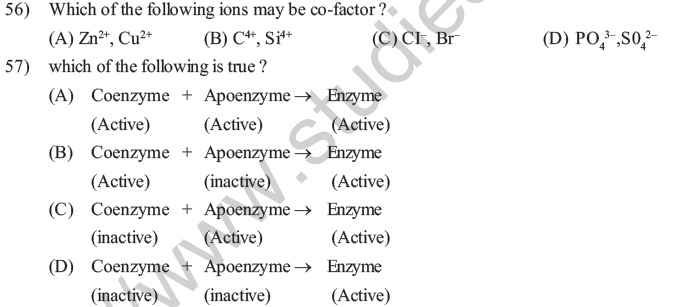
55) Which is called as coenzyme ?
(A) protein chain (B) inorganic component as cofactor
(C) organic component as co-factor (D) apoenzyme
58) Sucrose is hydrolyzed by__________enzyme
(A) zymase (B) invertaze (C) emulsin (D) lipase
59) Fat soluble vitamin is
(A) H (B) A (C) C (D) B
60) Haemorrhage disease caused by deficiency of___________vitamin
(A) Calciferol (B) phylloquinone (C) Tocopherol (D) retinol
61) Which vitamin isn’t synthesizes from vegetable ?
(A) Cyanocobalamine (B) pyridoxine (C)thiamine (D) Tocopherol
62) Which vitamin’s source is yeast?
(A) B1 (B) H (C) B6 (D) all
63) Which disease caused by deficiency of vitamin E ?
(A) Sterility (B) skin disease
(C) bone deformation in children (D) paralysis
64) Which substance isn’t formed by complete hydrolysis of nucleic acid ?
(A) hexos sugar (B) phosphoric acid
(C) hetrocyclic bases which contains nitrogen element (D) pentose sugar
65) Purine base is
(A) G (B) C (C) T (D) U
66) Pyrimidine base is
(A) C (B) T (C) U (D) All
67) Which base isn’t present in DNA ?
(A) A (B) G (C) C (D) U
68) Which base isn’t present in RNA ?
(A) G (B)T (C) U (D)C
69) A unit formed by attachment of a base to_________ position of sugar is known as nucleoside
(A) Cl (B) C2 (C) C3 (C) C4
70) Unit formed by attachment of which carbon of nucleoside to phosphate ion is known as nucleotide ?
(A) Cl (B)C2 (C)C3 (C)C4
71) Two nucleosides are joined together by phosphodiester linkage, this linkage is formed between ___________ of one sugar and ________ of other sugar.
(A) Cl ,C1 (B) Cl, C3 (C) C3, C5 (D) C5,C5
72) Structure of DNA is look alike _________
(A) spiral straircase (B) double helix (C) twisted rope (D) all
73) Who proposed that structure of DNA is double helix ?
(A) luis & pouling (B) HC crick & JDWatson
(C) howarth & hirst (D) tallence & tenrate
74) By which bond , base of one nucleotide and base of another nucleotide are joined together ?
(A) hydrogen bond (B) covalent bond (C) coordination covalent bond (D) ionic
75) Which pairs of bases are true for linkage between two chain of polynucleiotide ?
(A) adenine-Thymine (B) adenine- guranine
(C) guanine-thymine (D) adenine-cytosine
76) How many hydrogen bonds between base G and Base C are present in structure of DNA ?
(A) 1 (B) 2 (C) 3 (D) no certain number
77) If a person bleeds by his gingiva , so what would you suggest to eat to prevent the disease ?
(A) vegetable oil (B) citrus fruits (C) cheese (D) milk
78) Which subgroup isn’t possible for vitamin ?
(A)B1 (B) B4 (C) B6 (D) B12
79) _________ term is familiar for vitamin now days
(A) vitamin (B) vitamine (C) vitmin (D) viatamine
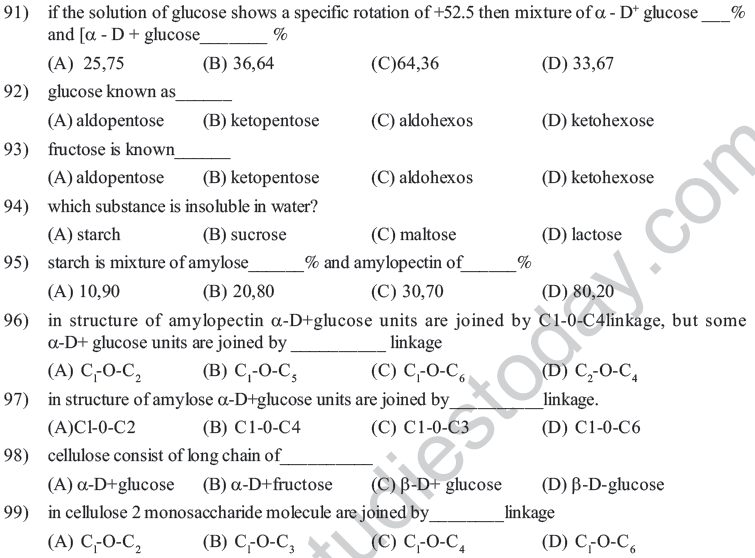
80) which sugar indicates mutarotation ?
(A) glucose (B) fructose (C) maltose (D) all
81) Which sugar isn’t indicating muta rotation?
(A) sucrose (B) lactose (C) maltose (D) none
82) Molecularmass of_________ carbohydrate is 180 gm/mol
(A) glucose (B) fructose (C) galactose (D) all
83) Molecular mass of_________ sugar is 342 gm/mol
(A) cellobios (B) maltose (C) A&B (D)none
84) Glucose is known as glucopyranose because
(A) cyclicstructure of glucose contains 6 memberring
(B) cyclicstructure of glucose contains 5 carbon atoms and one oxygen atoms
(C) glucose is aldohexose
(D) glucose is ketohexose
85) One base present in central part of DNA, it’s joined to another base with 3 hydrogen bond, so what is that base ?
(A)A (B) G (C)T (D) U
86) One pyrimidine base present in central part of DNA, it’s joined to another base with 2 hydrogen bond, so what is that base ?
(A) A (B) G (C) C (D) T
87) Which reaction isn’tgiven by glucose ?
(A) glucose is oxidized by tollen’s reagent
(B) glucose gives violet color with skiff’s reagent
(C) Fehling’ssolution is reduced by glucose
(D) glucose gives addition product with sodium bisulphite
88) The crystal of glucose obtained from which solvent are dissolved in water and the specific rotation of this freshly prepared solution of glucose is +112 ?
(A) ethyle alcohol (B) aceticacid (C) pyridine (D) A & B
89) Mutarotation for aqueous solution of glucose is_________
(A)+19° (B) +52.5° (C) +112° (D) +119°
90) Which type of carbon is called anomeric carbon in cyclic structure of glucose ?
(A) it’s joined with aldehyde group in open chain structure
(B) it’s carbonyl carbon in open chain structure of glucose
(C) it’s joined with carboxylic group in open chain structure
(D) none
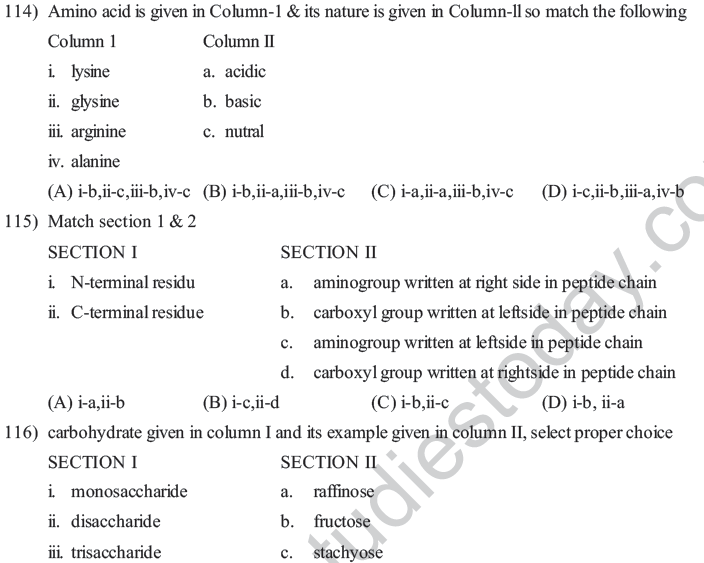
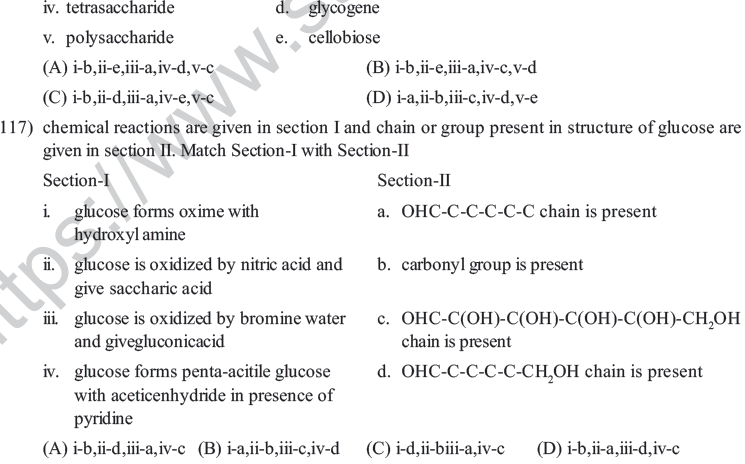

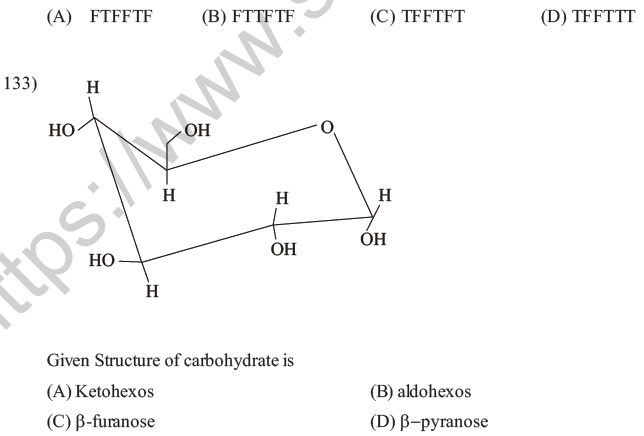
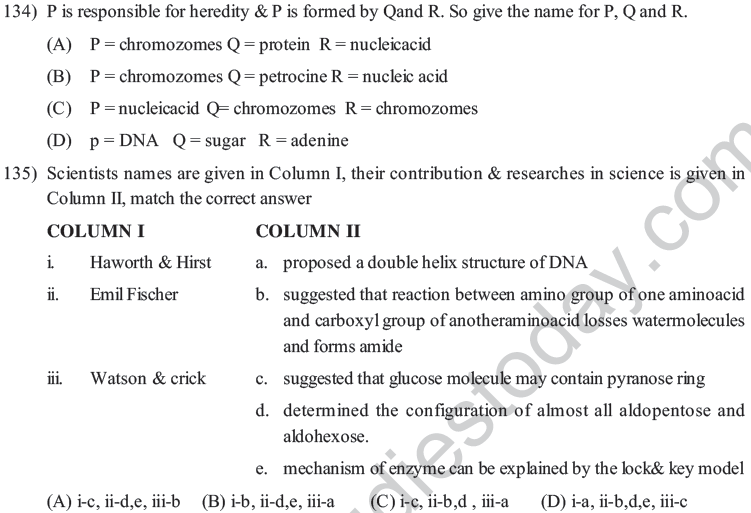
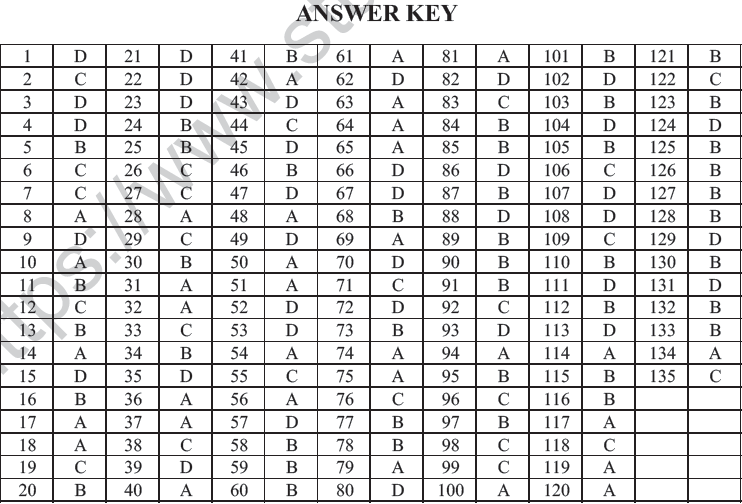
Practice MCQs for NEET Chemistry Biomolecule
Chapter MCQs with Answers for NEET Chemistry
Review structured objective questions for NEET Chemistry Biomolecule. Built according to official NEET guidelines, these MCQ sets support daily revision and core concept reinforcement.
Expert Practice Material for NEET Chemistry
Each question includes structured solution keys mapped directly to standard NEET textbooks, helping students evaluate their reasoning and correct mistakes early in their revision.
Complete Your Chapter Revision
Wrap up your chapter revision by testing your knowledge against standard question formats. Everything on our platform is provided free of charge.
FAQs
You can get most exhaustive NEET UG Chemistry Biomolecule MCQs for free on StudiesToday.com. These MCQs for NEET Chemistry are updated for the 2026-27 academic session as per NEET examination standards.
Yes, our NEET UG Chemistry Biomolecule MCQs include the latest type of questions, such as Assertion-Reasoning and Case-based MCQs. 50% of the NEET paper is now competency-based.
By solving our NEET UG Chemistry Biomolecule MCQs, NEET students can improve their accuracy and speed which is important as objective questions provide a chance to secure 100% marks in the Chemistry.
Yes, Chemistry MCQs for NEET have answer key and brief explanations to help students understand logic behind the correct option as its important for 2026 competency-focused NEET exams.
Yes, you can also access online interactive tests for NEET UG Chemistry Biomolecule MCQs on StudiesToday.com as they provide instant answers and score to help you track your progress in Chemistry.