

Download NEET MCQs for NEET Chemistry: Haloalkanes and Haloarenes
Review structured MCQ sets for NEET Chemistry Haloalkanes and Haloarenes. Built according to official NEET guidelines, these downloadable questions support daily revision and core concept reinforcement.
Chapter-wise Objective Questions: Haloalkanes and Haloarenes
View or download the dedicated Haloalkanes and Haloarenes MCQ resource below. Practicing these 50 objective questions regularly builds familiarity with standard exam patterns and helps secure higher marks in final Chemistry evaluations.
Question: Which of the following is a secondary alkyl halide?
- a) Isobutyl chloride
- b) Isopentyl chloride
- c) Neopentyl chloride
- d) Isopropyl chloride
Answer: Isopropyl chloride
Question: The IUPAC name of the compound

- a) 4-Bromobut-2-ene
- b) 1-Bromobut-2-ene
- c) 3-Bromobut-2-ene
- d) Allyl bromide
Answer: 1-Bromobut-2-ene
Question: Which of the following may be classified as an aryl halide?
- a)
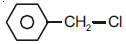
- b)

- c)
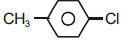
- d)
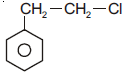
Answer:
Question: Which of the following belongs to the class of vinyl halides?
- a)

- b)
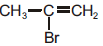
- c)

- d)

Answer:
Question: Which one of the following reagents will not convert ethyl alcohol into ethyl chloride?
- a) HCl – ZnCl2
- b) CCl4
- c) PCl5
- d) SOCl2
Answer: CCl4
Question: The addition of HBr is easiest with
- a)
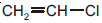
- b)

- c)

- d)

Answer:
Question:

The major product ‘P’ is
- a)
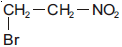
- b)
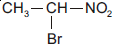
- c)

- d)

Answer:
Question: The intermediate during the addition of HCl to propene in presence of peroxide is
- a)

- b)
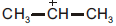
- c)

- d)

Answer:
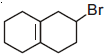
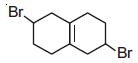
Question:

- a)
- b)

- c)
- d)
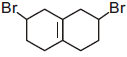
Answer:
Question: The addition of propene with HOCl proceeds via the addition of
- a) H+ in the first step
- b) Cl+ in the first step
- c) OH– in the first step
- d) Either H+ or OH– in first step
Answer: Cl+ in the first step
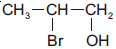
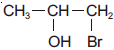
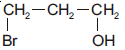
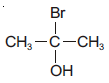
Question:

The major product ‘P’ is
- a)
- b)
- c)
- d)
Answer:
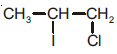
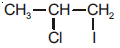
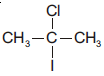
Question:

- a)
- b)
- c)
- d)
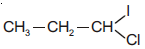
Answer:
Question: Which of the following is correct for the reaction?

- a) Electrophilic substitution
- b) Anti-Markovnikov’s addition
- c) Nucleophilic substitution
- d) Markovnikov’s addition
Answer: Anti-Markovnikov’s addition
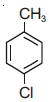
Question:
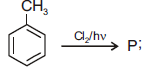
Product (P) is
- a)
- b)

- c)

- d)

Answer:
Question:

(Major), Product (P) is
- a)

- b)

- c)

- d)

Answer:
Question: Which is most stable radical?
- a) CH3
- b)

- c)

- d)

Answer:
Question:
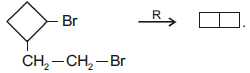
The reagent R is
- a) NH3
- b) H2O
- c) KCN
- d) Na/ether
Answer: Na/ether
Question: Which of the following halogen exchange reaction will occur in acetone?
- a)

- b)

- c)

- d)

Answer:
Question:
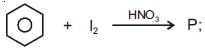
P is
- a)

- b)

- c)

- d)

Answer:
Question:

the reaction is called
- a) Nucleophilic substitution
- b) Free radical addition
- c) Electrophilic substitution
- d) Free radical substitution
Answer: Electrophilic substitution
Question:
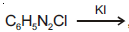
this reaction is named as
- a) Sandmeyer
- b) Swarts
- c) Wurtz-Fittig
- d) Finkelstein
Answer: Sandmeyer
Question: Which is most reactive nucleophile in polar protic solvent?
- a) F–
- b) Cl–
- c) Br–
- d) I–
Answer: I–
Question: Which is most reactive nucleophile in polar aprotic solvent?
- a) F–
- b) Cl–
- c) Br–
- d) I–
Answer: F–
Question: Which cannot act as an ambident nucleophile?
- a) CN–
- b)

- c) SCN–
- d) OH–
Answer: OH–
Question: Which of the following solvent is suitable for SN1 reaction?
- a) Non-polar
- b) Polar protic
- c) Polar aprotic
- d) All of these
Answer: Polar protic
Question: For SN1 mechanism, which of the following is correct?
- a) Inversion (100%)
- b) Formation of carbocation
- c) Non-polar solvent
- d) Elimination
Answer: Formation of carbocation
Question:
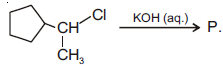
Product P (major) is
- a)

- b)

- c)

- d)

Answer:
Question: The reaction,

proceeds mainly by the mechanism
- a) SN1
- b) SN2
- c) SE1
- d) SE2
Answer: SN2
Question:
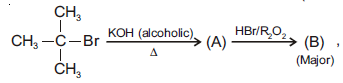
(B) is
- a)
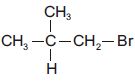
- b)
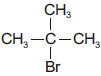
- c)
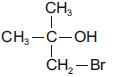
- d)
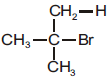
Answer:
Question: An SN2 reaction at an asymmetric carbon of a compound always gives
- a) An enantiomer of the substrate
- b) A product with opposite optical rotation
- c) A mixture of diastereomers
- d) A product with 100% inversion
Answer: A product with 100% inversion
More Questions.................................
Question:

the compound (C) is
- a)

- b)

- c)
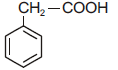
- d)

Answer:
Question: Which one is the most reactive towards SN1 reaction?
- a)
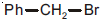
- b)

- c)

- d)

Answer:
Question:
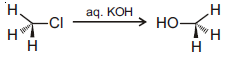
The reaction goes through
- a) SN1
- b) SN2
- c) E2
- d) E1
Answer: SN2
Question: The order of E2 elimination for alkyl halide is
- a) 1° > 2° > 3°
- b) 3° > 2° > 1°
- c) 2° > 3° > 1°
- d) 3° > 1° > 2°
Answer: 3° > 2° > 1°
Question: 2-Bromopentane is heated with EtO- Na+ in ethanol. The major product obtained is
- a) 2-Ethoxypentane
- b) Pent-1-ene
- c) Isobutane
- d) Pent-2-ene
Answer: Pent-2-ene
Question:
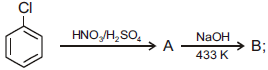
B is
- a)

- b)

- c)
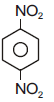
- d)

Answer:
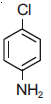
Question:
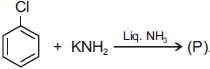
Product (P) is
- a)

- b)
- c)

- d)

Answer:
Question:
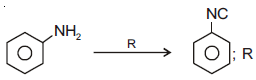
- a) N2
- b) CHCl3/KOH (alcoholic)
- c) NH3
- d) KCN
Answer: CHCl3/KOH (alcoholic)
Question: Which of the following acts as a poisonous gas?
- a) COCl2
- b) CCl2F2
- c) Benzene
- d) CH3Cl
Answer: COCl2
Question: Which of the following is used as fire extinguisher under the name pyrene?
- a) CO2
- b) CCl4
- c) CH2= CH—Cl
- d) Cl—CH = CH—Cl
Answer: CCl4
Question: Which of the following is used as a refrigerant?
- a) COCl2
- b) CCl4
- c) CF4
- d) CF2Cl2
Answer: CF2Cl2
Question: Which of the following is known as freon 12?
- a) CHCl3
- b) CCl2F2
- c) Ph-COCH2Cl
- d) Ph – Cl
Answer: CCl2F2
Question: (p-ClC6H4)2 CHCCl3 is used as a/an
- a) Antiseptic for wounds
- b) Insecticide
- c) Pyrene
- d) Refrigerant
Answer: Insecticide
Question: Which one of the following is gem-dihalide?
- a) CH3CHBr2
- b) CH2Br –CH2Br
- c) CH3CHBrCH2Br
- d) CH3CHBrCH2BH2Br Or CH3CHBrCH2B–H2Br Or CH3CHBrCH2CH2Br
Answer: CH3CHBr2
Question: Which of the following is least reactive towards SN2 mechanism?
- a)

- b)

- c)

- d)

Answer:
Question:

How many moles of CH3OH required to react completely with B ?
- a) One
- b) Two
- c) Three
- d) Four
Answer: Two
Question: CHI3 is used as a/an
- a) Antiseptic for wounds
- b) Insecticide
- c) Pyrene
- d) Refrigerant
Answer: Antiseptic for wounds
Question:
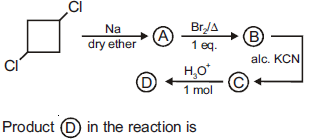
- a) Optically active cyanide
- b) Optically inactive acid
- c) Optically active acid
- d) Optically active aldehyde
Answer: Optically inactive acid
Question: Which of the following is the least volatile?
- a) CH3—CH2—CH2—F
- b) CH3—CH2—CH2—Cl
- c)
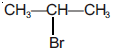
- d) CH3—CH2—CH2—Br
Answer: CH3—CH2—CH2—Br
Question: Which of the following will be readily soluble in water?
- a)

- b)

- c)

- d)

Answer:
Question: Which one of the following is a free-radical substitution reaction?
- a)

- b)

- c)

- d) CH3CHO + HCN—→ CH3CH(OH)CN
Answer:
Question: Which of the following compounds undergoes nucleophilic substitution reaction most easily?
- a)

- b)

- c)
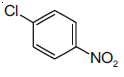
- d)
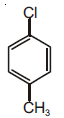
Answer:
Question: Replacement of Cl of chlorobenzene to give phenol requires drastic conditions. But chlorine of 2, 4-dinitrochlorobenzene is readily replaced
- a) NO2 donates electron at meta position
- b) NO2 withdraws electron from ortho/para positions
- c) NO2 make ring electron rich at ortho & para
- d) NO2 withdraws electron from meta position
Answer: NO2 withdraws electron from ortho/para positions
Question: Chloropicrin is obtained by the reaction of
- a) Steam on carbon tetrachloride
- b) Nitric acid on chlorobenzene
- c) Chlorine on pricric acid
- d) Nitric acid on chloroform
Answer: Nitric acid on chloroform
Question: The reaction of toluene with Cl2 in presence of FeCl3 gives X and reaction in presence of light gives Y. Thus, X and Y are
- a) X = Benzyl chloride, Y = m-chlorotoluene
- b) X = Benzal chloride, Y = o-chlorotoluene
- c) X = m-chlorotoluene, Y = p-chlorotoluene
- d) Y = o- and p-chlorotoluene, Y = Trichloromethyl benzene
Answer: Y = o- and p-chlorotoluene, Y = Trichloromethyl benzene
Question: Ethylidene chloride reacts with aq. KOH to form which of the following compound?
- a) Acetaldehyde
- b) Ethylene glycol
- c) Ethyl alcohol
- d) Acetic acid
Answer: Acetaldehyde
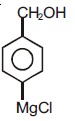
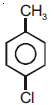
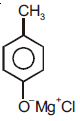
Question:
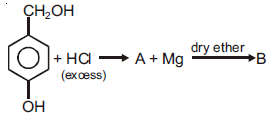
What is B?
- a)
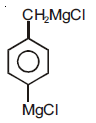
- b)
- c)
- d)
Answer:
Question: The correct order of reactivity of the following compounds towards aqueous NaCN will be

- a) I > II > III > IV
- b) I > IV > II > III
- c) IV > II > I > III
- d) IV > II > III > I
Answer: IV > II > III > I
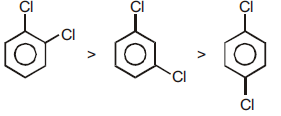
Question: Which among the following is the correct order of melting point?
- a)
- b)
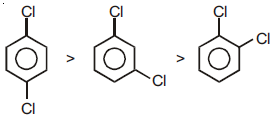
- c)
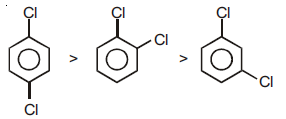
- d)
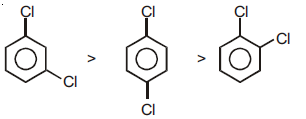
Answer:
Question:
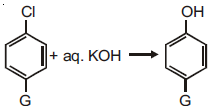
For which of the following G, above reaction will be the fastest?
- a) –OH
- b) –CH3
- c) –NO2
- d) –CHO
Answer: –NO2
Multiple Choice Questions (MCQs) for NEET Chemistry Haloalkanes and Haloarenes
About Haloalkanes and Haloarenes MCQs for NEET Chemistry
Review structured objective questions for NEET Chemistry Haloalkanes and Haloarenes. Built according to official NEET guidelines, these MCQ sets support daily revision and core concept reinforcement.
How to Verify Your MCQ Answers
Built using the official NCERT book for NEET, these Chemistry objective sets provide reliable academic guidance. Pair your practice with our recommended NCERT solutions to master optimal problem-solving approaches.
Enhance Speed with Online MCQ Tests
Explore our broader library of printable assignments, chapter notes, and mock tests designed to support continuous revision and secure higher marks in NEET assessments.
FAQs
You can get most exhaustive NEET Chemistry Haloalkanes and Haloarenes MCQs Set 01 for free on StudiesToday.com. These MCQs for NEET Chemistry are updated for the 2026-27 academic session as per NEET examination standards.
Yes, our NEET Chemistry Haloalkanes and Haloarenes MCQs Set 01 include the latest type of questions, such as Assertion-Reasoning and Case-based MCQs. 50% of the NEET paper is now competency-based.
By solving our NEET Chemistry Haloalkanes and Haloarenes MCQs Set 01, NEET students can improve their accuracy and speed which is important as objective questions provide a chance to secure 100% marks in the Chemistry.
Yes, Chemistry MCQs for NEET have answer key and brief explanations to help students understand logic behind the correct option as its important for 2026 competency-focused NEET exams.
Yes, you can also access online interactive tests for NEET Chemistry Haloalkanes and Haloarenes MCQs Set 01 on StudiesToday.com as they provide instant answers and score to help you track your progress in Chemistry.