

Practice MCQs for NEET Chemistry Hydrocarbons
Access targeted multiple-choice questions for Hydrocarbons designed to align with the latest NEET academic syllabus for NEET Chemistry. These objective practice sets help students evaluate their conceptual understanding and improve exam readiness.
Access Hydrocarbons Questions and Solutions
View or download the dedicated Hydrocarbons MCQ resource below. Practicing these 50 objective questions regularly builds familiarity with standard exam patterns and helps secure higher marks in final Chemistry evaluations.
Question: When CH3CH2CHCl2 is treated with NaNH2 , the product formed is
- a) CH3– CH = CH2
- b) CH3– C ≡ CH
- c)
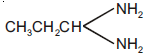
- d)
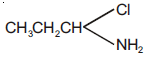
Answer: CH3– C ≡ CH
Question: 2-Bromopentane is heated with potassium ethoxide in ethanol. The major product obtained is
- a) trans-pent-2-ene
- b) Pent-1-ene
- c) 2-ethoxypentane
- d) cis-pent-2-ene
Answer: trans-pent-2-ene
Question: In the following reaction

the product ‘X’ is
- a) C6H5CH2OCH2C6H5
- b) C6H5CH2OH
- c) C6H5CH3
- d) C6H5CH2CH2C6H5
Answer: C6H5CH3
Question: When 3, 3-dimethyl 2-butanol is heated with H2SO4 , the major product obtained is
- a) 2, 3-dimethyl 2-butene
- b) cis and trans isomers of 2, 3-dimethyl 2-butene
- c) 2, 3-dimethyl 1-butene
- d) 3, 3-dimethyl 1-butene
Answer: 2, 3-dimethyl 2-butene
Question: Identify Z in the sequence of reaction

- a)
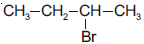
- b) CH3– CH2– CH2– CH2– Br
- c)
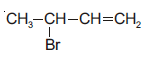
- d) None of these
Answer: CH3– CH2– CH2– CH2– Br
Question: In the following reaction
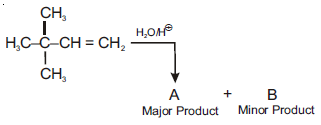
The major product is
- a)
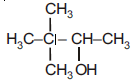
- b)
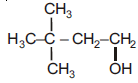
- c)
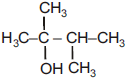
- d)
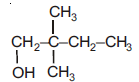
Answer:
Question: What products are formed when the following compound is treated with Br2 in the presence of FeBr3?

- a)
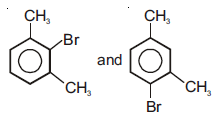
- b)
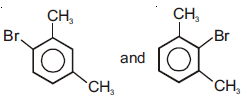
- c)
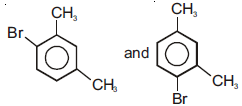
- d)
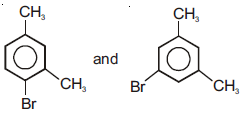
Answer:
Question: One of the following which does not observe the anti-Markownikoff’s addition of HBr, is
- a) Pent-2-ene
- b) Propene
- c) But-2-ene
- d) But-1-ene
Answer: But-2-ene
Question: Which of the compounds with molecular formula C5H10 yields acetone on ozonolysis?
- a) 3-methylbut-1-ene
- b) Cyclopentane
- c) 2-methylbut-1-ene
- d) 2-methylbut-2-ene
Answer: 2-methylbut-2-ene
More Questions............................................
Question: In preparation of alkene from alcohol using Al2O3 which is the effective factor?
- a) Porosity of Al2O3
- b) Temperature
- c) Concentration
- d) Surface area of Al2O3
Answer: Temperature
Question: Dihedral angle in staggered form of ethane is
- a) 0°
- b) 120°
- c) 60°
- d) 180°
Answer: 60°
Question: 2-butene shows geometrical isomerism due to
- a) Restricted rotation about double bond
- b) Free rotation about double bond
- c) Free rotation about single bond
- d) Chiral carbon
Answer: Restricted rotation about double bond
Question: Gammexane is
- a) Bromobenzene
- b) Benzyl Chloride
- c) Chlorobenzene
- d) Benzene hexachloride
Answer: Benzene hexachloride
Question: In Friedel-Crafts reaction, toluene can be prepared by
- a) C6H6+ CH3Cl
- b) C6H5Cl + CH4
- c) C6H6+ CH2Cl2
- d) C6H6+ CH3COCl
Answer: C6H6+ CH3Cl
Question: When acetylene is passed through dil. H2SO4 in the presence of HgSO4 , the compound formed is
- a) Acetic acid
- b) Ketone
- c) Ether
- d) Acetaldehyde
Answer: Acetaldehyde
Question: In the commercial gasolines, the type of hydrocarbons which are more desirable is
- a) Linear unsaturated hydrocarbon
- b) Toluene
- c) Branched hydrocarbon
- d) Straight-chain hydrocarbon
Answer: Branched hydrocarbon
Question: Which one of these is not compatible with arenes?
- a) Electrophilic additions
- b) Delocalisation of π-electrons
- c) Greater stability
- d) Resonance
Answer: Electrophilic additions
Question: The cylindrical shape of alkyne is due to
- a) Two sigma C–C and one π C–C bonds
- b) One sigma C–C and two π C–C bonds
- c) Three sigma C–C bonds
- d) Three π C–C bonds
Answer: One sigma C–C and two π C–C bonds
Question: Which of the following is used as an anti-knocking material?
- a) Glyoxal
- b) Freon
- c) T.E.L.
- d) Ethyl alcohol
Answer: T.E.L.
Question: The bond length between central carbon atom and other carbon atom is minimum in
- a) Propene
- b) Propyne
- c) Propane
- d) Pentane
Answer: Propyne
Question: Geometrical isomers differ in
- a) Position of functional group
- b) Position of atoms
- c) Spatial arrangement of atoms
- d) Length of carbon chain
Answer: Spatial arrangement of atoms
Question: Liquid hydrocarbons can be converted to a mixture of gaseous hydrocarbons by
- a) Oxidation
- b) Cracking
- c) Distillation under reduced pressure
- d) Hydrolysis
Answer: Cracking
Question: Eclipsed form of ethane has higher energy due to
- a) Torsional strain
- b) Steric strain
- c) Angle strain
- d) Both (1) & (2)
Answer: Both (1) & (2)
Question: The difference in potential energy between eclipsed and staggered form of ethane is
- a) 4 kJ/mol
- b) 12.55 kJ/mol
- c) 2 kJ/mol
- d) 44 kJ/mol
Answer: 12.55 kJ/mol
Question: Which one is most stable?
- a) Cyclopropane
- b) Cyclobutane
- c) Cyclopentane
- d) Cyclohexane
Answer: Cyclohexane
Question: In iodination ; for preparation of iodomethane compound used is
- a) HIO3
- b) HgO
- c) Both (1) & (2)
- d) HI
Answer: Both (1) & (2)
Question: In chlorination the relation rate of abstraction of H in 3°, 2° and 1°C atom respectively
- a) 5 : 3.8 : 2
- b) 5 : 3.8 : 1
- c) 1600 : 82 : 1
- d) 1600 : 5 : 82
Answer: 5 : 3.8 : 1
Question: In which alkane isomerization will not occur?
- a) C2H6
- b) C4H10
- c) C5H10
- d) C6H14
Answer: C2H6
Question: C6H5CH2CH2CH3 is when oxidised in the presence of alk. KMnO4, the product obtained is
- a) C6H5CHO
- b) C6H5COOH
- c) C6H5CH2CH2CHO
- d) C6H5COCH3
Answer: C6H5COOH
Question: Liquid hydrocarbons can be converted to a mixture of gaseous hydrocarbons by
- a) Oxidation
- b) Cracking
- c) Distillation under reduced pressure
- d) Hydrolysis
Answer: Cracking
Download Chapter MCQs: NEET Chemistry Hydrocarbons
Download Multiple Choice Questions: Hydrocarbons (NEET Chemistry)
Test your conceptual understanding of Hydrocarbons with these targeted multiple-choice questions. Designed in alignment with the latest NEET curriculum for NEET Chemistry, these problem sets build accuracy and prepare students for objective exams.
Concept Clarification for Hydrocarbons
Each question includes structured solution keys mapped directly to standard NEET textbooks, helping students evaluate their reasoning and correct mistakes early in their revision.
Additional Study Resources for NEET Chemistry
Wrap up your chapter revision by testing your knowledge against standard question formats. Everything on our platform is provided free of charge.
FAQs
You can get most exhaustive NEET Chemistry Hydrocarbons MCQs Set 03 for free on StudiesToday.com. These MCQs for NEET Chemistry are updated for the 2026-27 academic session as per NEET examination standards.
Yes, our NEET Chemistry Hydrocarbons MCQs Set 03 include the latest type of questions, such as Assertion-Reasoning and Case-based MCQs. 50% of the NEET paper is now competency-based.
By solving our NEET Chemistry Hydrocarbons MCQs Set 03, NEET students can improve their accuracy and speed which is important as objective questions provide a chance to secure 100% marks in the Chemistry.
Yes, Chemistry MCQs for NEET have answer key and brief explanations to help students understand logic behind the correct option as its important for 2026 competency-focused NEET exams.
Yes, you can also access online interactive tests for NEET Chemistry Hydrocarbons MCQs Set 03 on StudiesToday.com as they provide instant answers and score to help you track your progress in Chemistry.