

Multiple Choice Questions (MCQs) for NEET Chemistry: The S Block Elements
Explore reliable objective questions for The S Block Elements tailored for NEET learners. Utilizing these Chemistry multiple-choice formats ensures thorough preparation and strengthens problem-solving speed for upcoming school assessments.
Practice The S Block Elements MCQs for NEET Chemistry
Access the complete set of multiple-choice questions for The S Block Elements below. This focused format allows students to isolate specific topics for thorough review and uninterrupted practice alongside official NEET textbooks.
Question: On heating which of the following releases CO2 most easily?
- a) MgCO3
- b) CaCO3
- c) K2CO3
- d) Na2CO3
Answer: MgCO3
Question: The function of "Sodium pump" is a biological process operating in each and every cell of all animals. Which of the following biologically important ions is also a constituent of the pump?
- a) Fe2+
- b) Ca2+
- c) Mg2+
- d) K+
Answer: K+
Question: Solubility of the alkaline earth's metal sulphates in water decreases in the sequence
- a) Ba > Mg > Sr > Ca
- b) Mg > Ca > Sr > Ba
- c) Ca > Sr > Ba > Mg
- d) Sr > Ca > Mg > Ba
Answer: Mg > Ca > Sr > Ba
Question: Which one of the alkali metals, forms only, the normal oxide, M2O on heating in air?
- a) Li
- b) Na
- c) Rb
- d) K
Answer: Li
Question: Equimolar solutions of the following substances were prepared separately. Which one of these will record the highest pH value?
- a) LiCl
- b) BeCl2
- c) BaCl2
- d) AlCl3
Answer: BaCl2
Question: Which of the following compounds has the lowest melting point?
- a) CaF2
- b) CaCl2
- c) CaBr2
- d) CaI2
Answer: CaI2
Question: Which one of the following is present as an active ingredient in bleaching powder for bleaching action?
- a) CaCl2
- b) CaOCl2
- c) Ca(OCl)2
- d) CaO2Cl
Answer: Ca(OCl)2
Question: Which of the following statements is incorrect ?
- a) Aluminium reacts with excess NaOH to give Al(OH)3
- b) NaHCO3 on heating gives Na2CO3
- c) Pure sodium metal dissolves in liquid ammonia to give blue solution
- d) NaOH reacts with glass to give sodium silicate
Answer: Aluminium reacts with excess NaOH to give Al(OH)3
Question: Match list-I with list-II for the composition of substances and select the correct answer using the code given below the lists
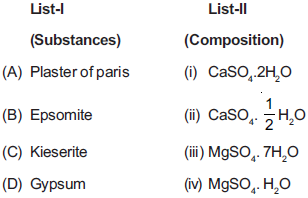
- a) (A) (B) (C) (D) (i) (ii) (iii) (iv)
- b) (A) (B) (C) (D) (iv) (iii) (ii) (i)
- c) (A) (B) (C) (D) (iii) (iv) (i) (ii)
- d) (A) (B) (C) (D) (ii) (iii) (iv) (i)
Answer: (A) (B) (C) (D) (ii) (iii) (iv) (i)
Question: Which of the following alkaline earth metal sulphates has hydration enthalpy higher than the lattice enthalpy ?
- a) CaSO4
- b) BeSO4
- c) BaSO4
- d) SrSO4
Answer: BeSO4
Question: Property of the alkaline earth metals that increases with their atomic number
- a) Solubility of their hydroxides in water
- b) Solubility of their sulphates in water
- c) Ionization energy
- d) Electronegativity
Answer: Solubility of their hydroxides in water
More Questions...........................................
Question: Which one of the following compounds is a peroxide ?
- a) KO2
- b) BaO2
- c) MnO2
- d) NO2
Answer: BaO2
Question: The compound A on heating gives a colourless gas and a residue that is dissolved in water to obtain B. Excess of CO2 is bubbled through aqueous solution of B, C is formed which is recovered in the solid form. Solid C on gentle heating gives back A. The compound is
- a) CaCO3
- b) Na2CO3
- c) K2CO3
- d) CaSO4.2H2O
Answer: CaCO3
Question: Which of the following oxides is not expected to react with sodium hydroxide ?
- a) CaO
- b) SiO2
- c) BeO
- d) B2O3
Answer: CaO
Question: The alkali metals from salt-like hydrides by the direct synthesis at elevated temperature. The thermal stability of these hydrides decreases in which of the following orders ?
- a) LiH > NaH > KH > RbH > CsH
- b) CsH > RbH > KH > NaH > LiH
- c) KH > NaH > LiH > CsH > RbH
- d) NaH > LiH > KH > RbH > CsH
Answer: LiH > NaH > KH > RbH > CsH
Question: In which of the following the hydration energy is higher than the lattice energy ?
- a) SrSO4
- b) BaSO4
- c) MgSO4
- d) RaSO4
Answer: MgSO4
Question: The correct order of increasing thermal stability of K2CO3, MgCO3, CaCO3 and BeCO3 is
- a) K2CO3< MgCO3< CaCO3< BeCO3
- b) BeCO3< MgCO3< K2CO3< CaCO3
- c) BeCO3< MgCO3< CaCO3< K2CO3
- d) MgCO3< BeCO3< CaCO3< K2CO3
Answer: BeCO3< MgCO3< CaCO3< K2CO3
Question: The correct order of the mobility of the alkali metal ions in aqueous solution is
- a) Li+ > Na+ > K+ > Rb+
- b) Na+ > K+ > Rb+ > Li+
- c) K+ > Rb+ > Na+ > Li+
- d) Rb+ > K+ > Na+ > Li+
Answer: Rb+ > K+ > Na+ > Li+
Question: In Castner-Kellner cell for production of sodium hydroxide :
- a) Brine is electrolyzed with Pt electrodes
- b) Brine is electrolyzed using graphite electrodes
- c) Molten sodium chloride is electrolysed
- d) Sodium amalgam is formed at mercury cathode
Answer: Sodium amalgam is formed at mercury cathode
Question: In the replacement reaction

The reaction will be most favourable if M happens to be
- a) Na
- b) K
- c) Rb
- d) Li
Answer: Rb
Question: The solubility in water of sulphate down the Be group is Be > Mg > Ca > Sr > Ba. This is due to
- a) Decreasing lattice energy
- b) High heat of solvation for smaller ions like Be2+
- c) Increase in melting points
- d) Increasing molecular weight
Answer: High heat of solvation for smaller ions like Be2+
Question: The sodium is made by the electrolysis of a molten mixture of about 40% NaCl and 60% CaCl2 because
- a) Ca++ can displace Na from NaCl
- b) This mixture has a lower melting point than NaCl
- c) CaCl2 helps in conduction of electricity
- d) Ca++ can reduce NaCl to Na
Answer: This mixture has a lower melting point than NaCl
Question: Identify the correct statement
- a) Plaster of Paris can be obtained by hydration of gypsum
- b) Plaster of Paris is obtained by partial oxidation of gypsum
- c) Gypsum contains a lower percentage of calcium than Plaster of Paris
- d) Gypsum is obtained by heating Plaster of Paris
Answer: Gypsum contains a lower percentage of calcium than Plaster of Paris
Question: When a substance (a) reacts with water it produces a combustible gas (b) and a solution of substance (c) in water. When another substance (d) reacts with this solution of (c), it also produces the same gas (b) on warming but (d) can produce gas (b) on reaction with dilute sulphuric acid at room temperature. Substance (a) imparts a deep golden yellow colour to a smokeless flame of Bunsen burner. Then (a), (b), (c) and (d) respectively are
- a) Ca, H2, Ca(OH)2, Sn
- b) K, H2, KOH, Al
- c) Na, H2, NaOH, Zn
- d) CaC2, C2H2, Ca(OH)2, Fe
Answer: Na, H2, NaOH, Zn
Question: Calcium is obtained by
- a) Reduction of calcium chloride with carbon
- b) Electrolysis of molten anhydrous calcium chloride
- c) Roasting of limestone
- d) Electrolysis of solution of calcium chloride in H2O
Answer: Electrolysis of molten anhydrous calcium chloride
Question: Among the oxides of group 2, least basic is
- a) MgO
- b) CaO
- c) SrO
- d) BaO
Answer: MgO
Question: Which is not the compound of sodium?
- a) Chile salt petre
- b) Salt petre
- c) Glauber's salt
- d) Soda ash
Answer: Salt petre
Question: Sodium is usually kept under
- a) Alcohol
- b) Kerosene oil
- c) Water
- d) Petrol
Answer: Kerosene oil
Question: Which one of the following statements concerning the compounds of Lithium is false?
- a) The hydroxide, carbonate, nitrate, decompose to give the oxide on heating
- b) It is the most electronegative among alkali metals
- c) The hydrogen carbonate cannot be isolated as a stable solid
- d) It forms a peroxide but not superoxide
Answer: It forms a peroxide but not superoxide
Question: The thermal stability of alkaline earth metal carbonates increases from Be to Ba. This is because
- a) Covalent nature decreases and Ionic nature increases
- b) Lattice energy increases
- c) Electropositive nature decreases
- d) None of these
Answer: Covalent nature decreases and Ionic nature increases
Practice MCQs for NEET Chemistry The S Block Elements
Download Multiple Choice Questions: The S Block Elements (NEET Chemistry)
Test your conceptual understanding of The S Block Elements with these targeted multiple-choice questions. Designed in alignment with the latest NEET curriculum for NEET Chemistry, these problem sets build accuracy and prepare students for objective exams.
Concept Clarification for The S Block Elements
Built using the official NCERT book for NEET, these Chemistry objective sets provide reliable academic guidance. Pair your practice with our recommended NCERT solutions to master optimal problem-solving approaches.
Additional Study Resources for NEET Chemistry
Wrap up your chapter revision by testing your knowledge against standard question formats. Everything on our platform is provided free of charge.
FAQs
You can get most exhaustive NEET Chemistry The S Block Elements MCQs Set 02 for free on StudiesToday.com. These MCQs for NEET Chemistry are updated for the 2026-27 academic session as per NEET examination standards.
Yes, our NEET Chemistry The S Block Elements MCQs Set 02 include the latest type of questions, such as Assertion-Reasoning and Case-based MCQs. 50% of the NEET paper is now competency-based.
By solving our NEET Chemistry The S Block Elements MCQs Set 02, NEET students can improve their accuracy and speed which is important as objective questions provide a chance to secure 100% marks in the Chemistry.
Yes, Chemistry MCQs for NEET have answer key and brief explanations to help students understand logic behind the correct option as its important for 2026 competency-focused NEET exams.
Yes, you can also access online interactive tests for NEET Chemistry The S Block Elements MCQs Set 02 on StudiesToday.com as they provide instant answers and score to help you track your progress in Chemistry.