

Practice MCQs for NEET Chemistry General Principles and Processes Of Isolation Of Elements
Explore reliable objective questions for General Principles and Processes Of Isolation Of Elements tailored for NEET learners. Utilizing these Chemistry multiple-choice formats ensures thorough preparation and strengthens problem-solving speed for upcoming school assessments.
Access General Principles and Processes Of Isolation Of Elements Questions and Solutions
Access the complete set of multiple-choice questions for General Principles and Processes Of Isolation Of Elements below. This focused format allows students to isolate specific topics for thorough review and uninterrupted practice alongside official NEET textbooks.
Question: Which metal is used for extraction of Au and Ag and also for galvanisation of iron objects?
- a) Mg
- b) Zn
- c) Cr
- d) Co
Answer: Zn
Question: Which of the following is not correctly matched?
- a)

- b)

- c)

- d)

Answer:
Question: Which of the following is not a mineral of aluminium?
- a) Bauxite
- b) Cryolite
- c) China clay
- d) Malachite
Answer: Malachite
Question: Which of the following is acidic flux?
- a) CaO
- b) MgO
- c) SiO2
- d) All of these
Answer: SiO2
Question: In the metallurgy of iron, the slag is
- a) FeSiO3
- b) CaCO3
- c) CaSiO3
- d) CaO
Answer: CaSiO3
Question: Which of the following is commonly used to produce foam in froth floatation process?
- a) Pine oil
- b) Cresol
- c) NaCN
- d) Xanthate
Answer: Pine oil
Question: Serpeck’s method involves the heating of bauxite with
- a) NaOH
- b) Na2CO3
- c) N2+ C
- d) CaCO3
Answer: N2+ C
Question: Sulphide ore is converted to oxide form by using the process
- a) Calcination
- b) Roasting
- c) Smelting
- d) Leaching
Answer: Roasting
Question: Which of the following oxides cannot be reduced by auto or self reduction?
- a) HgO
- b) Cu2O
- c) PbO
- d) Al2O3
Answer: Al2O3
Question: Which of the following is used as reducing agent in Gold schmidt method?
- a) Al
- b) K
- c) C
- d) Mg
Answer: Al
Question: Which of the following is concentrated by magnetic separation method?
- a) Pyrolusite MnO2
- b) Chromite ore FeO.Cr2O3
- c) Magnetite Fe3O4
- d) All of these
Answer: All of these
Question: Which of the following is used to reduce TiCl4 to Ti?
- a) C
- b) Al
- c) Mg
- d) H2
Answer: Mg
Question: Ellingham diagrams are plots of ΔGf° Vs T for the formation of
- a) Oxides
- b) Halides
- c) Sulphides
- d) All of these
Answer: All of these
Question: Which of the following statement is correct w.r.t. the following graph?
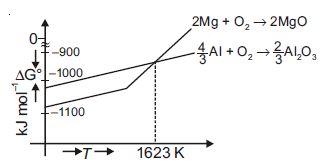
- a) Below 1623 K, Mg reduces Al2O3
- b) Above 1623 K, Al reduces MgO
- c) Both (1) & (2) are correct
- d) Both (1) & (2) are wrong
Answer: Both (1) & (2) are correct
Question: In Ellingham diagrams of Δf G oxide formation Vs T, which of the following graphs has negative slope?
- a) C → CO
- b) Fe → Fe2O3
- c) Mg → MgO
- d) All of these
Answer: C → CO
Question: Which of the following has the lowest percentage of carbon in it?
- a) Pig iron
- b) Cast iron
- c) Wrought iron
- d) Haematite
Answer: Wrought iron
Question: Which of the following is incorrect w.r.t. metallurgy of iron in the blast furnace?
- a) Zone of combustion : C + O2→CO2
- b) Zone of heat absorbtion : CO2→ C + O2
- c) Zone of slag formation : CaO + SiO2→CaSiO3
- d) Zone of reduction : Fe2O3+ 3C → 3CO + 2Fe
Answer: Zone of heat absorbtion : CO2→ C + O2
Question: Roasting of sulphide ore is generally performed in
- a) Muffle furnace
- b) Bessemer converter
- c) Blast furnace
- d) Reverberatory furnace
Answer: Reverberatory furnace
Question: Zinc is extracted from zinc blende by
- a) Carbon reduction process
- b) Nitrogen reduction process
- c) Oxygen reduction process
- d) All of these
Answer: Carbon reduction process
Question: Which of the following is leached with NaCN?
- a) Ore of Al
- b) Ore of Cu
- c) Ore of Ag
- d) Ore of Zn
Answer: Ore of Ag
Question: Hall Heroult method is used for the extraction of
- a) Ti
- b) Al
- c) Au
- d) Zn
Answer: Al
Question: Poling is used for purification of metals having impurities of
- a) Metal sulphides
- b) Metal carbonates
- c) Metal bicarbonates
- d) Metal oxides
Answer: Metal oxides
Question: Impure zinc, as collected from earthen clay retort, is called
- a) Blister zinc
- b) Pig zinc
- c) Zinc spelter
- d) Cast zinc
Answer: Zinc spelter
Question: The process of converting hydrated alumina into anhydrous alumina is called
- a) Roasting
- b) Calcination
- c) Dressing
- d) Smelting
Answer: Calcination
Question: Extraction of zinc from zinc blende is achieved by
- a) Electrolytic reduction
- b) Roasting followed by reduction with carbon
- c) Roasting followed by reduction with another metal
- d) Roasting followed by self reduction
Answer: Roasting followed by reduction with carbon
Question: Which of the following metal is purified by distillation process?
- a) Zn
- b) Fe
- c) Al
- d) Cu
Answer: Zn
Question: Vapour phase refining can be carried out in case of
- a) Ni
- b) Zr
- c) Ti
- d) All of these
Answer: All of these
Question: Which of the following is not a method of purification of metals?
- a) Liquation
- b) Distillation
- c) Zone refining
- d) Galvanisation
Answer: Galvanisation
Question: Which of the following metal can be extracted by self reduction process?
- a) Pb
- b) Hg
- c) Cu
- d) All of these
Answer: All of these
Question: Which of the following gives metal by electrolytic reduction conveniently and profitably?
- a) PbO
- b) Fe2O3
- c) Cr2O3
- d) Al2O3
Answer: Al2O3
More Questions........................................
Question: Which of the following metal can be extracted without using reducing agent?
- a) Sn
- b) Pb
- c) Fe
- d) Both (1) & (2)
Answer: Pb
Question: Which of the following metal is extracted by using coke and carbon monoxide as reducing agent?
- a) Na
- b) Cu
- c) Fe
- d) Al
Answer: Fe
Question: Which of the following metal is extracted by the use of cyanide solution?
- a) Pb
- b) Zn
- c) Mn
- d) Ag
Answer: Ag
Question: A substance which reacts with gangue to form fusible material is called
- a) Flux
- b) Catalyst
- c) Ore
- d) Slag
Answer: Flux
Question: Electrolytic reduction method is used for extraction of
- a) Highly electronegative elements
- b) Transition metals
- c) Highly electropositive elements
- d) Metalloids
Answer: Highly electropositive elements
Question: Cyanide process is used for the extraction of
- a) Au
- b) Cu
- c) Zn
- d) Fe
Answer: Au
Question: Which of the following is not a concentration technique?
- a) Levigation
- b) Froth- flotation
- c) Leaching
- d) Calcination
Answer: Calcination
Question: Which of the following metals cannot be extracted by carbon reduction process?
- a) Pb
- b) Al
- c) Hg
- d) Zn
Answer: Al
Question: Which of the following is not a refining process?
- a) Mond’s process
- b) Van-Arkel process
- c) Poling
- d) Leaching
Answer: Leaching
Question: The ores that are concentrated by Froth flotation method are
- a) Carbonate
- b) Sulphides
- c) Oxides
- d) Phosphates
Answer: Sulphides
Question: In blast furnace, iron oxide is reduced by
- a) Silica
- b) CO
- c) H2S
- d) Lime stone
Answer: CO
Question: The silver complex formed during cyanide process is
- a) Na2[Ag(CN)]
- b) Na[AgCN]
- c) Na2[Ag(CN)2]
- d) Na[Ag(CN)2]
Answer: Na[Ag(CN)2]
Question: Zincite and calamine respectively are
- a) Oxide and carbonate ore of Zn
- b) Carbonate and oxide ore of Zn
- c) Oxide and sulphate ore of Zn
- d) Sulphate and sulphite ore of Zn
Answer: Oxide and carbonate ore of Zn
Question: Which of the following is chalcopyrite?
- a) CuFeS2
- b) FeS2
- c) KMgCl3.6H2O
- d) Al2O3.2H2O
Answer: CuFeS2
Question: The alloy used in dental filling contains
- a) Ag and Sn
- b) Ag and Sb
- c) Hg, Ag and Sn
- d) Hg, Ag and Sb
Answer: Hg, Ag and Sn
Question: What will happen, if anode is made of nickel instead of graphite in the extraction of aluminium from AlCl3 ?
- a) Nickel will be affected by high temperature
- b) Nickel will combine with Cl2
- c) Nickel is insulator
- d) All of these
Answer: Nickel will combine with Cl2
Question: When molten NaCl is electrolysed by using inert electrode, the product obtained at cathode is
- a) Na
- b) Cl2
- c) H2
- d) Na-Hg amalgam
Answer: Na
Question: By which process zinc is extracted from zinc blende?
- a) Electrolytic reduction
- b) Roasting followed by reduction with carbon
- c) Calcination followed by reduction with carbon
- d) Roasting followed by self reduction
Answer: Roasting followed by reduction with carbon
Question: What is the slag formed from P2O5 impurity in metallurgy of iron?
- a) Ca3(PO4)2
- b) CaSiO3
- c) Fe3(PO4)2
- d) FeSiO3
Answer: Ca3(PO4)2
Question: Which of the following oxide is thermally least stable?
- a) CaO
- b) Al2O3
- c) Fe2O3
- d) Ag2O
Answer: Ag2O
Question: Thomas slag is
- a) Calcium silicate
- b) Anode mud
- c) FeSiO3
- d) Calcium phosphate
Answer: Calcium phosphate
Question: Which of the following give respective metal by self reduction?
- a) Galena PbS
- b) HgS
- c) ZnS
- d) Both (1) & (2)
Answer: Both (1) & (2)
Question: Which of the following statement is incorrect?
- a) Al2O3 cannot be reduced into Al by Cr2O3
- b) Ca is stronger reducing agent than Mg
- c) At 673 K, CO is poor reducing agent than carbon
- d) All of these
Answer: At 673 K, CO is poor reducing agent than carbon
Question: Aluminium is extracted from alumina (Al2O3) by electrolysis of a molten mixture of
- a) Al2O3+ Na3AIF6+ CaF2
- b) Al2O3+ KF + Na3AIF6
- c) Al2O3+ HF + NaAIF4
- d) Al2O3+ CaF2+ NaAIF4
Answer: Al2O3+ Na3AIF6+ CaF2
Question: In the extraction of copper from its sulphide ore, the metal is finally obtained by the reduction of cuprous oxide with
- a) Iron sulphide (FeS)
- b) Carbon monoxide (CO)
- c) Copper (I) sulphide (Cu2S)
- d) Sulphur dioxide (SO2)
Answer: Copper (I) sulphide (Cu2S)
Question: Identify the alloy containing a non-metal as a constituent in it
- a) Bell metal
- b) Bronze
- c) Invar
- d) Steel
Answer: Steel
Question: Which one of the following is a mineral of iron ?
- a) Pyrolusite
- b) Magnetite
- c) Malachite
- d) Cassiterite
Answer: Magnetite
Question: Which of the following elements is present as the impurity to the maximum extent in the pig iron?
- a) Phosphorus
- b) Manganese
- c) Carbon
- d) Silicon
Answer: Carbon
Question: From gold amalgam, gold may be recovered by
- a) Distillation
- b) Oxidation
- c) Electrolytic refining
- d) Dissolving in HNO3
Answer: Distillation
Question: Which of the following pairs of metals is purified by Van Arkel method?
- a) Ni and Fe
- b) Ga and In
- c) Zr and Ti
- d) Ag and Au
Answer: Zr and Ti
General Principles and Processes Of Isolation Of Elements Objective Questions & Solutions for NEET Chemistry
Download Multiple Choice Questions: General Principles and Processes Of Isolation Of Elements (NEET Chemistry)
Review structured objective questions for NEET Chemistry General Principles and Processes Of Isolation Of Elements. Built according to official NEET guidelines, these MCQ sets support daily revision and core concept reinforcement.
Concept Clarification for General Principles and Processes Of Isolation Of Elements
Cross-reference your completed choices with comprehensive NCERT solutions for NEET Chemistry to ensure absolute clarity across all sub-topics in this chapter.
Additional Study Resources for NEET Chemistry
Follow up your worksheet practice by attempting the interactive online Chemistry MCQ test for this chapter to evaluate your execution speed. All platform resources are free to access.
FAQs
You can get most exhaustive NEET Chemistry General Principles and Processes Of Isolation Of Elements MCQs Set 01 for free on StudiesToday.com. These MCQs for NEET Chemistry are updated for the 2026-27 academic session as per NEET examination standards.
Yes, our NEET Chemistry General Principles and Processes Of Isolation Of Elements MCQs Set 01 include the latest type of questions, such as Assertion-Reasoning and Case-based MCQs. 50% of the NEET paper is now competency-based.
By solving our NEET Chemistry General Principles and Processes Of Isolation Of Elements MCQs Set 01, NEET students can improve their accuracy and speed which is important as objective questions provide a chance to secure 100% marks in the Chemistry.
Yes, Chemistry MCQs for NEET have answer key and brief explanations to help students understand logic behind the correct option as its important for 2026 competency-focused NEET exams.
Yes, you can also access online interactive tests for NEET Chemistry General Principles and Processes Of Isolation Of Elements MCQs Set 01 on StudiesToday.com as they provide instant answers and score to help you track your progress in Chemistry.