

Official Class 5 Mathematics Worksheets: Factors And Multiples
Access comprehensive chapter-wise worksheets for Factors And Multiples using the CBSE Class 5 Mathematics Factors And Multiples Worksheet Set 02. Designed to align with the 2026-27 academic syllabus for Class 5 Mathematics, these printable practice sets help students reinforce key concepts and improve their overall exam readiness.
Solved Practice Worksheets for Mathematics
Access the complete worksheet PDF for Class 5 Mathematics below. Regular practice with these targeted academic tasks builds familiarity with standard question patterns and helps secure higher marks in final school examinations.
Topic : Factors and Multiples
Even Number : A number which is divisible by 2 is called even number.
Every even number has 0, 2, 4, 6, 8 as its unit digit.
For example : 80 , 246, 602, 23658 etc.
Odd Number : A number which is not divisible by 2 is called odd number.
Every odd number has 1, 3, 5, 7, 9 as its unit digit.
For example : 531, 457, 179, 3621 etc.
Test of Divisibility:
(1) Test of divisibility by 2: A number is divisible by 2, if its unit digit is any one of 0, 2, 4, 6 and 8.
For example- 246 , 680 , 15798 etc
(2)Test of divisibility by 3: A number is divisible by 3, if the sum of its digits is divisible by 3.
For example: Test the divisibility 837 by 3.
Sum of its digit = 8 + 3 + 7 = 18 , Which is divisible by 3.
Hence 837 is divisible by 3.
(3)Test of divisibility by 4: A number is divisible by 4 , if the number formed by its last two digit ( ones and tens) is divisible by 4.
For example: Test the divisibility 97312 by 4.
The number formed by its last two digits is 12, Which is divisible by 4.
Hence 97312 is divisible by 4.
(4) Test of divisibility by 5: A number is divisible by 5, if its unit digit is 0 or 5.
For example: Test the divisibility by 5 of 26425 and 3580 .
In given numbers unit digit is 5 and 0 .
Hence given numbers is divisible by 5 .
(5) Test of divisibility by 6: A number is divisible by 6, if it is divisible by each one of 2 and 3 .
For example: Test the divisibility of 6 by 7512.
Unit digit is 2.
Sum of digits = 7+5+1+2 = 15, which is divisible by 3.
Hence given number is divisible by 6.
(6) Test of divisibility by 8:
NOTE - ALL QUESTIONS ARE COMPULSORY.
(1) Which of the following numbers are divisible by 2 ?
(a) 5694 (b) 7358 (c) 2890 (d) 1989 (e) 289
(2) Which of the following numbers are divisible by 3 ?
(a) 1395 (b) 26412 (c) 16347 (d) 31547 (e)37401
(3) Which of the following numbers are divisible by 4 ?
(a) 1056 (b) 2360 (c) 16338 (d) 24842 (e) 7130
(4) Which of the following numbers are divisible by 5 ?
(a) 1980 (b) 1895 (c) 3206 (d) 9915 (e) 27905
(5) Write all the even number between:
(a) 73 and 87 (b) 519 and 531 (c) 91 and 111
(6) Write all the odd numbers between:
(a) 64 and 80 (b) 624 and 640 (c) 70 and 81
(7) Separate even and odd numbers :
(a) 25 (b) 34 (c) 85 (d) 124 (e) 905 (f) 258
(8) Write all the factors of 28 .
(9) Write all the factors of 60 .
(10) Write all the factors of 45 .
Multiple Choice Questions
Question. ________ are the numbers which are multiplied together to get another number.
(a) Factors
(b) Multiples
(c) Product
(d) Difference
Answer : A
Question. A ________ is a diagram which is used to break down a number by dividing it by its factors until all the numbers left are prime numbers.
(a) factor tree
(b) product tree
(c) maths tree
(d) multiplication tree
Answer : A
Question. ________ is the factor of every number.
(a) 0
(b) 1
(c) 2
(d) 3
Answer : B
Question. Every number is the ________ factor of itself.
(a) greatest
(b) smallest
(c) equal to
(d) less than equal to
Answer : A
Question. The factors of any number are ________ the number.
(a) equal to or less than
(b) equal to or greater than
(c) equal to
(d) less than
Answer : A
Question. We can find factors by ________.
(a) multiplication
(b) division
(c) multiplication & division
(d) addition
Answer : C
Question. When we divide one number by another and there is no remainder, the divisor & the quotient are the ________ of the first number.
(a) factors
(b) multiples
(c) product
(d) answer
Answer : A
Question. Pick the odd one out.
(a) 2
(b) 4
(c) 6
(d) 7
Answer : D
Question. Every number except 1 has at least ________ factors.
(a) 2
(b) 3
(c) 4
(d) 5
Answer : A
Question. A ________ is a number that is the product of a given number and some other number.
(a) multiple
(b) factor
(c) product
(d) factor tree
Answer : A
Question. A multiple is basically a ________.
(a) time table
(b) factor tree
(c) product tree
(d) division table
Answer : A
Question. We can find the ________ of a number by multiplying it by 1,2,3,4, and so on.
(a) factors
(b) multiples
(c) products
(d) sum
Answer : B
Question. Pick odd one out.
(a) 3
(b) 6
(c) 9
(d) 10
Answer : D
Question. Every multiple of a number is ________ the number itself.
(a) greater than or equal to
(b) less than or equal to
(c) greater than
(d) less than
Answer : A
Question. There is no end to the ________ you can get of a particular number.
(a) multiples
(b) factors
(c) product
(d) sum
Answer : A
Question. 56 is a ________ of 8.
(a) factor
(b) multiple
(c) product
(d) difference
Answer : B
Question. The common factors of 56 & 44 are ________. (2008, Mental Mathematics)
(a) 1, 2, 4.
(b) 1, 2, 11.
(c) 1, 8.
(d) 2.
Answer : A
Question. Is 6 a factor of 78 ?
(a) Yes
(b) No
(c) May be
(d) May not be
Answer : A
Question. How many factors do prime numbers have?
(a) 0
(b) 1
(c) 2
(d) 3
Answer : C
Question. If 6 × 5 = 30, then 6 and 5 are
(a) addends
(b) divisor
(c) factors
(d) none of these
Answer : C
Question. Which pair of numbers has a greatest common factor 1?
(a) 7 and 20
(b) 3 and 45
(c) 15 and 18
(d) 4 and 16
Answer : A
Question. What is the seventh multiple of 9?
(a) 45
(b) 54
(c) 63
(d) 72
Answer : C
Question. Which list shows the first five multiples of 7?
(a) 7, 8, 9, 10, 11
(b) 7, 9, 11, 13, 15
(c) 7, 14, 21, 28, 35
(d) 7, 49, 343, 2,401, 6,807
Answer : C
Question. Which list contains all prime numbers?
(a) 1, 7, 13, 29
(b) 2, 13, 27, 41
(c) 5, 11, 29, 31
(d) 6, 18, 21, 50
Answer : C
Question. Which number is neither a prime number nor a composite number?
(a) 3
(b) 5
(c) 1
(d) 2
Answer : C
Question. Which of the following pairs of numbers are co-primes?
(a) (11, 111)
(b) (22, 222)
(c) (12, 36)
(d) (14, 50)
Answer : A
Question. Match the following :
| List I | List II | ||
| A | Factors of 6 | 1 | 1, 3, 9. |
| B | Factors of 9 | 2 | 5, 10, 15, 20, |
| C | Multiples of 5 | 3 | 3, 6, 9, 12, |
| D | Multiples of 3 | 4 | 1, 2, 3, 6. |
A B C D
(a) 4 1 2 3
(b) 4 1 3 2
(c) 1 4 2 3
(d) 4 3 2 1
Answer : A
Question. Which number completes the puzzle?

(a) 23
(b) 19
(c) 21
(d) 20
Answer : B
Question. Fill in the blanks by choosing the correct option for the given factor tree of 120.
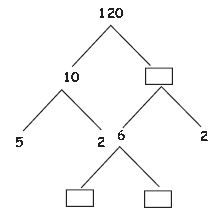
a) 12, 2, 2
(b) 12, 2, 3
(c) 2, 3, 1
(d) 1, 2, 3
Answer : B
Question. Directions (Qs. a to d) : Consider the following statements and choose the correct option.
Statement A : A number which has more than two factors is called a prime number.
Statement B : A number which has only two distinct factors, is called a composite number.
(a) Statement A is correct.
(b) Statement B is correct.
(c) Both are correct.
(d) Both are incorrect.
Answer : D
Question a. Statement A : If one of the two given numbers is a multiple of the other, the greater number is the L.C.M. of the given numbers.
Statement B : The Highest Common Factor of two or more given numbers is the greatest among all their common factors. (Tricky)
(a) Statement A is correct.
(b) Statement B is correct.
(c) Both are correct.
(d) Both are incorrect.
Answer : C
Question b. Statement A : The multiples of 8 are 16, 24, 32, 40, 48…. (Critical Thinking)
Statement B : The common multiples of 8 & 6 are 24 & 48.
(a) Statement A is correct.
(b) Statement B is correct.
(c) Both are correct.
(d) Both are incorrect.
Answer : C
Question c. Statement A : The H.C.F. is the greatest number which divides two or more numbers without a remainder. (Critical Thinking)
Statement B : The L.C.M. of two or more numbers is the smallest number which is divisible by each one of the given numbers.
(a) Statement A is correct.
(b) Statement B is correct.
(c) Both are correct.
(d) Both are incorrect.
Answer : C
Question d. Statement A : 30 is the smallest number which when divided by 10 and 15 leaves no remainder.
Statement B : 4 is the largest number that divides 12 and 20 without a remainder.
(a) A is correct.
(b) B is correct.
(c) Both are correct.
(d) Both are incorrect.
Answer : C
Question 1. Find the prime factors of: 110, 224, 200, 19, 38, 46
Answer: Prime factorization of each number by successive division:
For 110:
\(110 \div 2 = 55\)
\(55 \div 5 = 11\)
\(11 \div 11 = 1\)
Prime factors of 110 = \(2 \times 5 \times 11\)
For 224:
\(224 \div 2 = 112\)
\(112 \div 2 = 56\)
\(56 \div 2 = 28\)
\(28 \div 2 = 14\)
\(14 \div 2 = 7\)
\(7 \div 7 = 1\)
Prime factors of 224 = \(2^5 \times 7\) (or \(2 \times 2 \times 2 \times 2 \times 2 \times 7\))
For 200:
\(200 \div 2 = 100\)
\(100 \div 2 = 50\)
\(50 \div 2 = 25\)
\(25 \div 5 = 5\)
\(5 \div 5 = 1\)
Prime factors of 200 = \(2^3 \times 5^2\) (or \(2 \times 2 \times 2 \times 5 \times 5\))
For 19:
19 is a prime number, so its only prime factor is 19.
For 38:
\(38 \div 2 = 19\)
\(19 \div 19 = 1\)
Prime factors of 38 = \(2 \times 19\)
For 46:
\(46 \div 2 = 23\)
\(23 \div 23 = 1\)
Prime factors of 46 = \(2 \times 23\)
In simple words: Prime factors are the prime numbers that divide a given number completely without leaving any remainder.
Exam Tip: Always start dividing by the smallest prime number (2, 3, 5, 7, etc.) and continue until the quotient becomes 1.
Question 2. Find HCF of 81, 243 (use long division method)
Answer: Step 1: Divide the larger number (243) by the smaller number (81).
\(243 \div 81 = 3\) with a remainder of 0.
Step 2: Since the remainder is 0, the divisor at this step is the HCF.
HCF of 81 and 243 = 81.
In simple words: In long division for HCF, divide the larger number by the smaller number, then divide the divisor by the remainder until the remainder becomes zero. The last divisor is your HCF.
Exam Tip: Notice that 243 is a multiple of 81 (\(81 \times 3 = 243\)), so the smaller number is automatically the HCF.
Question 3. Find HCF of 65, 105 (prime factorization)
Answer: Step 1: Find the prime factorization of each number.
Prime factorization of 65 = \(5 \times 13\)
Prime factorization of 105 = \(3 \times 5 \times 7\)
Step 2: Identify the common prime factors.
The only common prime factor is 5.
HCF of 65 and 105 = 5.
In simple words: The HCF by prime factorization is the product of all common prime factors shared by the numbers.
Exam Tip: List the prime factors clearly and circle the ones that appear in both factor lists.
Question 4. Find LCM of 48, 60, 84
Answer: Using the common division method:
Divide by 2: \(24, 30, 42\)
Divide by 2: \(12, 15, 21\)
Divide by 2: \(6, 15, 21\)
Divide by 2: \(3, 15, 21\)
Divide by 3: \(1, 5, 7\)
Divide by 5: \(1, 1, 7\)
Divide by 7: \(1, 1, 1\)
LCM = \(2 \times 2 \times 2 \times 2 \times 3 \times 5 \times 7\)
\(= 16 \times 3 \times 5 \times 7 = 48 \times 35 = 1680\)
In simple words: The LCM is the smallest common multiple that is evenly divisible by all the given numbers.
Exam Tip: Double-check your multiplication steps when finding the product of prime divisors for large numbers.
Chapter-4 Fraction
Question 5. Find two equivalent factors (equivalent fractions) for each of the following: 2/13, 9/15, 6/10
Answer: To find equivalent fractions, multiply or divide the numerator and denominator by the same non-zero number.
For \(\frac{2}{13}\):
Multiply by 2: \(\frac{2 \times 2}{13 \times 2} = \frac{4}{26}\)
Multiply by 3: \(\frac{2 \times 3}{13 \times 3} = \frac{6}{39}\)
Equivalent fractions for \(\frac{2}{13}\) are \(\frac{4}{26}\) and \(\frac{6}{39}\).
For \(\frac{9}{15}\):
Multiply by 2: \(\frac{9 \times 2}{15 \times 2} = \frac{18}{30}\)
Divide by 3: \(\frac{9 \div 3}{15 \div 3} = \frac{3}{5}\)
Equivalent fractions for \(\frac{9}{15}\) are \(\frac{18}{30}\) and \(\frac{3}{5}\).
For \(\frac{6}{10}\):
Multiply by 2: \(\frac{6 \times 2}{10 \times 2} = \frac{12}{20}\)
Divide by 2: \(\frac{6 \div 2}{10 \div 2} = \frac{3}{5}\)
Equivalent fractions for \(\frac{6}{10}\) are \(\frac{12}{20}\) and \(\frac{3}{5}\).
In simple words: Equivalent fractions represent the same value even though their numbers look different, created by multiplying or dividing top and bottom by the same number.
Exam Tip: Always use simple numbers like 2, 3, or 10 to generate equivalent fractions quickly.
Question 6. Convert into lowest form: 8/16, 33/66, 15/21, 26/39
Answer: To convert into the lowest form, divide the numerator and denominator by their HCF.
For \(\frac{8}{16}\):
HCF of 8 and 16 is 8.
\(\frac{8 \div 8}{16 \div 8} = \frac{1}{2}\)
For \(\frac{33}{66}\):
HCF of 33 and 66 is 33.
\(\frac{33 \div 33}{66 \div 33} = \frac{1}{2}\)
For \(\frac{15}{21}\):
HCF of 15 and 21 is 3.
\(\frac{15 \div 3}{21 \div 3} = \frac{5}{7}\)
For \(\frac{26}{39}\):
HCF of 26 and 39 is 13.
\(\frac{26 \div 13}{39 \div 13} = \frac{2}{3}\)
In simple words: A fraction is in its lowest form when the numerator and denominator have no common factor other than 1.
Exam Tip: Cancel common factors step-by-step if you cannot find the HCF immediately.
Question 7. Convert the mixed fractions into improper fractions: \(8\frac{1}{3}, 2\frac{2}{3}, 9\frac{4}{3}, 6\frac{1}{6}, 3\frac{1}{3}, 11\frac{1}{2}\)
Answer: Formula: \(\text{Improper Fraction} = \frac{(\text{Whole number} \times \text{Denominator}) + \text{Numerator}}{\text{Denominator}}\)
For \(8\frac{1}{3}\):
\(\frac{(8 \times 3) + 1}{3} = \frac{24 + 1}{3} = \frac{25}{3}\)
For \(2\frac{2}{3}\):
\(\frac{(2 \times 3) + 2}{3} = \frac{6 + 2}{3} = \frac{8}{3}\)
For \(9\frac{4}{3}\):
\(\frac{(9 \times 3) + 4}{3} = \frac{27 + 4}{3} = \frac{31}{3}\)
For \(6\frac{1}{6}\):
\(\frac{(6 \times 6) + 1}{6} = \frac{36 + 1}{6} = \frac{37}{6}\)
For \(3\frac{1}{3}\):
\(\frac{(3 \times 3) + 1}{3} = \frac{9 + 1}{3} = \frac{10}{3}\)
For \(11\frac{1}{2}\):
\(\frac{(11 \times 2) + 1}{2} = \frac{22 + 1}{2} = \frac{23}{2}\)
In simple words: Multiply the whole number by the denominator, then add the numerator to get the new numerator over the same denominator.
Exam Tip: Never change the denominator when converting mixed numbers to improper fractions.
Question 8. Convert the improper fractions into mixed fractions: \(\frac{13}{4}, \frac{11}{7}, \frac{34}{5}, \frac{12}{4}, \frac{33}{8}, \frac{159}{7}, \frac{67}{5}, \frac{128}{6}\)
Answer: Divide the numerator by the denominator to get the quotient (whole number), remainder (numerator), and keep the same denominator.
For \(\frac{13}{4}\): \(13 \div 4 = 3\) remainder 1 \(\rightarrow 3\frac{1}{4}\)
For \(\frac{11}{7}\): \(11 \div 7 = 1\) remainder 4 \(\rightarrow 1\frac{4}{7}\)
For \(\frac{34}{5}\): \(34 \div 5 = 6\) remainder 4 \(\rightarrow 6\frac{4}{5}\)
For \(\frac{12}{4}\): \(12 \div 4 = 3\) (exact whole number, \(3\)
For \(\frac{33}{8}\): \(33 \div 8 = 4\) remainder 1 \(\rightarrow 4\frac{1}{8}\)
For \(\frac{159}{7}\): \(159 \div 7 = 22\) remainder 5 \(\rightarrow 22\frac{5}{7}\)
For \(\frac{67}{5}\): \(67 \div 5 = 13\) remainder 2 \(\rightarrow 13\frac{2}{5}\)
For \(\frac{128}{6}\): \(128 \div 6 = 21\) remainder 2 \(\rightarrow 21\frac{2}{6} = 21\frac{1}{3}\)
In simple words: Divide top by bottom; the answer is your whole number, the left-over is your new top number, and the bottom number stays the same.
Question 9. Complete the following:
\(\frac{1}{4} = \frac{\quad}{16}\)
\(\frac{13}{52} = \frac{1}{\quad}\)
\(\frac{7}{11} = \frac{\quad}{77}\)
\(\frac{3}{4} = \frac{\quad}{32}\)
Answer: For \(\frac{1}{4} = \frac{\Box}{16}\):
Denominator changes from 4 to 16 by multiplying by 4 (\(16 \div 4 = 4\)).
Multiply numerator by 4: \(1 \times 4 = 4\).
Missing value = 4 (\(\frac{4}{16}\)).
For \(\frac{13}{52} = \frac{1}{\Box}\):
Numerator changes from 13 to 1 by dividing by 13 (\(13 \div 13 = 1\)).
Divide denominator by 13: \(52 \div 13 = 4\).
Missing value = 4 (\(\frac{1}{4}\)).
For \(\frac{7}{11} = \frac{\Box}{77}\):
Denominator changes from 11 to 77 by multiplying by 7 (\(77 \div 11 = 7\)).
Multiply numerator by 7: \(7 \times 7 = 49\).
Missing value = 49 (\(\frac{49}{77}\)).
For \(\frac{3}{4} = \frac{\Box}{32}\):
Denominator changes from 4 to 32 by multiplying by 8 (\(32 \div 4 = 8\)).
Multiply numerator by 8: \(3 \times 8 = 24\).
Missing value = 24 (\(\frac{24}{32}\)).
In simple words: Whatever you multiply or divide the bottom number by, you must do the exact same thing to the top number to keep the fraction balanced.
Exam Tip: Find the multiplier by dividing the given complete number by the incomplete corresponding number.
Free study material for Mathematics
CBSE Class 5 Mathematics Worksheets for Factors And Multiples
Mastering Factors And Multiples with Printable Worksheets
Access structured practice worksheets for Factors And Multiples aligned with the 2026 CBSE curriculum. These downloadable exercises for Class 5 Mathematics help students build accuracy and reinforce core concepts for upcoming school tests.
Verified Solutions and NCERT Alignment
Each worksheet draws directly from authorized standard textbooks to maintain academic accuracy. Evaluating your finished exercises against expert-verified solutions helps master the formal presentation standards expected in school evaluations.
Additional Study Resources for Class 5 Mathematics
Follow up your worksheet practice by attempting the interactive online MCQ tests for Factors And Multiples to evaluate your execution speed. All printable assignments and revision sheets on our platform are updated for the 2026 session and available free of charge.
FAQs
You can download the latest chapter-wise printable worksheets for Class 5 Mathematics Factors And Multiples for free from StudiesToday.com. These have been made as per the latest CBSE curriculum for this academic year.
Yes, Class 5 Mathematics worksheets for Factors And Multiples focus on activity-based learning and also competency-style questions. This helps students to apply theoretical knowledge to practical scenarios.
Yes, we have provided solved worksheets for Class 5 Mathematics Factors And Multiples to help students verify their answers instantly.
Yes, our Class 5 Mathematics test sheets are mobile-friendly PDFs and can be printed by teachers for classroom.
For Factors And Multiples, regular practice with our worksheets will improve question-handling speed and help students understand all technical terms and diagrams.