

Class 5 Mathematics Practice Sheet: CBSE Class 5 Mathematics Area And Perimeter Worksheet Set 01
Access comprehensive chapter-wise worksheets for Area And Perimeter using the CBSE Class 5 Mathematics Area And Perimeter Worksheet Set 01. Designed to align with the 2026-27 academic syllabus for Class 5 Mathematics, these printable practice sets help students reinforce key concepts and improve their overall exam readiness.
Download Area And Perimeter Worksheet PDF with Answers
Access the complete worksheet PDF for Class 5 Mathematics below. Regular practice with these targeted academic tasks builds familiarity with standard question patterns and helps secure higher marks in final school examinations.
Question. Calculate the area of rectangle if one square represents an area of 1 cm2.
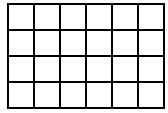
(a) 2 cm2
(b) 9 cm2
(c) 50 cm2
(d) 24 cm2
Answer : D
Question. What is the area of rectangle if Length = 2 m, Breadth = 5 m
(a) 12 m2
(b) 14 m2
(c) 10 m2
(d) 18 m2
Answer : C
Question. Each side of square is of 10 m. What will be the area of the square?
(a) 100 m2
(b) 90 m2
(c) 34 m2
(d) 115 m2
Answer : A
Question. The third side of the triangle if the perimeter of a triangle is 20 m and two of its sides are 5 m and 4 m, is
(a) 11 m
(b) 10 m
(c) 12 m
(d) 5 m
Answer : A
Question. Find the missing side in the figure given below if the perimeter of the figure is 28 m.
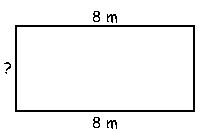
(a) 12 m
(b) 3 m
(c) 9 m
(d) 6 m
Answer : D
Question. Find the area of shaded region. (Each square = 1m2)
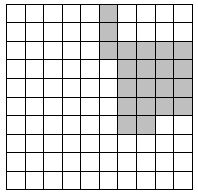
(a) 21 m2
(b) 35 m2
(c) 34 m2
(d) 13 m2
Answer : A
Question. The length and breadth of a rectangle are (3a + 2) and (2a – 1). Which of the following represents its perimeter?
(a) 2(5a – 1)
(b) (5a + 1)
(c) (5a – 1)
(d) 2(5a + 1)
Answer : D
Question. The difference between the length and the breadth of a rectangle is 8 cm and the perimeter is 64 cm. Which of the following can be the length and breadth of this rectangle?
(a) L = 12 cm, B = 4 cm
(b) L = 20 cm, B = 8 cm
(c) L = 20 cm, B = 12 cm
(d) L = 12 cm, B = 8 cm
Answer : C
Question. The area of a triangle whose base is 12 cm and the Height twice the base, is
(a) 144 sq. cm
(b) 288 sq. cm
(c) 289 sq. cm
(d) Can not be determined
Answer : A
Question. How many small cubes of side 2 cm can be put in a cubical box of side 6 cm?
(a) 9
(b) 12
(c) 27
(d) 611.
Answer : C
Question. The breadth of a rectangle is increased by 2 units. Its perimeter is now increased by?
(a) 2 units
(b) 4 units
(c) 8 units
(d) 16 units
Answer : B
Question. The area of a square is equal to the area of a rectangle of l = 8 cm and b = 2 cm. What is the side of the square?
(a) 6 cm
(b) 4 cm
(c) 3 cm
(d) 8 cm
Answer : B
Question. The area of a square is 100 sq. cm. If the sides this square are increased by 10% then what will be the area of new square?
(a) 121 sq. cm
(b) 101 sq. cm
(c) 81 sq. cm
(d) 169 sq. cm
Answer : A
Question. Area of a square is :
(a) product of all sides
(b) sum of all sides
(c) side × side
(d) 2 × side
Answer : C
Question. A cuboid measures 24 m × 12 m × 16 m. How many cubes of side 8 m can fit in the box?
(a) 9
(b) 16
(c) 15
(d) 24
Answer : A
Question. The area of a square is 25 square units and its side is 5. Find its perimeter. (2018)
(a) 25
(b) 20
(c) 50
(d) 40
Answer : B
Question. What is the perimeter of a square if each side is 8.2 centimetres long ?
(a) 64.16 cm
(b) 67.24 cm
(c) 32.8 cm
(d) 16.2 cm
Answer : A
Question. Which of the following statement is INCORRECT?
(a) A square has 5 equal sides
(b) A rectangle has 2 pair of equal sides
(c) A square has 4 right angles
(d) A rectangle has only 2 right angles
Answer : D
Question. If a figure has sides 4 m, 2 m, 4 m and 2 m then which type of figure is this?
(a) Circle
(b) Rectangle
(c) Square
(d) Triangle
Answer : B
Question. Which geometric figure has six square faces?
(a) Cube
(b) Cone
(c) Cylinder
(d) Sphere
(e) None of these
Answer : A
Question. Calculate the area of rectangle given below if each square has an area of 4 m2.
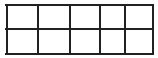
(a) 80 m2
(b) 64 m2
(c) 40 m2
(d) 15 m2
Answer : C
Question. Which of these figures represents the area of 24m2 if given that each block ⬜ = 2 m2
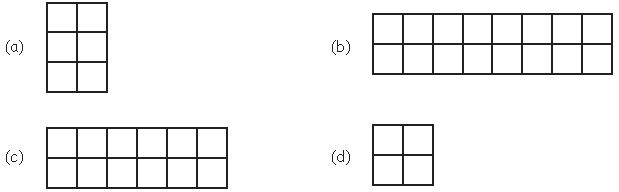
Answer : C
Question. Area of rectangle is 32 m2. If the length is 8 m then breadth = __________
(a) 20 m
(b) 4 m
(c) 10 m
(d) 12 m
Answer : B
Question. Match the following :
| List-I | List-II | ||
| A | Area of rectangle | 1 | Side × side |
| B | Perimeter of triangle | 2 | Length × breadth |
| C | Area of square | 3 | 4 × side |
| D | Perimeter of square | 4 | Sum of the lengths of three sides |
A B C D
(a) 2 4 3 1
(b) 2 4 1 3
(c) 3 4 1 2
(d) 4 1 2 3
Answer : B
Question. Find area of unshaded region if each box = 3 m2.
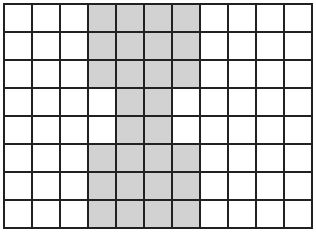
(a) 88 m2
(b) 60 m2
(c) 84 m2
(d) 180 m2
Answer : D
Question. Look at the diagram of Shreya’s yard. Which expression can Shreya use to find the perimeter of her yard?
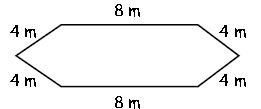
(a) (4 × 4) + (2 × 8)
(b) (4 × 8) + (2 × 8)
(c) (4 + 4) + (2 + 8)
(d) (4 × 8) + (2 × 4)
Answer : A
Question. Which of the following statement(s) are true or false? Choose the correct option.
A. The perimeter of triangle = 2 × sum of three sides.
B. Area of square = side x side.
C. If we want to fence an area we calculate perimeter of that place.
D. A rectangle has all its four sides equal.
(a) TTTT
(b) TFFT
(c) FTTF
(d) TFFT
Answer : C
Question. Find the perimeter of the given figure.
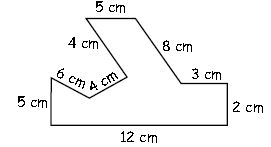
(a) 42 cm
(b) 45 cm
(c) 49 cm
(d) 53 cm
Answer : C
Directions (Qs. 29 to 32) : Fill in the blanks in the given passage by choosing the correct option.
Jayant has a garden of 20feet × 25feet. He wants to have a grass lawn on some part of it.
He wants the grass lawn to be 10feet by 13feet. To find area of grass lawn he should use the formula ______ (29) he also wants to fence the whole garden. For that Jayant will have to calculate the ______ (30) of the garden which is = ______ (31) . So he will have a grass lawn of area ______ (32) sq feet.
Question.
(a) side × side
(b) l + b
(c) l × b
(d) none of these
Answer : C
Question.
(a) area
(b) perimeter
(c) both
(d) none of these
Answer : B
Question.
(a) 2l + b
(b) 2b + l
(c) 2(l + b)
(d) 2l
Answer : C
Question.
(a) 130
(b) 140
(c) 124
(d) 80
Answer : A
Please click the below link to access CBSE Class 5 Mathematics Worksheet- Area and Perimeter
Unit 9 - Area and Perimeter
Fill in the blanks.
Question 1. Perimeter is the distance around the edge of a figure.
Answer: Perimeter
In simple words: Perimeter is the total outer boundary length of any closed shape.
Exam Tip: Always remember that perimeter measures length and has units like cm, m, or km.
Question 2. Area is the amount of surface a figure covers.
Answer: Area
In simple words: Area measures the flat space inside a closed boundary.
Exam Tip: Area is always expressed in square units like sq. cm or sq. m.
Question 3. Perimeter of a rectangle = \(2 \times (\text{Length} + \text{Breadth})\)
Answer: Length + Breadth
In simple words: Add length and breadth together, then multiply the sum by 2.
Exam Tip: Double check that both length and breadth are in the same unit before adding.
Question 4. Perimeter of a square = \(4 \times \text{Side}\)
Answer: Side
In simple words: Since all four sides of a square are equal, multiply the side length by 4.
Question 5. Area of a rectangle = Length \(\times\) Breadth
Answer: Length, Breadth
In simple words: Multiply length by breadth to get the rectangular region.
Exam Tip: Ensure dimensions are converted to the same units before multiplying.
Question 6. Area of a square = Side \(\times\) Side
Answer: Side, Side
In simple words: Multiply the side length by itself to find the area of a square.
Exam Tip: Can also be written as \((\text{Side})^2\).
Question 7. Length of the rectangle = Area \(\div\) Breadth
Answer: Breadth
In simple words: Divide the given area by the breadth to find the missing length.
Exam Tip: Keep units consistent between area and breadth.
Question 8. Breadth of the rectangle = Area \(\div\) Length
Answer: Length
In simple words: Divide the total area by the length to get the breadth.
Exam Tip: Division reverses multiplication in area formulas.
Question 9. Area is always measured in square units.
Answer: Area
In simple words: Two-dimensional space is always counted using square units.
Exam Tip: Never write simple units like cm or m for area.
Question 10. A square with 1 cm sides is a square centimetre.
Answer: square centimetre
In simple words: A tiny square of side 1 cm has an area of 1 sq. cm.
Exam Tip: Abbreviated as sq. cm or cm\(_2\).
Question 11. A square with 1 metre sides is a square metre.
Answer: square
In simple words: A square with each side measuring 1 meter covers 1 square meter of area.
Exam Tip: Abbreviated as sq. m.
Question 12. A square with 1 kilometre sides is a square kilometre.
Answer: 1 km / one kilometre
In simple words: Very large areas like countries or cities are measured in square kilometres.
Exam Tip: Written as sq. km.
Question 13. Side of a square = Perimeter \(\div\) 4
Answer: 4
In simple words: Divide the total perimeter by 4 to get the length of one side.
Exam Tip: Useful when perimeter is given and you need to find the side for area calculation.
Question 14. Perimeter of a square having side 1 cm is 4 cm.
Answer: 4 cm
In simple words: \(4 \times 1\text{ cm} = 4\text{ cm}\).
Exam Tip: Perimeter uses linear units.
Question 15. Area of a square having side 1 cm is 1 sq. cm.
Answer: 1 sq. cm
In simple words: \(1\text{ cm} \times 1\text{ cm} = 1\text{ sq. cm}\).
Exam Tip: Area uses square units.
Question 16. Perimeter of a square having side 3 cm is 12 cm.
Answer: 12 cm
In simple words: Multiply 4 by 3 cm to get 12 cm.
Exam Tip: Total boundary length equals sum of all four sides.
Question 17. Area of a square having side 2 m is 4 sq. m.
Answer: 4 sq. m
In simple words: \(2\text{ m} \times 2\text{ m} = 4\text{ sq. m}\).
Exam Tip: Multiply side by side.
Question 18. Area of rectangle whose length is 3 cm and breadth is 2 cm is 6 sq. cm.
Answer: 6 sq. cm
In simple words: \(3\text{ cm} \times 2\text{ cm} = 6\text{ sq. cm}\).
Exam Tip: Product of length and breadth gives rectangle area.
II. Do the Following
Question 1. Find the perimeter of the following figures by using the formula.
(Note: Left figure is a rectangle with length 17 cm and breadth 9 cm. Right figure is a square with side 15 cm.)
Answer:
For the rectangle:
Length = 17 cm
Breadth = 9 cm
Perimeter of rectangle = \(2 \times (\text{Length} + \text{Breadth})\)
\(= 2 \times (17 + 9)\)
\(= 2 \times 26\)
\(= 52\text{ cm}\)
For the square:
Side = 15 cm
Perimeter of square = \(4 \times \text{Side}\)
\(= 4 \times 15\)
\(= 60\text{ cm}\)
In simple words: Calculate boundary lengths using respective formulas for rectangles and squares.
Exam Tip: Always state the formula before substituting values.
Question 2. Find the perimeter of the rectangles whose sides are given below.
a) length = 85 cm, breadth = 14 cm
Answer:
Perimeter = \(2 \times (\text{Length} + \text{Breadth})\)
\(= 2 \times (85 + 14)\)
\(= 2 \times 99\)
\(= 198\text{ cm}\)
In simple words: Add 85 and 14, then double the result.
Exam Tip: Write units clearly in the final answer.
Question 2. b) length = 150 cm, breadth = 100 cm
Answer:
Perimeter = \(2 \times (\text{Length} + \text{Breadth})\)
\(= 2 \times (150 + 100)\)
\(= 2 \times 250\)
\(= 500\text{ cm}\)
In simple words: Sum length and breadth, then multiply by 2.
Exam Tip: Double check addition: \(150 + 100 = 250\).
Question 2. c) length = 7 m, breadth = 12 m
Answer:
Perimeter = \(2 \times (\text{Length} + \text{Breadth})\)
\(= 2 \times (7 + 12)\)
\(= 2 \times 19\)
\(= 38\text{ m}\)
In simple words: Add 7 and 12, then multiply by 2.
Exam Tip: Retain the given unit (meters) in the answer.
Question 3. Find the side of the rectangles with the given measures.
a) Area = 96 sq. cm, length = 12 cm. Breadth = ?
Answer:
Breadth = Area \(\div\) Length
\(= 96 \div 12\)
\(= 8\text{ cm}\)
In simple words: Divide area by length to find breadth.
Exam Tip: Breadth is a linear measure, so unit is cm, not sq. cm.
Question 3. b) Area = 72 sq. cm, breadth = 8 cm. Length = ?
Answer:
Length = Area \(\div\) Breadth
\(= 72 \div 8\)
\(= 9\text{ cm}\)
In simple words: Divide area by breadth to find length.
Exam Tip: Ensure correct division tables are used.
Question 3. c) Area = 805 sq. m, length = 35 m. Breadth = ?
Answer:
Breadth = Area \(\div\) Length
\(= 805 \div 35\)
\(= 23\text{ m}\)
In simple words: Divide 805 by 35 to get 23.
Question 3. d) Area = 156 sq. cm, breadth = 12 cm. Length = ?
Answer:
Length = Area \(\div\) Breadth
\(= 156 \div 12\)
\(= 13\text{ cm}\)
In simple words: Divide 156 by 12 to find the length.
Exam Tip: Check by multiplying 13 by 12 to verify 156.
III. Do as directed.
Question 1. A square field has a perimeter of 580 m. What is its area?
Answer:
Perimeter = 580 m
Side of square = Perimeter \(\div\) 4
\(= 580 \div 4 = 145\text{ m}\)
Area of square = Side \(\times\) Side
\(= 145 \times 145\)
\(= 21025\text{ sq. m}\)
In simple words: First find the side by dividing perimeter by 4, then multiply side by itself to get area.
Exam Tip: Multi-step problems require finding intermediate values (like side length) first.
Question 2. Sapna jogs around a square park whose side is 60 m. One day she jogged around the park 6 times. How much did she jog in all?
Answer:
Side of square park = 60 m
Perimeter of park = \(4 \times \text{Side} = 4 \times 60 = 240\text{ m}\)
Distance jogged in 1 round = 240 m
Total distance for 6 rounds = \(240 \times 6 = 1440\text{ m}\) (or 1.44 km)
In simple words: Find the distance of one complete lap (perimeter), then multiply by 6.
Exam Tip: Distance around a shape equals its perimeter.
Question 3. Raj has a rectangular backyard that is 54 m wide and 63 m long. How much fencing will he need to enclose the yard? If fencing costs Rs. 85 per metre, how much will he have to pay?
Answer:
Length = 63 m, Breadth = 54 m
Fencing needed = Perimeter of rectangle
Perimeter = \(2 \times (\text{Length} + \text{Breadth})\)
\(= 2 \times (63 + 54)\)
\(= 2 \times 117\)
\(= 234\text{ m}\)
Cost per metre = Rs. 85
Total cost = \(234 \times 85\)
\(= \text{Rs. } 19890\)
In simple words: Calculate the perimeter for fencing length, then multiply by the cost per metre.
Exam Tip: Word problems involving total cost require finding the total quantity first and multiplying by unit price.
Question 4. A square picture has a frame of 500 cm. What is the length of each side?
Answer:
Perimeter of frame = 500 cm
Side of square = Perimeter \(\div\) 4
\(= 500 \div 4\)
\(= 125\text{ cm}\)
In simple words: Divide the total frame length by 4 to get one side.
Exam Tip: Frame length represents the perimeter of the square.
Question 3 (cont.). Find the area of the rectangles whose sides are given below.
a) length = 24 cm, breadth = 9 cm
Answer:
Area = Length \(\times\) Breadth
\(= 24 \times 9\)
\(= 216\text{ sq. cm}\)
In simple words: Multiply length by breadth.
Exam Tip: Use square units for area.
Question 3. b) length = 15 cm, breadth = 12 cm
Answer:
Area = Length \(\times\) Breadth
\(= 15 \times 12\)
\(= 180\text{ sq. cm}\)
In simple words: Multiply 15 by 12.
Exam Tip: Check multiplication carefully.
Question 3. c) length = 50 m, breadth = 30 m
Answer:
Area = Length \(\times\) Breadth
\(= 50 \times 30\)
\(= 1500\text{ sq. m}\)
In simple words: Multiply 50 by 30.
Exam Tip: Include trailing zeros: \(5 \times 3 = 15\) followed by two zeros.
Question 4. Find the area and perimeter of the squares with the following sides.
a) 72 cm
Answer:
Side = 72 cm
Area = Side \(\times\) Side = \(72 \times 72 = 5184\text{ sq. cm}\)
Perimeter = \(4 \times \text{Side} = 4 \times 72 = 288\text{ cm}\)
In simple words: Multiply side by itself for area, and by 4 for perimeter.
Exam Tip: Do not confuse area and perimeter formulas for squares.
Question 4. b) 65 m
Answer:
Side = 65 m
Area = \(65 \times 65 = 4225\text{ sq. m}\)
Perimeter = \(4 \times 65 = 260\text{ m}\)
In simple words: Compute area by squaring 65, and perimeter by multiplying by 4.
Exam Tip: Write proper units for each.
Question 4. c) 43 cm
Answer:
Side = 43 cm
Area = \(43 \times 43 = 1849\text{ sq. cm}\)
Perimeter = \(4 \times 43 = 172\text{ cm}\)
In simple words: Square 43 for area and multiply by 4 for perimeter.
Exam Tip: Double check multiplication steps.
Question 4. d) 25 cm
Answer:
Side = 25 cm
Area = \(25 \times 25 = 625\text{ sq. cm}\)
Perimeter = \(4 \times 25 = 100\text{ cm}\)
In simple words: Standard square values: \(25^2 = 625\).
Exam Tip: Memorize common squares up to 30 for speed.
Question 4. e) 30 m
Answer:
Side = 30 m
Area = \(30 \times 30 = 900\text{ sq. m}\)
Perimeter = \(4 \times 30 = 120\text{ m}\)
In simple words: Multiply 30 by 30 for area, and 4 by 30 for perimeter.
Exam Tip: Handle zeros by multiplying non-zero digits and appending zeros.
Question 4. f) 92 cm
Answer:
Side = 92 cm
Area = \(92 \times 92 = 8464\text{ sq. cm}\)
Perimeter = \(4 \times 92 = 368\text{ cm}\)
In simple words: Multiply 92 by itself and by 4 respectively.
Exam Tip: Keep calculations neat to avoid arithmetic errors.
Question 5. Find the side of these squares with the given perimeter.
a) perimeter = 248 cm
Answer:
Side = Perimeter \(\div\) 4
\(= 248 \div 4\)
\(= 62\text{ cm}\)
In simple words: Divide the perimeter by 4 to get the side length.
Exam Tip: Side is a linear dimension.
Question 5. b) Perimeter = 616 cm
Answer:
Side = Perimeter \(\div\) 4
\(= 616 \div 4\)
\(= 154\text{ cm}\)
In simple words: Divide 616 by 4.
Exam Tip: Check division: \(154 \times 4 = 616\).
Question 5. c) Perimeter = 440 m
Answer:
Side = Perimeter \(\div\) 4
\(= 440 \div 4\)
\(= 110\text{ m}\)
In simple words: Divide 440 by 4 to find side length.
Exam Tip: Match units with the given perimeter.
Question 6. Find the area of the following figures.
(Note: Composite figure consisting of a rectangle of length 25 cm and breadth 15 cm, joined with another rectangle of length 8 m and breadth 8 m.)
Answer:
Area of first rectangle = \(25\text{ cm} \times 15\text{ cm} = 375\text{ sq. cm}\)
Area of second rectangle/square = \(8\text{ m} \times 8\text{ m} = 64\text{ sq. m}\)
Total Area = Sum of both areas = \(375\text{ sq. cm} + 64\text{ sq. m}\) (Note: Units are mixed in source diagram; compute separately as given)
In simple words: Split the composite figure into two separate rectangles, find their individual areas, and add them up.
Exam Tip: For composite figures, always divide the shape into standard rectangles and squares.
Free study material for Mathematics
Download Class 5 Mathematics Area And Perimeter Practice Worksheets
Download Chapter Worksheets: Class 5 Mathematics
Review targeted practice exercises for Class 5 Mathematics Area And Perimeter. Curated to match official CBSE guidelines, these printable problem sets support daily revision and improve overall test readiness.
Concept Clarification for Area And Perimeter
Built using official NCERT guidelines for Class 5 Mathematics, these practice sheets provide reliable academic support. Cross-reference your completed work with our detailed solutions to learn standard answer-writing formats for CBSE exams.
Effective Revision Strategies for School Exams
Follow up your worksheet practice by attempting the interactive online MCQ tests for Area And Perimeter to evaluate your execution speed. All printable assignments and revision sheets on our platform are updated for the 2026 session and available free of charge.
FAQs
You can download the latest chapter-wise printable worksheets for Class 5 Mathematics Area And Perimeter for free from StudiesToday.com. These have been made as per the latest CBSE curriculum for this academic year.
Yes, Class 5 Mathematics worksheets for Area And Perimeter focus on activity-based learning and also competency-style questions. This helps students to apply theoretical knowledge to practical scenarios.
Yes, we have provided solved worksheets for Class 5 Mathematics Area And Perimeter to help students verify their answers instantly.
Yes, our Class 5 Mathematics test sheets are mobile-friendly PDFs and can be printed by teachers for classroom.
For Area And Perimeter, regular practice with our worksheets will improve question-handling speed and help students understand all technical terms and diagrams.