

Download Class 5 Mathematics Practice Worksheets
Explore structured practice materials through the CBSE Class 5 Mathematics Be My Multiple Worksheet Set 01. Tailored for Class 5 learners, utilizing these Mathematics worksheets ensures thorough preparation and strengthens problem-solving accuracy before final school evaluations.
Access Math-Magic Chapter 06 Be My Multiple, I'll be Your Factor Practice Papers and Solutions
View or download the dedicated CBSE Class 5 Mathematics Be My Multiple Worksheet Set 01 resource below. Engaging with these practice papers under focused study conditions ensures continuous academic progress and mastery of the 2026-27 curriculum for Math-Magic Chapter 06 Be My Multiple, I'll be Your Factor.
Question. The difference of two numbers is 42. If the smaller number is increased by 10, the new difference will be
(a) 32
(b) 42
(c) 52
(d) 420
Answer : A
Question. A matchstick can measure each side of the given triangle exactly. Which of these could be the length of the matchstick?
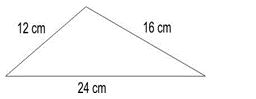
(a) 3 cm
(b) 4 cm
(c) 5 cm
(d) 6 cm
Answer : B
Question. Mr. Frog and Mr. Toad are sitting on a rock. There are many stones in front of them. Mr. Frog can jump 6 stones at a time and Mr. Toad can jump 4 stones at a time. Which is the first stone on which both of them will land, if they jump as far they can each time?
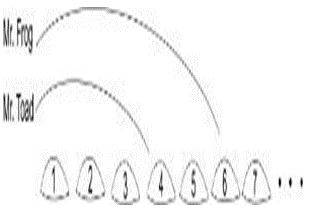
(a) 3
(b) 4
(c) 12
(d) 24
Answer : C
Question. The number 10 has 4 factors - 1, 2, 5 and 10. The table lists the NUMBER OF FACTORS for some numbers.
From this we can say that the number of prime numbers between 520 and 530 are:
| Number | Number of Factors |
| 521 | 2 |
| 523 | 2 |
| 525 | 12 |
| 527 | 4 |
| 529 | 4 |
(a) 0
(b) 2
(c) 4
(d) Cannot be said for sure.
Answer : B
Question. The first 5 multiples of a few numbers are given below: Which of these pairs of numbers has 48 as its FIRST common multiple?
| Number | First 5 Multiples |
| 8: | 8 16 24 32 40 |
| 12: | 12 24 36 48 60 |
| 16: | 16 32 48 64 80 |
| 24: | 24 48 72 96 120 |
(a) 12 and 24
(b) 8 and 12
(c) 8 and 24
(d) 12 and 16
Answer : D
Question. Leela is making gift packets for a group of friends. Each packet contains 8 toffees and 5 lollipops. If the total number of lollipops needed was 30, the number of toffees needed would be
(a) 48
(b) 40
(c) 33
(d) 30
Answer : A
Question. Simi has 14 red balls, 9 blue balls, and 12 yellow balls in a bag. What is the LEAST number of balls that she must take out to leave an EQUAL number of red, blue, and yellow balls in the bag?
(a) 3
(b) 5
(c) 8
(d) 35
Answer : C
Q. 1 Do as directed
I. Fill in the blanks-
1. The smallest common multiple of 3 & 5 is ______________.
2. ___________ is a factor of every number.
3. The first four multiples of 6 are _______, ________, _______, ______.
4. Factors are also _________ of a number.
5. Rajasthan is to the __________ of Tripura.
II. Choose the correct answer.
1. Numbers which are multiple of 2 are called ______ numbers.
a) Even b) Composite c) Odd d) Prime
2. The actual distance between Boirdadar and Chakradharnagar is 4 km but in map it is 2 cm. What would be the scale.
a) 1 km on the ground = 1 cm on map.
b) 1 km on the ground = ½ cm on map.
c) 1 km on the ground = 2 cm on map.
d) 1 km on the map = ½ cm on the ground.
III. State True or False.
1. 15 is the multiple of 30
2. 1, 2, 3, 4, 6, 12 are factors of 12.
3. Biggest common multiple of 4, 6 and 5 is 60
Q. 2 Find the HCF of 16, 44 and 84 by listing the factors.
Q.3 Write the factors of 28 in circle A and the factors of 32 in circle B. Write their common factors in the common part of both. Which is the biggest common factor of 28 &32?
Q.4 Find the LCM of 8, 24, & 36.
Q.5 Write the first 6 multiples of 12.
Q 6 Circle the numbers which have 60 as multiple – 28, 15, 5, 10, 2, 3, 22, 12, 16
Q.7. 9 is the factor of which of these numbers 27, 22, 81, 18, 46, 65, 54, 72, 45
Q.8 Find the factors of 20 by arranging 20 seeds in the form of different rectangles (rows & columns)
Q.9 Write any 6 multiples of 8
Q.10 Write all the factors of 15,48, 120, 75
Q.11 If it is written at the bottom of a map, scale 1 cm=200m. The distance between patrapali
and Gorkha is found to be 5 cm on the map. Then what is the actual distance between them.
Q.12 Two wires 15 cm and 25 cm in length are to be cut into smaller pieces of equal length. What can be the maximum length of each small wir
Q.13 Three bells rings at interval of 10, 12 and 15 minutes. They rang together at 12 Noon, when will they next ring together?
Q.14 Sunita took some seeds. She made groups of five with them and found one seed was left over. She tried making groups of 6 and groups of 4. Each time one seed was left over. What is the smallest number of seeds that Sunita had?
Q.15 Write the multiple of 4, 5 and 6 in their respective circles. The common multiples of any tw or three numbers has to be written in the intersection part of their circles. Then find out the smallest common multiple of 4,6 and 5.
Q.16 Draw a floor map of your class room and mark your bench in the class room.
Q.17 Find three common multiples of 2, 3 & 4. What is the LCM of these?
Q.18 Draw factor tree for the following numbers.
a)24 b)72 c)96
Q.19 List all the factors of 16 and 54. What is the common factor of 16 and 54. What is the highest common factor of 16 and 54.
Q.20 Following the direction given below to mark the roads, land marks and places mention below on the 1 cm grid to make your own map. The scale of the map is 1cm =10 km.
a. Pedapur is 30 km north of Panipur.
b. 50 km to the east of Pedapur is Mithapur.
c. 10 km south of Mithapur is the Airport
d. 450 east of Panipur about 20 km away in Haldighat.
e. Midway between Pedapur and Mithapur is a wild life sanctuary called Sambalpur.
f. A railway line runs in a straight line between Panipur & Mithapur. What is its approximates length in km.
1. When two or more numbers are multiplied, then each number is a_______________ of the product and the product is the____________ the numbers.
2. In statement 7 X 4 =28 , 7 and 4 are _______________ of the multiple_____________
3. _____________ is a factor of every number.
4. Every non zero number is a factor of _____________
5. Every number is a multiple of __________________
6. The next four numbers are 3 ,6, 9,_____ ,______ ,_____ ,______
7. The first common multiple of 4 and 8 is _____________
8. The multiplies of 15 lying between 50 and 100 are ________________
9. _______________ is neither prime nor composite.
10. Are all prime numbers odd? YES /NO_____________
11. The factors of 12 are 1 , 2 ,3, 4, 6 and X .What is X?________
12. Numbers which have more than two factors are called____________
13. Numbers which have only two factors are called_________________
Q. 1 Do as directed
I. Fill in the blanks-
1. The smallest common multiple of 3 & 5 is 15.
2. 1 is a factor of every number.
3. The first four multiples of 6 are 6, 12, 18, 24.
4. Factors are also divisors of a number.
5. Rajasthan is to the west of Tripura.
II. Choose the correct answer.
1. Numbers which are multiple of 2 are called even numbers.
(a) Even (b) Composite (c) Odd (d) Prime
Answer: (a) Even
Numbers divisible by 2 or multiples of 2 are called even numbers.
In simple words: Even numbers always end in 0, 2, 4, 6, or 8 and are multiples of 2.
Exam Tip: Remember that multiples of 2 are always even numbers.
2. The actual distance between Boirdadar and Chakradharnagar is 4 km but in map it is 2 cm. What would be the scale.
(a) 1 km on the ground = 1 cm on map.
(b) 1 km on the ground = 1/2 cm on map.
(c) 1 km on the ground = 2 cm on map.
(d) 1 cm on the map = 1/2 km on the ground.
Answer: (c) 1 km on the ground = 2 cm on map.
Scale = Map distance / Actual distance = \(\frac{2\text{ cm}}{4\text{ km}} = \frac{1\text{ cm}}{2\text{ km}}\), which means 1 km on the ground is represented by 2 cm on the map.
In simple words: For every 1 km of real distance, the map shows 2 cm.
Exam Tip: Always divide map distance by actual distance to find the scale ratio.
III. State True or False.
1. 15 is the multiple of 30
Answer: False (15 is a factor of 30, not a multiple).
In simple words: Multiples are greater than or equal to the number, whereas 15 is smaller than 30.
Exam Tip: A number cannot be a multiple of a number larger than itself.
2. 1, 2, 3, 4, 6, 12 are factors of 12.
Answer: True.
In simple words: All these numbers divide 12 completely without leaving a remainder.
Answer: False (There is no biggest common multiple as multiples go on infinitely; 60 is the *least* common multiple or LCM).
In simple words: Multiples never end, so you cannot find a biggest common multiple.
Exam Tip: Multiples are infinite; only common *factors* have a highest limit.
Question 2. Find the HCF of 16, 44 and 84 by listing the factors.
Answer:
Factors of 16 = 1, 2, 4, 8, 16
Factors of 44 = 1, 2, 4, 11, 22, 44
Factors of 84 = 1, 2, 3, 4, 6, 7, 12, 14, 21, 28, 42, 84
Common factors of 16, 44, and 84 = 1, 2, 4
Highest Common Factor (HCF) = 4
In simple words: List all numbers that divide 16, 44, and 84, then find the largest number that appears in all three lists.
Exam Tip: Always double check your factor lists by pairing multiplication factors (e.g., \(4 \times 21 = 84\)).
Question 3. Write the factors of 28 in circle A and the factors of 32 in circle B. Write their common factors in the common part of both. Which is the biggest common factor of 28 & 32?
Answer:
Factors of 28 = 1, 2, 4, 7, 14, 28
Factors of 32 = 1, 2, 4, 8, 16, 32
Common factors = 1, 2, 4
Biggest common factor (HCF) = 4
In simple words: Circle A has unique factors of 28, Circle B has unique factors of 32, and the overlapping middle section contains 1, 2, and 4.
Exam Tip: In Venn diagrams for factors, put shared numbers strictly in the intersection zone.
Question 4. Find the LCM of 8, 24, & 36.
Answer:
Multiples of 8 = 8, 16, 24, 32, 40, 48, 56, 64, 72, ...
Multiples of 24 = 24, 48, 72, 96, ...
Multiples of 36 = 36, 72, 108, ...
Least Common Multiple (LCM) = 72
In simple words: Find the smallest multiple that appears in the multiplication tables of 8, 24, and 36.
Exam Tip: You can also use prime factorization method to find LCM quickly for larger numbers.
Question 5. Write the first 6 multiples of 12.
Answer:
First 6 multiples of 12 are:
\(12 \times 1 = 12\)
\(12 \times 2 = 24\)
\(12 \times 3 = 36\)
\(12 \times 4 = 48\)
\(12 \times 5 = 60\)
\(12 \times 6 = 72\)
In simple words: Multiply 1 by 12, 2 by 12, up to 6 by 12 to get the first six multiples.
Exam Tip: Writing out multiplication tables up to the required number of terms ensures no errors.
Question 6. Circle the numbers which have 60 as multiple - 28, 15, 5, 10, 2, 3, 22, 12, 16
Answer:
Numbers which have 60 as a multiple are factors of 60: 15, 5, 10, 2, 3, 12
In simple words: If 60 can be divided completely by a number, then that number has 60 as a multiple.
Exam Tip: Testing divisibility for each number against 60 is the fastest method.
Question 7. 9 is the factor of which of these numbers 27, 22, 81, 18, 46, 65, 54, 72, 45
Answer:
9 is a factor of: 27, 81, 18, 54, 72, 45
In simple words: Check which of the given numbers come in the 9 times multiplication table.
Exam Tip: Use the sum of digits test (sum divisible by 9) to verify quickly.
Question 8. Find the factors of 20 by arranging 20 seeds in the form of different rectangles (rows & columns)
Answer:
Possible rectangular arrangements for 20 seeds:
1 row of 20 seeds (\(1 \times 20 = 20\))
2 rows of 10 seeds (\(2 \times 10 = 20\))
4 rows of 5 seeds (\(4 \times 5 = 20\))
5 rows of 4 seeds (\(5 \times 4 = 20\))
10 rows of 2 seeds (\(10 \times 2 = 20\))
20 rows of 1 seed (\(20 \times 1 = 20\))
Therefore, the factors of 20 are 1, 2, 4, 5, 10, and 20.
In simple words: Arrange seeds in equal rows and columns to find all factor pairs that multiply to 20.
Exam Tip: Factor pairs always read forwards and backwards (e.g., \(2 \times 10\) and \(10 \times 2\)).
Question 9. Write any 6 multiples of 8
Answer:
6 multiples of 8 are 8, 16, 24, 32, 40, and 48.
In simple words: Write down the first six numbers in the 8 times table.
Exam Tip: Any six consecutive multiples starting from 8 work here.
Question 10. Write all the factors of 15, 48, 120, 75
Answer:
Factors of 15 = 1, 3, 5, 15
Factors of 48 = 1, 2, 3, 4, 6, 8, 12, 16, 24, 48
Factors of 120 = 1, 2, 3, 4, 5, 6, 8, 10, 12, 15, 20, 24, 30, 40, 60, 120
Factors of 75 = 1, 3, 5, 15, 25, 75
In simple words: List all whole numbers that divide each given number without leaving a remainder.
Exam Tip: Always start checking factors systematically from 1 upwards.
Question 11. If it is written at the bottom of a map, scale 1 cm = 200m. The distance between Patrapali and Gorkha is found to be 5 cm on the map. Then what is the actual distance between them.
Answer:
Map distance = 5 cm
Scale = 1 cm = 200 m
Actual distance = \(5 \times 200\text{ m} = 1000\text{ m}\) or 1 km.
In simple words: Multiply the map distance by 200 meters to get the real-world distance.
Exam Tip: Pay attention to units (meters vs. kilometers) when converting.
Question 12. Two wires 15 cm and 25 cm in length are to be cut into smaller pieces of equal length. What can be the maximum length of each small wire?
Answer:
To find the maximum length of each small piece, we calculate the HCF of 15 and 25.
Factors of 15 = 1, 3, 5, 15
Factors of 25 = 1, 5, 25
HCF = 5
Maximum length of each small wire = 5 cm.
In simple words: Find the HCF of 15 and 25 to get the largest possible equal size.
Exam Tip: Questions asking for 'maximum length' or 'greatest size' always require finding the HCF.
Question 13. Three bells rings at interval of 10, 12 and 15 minutes. They rang together at 12 Noon, when will they next ring together?
Answer:
To find when they ring together again, we calculate the LCM of 10, 12, and 15.
Multiples of 10 = 10, 20, 30, 40, 50, 60, ...
Multiples of 12 = 12, 24, 36, 48, 60, ...
Multiples of 15 = 15, 30, 45, 60, ...
LCM = 60 minutes (1 hour)
They will next ring together at 1:00 PM.
In simple words: Find the LCM of the time intervals to know when events repeat simultaneously.
Exam Tip: Questions about events happening 'together again' or at simultaneous intervals always use LCM.
Question 14. Sunita took some seeds. She made groups of five with them and found one seed was left over. She tried making groups of 6 and groups of 4. Each time one seed was left over. What is the smallest number of seeds that Sunita had?
Answer:
First, find the LCM of 5, 6, and 4.
Multiples of 5 = 5, 10, 15, 20, 25, 30, 35, 40, 45, 50, 55, 60, ...
Multiples of 6 = 6, 12, 18, 24, 30, 36, 42, 48, 54, 60, ...
Multiples of 4 = 4, 8, ..., 60, ...
LCM of 5, 6, and 4 = 60
Since 1 seed is always left over, add 1 to the LCM: \(60 + 1 = 61\).
Smallest number of seeds = 61.
In simple words: Find the LCM of group sizes and add the remainder that is left over.
Exam Tip: Whenever a problem says 'X left over', find the LCM and add X at the end.
Question 15. Write the multiple of 4, 5 and 6 in their respective circles. The common multiples of any two or three numbers has to be written in the intersection part of their circles. Then find out the smallest common multiple of 4, 6 and 5
Answer:
Multiples of 4, 5, and 6 intersect at their common multiples.
Smallest common multiple (LCM) of 4, 6, and 5 = 60.
In simple words: The first number that appears in the 4, 5, and 6 multiplication tables is 60.
Exam Tip: The smallest common multiple is simply the LCM.
Question 16. Draw a floor map of your class room and mark your bench in the class room.
Answer:
(Student activity: Draw a rectangular box representing the classroom, mark the entrance door, teacher's table at the front, and point out your specific desk position.)
In simple words: Sketch a bird's-eye view of your classroom layout and point to your desk.
Exam Tip: Include key landmarks like doors, windows, and the blackboard in your map.
Question 17. Find three common multiples of 2, 3 & 4. What is the LCM of these?
Answer:
Multiples of 2 = 2, 4, 6, 8, 10, 12, 14, 16, 18, 20, 22, 24, ...
Multiples of 3 = 3, 6, 9, 12, 15, 18, 21, 24, ...
Multiples of 4 = 4, 8, 12, 16, 20, 24, ...
Three common multiples = 12, 24, 36
LCM = 12
In simple words: Find numbers shared across all three tables; the smallest is the LCM and others are its multiples.
Exam Tip: Once you find the LCM, all other common multiples are simply times tables of the LCM (\(12 \times 1, 12 \times 2, 12 \times 3\)).
Question 18. Draw factor tree for the following numbers. a) 24 b) 72 c) 96 d) 120 e) 40
Answer:
a) Factor tree of 24: \(24 = 2 \times 12 = 2 \times 2 \times 6 = 2 \times 2 \times 2 \times 3\)
b) Factor tree of 72: \(72 = 2 \times 36 = 2 \times 2 \times 18 = 2 \times 2 \times 2 \times 9 = 2 \times 2 \times 2 \times 3 \times 3\)
c) Factor tree of 96: \(96 = 2 \times 48 = 2 \times 2 \times 24 = 2 \times 2 \times 2 \times 12 = 2 \times 2 \times 2 \times 2 \times 6 = 2 \times 2 \times 2 \times 2 \times 2 \times 3\)
d) Factor tree of 120: \(120 = 2 \times 60 = 2 \times 2 \times 30 = 2 \times 2 \times 2 \times 15 = 2 \times 2 \times 2 \times 3 \times 5\)
e) Factor tree of 40: \(40 = 2 \times 20 = 2 \times 2 \times 10 = 2 \times 2 \times 2 \times 5\)
In simple words: Split each number into branches of prime numbers until no more splitting is possible.
Exam Tip: Always start breaking down composite numbers by dividing by the smallest prime number (2).
Question 19. List all the factors of 16 and 54. What is the common factor of 16 and 54. What is the highest common factor of 16 and 54.
Answer:
Factors of 16 = 1, 2, 4, 8, 16
Factors of 54 = 1, 2, 3, 6, 9, 18, 27, 54
Common factors = 1, 2
Highest Common Factor (HCF) = 2
In simple words: Find all divisors of both numbers; 1 and 2 appear in both lists, and 2 is the largest.
Question 20. Following the direction given below to mark the roads, land marks and places mention below on the 1 cm grid to make your own map. The scale of the map is 1cm = 10 km.
a. Pedapur is 30 km north of Panipur.
b. 50 km to the east of Pedapur is Mithapur.
c. 10 km south of Mithapur is the Airport.
d. 45-degree east of Panipur about 20 km away in Haldighat.
e. Midway between Pedapur and Mithapur is a wild life sanctuary called Sambalpur.
f. A railway line runs in a straight line between Panipur & Mithapur. What is its approximate length in km.
Answer:
Using scale 1 cm = 10 km:
a. Pedapur is placed 3 cm North of Panipur.
b. Mithapur is placed 5 cm East of Pedapur.
c. Airport is placed 1 cm South of Mithapur.
d. Haldighat is placed 2 cm away at 45-degree northeast from Panipur.
e. Sambalpur is placed 2.5 cm East of Pedapur (midway to Mithapur).
f. Distance between Panipur and Mithapur forms a right-angled triangle with base = 5 cm (50 km) and height = 3 cm (30 km).
Using Pythagoras theorem: distance \(= \sqrt{50^2 + 30^2} = \sqrt{2500 + 900} = \sqrt{3400} \approx 58.3 \text{ km}\).
In simple words: Convert real distances into cm using the scale to plot positions on grid paper.
Exam Tip: Always divide real distances by 10 to get map measurements in cm.
Question 21. Draw the deep drawing for the given floor maps. a) / b)
Answer:
(Student activity: Convert 2D floor plans into 3D isometric box drawings showing height, length, and width perspectives.)
In simple words: Add vertical walls and depth lines to make a 2D floor plan look 3D.
Exam Tip: Use parallel slanted lines to represent depth accurately in 3D deep drawings.
Question 22. Draw the following picture in 1/2 cm and 2 cm grid.
Answer:
(Student activity: Redraw the given geometric star pattern inside a smaller 1/2 cm grid and a larger 2 cm grid to practice scaling shapes up and down.)
In simple words: Copy the exact pattern onto smaller and larger grid boxes.
Exam Tip: Count grid squares carefully from the center point when enlarging or reducing shapes.
Question 23. Look at the map of India shown in your math magic book and answer the questions that follows.
i) Largest state in term of area ____________
Answer: Rajasthan
In simple words: Rajasthan covers the maximum geographical land area among Indian states.
Exam Tip: Memorize major geographical trivia for map-based questions.
ii) The state which touches all the three oceans: Arabian sea, Indian ocean and Bay of Bengal ________________.
Answer: Tamil Nadu
In simple words: Tamil Nadu lies at the southern tip where all three major water bodies meet.
Exam Tip: Look at the southernmost tip of the Indian peninsula on the map.
iii) The state which is surrounded by five other states. The five states which surround of are __________, __________, ___________, ___________, ___________
Answer: Madhya Pradesh (surrounded by Uttar Pradesh, Chhattisgarh, Maharashtra, Gujarat, and Rajasthan)
In simple words: Madhya Pradesh sits right in the heart of India touching five neighboring states.
Exam Tip: Madhya Pradesh is known as the heart state of India due to its central location.
iv) Tamil Nadu and Kerala lie in the __________ of the country
Answer: South
In simple words: Both states are located at the bottom (southern region) of India.
Exam Tip: Use standard directions (North, South, East, West) for regional location questions.
v) Rajasthan lies on the ___________ of the country
Answer: West
In simple words: Rajasthan is situated on the western side of India bordering Pakistan.
Exam Tip: Rajasthan is famous for the Thar Desert in western India.
vi) Three state which share border with Nepal are ____________.
Answer: Uttarakhand, Uttar Pradesh, and Bihar (also Sikkim and West Bengal)
In simple words: These states lie along the northern foothills touching Nepal.
vii) The shortest route from Bangalore Karnataka to Kolkata West Bengal is through the states of _____________ and _____________. If 1 cm on the map shows 100 km on the ground, then find out the length of the route.
Answer: Andhra Pradesh and Odisha. Map distance multiplied by 100 km gives the total road distance (approx. 1500 km depending on exact map scale measurement).
In simple words: Travel straight northeast from Karnataka through Andhra Pradesh and Odisha to reach West Bengal.
Exam Tip: Always multiply map distance in cm by the scale factor (100 km) to find real distance.
viii) Gujarat lies to the _____________ of M.P.
Answer: West
In simple words: Gujarat is situated to the left (west) of Madhya Pradesh.
Exam Tip: West is towards your left when facing North on a standard map.
ix) Punjab lies to the _________________ of Rajasthan
Answer: North-West
In simple words: Punjab is located above and to the left of Rajasthan.
Exam Tip: Intermediate directions like North-West lie directly between North and West.
x) Odisha lies to the ________________ of Jharkhand
Answer: South
In simple words: Odisha is situated directly below (south of) Jharkhand.
Exam Tip: South is towards the bottom of the map.
Free study material for Mathematics
Free CBSE Practice Worksheets: Class 5 Mathematics Math-Magic Chapter 06 Be My Multiple, I'll be Your Factor
Download Chapter Worksheets: Class 5 Mathematics
Review targeted practice exercises for Class 5 Mathematics Math-Magic Chapter 06 Be My Multiple, I'll be Your Factor. Curated to match official CBSE guidelines, these printable problem sets support daily revision and improve overall test readiness.
Concept Clarification for Math-Magic Chapter 06 Be My Multiple, I'll be Your Factor
Built using official NCERT guidelines for Class 5 Mathematics, these practice sheets provide reliable academic support. Cross-reference your completed work with our detailed solutions to learn standard answer-writing formats for CBSE exams.
Effective Revision Strategies for School Exams
Wrap up your chapter revision by testing your knowledge against standard objective question formats. Explore our full library of free, up-to-date printable assignments to maximize your academic results in upcoming CBSE evaluations.
FAQs
You can download the latest chapter-wise printable worksheets for Class 5 Mathematics Math-Magic Chapter 06 Be My Multiple, I'll be Your Factor for free from StudiesToday.com. These have been made as per the latest CBSE curriculum for this academic year.
Yes, Class 5 Mathematics worksheets for Math-Magic Chapter 06 Be My Multiple, I'll be Your Factor focus on activity-based learning and also competency-style questions. This helps students to apply theoretical knowledge to practical scenarios.
Yes, we have provided solved worksheets for Class 5 Mathematics Math-Magic Chapter 06 Be My Multiple, I'll be Your Factor to help students verify their answers instantly.
Yes, our Class 5 Mathematics test sheets are mobile-friendly PDFs and can be printed by teachers for classroom.
For Math-Magic Chapter 06 Be My Multiple, I'll be Your Factor, regular practice with our worksheets will improve question-handling speed and help students understand all technical terms and diagrams.