

Chapter-wise Worksheets for Class 5 Mathematics: Decimals
Explore structured practice materials through the CBSE Class 5 Mathematics Decimals Worksheet Set 01. Tailored for Class 5 learners, utilizing these Mathematics worksheets ensures thorough preparation and strengthens problem-solving accuracy before final school evaluations.
Practice Class 5 Mathematics Worksheets: Decimals
Navigate directly to the solved Mathematics worksheets using the digital viewer below. Each practice set includes detailed step-by-step solutions, allowing students to instantly cross-check their work and identify areas requiring further revision.
Question: Rounding off 9.19 to one decimal place will give
(a) 9.20
(b) 9.00
(c) 9.10
(d) 10.00
Answer : A
Question: Find the decimal number for “Seven Twenty Fifths”.
(a) 0.7
(b) 7.0
(c) 0.28
(d) 0.7
Answer : C
Question: Dividing 145.208 by 0.25.
(a) 580.832
(b) 58.0832
(c) 5808.32
(d) 588.32
Answer : A
Question: Round 12.6257 to three decimal places.
(a) 12.6
(b) 12.626
(c) 12.625
(d) 12.63
Answer : B
Question: Rewrite the following in the decimal form of the given unit 92 mm into cm.
(a) 0.92 cm
(b) 9.2 cm
(c) 920 cm
(d) 0.092 cm
Answer : B
Question: Rewrite the following in the decimal form of the given unit 7 ml into litre.
(a) 0.007 litre
(b) 0.07 litre
(c) 0.7 litre
(d) 70 litre
Answer : A
Question: Rewrite the following in the decimal form of the given unit 29 cm into mm.
(a) 2.90 mm
(b) 0.29 mm
(c) 290 mm
(d) 29000 mm
Answer : C
Question: The difference of 325.312 and 253.175 is:
(a) 72.003
(b) 72.137
(c) 72.130
(d) 72.107
Answer : B
Question: Which of the following expressions is true?
(a) 2.3749 > 2.0349
(b) 2.03749 < 2.003749
(c) 2.3749 > 2.4749
(d) None of these
Answer : A
Question: Round 106.5 to the nearest whole number.
(a) 100
(b) 106
(c) 107
(d) 110
Answer : C
Question: The product of 982.311 and 2.43 is:
(a) 2387.0133
(b) 2387.01000
(c) 2387.0573
(d) 2387.01573
Answer : D
Question: 9.471 if expressed as fraction can be written as:
(a) 471/1000
(b) 9(471/1000)
(c) 9(471/100)
(d) 900(471/10)
Answer : B
Question: The value of 9.85 + 0.6 – 0.28 is _______.
(a) 10.73
(b) 10.37
(c) 10.1 7
(d) 9.17
Answer : C
Question: Find the decimal number for “12.78” rounded to the nearest tenth.
(a) 12.8
(b) 12.7
(c) 12.79
(d) 13.0
Answer : A
Question: 500.5 × __________ = 5005
(a) 10
(b) 100
(c) 1000
(d) 10000
Answer : A
34. Find
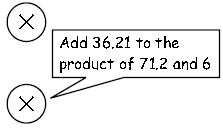
(a) 390.99
(b) 436.41
(c) 427.20
(d) 463.41
Answer : D
Question: Diana sells 12 garlands for ₹ 12.12. What is the cost of each garland?
(a) 1.01
(b) 1.1
(c) 1.0
(d) 0.11
Answer : A
Question: Find the decimal number for “3.8439” rounded to the nearest hundredth.
(a) 3.84
(b) 3.844
(c) 3.843
(d) 3.85
Answer : A
Question: Which of the following holds true or false? (Critical Thinking)
(A) 0.5 = 0.5000.
(B) 0.5 = 5/100 .
(C) 0.5 = 5 × 1/1000 .
(D) 0.5 = 5.0.
(a) TFFF
(b) FTFF
(c) FFTF
(d) FFFT
Answer : A
Question: Which of the following holds true or false?
(A) 0.3 + 0.7 = 10.00.
(B) 0.30 + 0.70 = 1.00.
(C) 0.30 + 0.70 = 0.10.
(D) 0.3 + 0.7 = 1.10.
(a) TFTT
(b) FTFF
(c) TFFF
(d) FFTT
Answer : B
Question: Find the decimal number for “one and four tenths”.
(a) 14.0
(b) 1.4
(c) 0.14
(d) 140.0
Answer : B
Question: 727.111 ÷ __________ = 7.27111
(a) 10
(b) 100
(c) 1000
(d) 10000
Answer : B
Question: If a drum hold 18.75 L of diesel, how many litres of diesel can 7 such drums hold?
(a) 130.89 L
(b) 131.25 L
(c) 128.25 L
(d) 130.75 L
Answer : B
Question: A ticket costs ₹ 12.60. How much shall I pay for 3(1/2) tickets?
(a) ₹ 40.80
(b) ₹ 44
(c) ₹ 44.10
(d) ₹ 34.80
Answer : C
Question: Find the round 239.456 to the nearest hundred.
(a) 200
(b) 300
(c) 239.45
(d) 239.46
Answer : A
Question: Find the greatest decimal from the following decimals 0.206, 2.06, 0.0206, 0.26.
(a) 2.06
(b) 0.206
(c) 0.0206
(d) 0.26
Answer : A
Question: Rewrite the following in the decimal form of the given unit 8335 g into kg.
(a) 8.335 kg
(b) 83.35 kg
(c) 833.5 kg
(d) 0.8335 kg
Answer : A
Question: 2.1143 × 10 is
(a) 0.21143
(b) 21.143
(c) 2114.3
(d) 2.11430
Answer : B
Question: Find the decimal number for “Sixty Seven and Twenty Three One-Hundredths”.
(a) 67.23
(b) 6.723
(c) 0.6723
(d) 6723.0
Answer : A
Question: 2000 + 200 + 20 + 2 + 2/10 + 2/100 + 2/1000 + 2/10000 =
(a) 222222.22
(b) 2222.2222
(c) 2222.2000
(d) 22222.222
Answer : B
Question: If 58 out of 100 students in a school are boys, then write a decimal for the part of school that consists of boys.
(a) 0.50
(b) 0.58
(c) 58
(d) 59
Answer : B
Question: Smallest number in the row 31.21, 31.12, 311.2, 3.112 is
(a) 31.21
(b) 31.12
(c) 311.2
(d) 3.112
Answer : D
Question: Highest number in the row 9.03, 9.33, 9.39, 9.09 is
(a) 9.03
(b) 9.33
(c) 9.39
(d) 9.09
Answer : C
Question: 929.5 ÷ 100 is
(a) 92.95
(b) 929.5
(c) 929.05
(d) 9.295
Answer : D
Question: Find the decimal number for “ 2 (1/2)“.
(a) 21
(b) 2
(c) 2.5
(d) 0.25
Answer : C
Question: Rewrite the following in the decimal form of the given unit 790 m into km. (Tricky)
(a) 79 km
(b) 7.90 km
(c) 7900 km
(d) 0.79 km
Answer : D
Question: Which of the following decimal numbers is the least?
1.305, 1.35, 1.053, 1.53
(a) 1.305
(b) 1.35
(c) 1.053
(d) 1.53
Answer : C
Question: Find the decimal number for “Twenty Three Fiftieths”.
(a) 0.23
(b) 0.46
(c) 2. 3
(d) 4.6
Answer : B
Question: 502(12/100) if expressed as decimals can be written as:
(a) 502.012
(b) 502.12
(c) 50.212
(d) 5021.2
Answer : B
Question: 3.95 __________ 395/100
(a) >
(b) <
(c) =
(d) None
Answer : C
Topic : Decimals
NOTE - ALL QUESTIONS ARE COMPULSORY :
(1) Convert the fractions into decimals:
(a) 1/5
(b) 7/4
(c) 7(1/6)
(d) 2(3//8)
(e) 3(7/20)
(f) 8(9/40)
(2) The cost of 24 pens is Rs 375.60 , find the cost of each pen ?
(3) The weight of 37 bags of sugar is 3644.5 kg. If all the bags weight equally, what is the weight of each bag ?
(4) 1.8 m of cloth is required for a shirt. How many such shirts can be made from a piece of cloth 45 m long ?
(5) The product of two decimals is 261.36 , If one of them is 17.6 , find the other.
(6) By how much should 100 be decreased to get 18.8 ?
(7) The cost of one chocolate is Rs 13.85 , what is the cost of 16 chocolates ?
(8) Find the weight of 16 bags of sugar, each weighing 48.450 kg.
(9) Divide 2.13 by 15 .
(10) Find the continued product : 1.73 × 8.2 × 0.6
Unit 5 Decimals (Ex. 5.6 - 5.10)
Question 1. The number of decimal places in the product equals the ________ of the number of decimal places in the factors.
Answer: sum
In simple words: When multiplying decimals, add up the total number of decimal places in the numbers being multiplied to find the decimal places in the answer.
Exam Tip: Count digits to the right of the decimal point in all factors combined.
Question 2. \(1.2 \times 3 =\)
Answer: \(3.6\)
In simple words: Multiply 12 by 3 to get 36, then place the decimal point one digit from the right.
Exam Tip: Ignore the decimal point temporarily, multiply normally, and then adjust the decimal places.
Question 3. To multiply a decimal by 10, move the decimal point one place to the ________.
Answer: right
In simple words: Multiplying by 10 makes the number larger, so shift the decimal point one position to the right.
Question 4. To multiply a decimal by 100, move the decimal point ________ places to the right.
Answer: two
In simple words: Since 100 has two zeros, move the decimal point two places to the right.
Exam Tip: If there are not enough digits, add zeros as placeholders on the right.
Question 5. To divide a decimal by 10, move the decimal point one place to the ________.
Answer: left
In simple words: Dividing by 10 makes the number smaller, so shift the decimal point one position to the left.
Exam Tip: Division by powers of 10 always moves the decimal point to the left.
Question 6. To divide a decimal by 100, move the decimal point ________ places to the left.
Answer: two
In simple words: Since 100 has two zeros, shift the decimal point two positions to the left.
Exam Tip: Add leading zeros if necessary when shifting past the first digit.
Question 7. \(18.5 \times 10 =\)
Answer: \(185\) (or \(185.0\)
In simple words: Move the decimal point one place to the right.
Exam Tip: Multiplying by 10 removes one decimal place.
Question 8. \(23.5 \div 10 =\)
Answer: \(2.35\)
In simple words: Move the decimal point one place to the left.
Exam Tip: Division by 10 decreases the place value of each digit by a factor of 10.
Question 9. \(16.73 \times 100 =\)
Answer: \(1673\) (or \(1673.0\)
In simple words: Move the decimal point two places to the right.
Exam Tip: Multiplying a two-decimal number by 100 results in a whole number.
Question 10. \(0.85 \times 100 =\)
Answer: \(85\) (or \(85.0\)
In simple words: Shift the decimal point two places to the right to get 85.
Exam Tip: Shift the exact number of places as the number of zeros in 100.
Question 11. \(5.93 \div 10 =\)
Answer: \(0.593\)
In simple words: Shift the decimal point one place to the left.
Exam Tip: Place a zero before the decimal point when there is no whole number part.
Add
Question 1(1). \(48.58 + 2.4\)
Answer:
\(48.58 + 2.40 = 50.98\)
In simple words: Line up the decimal points and add the numbers column by column.
Exam Tip: Always pad decimals with trailing zeros so both numbers have the same number of decimal digits before adding.
Question 1(2). \(693.4 + 49.7\)
Answer:
\(693.4 + 49.7 = 743.1\)
In simple words: Align decimal points and add to get 743.1.
Exam Tip: Remember to carry over correctly when the sum in any column exceeds 9.
Question 1(3). \(18.95 + 0.71\)
Answer:
\(18.95 + 0.71 = 19.66\)
In simple words: Add the tenths and hundredths places carefully with proper alignment.
Exam Tip: Keep the decimal point straight in your vertical alignment.
Question 1(4). \(12.05 + 2.1 + 1.97\)
Answer:
\(12.05 + 2.10 + 1.97 = 16.12\)
In simple words: Convert all decimals to two decimal places (\(2.1\) becomes \(2.10\)) and add them up.
Question 1(5). \(17.01 + 20.1\)
Answer:
\(17.01 + 20.10 = 37.11\)
In simple words: Line up the decimal points and add to find 37.11.
Exam Tip: Double-check column alignment to avoid addition errors.
Compare using \(<, >\) or \(=\)
Question 2(1). \(8 + 0.05\) \Box \ 0.85 \)
Answer:
\(8 + 0.05 = 8.05\)
Comparing \(8.05\) and \(0.85\), we get \(8.05 > 0.85\)
So, \(8 + 0.05 > 0.85\)
In simple words: Calculate the left side first (\(8.05\)) and compare it with the right side (\(0.85\)).
Exam Tip: Compare the whole number parts first; since 8 is greater than 0, the left side is larger.
Question 2(2). \(9.3 + 1.2\) \Box \ 8.7 + 4.8 \)
Answer:
Left side: \(9.3 + 1.2 = 10.5\)
Right side: \(8.7 + 4.8 = 13.5\)
Comparing \(10.5\) and \(13.5\), we get \(10.5 < 13.5\)
So, \(9.3 + 1.2 < 8.7 + 4.8\)
In simple words: Find the sum on both sides and compare the resulting values.
Exam Tip: Always evaluate both expressions completely before placing the inequality sign.
Question 2(3). \(20 + 0.01\) \Box \ 20.01 \)
Answer:
Left side: \(20 + 0.01 = 20.01\)
Right side: \(20.01\)
Comparing \(20.01\) and \(20.01\), they are equal.
So, \(20 + 0.01 = 20.01\)
In simple words: Both sides simplify to the exact same decimal number.
Exam Tip: Recognize standard decimal expansions to quickly spot equality.
Subtract
Question 3(1). \(11.52 - 5.7\)
Answer:
\(11.52 - 5.70 = 5.82\)
In simple words: Pad \(5.7\) with a zero to make it \(5.70\), then subtract column by column.
Exam Tip: Always align decimal points vertically before subtracting.
Question 3(2). \(11.01 - 10.11\)
Answer:
\(11.01 - 10.11 = 0.90\) (or \(0.9\)
In simple words: Subtract \(10.11\) from \(11.01\) using borrowing to get \(0.90\).
Exam Tip: Pay close attention to borrowing across the decimal point.
Question 3(3). \(8 - 7.05\)
Answer:
\(8.00 - 7.05 = 0.95\)
In simple words: Write whole number 8 as \(8.00\) and subtract \(7.05\) to get \(0.95\).
Exam Tip: Whole numbers must have a decimal point and zeros added when subtracting decimals.
Question 3(4). \(14.2 - 12.05\)
Answer:
\(14.20 - 12.05 = 2.15\)
In simple words: Write \(14.2\) as \(14.20\) and subtract \(12.05\) to get \(2.15\).
Exam Tip: Ensure equal decimal places by adding placeholder zeros.
Introduce the decimal point at the correct place in the product.
Question 4(1). \(0.05 \times 9 = 45\)
Answer:
\(0.05 \times 9 = 0.45\)
In simple words: Since \(0.05\) has two decimal places, the product must have two decimal places.
Exam Tip: Count total decimal places in the factors to place the decimal point in the product.
Question 4(2). \(9 \times 10.1 = 909\)
Answer:
\(9 \times 10.1 = 90.9\)
In simple words: \(10.1\) has one decimal place, so put the decimal point one digit from the right.
Exam Tip: The number of decimal places in the answer equals the number of decimal places in the decimal factor.
Question 4(3). \(2.5 \times 4 = 100\)
Answer:
\(2.5 \times 4 = 10.0\) (or \(10\)
In simple words: \(2.5\) has one decimal place, so place the decimal point one digit from the right in 100 to get \(10.0\).
Exam Tip: \(10.0\) simplifies to the whole number \(10\).
Question 4(4). \(0.24 \times 3 = 72\)
Answer:
\(0.24 \times 3 = 0.72\)
In simple words: \(0.24\) has two decimal places, so the result is \(0.72\).
Exam Tip: Count two places from the right of 72.
Question 4(5). \(17 \times 1.17 = 1989\)
Answer:
\(17 \times 1.17 = 19.89\)
In simple words: \(1.17\) has two decimal places, so the product has two decimal places.
Exam Tip: Place the decimal point two digits from the right in 1989.
Question 12. \(65.2 \div 100 =\)
Answer: \(0.652\)
In simple words: Move the decimal point two places to the left.
Exam Tip: Dividing by 100 shifts the decimal point two positions left.
Question 13. \(2.7 \div 100 =\)
Answer: \(0.027\)
In simple words: Shift the decimal point two places to the left, adding a zero placeholder.
Exam Tip: Insert zeros between the decimal point and the digits when needed during left shifts.
Question 14. \(42.1 \times \underline{\quad\quad} = 421\)
Answer: \(10\)
In simple words: The decimal point moved one place to the right, which means multiplying by 10.
Exam Tip: Count the number of places the decimal point shifted to determine if it is 10, 100, or 1000.
Question 15. \(1.93 \times \underline{\quad\quad} = 19.3\)
Answer: \(10\)
In simple words: The decimal point moved one place to the right, so the multiplier is 10.
Exam Tip: Shifting one place right corresponds to multiplication by 10.
Question 16. \(2.75 \times \underline{\quad\quad} = 275\)
Answer: \(100\)
In simple words: The decimal point moved two places to the right, so the multiplier is 100.
Exam Tip: Shifting two places right corresponds to multiplication by 100.
Question 17. \(0.93 \times \underline{\quad\quad} = 93\)
Answer: \(100\)
In simple words: The decimal point moved two places to the right, so the multiplier is 100.
Exam Tip: Two decimal places eliminated means multiplication by 100.
Question 18. \(0.5 \div \underline{\quad\quad} = 0.05\)
Answer: \(10\)
In simple words: The decimal point moved one place to the left, which means dividing by 10.
Exam Tip: A left shift of one place in division indicates the divisor is 10.
Question 19. \(0.63 \div \underline{\quad\quad} = 0.063\)
Answer: \(10\)
In simple words: The decimal point moved one place to the left, so the divisor is 10.
Exam Tip: Check the direction and count of decimal shifts to find the power of 10.
Question 20. \(\underline{\quad\quad} \div 100 = 0.08\)
Answer: \(8\)
In simple words: Move the decimal point two places to the right of \(0.08\) to find the original number, which is 8.
Exam Tip: To reverse division by 100, multiply the result by 100.
Question 21. \(2.1 \div \underline{\quad\quad} = 0.021\)
Answer: \(100\)
In simple words: The decimal point moved two places to the left, so the divisor is 100.
Exam Tip: Shifting two places left in division means dividing by 100.
Free study material for Mathematics
Decimals Printable Worksheets and Exercises for Class 5 Mathematics
Practice Exercises for Class 5 Mathematics Decimals
Access structured practice worksheets for Decimals aligned with the 2026 CBSE curriculum. These downloadable exercises for Class 5 Mathematics help students build accuracy and reinforce core concepts for upcoming school tests.
Step-by-Step Solutions and Practice Guidelines
Built using official NCERT guidelines for Class 5 Mathematics, these practice sheets provide reliable academic support. Cross-reference your completed work with our detailed solutions to learn standard answer-writing formats for CBSE exams.
Enhance Speed with Online Practice
Consistent engagement with these exercises builds familiarity with recurring exam themes. If specific areas within Decimals cause trouble, utilize our dedicated NCERT solutions for Class 5 Mathematics to clear up doubts immediately.
FAQs
You can download the latest chapter-wise printable worksheets for Class 5 Mathematics Decimals for free from StudiesToday.com. These have been made as per the latest CBSE curriculum for this academic year.
Yes, Class 5 Mathematics worksheets for Decimals focus on activity-based learning and also competency-style questions. This helps students to apply theoretical knowledge to practical scenarios.
Yes, we have provided solved worksheets for Class 5 Mathematics Decimals to help students verify their answers instantly.
Yes, our Class 5 Mathematics test sheets are mobile-friendly PDFs and can be printed by teachers for classroom.
For Decimals, regular practice with our worksheets will improve question-handling speed and help students understand all technical terms and diagrams.