

Chapter-wise Worksheets for Class 5 Mathematics: All Chapters
Review targeted academic worksheets with the CBSE Class 5 Mathematics Revision Worksheet Set 18. Built according to official educational standards for the 2026-27 term, these downloadable Class 5 Mathematics resources support effective daily practice and detailed self-evaluation for All Chapters.
Practice Class 5 Mathematics Worksheets: All Chapters
Navigate directly to the solved Mathematics worksheets using the digital viewer below. Each practice set includes detailed step-by-step solutions, allowing students to instantly cross-check their work and identify areas requiring further revision.
Objectives:
Question 1. To ensure a complete understanding of the basic concepts of each topic taught in the class.
Answer: This objective focuses on building a strong foundational knowledge in students across all math domains.
In simple words: Students must thoroughly understand core math concepts.
Exam Tip: Focus on understanding definitions and properties rather than rote memorization.
Question 2. To lead the pupils to arrive at conclusion and generalisation through concrete exercises and activities.
Answer: Encourages experiential learning where students derive rules and formulas through hands-on practice.
In simple words: Learn math rules by doing practical activities.
Exam Tip: Relate math problems to physical objects or real-world scenarios.
Question 3. To improve the power to think and work in an organised way.
Answer: Develops structured problem-solving habits and logical deduction skills.
In simple words: Organize your steps clearly when solving problems.
Exam Tip: Always write down given data, formula, and step-by-step working.
Question 4. To develop an attitude of intellectual honesty among the students.
Answer: Fosters integrity in verifying calculations, acknowledging errors, and following proper mathematical proofs.
In simple words: Be honest and accurate in your calculations.
Exam Tip: Always cross-verify your final answers using reverse operations.
Grade 5: Level Description
The proficiency strands: Understanding, fluency, problem solving and reasoning are an integral part of mathematics content across the three content strands:
i) Number and Algebra
ii) Measurement and Geometry
iii) Statistics.
Content Description
1. Number and place value
Question a). Investigate the conditions required for a number to be odd or even and identify odd and even numbers.
Answer: A number is even if its units digit is \(0, 2, 4, 6,\) or \(8\) (divisible by \(2\)). A number is odd if its units digit is \(1, 3, 5, 7,\) or \(9\) (not divisible by \(2\)).
In simple words: Even numbers end in 0, 2, 4, 6, 8. Odd numbers end in 1, 3, 5, 7, 9.
Exam Tip: Always check only the last digit of any large number to determine if it is odd or even.
Question b). Recognise, represent and order numbers upto at least 10 crores and 100 million place. Write number in words & figures. Put numbers in order. Comparing numbers. Recognise the place value and face value of the given digits in a number upto 9 digits.
Answer: Master reading and writing 9-digit numbers in both Indian System (Crores, Lakhs, Thousands, Ones) and International System (Millions, Thousands, Ones). Place value depends on the digit's position, while face value is the digit itself.
In simple words: Know how to read, write, compare, and order very large numbers up to 9 digits.
Exam Tip: Place commas correctly: after every 2 digits from the right in the Indian system, and every 3 digits in the International system.
Question c). Apply place value to partition, rearrange & regroup number. Extend the numeric pattern (Expanded form) and convert in standard form. Formation of the greatest and smallest numbers.
Answer: Numbers can be expanded into place values (e.g., \(5,43,210 = 5,00,000 + 40,000 + 3,000 + 200 + 10\)). To form the greatest number, arrange digits in descending order; for the smallest, arrange in ascending order (ignoring leading zeros initially).
In simple words: Expand numbers into addition statements and use given digits to make the biggest and smallest numbers.
Exam Tip: When forming the smallest number with a zero, place the smallest non-zero digit first, followed immediately by the zero.
Question d). Recognise the relationship between Indian and International place value system.
Answer: \(1\) Million = \(10\) Lakhs, \(10\) Millions = \(1\) Crore, \(100\) Millions = \(10\) Crores.
In simple words: Relate lakhs and crores to millions.
Question a). Rules to write Roman Numerals. Recognise and represent numbers upto 100 using Roman Numerals.
Answer: Basic symbols: \(I = 1, V = 5, X = 10, L = 50, C = 100\). Rules include: repetition means addition (max 3 times), smaller symbol to the right means addition, smaller symbol to the left means subtraction.
In simple words: Use letters I, V, X, L, C to write numbers following addition and subtraction rules.
Exam Tip: Symbols V, L, and D are never repeated.
3. Operations on numbers
Question a). Recall addition facts for single-digit numbers to develop increasingly efficient mental strategies for computation. Understanding the properties of addition. Addition of numbers upto 7-digits without and with carryover. Solving simple word problems useful in our day to day life.
Answer: Properties include Commutative Property (\(a + b = b + a\)) and Associative Property (\((a + b) + c = a + (b + c)\)). Align numbers by place value when adding up to 7 digits.
In simple words: Add large numbers carefully column by column and remember order does not change the sum.
Question b). Represent and solve problems involving multiplication using efficient mental and written strategies and appropriate digital technologies. Multiplication - skill builders (Multiplication of 4 digit Numbers by 2 digits, Multiplication of 2 and 3 digit Numbers by 2 digit numbers), Multiply numbers ending in zeroes. Solving simple word problems useful in our day to day life.
Answer: Multiply numbers by breaking them down or using standard algorithmic multiplication. For numbers ending in zeroes, multiply the non-zero digits first and append the total number of zeroes at the end.
In simple words: Multiply large numbers step by step and attach trailing zeros easily.
Exam Tip: For numbers ending in zeros like \(400 \times 30\), calculate \(4 \times 3 = 12\) and attach \(3\) zeros to get \(12,000\).
Question c). Recall subtraction facts for single digit numbers to develop increasingly efficient mental strategies for computation. Understanding the properties of subtraction. Subtraction of numbers upto 7 digit without and with borrowing. Solving simple word problems useful in our day to day life.
Answer: Subtraction is the inverse of addition. For numbers up to 7 digits, borrow correctly from the neighboring higher place value column when the top digit is smaller than the bottom digit.
In simple words: Subtract column by column, borrowing when necessary.
Exam Tip: Check your subtraction result by adding the difference to the subtrahend; it should equal the minuend.
Question d). Represent and solve problems involving division. Understanding division by repeated subtraction. Simple division. Solve problems involving division by a 1 digit or 2 digit number including those that result in a remainder with the rule of verification. Use efficient mental and written strategies and apply appropriate digital technologies to solve problems with integrated operations. (addition and subtraction only)
Answer: Division is repeated subtraction or sharing equally. Verification rule: \(\text{Dividend} = (\text{Divisor} \times \text{Quotient}) + \text{Remainder}\).
In simple words: Divide numbers and verify using multiplication plus remainder.
Exam Tip: Always check that the remainder is strictly smaller than the divisor.
4. Fractions
Question a). Model and represent unit fractions including \(\frac{1}{2}, \frac{1}{4}, \frac{1}{3}, \frac{1}{5}\) and with mixed numerals and their multiples to complete a whole. Investigate "Types of Fractions" and "Equivalent Fractions" used in context. Compare and order common unit fractions, locate and represent them. (only like fractions)
Answer: Fractions represent parts of a whole. Like fractions have the same denominator. Equivalent fractions represent the same value (e.g., \(\frac{1}{2} = \frac{2}{4}\)).
In simple words: Understand parts of a whole, compare fractions with same denominators, and find equivalent fractions.
Exam Tip: For like fractions, the fraction with the larger numerator is greater.
5. Money and financial mathematics
Question a). Recognition of coins, currency notes of different denominations. Represent money values in multiple ways and count the change required for simple transactions. Money: Count coins and notes. Money: Purchases - Do you have enough money? Money: Conversion - i) Rupees to paise, ii) Paise to Rupees. Solve problems involving purchases and the calculation of change to the nearest rupee and paise with and without digital technologies. Create simple financial plans. (Bills)
Answer: Convert Rupees to paise by multiplying by \(100\) (\(\text{Rs. } 1 = 100 \text{ paise}\)). Convert paise to Rupees by dividing by \(100\). Calculate total cost and change by addition and subtraction.
In simple words: Handle money calculations, make bills, convert rupees to paise, and calculate change.
Exam Tip: Always include the decimal point correctly when separating Rupees and paise.
6. Measurement and Geometry
Question a). Identification of standard units. (highest / standard / lowest units). Measure, order and compare objects using familiar metric units of length, mass and capacity. Addition and subtraction of length, weight and capacity. Calculate the perimeter of irregular and regular figures (square and rectangle) using familiar metric units.
Answer: Standard units are meter (\(\text{m}\)), gram (\(\text{g}\)), and liter (\(\text{L}\)). Perimeter of square = \(4 \times \text{side}\). Perimeter of rectangle = \(2 \times (\text{length} + \text{breadth})\).
In simple words: Measure length, weight, and capacity, and calculate perimeters of shapes.
Exam Tip: Always convert all measurements to the same unit before adding or subtracting.
b) Geometry
Question b. Understanding different 2-D and 3-D shapes (simple recognition type shapes). Open and closed figures. Differentiating line, line segment and ray and learn their constructions.
Answer: A line has no endpoints, a line segment has two endpoints, and a ray has one starting point extending infinitely in one direction. Closed figures start and end at the same point.
In simple words: Learn basic shapes, lines, rays, and line segments.
Exam Tip: Use arrowheads correctly to represent lines and rays in diagrams.
7. Measurement of Time
Question a). Investigate the relation between days in weeks, months and year. Read and write time. Identify and use of a.m. and p.m. to represent time. Compare 12 hour and 24 hour time system and convert appropriately them. Use a.m and p.m notation and solve simple time duration. Read and explore the calendar and investigate the basic facts related to years, months, weeks & days.
Answer: \(1 \text{ week} = 7 \text{ days}\), \(1 \text{ year} = 365 \text{ days}\) (\(366\) in a leap year), \(1 \text{ day} = 24 \text{ hours}\). To convert 12-hour time to 24-hour time for PM hours (except 12 noon), add 1200.
In simple words: Convert between 12-hour and 24-hour clocks, read calendars, and calculate time elapsed.
Exam Tip: 12:00 midnight is 00:00 hours in 24-hour format.
8. Patterns and data handling
Question a). Representing information through pictographs. Interpreting pictograph. Missing number series.
Answer: A pictograph uses symbols or pictures to represent data with a specific key. Number series follow a logical arithmetic or geometric pattern.
In simple words: Read data from pictures and find missing numbers in number patterns.
Exam Tip: Always check the symbol key in pictographs before counting or calculating values.
Q1 Arrange in columns and add
a) 14871234 , 44900393 , 6959325
b) 3121675 , 98935962 , 25299356
c) 2143789 , 8974123 , 5363237
d) 3723653 , 78412345
Q.2) A large departmental store of Delhi sold 3538697 gel pens; 1789674 art files and 2905891 pencil boxes in one year. Find the total number of these items sold.
Q.3) A bakery supplied 415893 coconut cookies, 1932697 chocolate chip cookies in one year. Find the total number of cookies delivered.
Q.4) These are 2851802 trees in Delhi. Bangalore has 678534 trees more than Delhi. Find the number of trees in Bangalore.
I. Operations on large numbers:
1) The sum of 3 consecutive number of 74689 is
(A) 224073
(B) 225083
(C) 228073
(D) 224055
2) Write the greatest 5 digit number using the digit 7,5,1,8 and 4
(A) 87514
(B) 87541
(C) 87415
(D) 87451
3) In a group of 5200 people, 2500 watch serial "A" and 1940 watch serial "B" how many people do not watch any serial?
(A) 860
(B) 960
(C) 760
(D) 820
4) A pen cost₹ 12 and pencil cost ₹ 1, if 220 sets of pen and pencil are ordered in a school the total amount is
(A) ₹5400
(B) ₹2860
(C) ₹2000
(D) ₹3860
II. Basic geometry:
1) Select the clock that shows the angle less than the right angle.

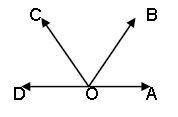
2) How many different angles can you count in the given figure?
(a) 3
(b) 4
(c) 5
(d) 6
4. Which type of angle has a measure that is smaller than aright angle?
(a) Acute
(b) Obtuse
(c) Straight
(d) Reflex
5. Each of the following is smaller than a straight angle , except
(a) Acute angle
(b) Obtuse angle
(c) Right angle
(d) Reflex angle
III. Factors and multiples:
1) The prime number among the following is
(A) 93
(B) 95
(C) 97
(D) 99
2) The Highest common factor of 3 and 6 is
(A) 1
(B) 2
(C) 3
(D) 6
3) The Highest common factor of two prime number is
(A) 1
(B) a prime number
(C) a composite number
(D) 0
4) The Least common multiple of 5,15, is
(A) 5
(B) 10
(C) 15
(D) none of these
IV. Fractions:
1.Stella has a fruit stand. She has 21 bananas, 14 pears, and 16 oranges. She sells 2/3 of her bananas 1/2 her pears, and 1/8 of her oranges.
a ) How many bananas did she sell?
(A) 21
(B) 14
(C) 7
(D) 15
b ) How many pears did she sell?
(A) 14
(B) 21
(C) 7
(D) 15
c ) How many oranges did she sell?
(A) 14
(B) 2
(C) 7
(D) 15
d ) How many pieces of fruit does she have left over?
(A) 14
(B) 23
(C) 15
(D) 51
Question. The number to be divided is called
a. Divisor
b. Dividend
c. Quotient
d. remainder
Answer : B
Question. Subtracting ten thousand from 1 million gives….
a. 9,90,000
b. 90,000
c. 99,000
d.99,999
Answer : A
Question. Sum of 5, 15 and 25 divided by 9 gives quotient
a. 5.
b. 9.
c. 4
d. 10
Answer : A
Question. When a number is divided by zero quotient is…..
a. 0.
b. 1.
c. Undefined
Answer : C
Question. When a zero is divided by any number quotient is….
a. 0.
b . 1.
c. Undefined
Answer : A
Question. When we multiply 103 by 7000 we get…..
a. 710200.
b . 712000.
c. 721000
d. 711002
Answer : C
Question. The number which are to be added are called
a. Minuend.
b . Addend.
c. Sum
d. difference
Answer : B
Question. How many times the number 23 are there in 943?
a. 40
b. 61.
C. 51.
d . 41
Answer : D
Question. How many 2 rupees notes can you get for rupees 500?
a. 200.
b . 500.
c. 250.
d. 100
Answer : C
Question. The number which is to be multiplied is known as …..
Answer : Multiplicand
Question. 146. X ( 1000 + 48) = (146 x …..) + (146 x…)
Answer : 1000, 48
Question. Successor of 99999. – successor of 9999 = … …
Answer : 90,000
Question. Subtract 68 tens from 8 hundred = …..
Answer : 120
Question. By how much is 43462 less than 50693?
Answer : 7231
Question. By which number 32 should be multiplied to get 7200?
Answer : 225
Question. When a number is multiplied by zero product is…….
Answer : 0
Question. Multiply three thousand two hundred by twenty.
Answer : 64000
Question. Find the product of the smallest three digit number formed by using the digits 6,7,0 and the greatest 3 digit number.
Answer : 461320
Question. What number when multiplied by the successor of 69 gives 2100?
Answer : 30
Question. Find the difference between the greatest and the smallest number that can be formed by using the digits for 2 ,5 ,7 ,9 ,0 only once.
Answer : 76941
Topic : Operations on Large Numbers
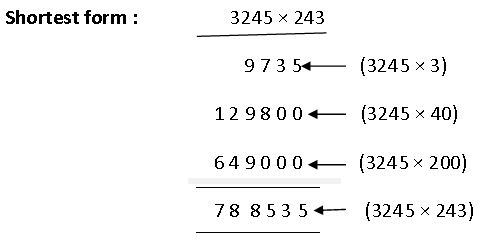
Multiplication of large numbers : We know that the multiplication of a number by a 2- digit or 3- digit number. In the same way , we multiply with large numbers .
For example : Multiply 3245 by 243 .
Solution : 243 = 200 + 40 + 3
3245 × 243 = 3245 × ( 200 + 40 + 3 )
= 3245 × 200 + 3245 × 40 + 3245 × 3
= 649000 + 129800 + 9735
= 788535
NOTE - ALL QUESTIONS ARE COMPULSORY.
Find the products of :
(1) 6854 × 89
(2) 23689 × 137
(3) 12874 × 1386
(4) 4873 × 1708
Multiply :
(5) 10654 by 875
(6) 10023 by 1034
Divide and find the quotient and remainder :
(7) 83254 ÷ 58
(8) 673900 ÷ 86
(9) 5419307 ÷ 396
(10) 8203015 ÷ 798
Find the dividend when :
(11) Divisor = 187 , Quotient = 3078 , Remainder = 96 .
(12) Divisor = 429 , Quotient = 5237 , Remainder = 248 .
Free study material for Mathematics
Free CBSE Practice Worksheets: Class 5 Mathematics All Chapters
Download Chapter Worksheets: Class 5 Mathematics
Access structured practice worksheets for All Chapters aligned with the 2026 CBSE curriculum. These downloadable exercises for Class 5 Mathematics help students build accuracy and reinforce core concepts for upcoming school tests.
Concept Clarification for All Chapters
Each worksheet draws directly from authorized standard textbooks to maintain academic accuracy. Evaluating your finished exercises against expert-verified solutions helps master the formal presentation standards expected in school evaluations.
Effective Revision Strategies for School Exams
Consistent engagement with these exercises builds familiarity with recurring exam themes. If specific areas within All Chapters cause trouble, utilize our dedicated NCERT solutions for Class 5 Mathematics to clear up doubts immediately.
FAQs
You can download the latest chapter-wise printable worksheets for Class 5 Mathematics All Chapters for free from StudiesToday.com. These have been made as per the latest CBSE curriculum for this academic year.
Yes, Class 5 Mathematics worksheets for All Chapters focus on activity-based learning and also competency-style questions. This helps students to apply theoretical knowledge to practical scenarios.
Yes, we have provided solved worksheets for Class 5 Mathematics All Chapters to help students verify their answers instantly.
Yes, our Class 5 Mathematics test sheets are mobile-friendly PDFs and can be printed by teachers for classroom.
For All Chapters, regular practice with our worksheets will improve question-handling speed and help students understand all technical terms and diagrams.