

Chapter-wise Worksheets for Class 5 Mathematics: Decimals
Explore structured practice materials through the CBSE Class 5 Mathematics Decimals Worksheet Set 02. Tailored for Class 5 learners, utilizing these Mathematics worksheets ensures thorough preparation and strengthens problem-solving accuracy before final school evaluations.
Practice Class 5 Mathematics Worksheets: Decimals
View or download the dedicated CBSE Class 5 Mathematics Decimals Worksheet Set 02 resource below. Engaging with these practice papers under focused study conditions ensures continuous academic progress and mastery of the 2026-27 curriculum for Decimals.
Question. The area of a swimming pool is 225.28 sq. metres. Its breadth is 8.8 metres. Find the length
(a) 25.8 m
(b) 25.6 m
(c) 35.2 m
(d) 40.1 m
Answer : B
Question. A baker buys 5 kg of flour and 3.5 kg of sugar for the cake and uses 2.25 kg of flour and 1.75 kg of sugar in the cake. What is the amount of flour and sugar left with him.
(a) 2.75 kg, 0.75 kg
(b) 2.25 kg, 1.75 kg
(c) 2.25 kg, 0.75 kg
(d) 2.75 kg, 1.75 kg
Answer : D
Question. The rainfall in a city an first 5 days of a month was 1.27 cm, 3.25 cm, 2.79 cm, 2.57 cm and 1.37 cm. How much did it rain altogether? (2009)
(a) 11.25 cm
(b) 9.98 cm
(c) 11.00 cm
(d) 11.98 cm
Answer : A
Question. A tailor takes 2.5 m of cloth for making a curtain. He received an order of making 25 curtains from Mrs. Radha puri. How much cloth will he require to fulfill the order?
(a) 62.50 m
(b) 65 m
(c) 51 m
(d) 625.50 m
Answer : A
Question. Divya spends 1.23 hours for English reading, 1.40 hours for Math and 0.39 hours for Science. How many hours does she spend on studying?
(a) 3.02
(b) 3.0
(c) 302.0
(d) 0.32
Answer : A
Question. Anshi bought cosmetic items which cost ₹ 78.60 in total. She gave ₹ 100 to the shop keeper. How much does she receive as change?
(a) 21
(b) 21.40
(c) 20.40
(d) 214.0
Answer : B
Question. Riya scored 56.73 points and Asha scored 74.92 points in a University exam. How many points less did Riya score than Asha?
(a) 1.8
(b) 18.19
(c) 18.10
(d) 18.00
Answer : B
Question. A broken scale is used to measure the height of the plant. The length of the broken scale is 12 cm. The height of the plant is 10.50 times greater than the broken scale. What is the height of the plant?
(a) 126.0
(b) 125.5
(c) 126.55
(d) 1.2650
Answer : A
Question. Fill the output column in the table below with the equivalent fraction by choosing the correct option.
| Input | Output |
| 0.28 | ? |
| 14.50 | ? |
| 07.80 | ? |
| 75.75 | ? |
(a) 7/25, 14(1/2), 7(4/5), 75(3/4)
(b) 28/100, 14, 7.8, 75(3/4)
(c) 7/25, 14(1/2), 7, 75
(d) 7, 14, 7, 75
Answer : A
Question. Fill the output column in the table below by rounding the given decimal number till 3 digits.
| Input | Output |
| 3.14159 | ? |
| 134.9 | ? |
| 1.239 | ? |
| 0.0165 | ? |
(a) 3.14, 134, 1.239,0
(b) 3.14, 135, 1.24, 0.017
(c) 3.14, 134, 1.2, 0.016
(d) 3.14, 135, 1.239, 0.016
Answer : B
Question. The sum 0.25 + 0.375 = 0.625 can be expressed using fractions as:
(a) 1/4 + 3/8 = 5/8
(b) 1/4 + 3/8 = 4/12
(c) 1/4 + 3/16 = 5/16
(d) 1/25 + 3/75 = 6/25
Answer : A
Question. Ekta has ₹ 90. She wants to buy the following items:
A DVD player for ₹ 49.95, a DVD holder for ₹ 19.95 and a personal stereo for ₹ 21.95. How many items Ekta can buy with the money she has?
(a) All three
(b) Any two
(c) Any One
(d) None
Answer : B
Question. If A = 2.5, B = 4.5, C = 1.25, then value of 7A + 5B is
(a) 22.5
(b) 17.5
(c) 40
(d) 39.8
Answer : C
Question. Study the table of distances.
| From / To | A | B | C |
| P | 40.18 km | 24.5 km | 6.8 km |
| Q | 52.32 km | 19.7 km | 11.8 km |
| R | 7.9 km | 10.12 km | 5.6 km |
Which of the following distance is the greatest?
(a) A to R
(b) A to P
(c) C to R
(d) B to Q
Answer : B
Question. The width of two skateboards are shown in the table. Which number sentence correctly compares the width of these two skateboards?
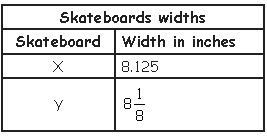
(a) 8.125 < 8(1/8)
(b) 8.125 = 8(1/8)
(c) 8.125 > 8(1/8)
(d) None of these
Answer : B
Question. Consider the following statements and choose the correct option.
Statement A : When a decimal number is multiplied by 10, the decimal point moves to the right by one place.
Statement B : When a decimal number is multiplied by 1000, the decimal point moves to the right by three places.
(a) Statement A is false and B is true.
(b) Both statements are true.
(c) Statement A is true and B is false.
(d) Both statements are false.
Answer : B
Question. Which of the following is correct?
(a) to divide a decimal number by 10, shift the decimal point to the left by one place.
(b) to divide by 100, shift the decimal point to the left by two places.
(c) to divide by 1000, shift the decimal point to the left by three places.
(d) All above are true.
Answer : D
Question. Which one of the following digit will come in the extreme right to the sum 4.235 + 56.230 + 45 + 2.02 + 0.02316
(a) 6
(b) 8
(c) 3
(d) 0
Answer : A
Question. Let P = 256.32, Q = 456.321 and R = 95.326. When Rahul adds two of the given decimals and subtracts third one from the sum he finds 295.327. Which one of the following is the correct expression for Rahul’s work?
(a) P + Q – R
(b) P + R – Q
(c) Q + R – P
(d) P – R + Q
Answer : C
Question. Given a step by step procedure of subtraction of two decimal numbers through a chart. Complete it by choosing the correct option.
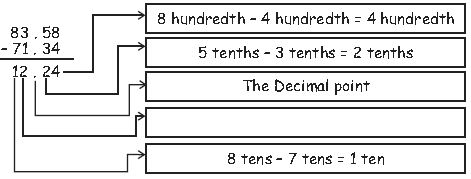
(a) 3 hundredth – 1 hundredth = 2 hundredth
(b) 3 tenths – 1 tenths = 2 tenths
(c) 3 ones – 1 one = 2 ones
(d) cannot find
Answer : C
Question. Varun purchased a book for ₹ 18.45, a pair of shoes for ₹ 70.25 and a shirt for ₹ 55.75. How much money did Varun spend in all?
(a) ₹ 144.35
(b) ₹ 154.53
(c) ₹ 144.45
(d) ₹ 114.55
Answer : C
Question. My father got 3.7 litres of petrol filled in his car. The price of petrol per litre is ₹ 21. How much money did my father pay at the petrol pump?
(a) ₹ 77.70
(b) ₹ 67.60
(c) ₹ 65.50
(d) ₹ 79.40
Answer : A
Question. 6 friends go out to eat pizza they order a 2 medium pizza’s of ₹329 and ₹429 respectively. How much amount each must contribute to pay the bill if they share it equally. Round it off to one decimal place.
(a) ₹126.30
(b) ₹54.80
(c) ₹71.50
(d) ₹126.33
Answer : A
Question. Krish and Kavya are playing a game. Each win gives 0.5 points and each loss takes away 0.25 points. If Krish stands at a score of 3 and Kavya at 3.5, who will win if Krish wins 3 out of the next 5 games?
(a) Krish
(b) Kavya
(c) Draw
(d) Can’t be calculated
Answer : A
Directions (Qs. a to e): In a multiple choice test of 50 questions each correct answer gives you 1 mark, each incorrect answer reduces the score by one-fourth of a mark. Any unattempted question do not get you any mark.
Question a. What will be the score of Kapil who attempts 38 and has 28 correct answers?
(a) 30.5
(b) 25.5
(c) 3
(d) 31
Answer : B
Question b. Which of the following is/are correct? (Critical Thinking)
| Attempted | Incorrect | Score | ||
| A | Shruti | 40 | 10 | 27.5 |
| B | Tripti | 48 | 24 | 18.0 |
| C | Vidhi | 36 | 4 | 31.5 |
Answer : C
Question c. What should be the most advisable strategy in such a test?
(a) Attempt maximum number of questions.
(b) Attempt all the questions irrespective of you know them.
(c) Avoid questions whose answers you are not sure off.
(d) None of these.
Answer : C
Question d. Which of the following is correct to obtain a score of 43.75?
(a) Attempt 50 correct 45
(b) Attempt 45 correct 40
(c) Attempt 45 correct 41
(d) Attempt 46 correct 42
Answer : A
Question e. A shopkeeper mixed 3.6 kg of hazelnuts with 0.756 kg of raisins. He packed the mixture equally into 5 boxes. What is the weight of each box?
(a) 14.25 kg
(b) 4.35 kg
(c) 0.87 kg
(d) 0.72 kg
Answer : C
Question. Neha weighs 35.4 kg and Manju weighs 42.9 kg. If Ashish, Neha and Manju weigh 117 kg altogether, then what is Ashish’s weight? (2016)
(a) 38 kg
(b) 38.9 kg
(c) 38.7 kg
(d) 38.6 kg
Answer : C
Question. Reema went for shopping. She hired an auto to cover the distance of 5.5 km. If auto fair is ₹20 for the first 1 km distance and ₹6.50 for further each 1 km, then how much amount she gave to the autodriver?
(a) 26.50
(b) 40.25
(c) 49.25
(d) 48
Answer : C
Question. Which of the following decimal numbers can represent shaded portion in the given figure?
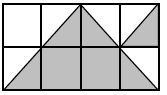
(a) 0.50
(b) 4.51
(c) 0.5625
(d) 0.5605
Answer : C
Question. Which of the following decimal numbers can represent shaded portion in the given figure?
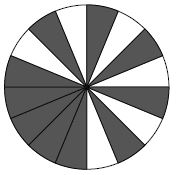
(a) 0.50
(b) 0.75
(c) 1.0
(d) 0.625
Answer : D
Question. The cost of 1 metre of wire is ₹5.50. Find the cost of 42.4 m of wire.
(a) ₹ 210.00
(b) ₹ 2332.00
(c) ₹ 23.32
(d) ₹ 233.20
Answer : D
Question. A tailor used 62.78 metres of red ribbon, 93.22 metres of blue ribbon, 59.10 metres of yellow ribbon in a dress. What is the total length of ribbon used by the tailor in the dress? If the cost of ribbon is 2.50/metre, what is the cost of ribbon used in the dress?
(a) 215.10 m, ₹ 537.75
(b) 215.22 m, ₹ 537.00
(c) 215.22 m, ₹ 537.50
(d) 215.10 m, ₹ 537.25
Answer : A
Question. A cake weighing 3.5 kg was divided among 40 guests in a birthday party. What will be the share of each person?
(a) 0.875 kg
(b) 0.0875 kg
(c) 8.75 kg
(d) 0.00875 kg
Answer : B
Question. A shopkeeper buys 30 toy cars of ₹112.12 each and gets a discount of ₹0.50 on each car. How much total money he is required to pay?
(a) ₹ 3363.60
(b) ₹ 3360.00
(c) ₹ 3348.60
(d) ₹ 3378.60
Answer : C
Question. Electricity bill of Mr. Mohan Das shows the following details :–
Monthly Rent = 500/–
Unit Consumed Rate (₹)
1 – 100 3.50
101-150 4.25
151-200 4.50
greater then 201 4.75
(i) Calculate amount payable by Mr. Mohan Das to BSES Rajdhani Power Limited if he consumes 120 units.
(a) ₹ 935
(b) ₹ 875
(c) ₹ 395
(d) ₹ 500
Answer : A
(ii) Calculate amount payable by Mr. Mohan Das to BSES Rajdhani Power Limited if he consumes 150 units.
(a) ₹ 1063
(b) ₹ 1062.5
(c) ₹ 1061
(d) ₹ 1060
Answer : B
Question. Which of the following holds true or false? (Critical Thinking)
(A) ₹5 and 25 paise = ₹5.025. (B) 1/100 of a rupee = ₹100.
(C) 1/50 of a rupee = 0.25 paise. (D) 20 paise = ₹0.20.
(a) TFFF
(b) FFTF
(c) TTFF
(d) FFFT
Answer : D
Directions : Complete the paragraph for a number 94.58.
94 is ______(80) the decimal point and ______(81) is after the decimal point. 94 is a whole number, it is called the ______(82) part. The digits after the ______(83) are not taken together. We do not say point fifty-eight, we say point ______(84). This is the decimal part or ______(85).
Question.
(a) equal
(b) after
(c) before
(d) none
Answer : C
Question.
(a) 58
(b) 94
(c) 45
(d) 5
Answer : A
Question.
(a) fractional part
(b) whole part
(c) natural part
(d) greater part
Answer : B
Question.
(a) fractional part
(b) decimal point
(c) whole part
(d) None
Answer : B
Question.
(a) five
(b) eight
(c) five and eight
(d) None
Answer : C
Question.
(a) fractional part
(b) fractional point
(c) decimal point
(d) integral part
Answer : A
Please click the below link to access CBSE Class 5 Mathematics Worksheet- Decimals (1)
26. Simplify :
(a) \(\frac{3}{5} \div \frac{1}{2}\)
(b) \(\frac{15}{17} \div \frac{4}{5}\)
(c) \(\frac{6}{11} \div \frac{3}{11}\)
(d) \(\frac{4}{5} \div \frac{1}{5}\)
(e) \(\frac{3}{9} \div 2\frac{2}{3}\)
(f) \(\frac{5}{9} \div 1\frac{1}{3}\)
(g) \(\frac{6}{13} \div 2\frac{1}{5}\)
(h) \(\frac{9}{10} \div 3\frac{1}{3}\)
(i) \(\frac{7}{35} \div 4\frac{2}{3}\)
Answer:
(a) \(\frac{3}{5} \times \frac{2}{1} = \frac{6}{5} = 1\frac{1}{5}\)
(b) \(\frac{15}{17} \times \frac{5}{4} = \frac{75}{68} = 1\frac{7}{68}\)
(c) \(\frac{6}{11} \times \frac{11}{3} = \frac{6}{3} = 2\)
(d) \(\frac{4}{5} \times \frac{5}{1} = \frac{20}{5} = 4\)
(e) \(\frac{3}{9} \div \frac{8}{3} = \frac{3}{9} \times \frac{3}{8} = \frac{9}{72} = \frac{1}{8}\)
(f) \(\frac{5}{9} \div \frac{4}{3} = \frac{5}{9} \times \frac{3}{4} = \frac{15}{36} = \frac{5}{12}\)
(g) \(\frac{6}{13} \div \frac{11}{5} = \frac{6}{13} \times \frac{5}{11} = \frac{30}{143}\)
(h) \(\frac{9}{10} \div \frac{10}{3} = \frac{9}{10} \times \frac{3}{10} = \frac{27}{100}\)
(i) \(\frac{7}{35} \div \frac{14}{3} = \frac{1}{5} \times \frac{3}{14} = \frac{3}{70}\)
In simple words: To divide fractions, multiply the first fraction by the reciprocal of the second fraction.
Exam Tip: Always convert mixed numbers into improper fractions before performing division.
LN. 5 : DECIMALS
I. Fill in the blanks :
Question 1. Decimal fractions having equal number of decimal places are called _________________.
Answer: Like decimals
In simple words: Decimals with the exact same count of digits after the decimal point are like decimals.
Exam Tip: Remember that trailing zeros do not change the number of decimal places when comparing like and unlike decimals.
Question 2. Decimal fractions having unequal number of decimal places are called ________________.
Answer: Unlike decimals
In simple words: Decimals with different numbers of digits after the decimal point are unlike decimals.
Exam Tip: Unlike decimals can be converted to like decimals by adding placeholder zeros.
Question 3. Decimal fractions having equal values are called ________________ .
Answer: Equivalent decimals
In simple words: Decimals that represent the same quantity, such as 0.5 and 0.50, are equivalent decimals.
Exam Tip: Annexing zeros to the extreme right of the decimal part does not change its value.
Question 4. To multiply a decimal fraction by 10 we shift the decimal point to the right by ________________ place.
Answer: one
In simple words: Multiplying by 10 moves the decimal point one place to the right.
Exam Tip: Count the zeros in the multiplier to know how many places to shift the decimal point to the right.
Question 5. To multiply a decimal fraction by 1000 we shift the decimal point to the ________________ by 3 places.
Answer: right
In simple words: Multiplying by 1000 shifts the decimal point three places to the right.
Exam Tip: If there are not enough digits, add placeholder zeros to the right.
Question 6. 0.9 x 10 = ________________
Answer: 9
In simple words: Shifting the decimal point one place to the right in 0.9 gives 9.
Exam Tip: 0.9 multiplied by 10 equals 9.
Question 7. 6.6 x 100 = ________________
Answer: 660
In simple words: Shifting the decimal point two places to the right in 6.6 gives 660.
Exam Tip: Add a zero as a placeholder when shifting past available digits.
Question 8. 4.25 x 1000 = ________________
Answer: 4250
In simple words: Shift the decimal point three places to the right, appending a zero.
Exam Tip: 4.25 becomes 42.5 (1 place), 425 (2 places), and 4250 (3 places).
Question 9. 0.9 x ________________ = 90
Answer: 100
In simple words: To move the decimal point two places right from 0.9 to 90, multiply by 100.
Exam Tip: Divide the product by the given factor to find the missing multiplier: \(90 \div 0.9 = 100\).
Question 10. 0.004 x ________________ = 4
Answer: 1000
In simple words: Moving the decimal point three places right from 0.004 to 4 requires multiplying by 1000.
Exam Tip: The number of places shifted equals the number of zeros in the multiplier.
Question 11. 1.45 x ________________ = 0
Answer: 0
In simple words: Any number multiplied by 0 results in 0.
Exam Tip: Remember the zero property of multiplication.
Question 12. ________________ x 1 = 9.7
Answer: 9.7
In simple words: Any number multiplied by 1 remains unchanged.
Question 13. 0.7 x 5 = ________________
Answer: 3.5
In simple words: Multiply 7 by 5 to get 35, then place the decimal point for one decimal place to get 3.5.
Exam Tip: Total decimal places in the product equal the sum of decimal places in the factors.
Question 14. 5.6 x 2.1 = 2.1 x ________________
Answer: 5.6
In simple words: Multiplication is commutative, so changing the order of factors does not change the product.
Exam Tip: Use the commutative property of multiplication.
Question 15. To divide a decimal fraction by 10 we shift the decimal point to the ________________ by one place.
Answer: left
In simple words: Division by 10 makes a number smaller by moving the decimal point one place to the left.
Exam Tip: Multiplication moves the decimal right; division moves it left.
Question 16. To divide a decimal fraction by 100, we shift the decimal point to the left by ________________ places.
Answer: two
In simple words: Dividing by 100 moves the decimal point two places to the left.
Exam Tip: Add leading zeros if necessary when shifting past the first digit.
Question 17. 1.5 \div 10 = ________________
Answer: 0.15
In simple words: Shift the decimal point one place to the left in 1.5 to get 0.15.
Exam Tip: 1.5 divided by 10 equals 0.15.
Question 18. 25.5 \div 1000 = ________________
Answer: 0.0255
In simple words: Shift the decimal point three places to the left in 25.5 to get 0.0255.
Exam Tip: Insert zeros between the decimal point and the digits as placeholders.
Question 19. 0.35 \div 100 = ________________
Answer: 0.0035
In simple words: Shift the decimal point two places to the left in 0.35 to get 0.0035.
Exam Tip: Count carefully when adding placeholder zeros to the left.
Question 20. 5.6 \div ________________ = 0.056
Answer: 100
In simple words: The decimal point moved two places left from 5.6 to 0.056, so the divisor is 100.
Exam Tip: Compare the positions of the decimal points to determine the power of 10.
Question 21. 16.5 \div ________________ = 0.165
Answer: 100
In simple words: The decimal point moved two places left, so we divide by 100.
Exam Tip: Two decimal places shift corresponds to dividing by 100.
Question 22. ________________ \div 100 = 7.59
Answer: 759
In simple words: Multiply 7.59 by 100 to find the original dividend before division by 100.
Question 1. \(\frac{5}{10}\)
Answer: 0.5
In simple words: Five tenths written as a decimal is 0.5.
Exam Tip: A denominator of 10 means one decimal place.
Question 2. \(\frac{16}{100}\)
Answer: 0.16
In simple words: Sixteen hundredths written as a decimal is 0.16.
Exam Tip: A denominator of 100 means two decimal places.
Question 3. \(\frac{5}{1000}\)
Answer: 0.005
In simple words: Five thousandths written as a decimal is 0.005.
Exam Tip: A denominator of 1000 means three decimal places.
Question 4. \(\frac{635}{100}\)
Answer: 6.35
In simple words: 635 divided by 100 gives 6.35.
Exam Tip: Count two places from the right for the decimal point.
b. Write the following mixed numbers as decimals
Question 1. \(4\frac{5}{10}\)
Answer: 4.5
In simple words: The whole number is 4 and the fraction is 0.5, giving 4.5.
Question 2. \(32\frac{9}{100}\)
Answer: 32.09
In simple words: 9 hundredths has a zero in the tenths place, so it is written as 32.09.
Exam Tip: Be careful with placeholder zeros in the tenths place.
Question 3. \(6\frac{5}{1000}\)
Answer: 6.005
In simple words: 5 thousandths requires two zeros after the decimal point, giving 6.005.
Exam Tip: Match the number of zeros in the denominator with decimal places.
c. Write the following decimals as mixed numbers
Question 1. 2.569
Answer: \(2\frac{569}{1000}\)
In simple words: The whole number is 2 and the decimal part has three places, making the denominator 1000.
Exam Tip: The number of decimal digits equals the number of zeros in the denominator.
Question 2. 7.8
Answer: \(7\frac{8}{10}\) (or \(7\frac{4}{5}\))
In simple words: 7 is the whole number and 8 tenths becomes the fraction \(\frac{8}{10}\).
Exam Tip: Simplify the fraction if required.
Question 3. 9.32
Answer: \(9\frac{32}{100}\) (or \(9\frac{8}{25}\))
In simple words: 9 is the whole number and 32 hundredths becomes \(\frac{32}{100}\).
Exam Tip: Two decimal places correspond to a denominator of 100.
Question 4. 50.049
Answer: \(50\frac{49}{1000}\)
In simple words: 50 is the whole number and 49 thousandths becomes \(\frac{49}{1000}\).
Exam Tip: Three decimal places mean the denominator is 1000.
d. Write the place value of the underlined
Question 1. 6.987
Answer: 8 hundredths (or 0.08 or \(\frac{8}{100}\))
In simple words: The underlined digit 8 is in the second place after the decimal point.
Exam Tip: Place values to the right of the decimal are tenths, hundredths, thousandths.
Question 2. 5.065
Answer: 6 hundredths (or 0.06 or \(\frac{6}{100}\))
In simple words: The digit 6 is in the hundredths place.
Exam Tip: Identify the position counting right from the decimal point.
Question 3. 1.97
Answer: 7 hundredths (or 0.07 or \(\frac{7}{100}\))
In simple words: The digit 7 is in the hundredths place.
Exam Tip: Tenths is first, hundredths is second.
Question 4. 3.62
Answer: 2 hundredths (or 0.02 or \(\frac{2}{100}\))
In simple words: The digit 2 is in the hundredths place.
Exam Tip: Always state both the digit name and its fraction or decimal value.
e. Write as decimals
Question 1. 400 + 60 + 5 + 0.2 + 0.09
Answer: 465.29
In simple words: Combine the whole number part 465 and the decimal part 0.29.
Exam Tip: Align place values properly before adding.
Question 2. 30 + 2 + 0.7 + 0.03
Answer: 32.73
In simple words: Combine 32 and 0.73 to get 32.73.
Exam Tip: Sum the whole numbers and decimal parts separately.
Question 3. \(50 + 4 + \frac{2}{10} + \frac{8}{100}\)
Answer: 54.28
In simple words: 54 is the whole number, 2 tenths is 0.2, and 8 hundredths is 0.08.
Exam Tip: Convert fractions to decimals first.
Question 4. \(200 + 10 + 5 + \frac{1}{10} + \frac{4}{1000}\)
Answer: 215.104
In simple words: Whole number is 215, tenths is 1, hundredths is 0, and thousandths is 4.
Exam Tip: Note the missing hundredths place, which is filled with 0.
f. Write in expanded form
Question 1. 2.56
Answer: \(2 + 0.5 + 0.06\) (or \(2 + \frac{5}{10} + \frac{6}{100}\))
In simple words: Break the number into its whole number, tenths, and hundredths parts.
Exam Tip: Each digit's value is written separately with a plus sign.
Question 2. 17.93
Answer: \(10 + 7 + 0.9 + 0.03\) (or \(10 + 7 + \frac{9}{10} + \frac{3}{100}\))
In simple words: Expand tens, ones, tenths, and hundredths.
Exam Tip: Check that every non-zero digit is represented.
Question 3. 563.006
Answer: \(500 + 60 + 3 + 0.006\) (or \(500 + 60 + 3 + \frac{6}{1000}\))
In simple words: Tenths and hundredths are zero, so only thousandths is added to the whole number part.
Exam Tip: Skip place values that contain zero.
g. Convert the pairs of unlike decimal fractions into like decimal fractions
Question 1. 6.7, 5.98
Answer: 6.70, 5.98
In simple words: 5.98 has two decimal places, so add a zero to 6.7 to make it 6.70.
Exam Tip: Make the number of decimal places equal to the maximum decimal places in the pair.
Question 2. 14.62, 9.845
Answer: 14.620, 9.845
In simple words: 9.845 has three decimal places, so add a zero to 14.62 to make it 14.620.
Exam Tip: Annex zeros on the right until both numbers have the same number of decimal digits.
h. Put the correct sign >, < or =
Question 1. 5.6 ________ 5.64
Answer: 5.6 < 5.64
In simple words: Comparing 5.60 and 5.64 shows that 5.64 is greater.
Exam Tip: Convert to like decimals before comparing digit by digit from left to right.
Question 2. 0.02 _________ 0.002
Answer: 0.02 > 0.002
In simple words: Comparing 0.020 and 0.002 shows that 0.02 is greater.
Exam Tip: Compare the tenths place first, then hundredths, then thousandths.
Question 3. \(4\frac{5}{10}\) _______ \(4\frac{5}{100}\)
Answer: \(4\frac{5}{10}\) > \(4\frac{5}{100}\)
In simple words: 4.5 is greater than 4.05.
Exam Tip: Tenths are larger than hundredths.
Question 4. 15.94 _________ 15.49
Answer: 15.94 > 15.49
In simple words: Comparing the tenths place (9 vs 4), 15.94 is greater.
Exam Tip: The comparison is decided at the first place where digits differ.
Question 5. 1.89 __________ 2.05
Answer: 1.89 < 2.05
In simple words: Comparing whole numbers, 2 is greater than 1.
Exam Tip: Always compare the whole number part first.
i. Write in ascending order
Question 1. 4.045, 4.049, 4.006, 4.540
Answer: 4.006, 4.045, 4.049, 4.540
In simple words: Order the numbers from smallest to largest by comparing digits from left to right.
Exam Tip: Ascending order means from smallest to largest.
Question 2. 30.56, 350.6, 30.65, 305.8
Answer: 30.56, 30.65, 305.8, 350.6
In simple words: Group by whole number magnitude: 30s first, then 300s, then 350s.
Exam Tip: Look at whole numbers first before looking at decimal parts.
j. Write in descending order
Question 1. 39.64, 396.45, 3.694, 39.463
Answer: 396.45, 39.64, 39.463, 3.694
In simple words: Order the numbers from largest to smallest.
Exam Tip: Descending order means from largest to smallest.
Question 2. 85.96, 80.96, 85.69, 80.66
Answer: 85.96, 85.69, 80.96, 80.66
In simple words: Compare 85.96 and 85.69 first, then 80.96 and 80.66.
Exam Tip: Double-check all digit comparisons before finalizing the sequence.
III Arrange in columns and add
Question 1. 1.7 + 4.8 + 6.37
Answer:
Convert to like decimals: 1.70, 4.80, 6.37
1.70
+ 4.80
+ 6.37
------
12.87
Answer: 12.87
In simple words: Convert all numbers to have two decimal places and add column by column.
Exam Tip: Always align decimal points vertically when adding decimals.
Question 2. 15.72 + 20 + 116.54
Answer:
15.72
20.00
+116.54
------
152.26
Answer: 152.26
In simple words: Write whole number 20 as 20.00 to align decimal points.
Exam Tip: Whole numbers have an implicit decimal point at their right end.
Question 3. 82.45 + 13.769 + 8.684
Answer:
82.450
13.769
+ 8.684
------
104.903
Answer: 104.903
In simple words: Make all decimals have three places by adding zeros, then add.
Exam Tip: Carry over correctly from column to column.
Question 4. Rs. 15.6 + Rs. 210.75
Answer:
15.60
+ 210.75
--------
226.35
Answer: Rs. 226.35
In simple words: Add 15.60 and 210.75 to get Rs. 226.35.
Exam Tip: Include the currency unit in your final answer.
Question 5. 0.75 l + 15.9 l
Answer:
0.75
+ 15.90
-------
16.65
Answer: 16.65 l
In simple words: Add 0.75 and 15.90 to get 16.65 litres.
Exam Tip: Include the unit (l) in the answer.
Question 6. 316 kg + 6.40 kg
Answer:
316.00
+ 6.40
--------
322.40
Answer: 322.40 kg
In simple words: Add 316.00 and 6.40 to get 322.40 kg.
Question 1. 8.75 - 4.982
Answer:
8.750
- 4.982
------
3.768
Answer: 3.768
In simple words: Convert 8.75 to 8.750 and subtract 4.982.
Exam Tip: Borrow correctly when a digit in the minuend is smaller than in the subtrahend.
Question 2. 39.6 - 18.775
Answer:
39.600
- 18.775
------
20.825
Answer: 20.825
In simple words: Annex two zeros to 39.6 to make it 39.600 and subtract.
Exam Tip: Always equalize decimal places before subtracting.
Question 3. 0.4 - 0.15
Answer:
0.40
- 0.15
------
0.25
Answer: 0.25
In simple words: Subtract 0.15 from 0.40 to get 0.25.
Exam Tip: Do not forget to write the placeholder zero on 0.4.
Question 4. 5.98 kg - 3.7 kg
Answer:
5.98
- 3.70
------
2.28
Answer: 2.28 kg
In simple words: Subtract 3.70 from 5.98 to get 2.28 kg.
Exam Tip: Retain the unit (kg) in the final result.
Question 5. Rs. 89 - Rs. 15.65
Answer:
89.00
- 15.65
------
73.35
Answer: Rs. 73.35
In simple words: Subtract 15.65 from 89.00 to get Rs. 73.35.
Exam Tip: Write Rs. before the final amount.
Question 6. 350.45 kg - 130.375 kg
Answer:
350.450
- 130.375
-------
220.075
Answer: 220.075 kg
In simple words: Subtract 130.375 from 350.450 to get 220.075 kg.
Exam Tip: Double-check borrowing steps carefully.
V Find the product.
Question a. 3.5 x 98
Answer:
3.5 \times 98 = 343
Answer: 343
In simple words: Multiply 35 by 98 to get 3430, then place the decimal point for one decimal place to get 343.
Exam Tip: Count total decimal places in the factors to place the decimal point in the product.
Question b. 4.43 x 390
Answer:
4.43 \times 390 = 1727.7
Answer: 1727.7
In simple words: Multiply 4.43 by 390 to get 1727.70 (or 1727.7).
Exam Tip: Drop trailing zeros in the decimal part if desired.
Question c. 0.7 x 25
Answer:
0.7 \times 25 = 17.5
Answer: 17.5
In simple words: Multiply 7 by 25 to get 175, then place the decimal point to get 17.5.
Exam Tip: One decimal place in 0.7 means one decimal place in the product.
Question d. 3.75 x 47
Answer:
3.75 \times 47 = 176.25
Answer: 176.25
In simple words: Multiply 375 by 47 to get 17625, then place the decimal point two places from the right.
Exam Tip: Two decimal places in 3.75 means two decimal places in the product.
Question e. 32 x 10.7
Answer:
32 \times 10.7 = 342.4
Answer: 342.4
In simple words: Multiply 32 by 107 to get 3424, then place the decimal point to get 342.4.
Exam Tip: Order of factors does not change the product.
Question f. 3.9 x 0.6
Answer:
3.9 \times 0.6 = 2.34
Answer: 2.34
In simple words: Multiply 39 by 6 to get 234, then count two decimal places in total to get 2.34.
Exam Tip: 1 decimal place + 1 decimal place = 2 decimal places in the product.
Question g. 0.08 x 10.9
Answer:
0.08 \times 10.9 = 0.872
Answer: 0.872
In simple words: Multiply 8 by 109 to get 872, then count three decimal places to get 0.872.
Question h. 7.98 x 46
Answer:
7.98 \times 46 = 367.08
Answer: 367.08
In simple words: Multiply 798 by 46 to get 36708, then place the decimal point two places from the right.
Exam Tip: Keep track of decimal places carefully.
Question i. 435 x 7.4
Answer:
435 \times 7.4 = 3219.0
Answer: 3219
In simple words: Multiply 435 by 74 to get 32190, then place the decimal point to get 3219.
Exam Tip: Whole numbers can be written without trailing decimal zeros.
VI Divide and find the quotient.
Question a. 1.92 \div 25
Answer:
1.92 \div 25 = 0.0768
Answer: 0.0768
In simple words: Divide 1.92 by 25 to get 0.0768.
Exam Tip: Add placeholder zeros in the quotient when needed.
Question b. 3.784 \div 4
Answer:
3.784 \div 4 = 0.946
Answer: 0.946
In simple words: Divide 3.784 by 4 to get 0.946.
Exam Tip: Align the decimal point in the quotient directly above the dividend's decimal point.
Question c. 17.76 \div 32
Answer:
17.76 \div 32 = 0.555
Answer: 0.555
In simple words: Divide 17.76 by 32 to get 0.555.
Exam Tip: Continue division until the remainder is zero or desired decimal places are reached.
Question d. 0.0075 \div 125
Answer:
0.0075 \div 125 = 0.00006
Answer: 0.00006
In simple words: Divide 0.0075 by 125 to get 0.00006.
Exam Tip: Use extra zeros after the decimal point as placeholders.
Question e. 0.9 \div 900
Answer:
0.9 \div 900 = 0.001
Answer: 0.001
In simple words: Divide 0.9 by 900 to get 0.001.
Exam Tip: Dividing by multiples of 100 moves the decimal point further left.
Question f. 1.2 \div 300
Answer:
1.2 \div 300 = 0.004
Answer: 0.004
In simple words: Divide 1.2 by 300 to get 0.004.
Exam Tip: Simplify by dividing by 3 first: \(0.4 \div 100 = 0.004\).
Question g. 819.6 \div 40
Answer:
819.6 \div 40 = 20.49
Answer: 20.49
In simple words: Divide 819.6 by 40 to get 20.49.
Exam Tip: Cancel a factor of 10 or divide by 4 then by 10.
Question h. 1.05 \div 1.5
Answer:
1.05 \div 1.5 = \frac{1.05}{1.5} = \frac{10.5}{15} = 0.7
Answer: 0.7
In simple words: Multiply both numbers by 10 to make the divisor a whole number: \(10.5 \div 15 = 0.7\).
Exam Tip: Always make the divisor a whole number by shifting decimal points equally in both dividend and divisor.
Question i. 18 \div 0.9
Answer:
18 \div 0.9 = \frac{180}{9} = 20
Answer: 20
In simple words: Multiply both numbers by 10 to convert the divisor to 9: \(180 \div 9 = 20\).
Exam Tip: Shifting the decimal point one place right in both numbers simplifies decimal division.
Ln. 10 : Profit and Loss
I. Fill in the blanks :
Question 1. The price at which an article is bought is its ________________.
Answer: Cost Price (C.P.)
In simple words: The buying price is called the cost price.
Exam Tip: Cost Price is abbreviated as C.P.
Question 2. The Price at which an article is sold is its _____________.
Answer: Selling Price (S.P.)
In simple words: The selling price is the price at which an item is sold.
Exam Tip: Selling Price is abbreviated as S.P.
Question 3. The ______________ includes overhead expenses.
Answer: Total Cost Price
In simple words: Extra expenses like transport and repairs are added to the cost price to get the total cost price.
Exam Tip: Total C.P. = Initial C.P. + Overhead charges.
Question 4. If the goods are sold at lower price than C.P., then there is a _______________.
Answer: loss
In simple words: Selling an article for less than its cost price results in a loss.
Exam Tip: Loss occurs when C.P. > S.P.
Question 5. If C.P. > S.P. then there is a ___________.
Answer: loss
In simple words: When the buying price is greater than the selling price, you incur a loss.
Exam Tip: Loss = C.P. - S.P.
Question 6. If C.P. < S.P. then there is a ___________.
Answer: profit
In simple words: When the selling price is greater than the cost price, you make a profit.
Exam Tip: Profit = S.P. - C.P.
Question 7. C.P. = Rs. 250, S.P. = Rs. 225, Loss = _____________.
Answer: Rs. 25
In simple words: Loss = C.P. - S.P. = 250 - 225 = Rs. 25.
Exam Tip: Subtract S.P. from C.P. to find the loss.
II Find the Profit or Loss
Question a. SP = Rs. 12500, CP = Rs. 11950
Answer:
Since S.P. (Rs. 12500) > C.P. (Rs. 11950), there is a profit.
Profit = S.P. - C.P. = 12500 - 11950 = Rs. 550
Answer: Profit = Rs. 550
In simple words: Selling price is higher than cost price, so you make a profit of Rs. 550.
Exam Tip: Profit occurs when selling price exceeds cost price.
Question b. SP = Rs. 816.75, CP = Rs. 905.50
Answer:
Since C.P. (Rs. 905.50) > S.P. (Rs. 816.75), there is a loss.
Loss = C.P. - S.P. = 905.50 - 816.75 = Rs. 88.75
Answer: Loss = Rs. 88.75
In simple words: Cost price is higher than selling price, resulting in a loss of Rs. 88.75.
Exam Tip: Subtract selling price from cost price to calculate loss.
Question c. SP = Rs. 9000, CP = Rs. 8540
Answer:
Since S.P. (Rs. 9000) > C.P. (Rs. 8540), there is a profit.
Profit = S.P. - C.P. = 9000 - 8540 = Rs. 460
Answer: Profit = Rs. 460
In simple words: Selling price is greater than cost price, yielding a profit of Rs. 460.
Exam Tip: Always state whether the result is a profit or a loss clearly.
Free study material for Mathematics
Decimals Printable Worksheets and Exercises for Class 5 Mathematics
Download Chapter Worksheets: Class 5 Mathematics
Review targeted practice exercises for Class 5 Mathematics Decimals. Curated to match official CBSE guidelines, these printable problem sets support daily revision and improve overall test readiness.
Concept Clarification for Decimals
Each worksheet draws directly from authorized standard textbooks to maintain academic accuracy. Evaluating your finished exercises against expert-verified solutions helps master the formal presentation standards expected in school evaluations.
Effective Revision Strategies for School Exams
Consistent engagement with these exercises builds familiarity with recurring exam themes. If specific areas within Decimals cause trouble, utilize our dedicated NCERT solutions for Class 5 Mathematics to clear up doubts immediately.
FAQs
You can download the latest chapter-wise printable worksheets for Class 5 Mathematics Decimals for free from StudiesToday.com. These have been made as per the latest CBSE curriculum for this academic year.
Yes, Class 5 Mathematics worksheets for Decimals focus on activity-based learning and also competency-style questions. This helps students to apply theoretical knowledge to practical scenarios.
Yes, we have provided solved worksheets for Class 5 Mathematics Decimals to help students verify their answers instantly.
Yes, our Class 5 Mathematics test sheets are mobile-friendly PDFs and can be printed by teachers for classroom.
For Decimals, regular practice with our worksheets will improve question-handling speed and help students understand all technical terms and diagrams.