

Class 5 Mathematics Practice Sheet: CBSE Class 5 Mathematics Ways To Multiply Worksheet
Explore structured practice materials through the CBSE Class 5 Mathematics Ways To Multiply Worksheet. Tailored for Class 5 learners, utilizing these Mathematics worksheets ensures thorough preparation and strengthens problem-solving accuracy before final school evaluations.
Download Math-Magic Chapter 13 Ways to Multiply and Divide Worksheet PDF with Answers
View or download the dedicated CBSE Class 5 Mathematics Ways To Multiply Worksheet resource below. Engaging with these practice papers under focused study conditions ensures continuous academic progress and mastery of the 2026-27 curriculum for Math-Magic Chapter 13 Ways to Multiply and Divide.
CBSE Class 5 Mathematics Worksheet- Ways to Multiply Worksheets have become an integral part of the education system. Worksheets are very critical for every student to practice his/ her concepts. Students, teachers and parents can download all CBSE educational material and extremely well prepared worksheets from this website. All revision worksheets, Sample papers, Question banks and easy to learn study notes for all classes and subjects have been prepared based on the latest guidelines sent by CBSE. All CBSE educational material is developed by our panel of teachers, have also been submitted by thousands of teachers and students. The study material has been carefully compiled by the best teachers in India. Worksheets have been submitted by teachers of various CBSE schools and also have been carefully developed keeping into consideration the latest CBSE syllabus.
WORK SHEET
SECOND TERM
SUBJECT- MATHEMATICS
Chapter – 12, 13, 14
CLASS- V
SECTION - A
1. 845 × = 845
2. 268 × 0 =
3. The number to be multiplied is the _________.
4. The number remaining at the end of division is called the _________.
5. Ram earns Re 1 everyday for 21 goats. How much will he earn in one month.
6. 21 × 16 =
Fill in the blanks with proper sign. +, – , ×, ÷. (for question no. 7 to 10).
7. 666 333 = 999
8. 625 5 = 125
9. 9895 1764 = 8131
10. 81 100 = 8100
11. Volume of a cuboid is ______ units.
12. Collection of information is called ______.
13. The approximate value of 10.98 is –
a) 11 b) 9 c) 8.5 d) 10
14. The space occupied by a solid is its ______.
15. Volume of a cube of edge 2cm is ______.
16. ______ is the number of times a score appeared in the given data.
17. 1 cubic cm is the space occupied by a cube with a side ______.
18. 5 marbles pushes 10m of water in a beaker then 20 marbles will push ______ ml of water.
19. An elephant weighs about 5000kg. Find the weight of a blue whale which is 35 times heavier than the elephant.
20. A plant is 2.8cm long on the 4th day of its germination. If It grows with the same speed what would be its length on the 20th day?
21. Divide 4590 by 9 and check the result by multiplication.
22. Divide 2475 by 11 in two different ways.
Question 23. Find the product of 876×24 using Maniratnam’s method.
Answer: \(876 \times 24 = 21024\)
In simple words: Multiply 876 by 4, then by 20, and add the two results.
Exam Tip: Check your product by multiplying in the other order.
Question 24. If Soha’s heart beats 75 times in one minute, how many times does it beat in one hour and how many times it beats in one day?
Answer: In one hour: \(75 \times 60 = 4500\) beats. In one day: \(4500 \times 24 = 108000\) beats.
In simple words: There are 60 minutes in an hour and 24 hours in a day, so multiply step by step.
Exam Tip: Write the units clearly: minutes to hours, then hours to days.
Question 25. 9612 pencils have to be packed in packets of 12 pencils each. How many packets can be made?
Answer: \(9612 \div 12 = 801\) packets.
In simple words: Share 9612 pencils into groups of 12 to find the number of packets.
Exam Tip: Check: \(801 \times 12 = 9612\).
Question 26. A bag of 5 rupee coins weighs 9kg 63gram. How many coins are there in the bag if 1 coin weighs 9 grams?
Answer: \(9\text{ kg }63\text{ g} = 9063\) g. Number of coins \(= 9063 \div 9 = 1007\) coins.
In simple words: Change kg to grams first, then divide the total weight by the weight of one coin.
Exam Tip: Always convert all units to the same unit before dividing.
Question 27. Calculate the volume of an almirah of length 5 feet, breadth 2 feet and height 7 feet.
Answer: Volume \(= 5 \times 2 \times 7 = 70\) cubic feet.
In simple words: Volume is length × breadth × height.
Exam Tip: Write the unit as cubic feet, not just feet.
Question 28. Radha, wrote the word REPRESENTATION in her diary. a) Write the frequencies of the letters R, T and N. b) Which letter has the maximum frequency.
Answer: a) R = 2, T = 2, N = 2. b) E has the maximum frequency (3 times).
In simple words: Count how many times each letter appears in the word, then pick the one that appears most.
Exam Tip: Cross out each letter as you count it so you do not miss any.
Question 29. A 2-rupee coin weighs 6 gram. What is the weights of a sack with – a) 3200 coins b) 4850 coins
Answer: a) \(3200 \times 6 = 19200\) g = 19 kg 200 g. b) \(4850 \times 6 = 29100\) g = 29 kg 100 g.
In simple words: Multiply the number of coins by the weight of one coin, then change grams to kilograms.
Exam Tip: 1000 g = 1 kg, so divide the grams by 1000 to get kilograms.
Question 30. See the bar graph and answer the questions that follow -
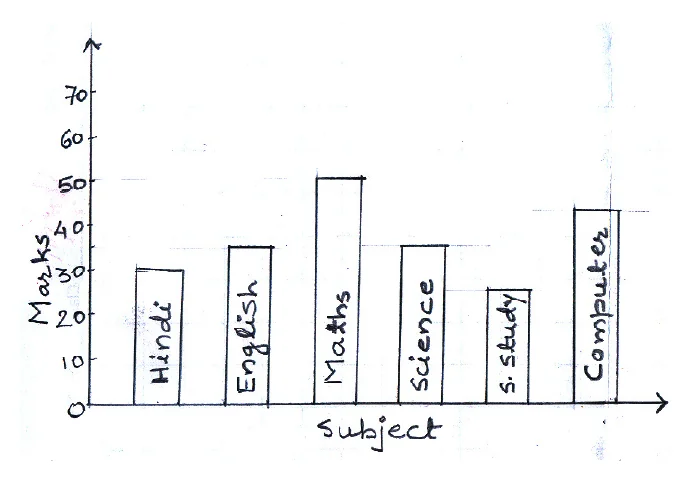
a) Maximum marks is scored in ______ and minimum in ______. b) ______ and ______ subjects have equal marks. c) English marks is ______ more than Hindi marks. d) ______ marks more must be attained in S. Study to score marks equal to Computer marks.
Answer: a) Maths; S. Study. b) English and Science. c) 5 (about 35 − 30). d) 18 (about 43 − 25).
In simple words: Read the height of each bar and compare them. The values are read from the graph, so they are approximate.
Exam Tip: Read the top of each bar against the marks scale before comparing.
Question 31. There are 34 laddoos in 1kg. How many laddoos will be there in 16kg? If 17 laddoos can be packed in 1 box, how many boxes are needed to pack all these laddoos.
Answer: Laddoos in 16 kg \(= 34 \times 16 = 544\). Boxes \(= 544 \div 17 = 32\) boxes.
In simple words: First find the total laddoos, then share them into boxes of 17.
Exam Tip: Check: \(17 \times 32 = 544\).
Question 32. Ram bought two fields of dimensions. Field A → l = 42cm, B = 18m. Field B → l = 29m, B = 22m. a) Find the area of both the fields. b) If he bought field A at the rate of Rs. 105 per sq.m. and field B at Rs. 115 per sq.m. Find the cost of each field.
Answer: a) Field A \(= 42 \times 18 = 756\) sq m; Field B \(= 29 \times 22 = 638\) sq m. b) Field A cost \(= 756 \times 105 = 79380\) Rs; Field B cost \(= 638 \times 115 = 73370\) Rs.
In simple words: Area is length × breadth; then multiply the area by the price per square metre.
Exam Tip: Keep the units the same (metres) before multiplying.
Question 33. If the life of a battery is 2000 hours. Reeta uses it throughout the day and the night. How many days will the battery run?
Answer: \(2000 \div 24 = 83\) days and 8 hours (about 83 days).
In simple words: One day has 24 hours, so divide the total hours by 24.
Exam Tip: Write the remainder as extra hours, not as extra days.
Question 34. A gardener bought 456 apple trees, at the rate of Rs. 25 each. How much does he pay? Now, he wants to plant 15 trees in each row. How many rows can he plant? How many trees would be left over?
Answer: Cost \(= 456 \times 25 = 11400\) Rs. Rows \(= 456 \div 15 = 30\) rows, with 6 trees left over.
In simple words: Multiply the number of trees by the price; then divide the trees into rows of 15 and count what is left.
Exam Tip: Check: \(30 \times 15 + 6 = 456\).
Question 35. There are 26 rooms in a school. Each room has 4 plants. If each plant needs 2 cups of water, how much water do we need for all the plants?
Answer: Plants \(= 26 \times 4 = 104\). Water \(= 104 \times 2 = 208\) cups.
In simple words: Find the total plants first, then multiply by the cups needed for each plant.
Exam Tip: Solve it in two steps and write each step.
Question 36. Draw a pie-chart for the given data – Red – 42, Orange – 22, Yellow – 8, Pink – 10, Blue – 18. Give a suitable title to your data.
Answer: Total = 100. Sample angles: Red 151.2°, Orange 79.2°, Yellow 28.8°, Pink 36°, Blue 64.8°. Give a title such as “Colours Chosen by Students”.
In simple words: Each colour gets a slice of the circle with angle = (value ÷ 100) × 360°.
Exam Tip: Check that all the angles add up to 360°.
Question 37. Solve each – a) 8kg 20g + 71kg 8g + 995 g b) 12kg 7g – 7kg 218g
Answer: a) 80 kg 23 g. b) 4 kg 789 g.
In simple words: Add or subtract the kilograms and grams separately, and change grams to kilograms when they go over 1000.
Exam Tip: Borrow 1 kg = 1000 g when subtracting.
Question 38. How many pastries of length 8cm, breadth 6cm and height 7cm can be arranged into a cuboidal cartoon of length 84cm, breadth 64cm and height 36cm?
Answer: Fitting along each edge: \(10 \times 10 \times 5 = 500\) pastries. (Volume ratio gives \(193536 \div 336 = 576\), but 576 cannot be packed exactly.)
In simple words: Count how many pastries fit along length, breadth and height, then multiply.
Exam Tip: Divide each carton edge by the matching pastry edge.
Question 39. Use 48 matchboxes to make 3 different platforms. Write the volume of each platform.
Answer: Sample: 16 matchboxes for each platform. Volume of each platform = 16 × volume of one matchbox, and the same method applies for any other split.
In simple words: Each platform is made of matchboxes, so its volume is the number of matchboxes times the volume of one matchbox.
Exam Tip: Measure one matchbox first, then count the boxes in each platform.
Question 40. Dinesh made 3 boxes A, B and C with given dimensions. Box A → l = 20cm, b = 10cm, h = 6cm. Box B → l = 11cm, b = 11cm, h = 10cm. Box C → l = 15cm, b = 9cm, h = 10cm. Which box has the maximum volume?
Answer: A: \(20 \times 10 \times 6 = 1200\) cm³; B: \(11 \times 11 \times 10 = 1210\) cm³; C: \(15 \times 9 \times 10 = 1350\) cm³. Box C has the maximum volume.
In simple words: Multiply length, breadth and height for each box and pick the biggest answer.
Exam Tip: Volume is always written in cubic centimetres (cm³).
Question 41. The cost of cow is Rs. 18,600. Kamla Bai pays Rs. 6000 and government spent the rest of the money. a) How much did the government spend on cow? b) If Kamla Bai spends Rs. 85 a day on the cow, how much she will spend in one month? c) The cow gives 8 litre of milk every day. How much will it give in one month? d) If the milk is sold at Rs. 9 per litre, how much money she earn in one month? e) So, the money spent on keeping the cow = Rs. ____ and money earned by selling the milk = Rs. ____. f) Which one is more? and by how much?
Answer: a) Rs. 12600. b) \(85 \times 30 = 2550\) Rs (30-day month). c) \(8 \times 30 = 240\) litres. d) \(240 \times 9 = 2160\) Rs. e) Money spent on keeping the cow = Rs. 2550; money earned = Rs. 2160. f) Money spent is more, by Rs. 390.
In simple words: Subtract to find the rest of the cost, multiply the daily amounts by 30 days, then compare the two totals.
Exam Tip: Write the assumption of 30 days in a month clearly.
Question 42. The table shows the amount fixed by governments of four states for one day work of farm workers. Read the table and answer the following questions. a) Surjeet Bagga is worker in Punjab. If he works for 7 weeks on the farm, how much will he earn? b) Kamla is worker in Maharashtra. If she works for 3½ months on the farm, how much will she earn? c) How much more will a farm worker in Chhattisgarh get than a worker in Uttar Pradesh after working for 6 days?
| Sl.No. | State | Salary for one day |
| 1 | Chhattisgarh | Rs. 85 |
| 2 | Maharashtra | Rs. 98 |
| 3 | Punjab | Rs. 130 |
| 4 | Uttar Pradesh | Rs. 75 |
Answer: a) 7 weeks = 49 days; \(49 \times 130 = 6370\) Rs. b) 3½ months = 105 days; \(105 \times 98 = 10290\) Rs. c) Chhattisgarh \(85 \times 6 = 510\) Rs; Uttar Pradesh \(75 \times 6 = 450\) Rs; difference = Rs. 60.
In simple families: Find the number of days, multiply by the daily pay, then compare.
Exam Tip: 1 week = 7 days and 1 month = 30 days in this sum.
Question 43. a) A tank is full of 300 litre of water. How much water will be filled in 25 tanks? If 15 buckets can be filled with one tank of water, how many buckets in all can be filled with the water in 25 tanks? b) Sohan drinks 12 glasses of water every day. i) How many glasses will he drink in one month? How many glasses will he drink in 1 year? ii) If 95 people drink 12 glasses of water in a day, how much water will they drink in a year?
Answer: a) \(300 \times 25 = 7500\) litres; buckets \(= 15 \times 25 = 375\). b) i) In one month \(12 \times 30 = 360\) glasses; in one year \(12 \times 365 = 4380\) glasses. ii) Per day \(95 \times 12 = 1140\) glasses; in a year \(1140 \times 365 = 416100\) glasses.
In simple words: Multiply the amount for one tank, or one person, by the number of tanks, days or people.
Exam Tip: Use 365 days for a year and 30 days for a month.
Question 44. Draw a cube A of 3cm edge. Draw another cube B having double the edge of A. Write the relation between their volumes.
Answer: Volume of A \(= 3^3 = 27\) cm³; volume of B \(= 6^3 = 216\) cm³. So volume of B is 8 times the volume of A.
In simple words: Doubling the edge makes the volume 2 × 2 × 2 = 8 times bigger.
Exam Tip: Draw both cubes with a ruler and label the edges 3 cm and 6 cm.
Question 45. Draw a bar graph for the given data using an appropriate scale. Give a suitable title for your graph.
| Name of trees | Number of trees |
| Mango | 45 |
| Neem | 72 |
| Peepal | 37 |
| Guava | 43 |
| Ashoka | 53 |
| Banyan | 13 |
Answer: Sample: Title “Number of Trees in the School Garden”; scale 1 unit on the vertical axis = 10 trees; bars of height 45, 72, 37, 43, 53 and 13 units (about 4.5, 7.2, 3.7, 4.3, 5.3 and 1.3 cm if 1 unit = 1 cm for the scale above).
In simple words: Choose a scale that fits all the bars on the page, then draw one bar for each tree.
Exam Tip: Write the scale on the graph so anyone can read it.
Question 46. a) A book is 25cm long, 12.5cm wide and 1.5cm thick. What is the volume of 7 such books piled one on the top of other?
Answer: Volume of one book \(= 25 \times 12.5 \times 1.5 = 468.75\) cm³. Volume of 7 books \(= 468.75 \times 7 = 3281.25\) cm³.
In simple words: Find the volume of one book, then multiply by 7.
Exam Tip: Stacking books one on top of another makes the thickness add up.
Question 47. 40 children of class V were asked about the snack they liked the most. The result was as follows: Samosa – 20, Pizza – 5, Dhokla – 10, Vada – 5. Represent the data in a circle graph.
Answer: Samosa \(= 20/40 \times 360° = 180°\); Pizza \(= 45°\); Dhokla \(= 90°\); Vada \(= 45°\). Total = 360°.
In simple words: Each snack gets a slice of the circle based on its share of the 40 children.
Exam Tip: Check that the four angles add up to 360°.
Question 48. A 5 rupee coin weighs 8g. What is the weight of a sack with 1600 coins?
Answer: \(1600 \times 8 = 12800\) g = 12.8 kg.
In simple words: Multiply the number of coins by the weight of one coin.
Exam Tip: Convert grams to kilograms by dividing by 1000.
Question 49. A hall measures 16m by 12m. How many square tiles of side 4m will be required to pave its floor?
Answer: Area of hall \(= 16 \times 12 = 192\) m². Area of one tile \(= 4 \times 4 = 16\) m². Tiles \(= 192 \div 16 = 12\).
In simple words: Divide the floor area by the area of one tile.
Exam Tip: Check: 4 tiles along 16 m and 3 tiles along 12 m give 12 tiles.
Free study material for Mathematics
Free CBSE Practice Worksheets: Class 5 Mathematics Math-Magic Chapter 13 Ways to Multiply and Divide
Mastering Math-Magic Chapter 13 Ways to Multiply and Divide with Printable Worksheets
Review targeted practice exercises for Class 5 Mathematics Math-Magic Chapter 13 Ways to Multiply and Divide. Curated to match official CBSE guidelines, these printable problem sets support daily revision and improve overall test readiness.
Verified Solutions and NCERT Alignment
Designed around the official curriculum for Class 5 Mathematics, these practice sheets guarantee standard compliance. Reviewing step-by-step solutions after completion sharpens your accuracy and clarifies complex sub-topics within Math-Magic Chapter 13 Ways to Multiply and Divide.
Additional Study Resources for Class 5 Mathematics
Wrap up your chapter revision by testing your knowledge against standard objective question formats. Explore our full library of free, up-to-date printable assignments to maximize your academic results in upcoming CBSE evaluations.
FAQs
You can download the latest chapter-wise printable worksheets for Class 5 Mathematics Math-Magic Chapter 13 Ways to Multiply and Divide for free from StudiesToday.com. These have been made as per the latest CBSE curriculum for this academic year.
Yes, Class 5 Mathematics worksheets for Math-Magic Chapter 13 Ways to Multiply and Divide focus on activity-based learning and also competency-style questions. This helps students to apply theoretical knowledge to practical scenarios.
Yes, we have provided solved worksheets for Class 5 Mathematics Math-Magic Chapter 13 Ways to Multiply and Divide to help students verify their answers instantly.
Yes, our Class 5 Mathematics test sheets are mobile-friendly PDFs and can be printed by teachers for classroom.
For Math-Magic Chapter 13 Ways to Multiply and Divide, regular practice with our worksheets will improve question-handling speed and help students understand all technical terms and diagrams.