

Class 5 Mathematics Practice Sheet: CBSE Class 5 Mathematics Area And Perimeter Worksheet Set 02
Access comprehensive chapter-wise worksheets for Area And Perimeter using the CBSE Class 5 Mathematics Area And Perimeter Worksheet Set 02. Designed to align with the 2026-27 academic syllabus for Class 5 Mathematics, these printable practice sets help students reinforce key concepts and improve their overall exam readiness.
Download Area And Perimeter Worksheet PDF with Answers
Access the complete worksheet PDF for Class 5 Mathematics below. Regular practice with these targeted academic tasks builds familiarity with standard question patterns and helps secure higher marks in final school examinations.
Objective Type
Question 1. The amount of surface occupied by a figure is given by its _______________.
Answer: area
In simple words: The surface area tells us how much flat space a shape covers.
Exam Tip: Remember that area always refers to a two-dimensional surface.
Question 2. The amount of space occupied by a solid is called its _______________.
Answer: volume
In simple words: Volume tells us how much 3D space an object takes up.
Exam Tip: Distinguish carefully between area (flat surface) and volume (3D space).
Question 3. The distance around a closed figure is called its ______________.
Answer: perimeter
In simple words: Perimeter is the total length of the boundary enclosing a shape.
Exam Tip: Think of perimeter as walking all the way around the outside edge of a park or field.
Question 4. Area is expressed in ______________ units.
Answer: square
In simple words: Area uses square units like square centimeters or square meters.
Exam Tip: Always include the word "square" or the power \(2\) when writing units of area.
Question 5. Volume is expressed in ______________ units.
Answer: cubic
In simple words: Volume uses cubic units like cubic centimeters or cubic meters.
Exam Tip: Volume requires three dimensions, hence cubic units (\(\text{cm}^3\) or \(\text{m}^3\)).
Question 6. The area of a square of side 1 cm is ______________.
Answer: \(1 \text{ sq. cm}\) (or \(1 \text{ cm}^2\))
In simple words: Side \(\times\) side equals \(1 \text{ cm} \times 1 \text{ cm}\).
Exam Tip: Area of square = \(\text{side} \times \text{side}\).
Question 7. The volume of cube of edge 1 m is ______________.
Answer: \(1 \text{ cubic meter}\) (or \(1 \text{ m}^3\))
In simple words: Edge \(\times\) edge \(\times\) edge equals \(1 \text{ m} \times 1 \text{ m} \times 1 \text{ m}\).
Exam Tip: Volume of cube = \(\text{edge} \times \text{edge} \times \text{edge}\).
Question 8. The perimeter of a square of side 1 cm is ________________.
Answer: \(4 \text{ cm}\)
In simple words: A square has 4 equal sides, so \(4 \times 1 \text{ cm} = 4 \text{ cm}\).
Question 9. Area of rectangle = ______________ x breadth.
Answer: length
In simple words: The formula for the area of a rectangle is length multiplied by breadth.
Exam Tip: Make sure length and breadth are in the same unit before multiplying.
Question 10. Volume of cuboid = length x breadth x ______________.
Answer: height
In simple words: Volume of a cuboid is found by multiplying its three dimensions: length, breadth, and height.
Exam Tip: All three dimensions must share the same unit of length.
Question 11. sq. m and sq. cm are units of measuring ___________________.
Answer: area
In simple words: These units measure flat surfaces.
Exam Tip: Recognize sq. m and sq. cm instantly as area units.
Question 12. The measure of inner space of a hollow solid is called its ______________.
Answer: capacity (or volume)
In simple words: Capacity tells us how much a hollow container can hold.
Exam Tip: Capacity is closely related to volume for hollow containers.
Question 13. The formula used to find the perimeter of rectangle is ______________.
Answer: \(2 \times (\text{length} + \text{breadth})\)
In simple words: Add length and breadth together, then multiply by 2.
Exam Tip: Alternatively written as \(\text{length} + \text{breadth} + \text{length} + \text{breadth}\).
Question 14. All sides of a square are ______________ in length.
Answer: equal
In simple words: Every side in a square has the exact same measurement.
Question 15. Area of a square = ____________ x ______________.
Answer: side \(\times\) side
In simple words: Multiply the side length by itself to get the area.
Exam Tip: Keep units squared in the final answer.
Question 16. Volume of a cube = ___________ x ___________ x __________
Answer: side \(\times\) side \(\times\) side (or edge \(\times\) edge \(\times\) edge)
In simple words: Multiply the edge length three times.
Exam Tip: Volume units are always cubic.
Question 17. A ____________ is a special kind of rectangle whose length and breadth are equal.
Answer: square
In simple words: When a rectangle's length and breadth become equal, it forms a square.
Exam Tip: A square is technically a regular quadrilateral and a special rectangle.
Question 18. A _______________ is a special cuboid whose length, breadth and height are equal.
Answer: cube
In simple words: A cuboid with equal length, breadth, and height is called a cube.
Exam Tip: Think of a die or a Rubik's cube.
Question 19. Cubic meter and cubic centimeter are units of measuring ______________.
Answer: volume
In simple words: These units measure three-dimensional space.
Exam Tip: Remember cubic units correspond to volume.
Question 20. Perimeter of a rectangle = 2 x (______________ + breadth)
Answer: length
In simple words: Perimeter formula uses length and breadth.
Exam Tip: Perform addition inside the parentheses first.
Question 21. Perimeter is the _____________ of all sides.
Answer: sum (or total length)
In simple words: Add up all outer sides to find the perimeter.
Question 22. Perimeter of a square = 4 x _______________
Answer: side
In simple words: Multiply one side by 4.
Exam Tip: Quick shortcut compared to adding all 4 sides individually.
Question 23. The ______________ of a figure is the number of times the unit square is continued in the figure.
Answer: area
In simple words: Area counts how many unit squares fit inside a shape.
Exam Tip: Conceptual definition of area using grid squares.
Question 24. 4 x side gives the ______________ of a square.
Answer: perimeter
In simple words: Multiplying side by 4 gives the distance around the square.
Exam Tip: Do not confuse with area (\(\text{side} \times \text{side}\)).
Question 25. Length x breadth gives the ______________ of a rectangle.
Answer: area
In simple words: Multiplying length and breadth gives the surface space.
Exam Tip: Fundamental formula for rectangular area.
Question 26. The perimeter of square of side 10 m is ______________.
Answer: \(40 \text{ m}\)
In simple words: \(4 \times 10 \text{ m} = 40 \text{ m}\).
Exam Tip: Include the correct linear unit (\(\text{m}\)).
Question 27. The area of rectangle with length 12 cm and breadth 8 cm is ______________.
Answer: \(96 \text{ sq. cm}\) (or \(96 \text{ cm}^2\))
In simple words: \(12 \times 8 = 96 \text{ sq. cm}\).
Exam Tip: Area calculation requires multiplication of length and breadth.
Question 28. The area of a square of side 15 cm is _______________.
Answer: \(225 \text{ sq. cm}\) (or \(225 \text{ cm}^2\))
In simple words: \(15 \times 15 = 225 \text{ sq. cm}\).
Exam Tip: Memorize squares up to \(20 \times 20\) for speed.
Question 29. The perimeter of rectangle with length 10 cm and 5 m is ______________.
Answer: \(10.2 \text{ m}\) (or \(1020 \text{ cm}\))
In simple words: Convert units first: \(10 \text{ cm} = 0.1 \text{ m}\). Then \(2 \times (5 + 0.1) = 10.2 \text{ m}\).
Exam Tip: Always convert mixed units to a single common unit before calculating.
Question 30. The volume of cube of edge 5 cm is ______________.
Answer: \(125 \text{ cubic cm}\) (or \(125 \text{ cm}^3\))
In simple words: \(5 \times 5 \times 5 = 125 \text{ cubic cm}\).
Exam Tip: Cube volume formula is \(\text{edge}^3\).
Question 31. The volume of a cuboid with length 5m, breadth 4m and height 2m is ______________.
Answer: \(40 \text{ cubic meters}\) (or \(40 \text{ m}^3\))
In simple words: \(5 \times 4 \times 2 = 40 \text{ cubic meters}\).
Exam Tip: Multiply all three dimensions together.
Question 32. An empty box and full box of same size and shape have ____________ volume.
Answer: the same
In simple words: The outer dimensions determine the geometrical volume of the box.
Exam Tip: Physical volume depends on external dimensions, not contents.
Question 33. The perimeter of a triangle with side 5cm, 8 cm and 7 cm is ______________.
Answer: \(20 \text{ cm}\)
In simple words: Add all three sides: \(5 + 8 + 7 = 20 \text{ cm}\).
Question 1. Find the area of the square with
a. Side = 9 cm
b. Side = 12 m
c. side = 6.5 cm
Answer:
Formula for area of a square = \(\text{side} \times \text{side}\)
a. Area = \(9 \text{ cm} \times 9 \text{ cm} = 81 \text{ sq. cm}\)
b. Area = \(12 \text{ m} \times 12 \text{ m} = 144 \text{ sq. m}\)
c. Area = \(6.5 \text{ cm} \times 6.5 \text{ cm} = 42.25 \text{ sq. cm}\)
In simple words: Multiply each side length by itself to find the area.
Exam Tip: Ensure units are written as square units (sq. cm or sq. m).
Question 2. Find the area of rectangle with
a) \(\ell = 15 \text{ cm} \quad b = 8 \text{ cm}\)
b) \(\ell = 2.5 \text{ m} \quad b = 6 \text{ m}\)
c) \(\ell = 2 \text{ cm} \quad b = 1.5 \text{ cm}\)
Answer:
Formula for area of a rectangle = \(\text{length} \times \text{breadth}\)
a) Area = \(15 \text{ cm} \times 8 \text{ cm} = 120 \text{ sq. cm}\)
b) Area = \(2.5 \text{ m} \times 6 \text{ m} = 15 \text{ sq. m}\)
c) Area = \(2 \text{ cm} \times 1.5 \text{ cm} = 3 \text{ sq. cm}\)
In simple words: Multiply length by breadth for each rectangle.
Exam Tip: Double-check decimal multiplication in part (b) and (c).
Question 3. Find the perimeter of the following shapes
Answer:
Perimeter is the sum of all outer boundary sides.
Shape 1 (Left polygon):
Sides = \(7 \text{ cm}, 5 \text{ cm}, 4 \text{ cm}, 6 \text{ cm}, 9 \text{ cm}, 4 \text{ cm}\)
Perimeter = \(7 + 5 + 4 + 6 + 9 + 4 = 35 \text{ cm}\)
Shape 2 (Right hexagon):
Sides = \(10 \text{ m}, 4 \text{ m}, 3 \text{ m}, 8 \text{ m}, 4 \text{ m}, 3 \text{ m}\)
Perimeter = \(10 + 4 + 3 + 8 + 4 + 3 = 32 \text{ m}\)
In simple words: Add every exterior side length together.
Exam Tip: Count the sides of the figure to ensure no side is missed during addition.
Question 4. Find the perimeter of a square whose
a) side = 12 cm
b) side = 16.5 m
Answer:
Formula for perimeter of a square = \(4 \times \text{side}\)
a) Perimeter = \(4 \times 12 \text{ cm} = 48 \text{ cm}\)
b) Perimeter = \(4 \times 16.5 \text{ m} = 66 \text{ m}\)
In simple words: Multiply the given side length by 4.
Exam Tip: Perimeter uses standard linear units, not square units.
Question 5. Find the perimeter of rectangle whose
a) \(\ell = 14.7 \text{ m} \quad b = 2.5 \text{ cm}\)
b) \(\ell = 24 \text{ cm} \quad b = 16 \text{ cm}\)
c) \(\ell = 7.5 \text{ cm} \quad b = 2.5 \text{ cm}\)
Answer:
Formula for perimeter of a rectangle = \(2 \times (\text{length} + \text{breadth})\)
a) Convert \(2.5 \text{ cm} = 0.025 \text{ m}\)
Perimeter = \(2 \times (14.7 + 0.025) = 2 \times 14.725 = 29.45 \text{ m}\) (or convert to cm: \(2 \times (1470 + 2.5) = 2945 \text{ cm}\))
b) Perimeter = \(2 \times (24 + 16) = 2 \times 40 = 80 \text{ cm}\)
c) Perimeter = \(2 \times (7.5 + 2.5) = 2 \times 10 = 20 \text{ cm}\)
In simple words: Add length and breadth, then double the sum. Convert units if they differ.
Exam Tip: Always check if units match before adding length and breadth.
Question 6. Find volume of a cube of side
a) 8 cm
b) 10 cm
c) 16 m
Answer:
Formula for volume of a cube = \(\text{side} \times \text{side} \times \text{side}\)
a) Volume = \(8 \times 8 \times 8 = 512 \text{ cubic cm}\) (or \(512 \text{ cm}^3\))
b) Volume = \(10 \times 10 \times 10 = 1000 \text{ cubic cm}\) (or \(1000 \text{ cm}^3\))
c) Volume = \(16 \times 16 \times 16 = 4096 \text{ cubic m}\) (or \(4096 \text{ m}^3\))
In simple words: Multiply the side length by itself three times.
Exam Tip: Volume units must be cubic (\(\text{cm}^3\) or \(\text{m}^3\)).
Question 7. Find the volume of a cuboid with
a) \(\ell = 14 \text{ cm} \quad b = 10 \text{ cm} \quad h = 8 \text{ cm}\)
b) \(\ell = 4.5 \text{ cm} \quad b = 2 \text{ m} \quad h = 1.5 \text{ m}\)
c) \(\ell = 15 \text{ cm} \quad b = 7.5 \text{ m} \quad h = 8.5 \text{ m}\)
Answer:
Formula for volume of a cuboid = \(\text{length} \times \text{breadth} \times \text{height}\)
a) Volume = \(14 \times 10 \times 8 = 1120 \text{ cubic cm}\) (or \(1120 \text{ cm}^3\))
b) Convert \(\ell = 4.5 \text{ cm} = 0.045 \text{ m}\)
Volume = \(0.045 \times 2 \times 1.5 = 0.135 \text{ cubic m}\) (or convert all to cm: \(4.5 \times 200 \times 150 = 135000 \text{ cm}^3\))
c) Convert \(\ell = 15 \text{ cm} = 0.15 \text{ m}\)
Volume = \(0.15 \times 7.5 \times 8.5 = 9.5625 \text{ cubic m}\) (or convert all to cm: \(15 \times 750 \times 850 = 9562500 \text{ cm}^3\))
In simple words: Multiply length, breadth, and height after converting them to the same unit.
Exam Tip: Watch out for mixed units (cm and m) in parts (b) and (c).
Question 8. Find the missing dimension in the following cuboid.
a. \(V = 2400 \text{ cu cm}, \quad \ell = 80 \text{ cm}, \quad b = 6 \text{ cm}, \quad h = ?\)
b. \(V = 792 \text{ cm}^3, \quad \ell = 12 \text{ cm}, \quad b = ?, \quad h = 6 \text{ cm}\)
c. \(V = 112 \text{ m}^3, \quad \ell = ?, \quad b = 3.5 \text{ m}, \quad h = 2 \text{ m}\)
Answer:
a. \(h = \frac{\text{Volume}}{\ell \times b} = \frac{2400}{80 \times 6} = \frac{2400}{480} = 5 \text{ cm}\)
b. \(b = \frac{\text{Volume}}{\ell \times h} = \frac{792}{12 \times 6} = \frac{792}{72} = 11 \text{ cm}\)
c. \(\ell = \frac{\text{Volume}}{b \times h} = \frac{112}{3.5 \times 2} = \frac{112}{7} = 16 \text{ m}\)
In simple words: Divide the total volume by the product of the two given dimensions to find the missing dimension.
Exam Tip: Formula rearrangement: \(\text{Missing dimension} = \frac{\text{Volume}}{\text{Product of known dimensions}}\).
Question 9. The length and breadth of the floor of a room are 12 m and 7.5 m. find the area of a carpet which is to be spread on the floor.
Answer:
Length of floor (\(\ell\)) = \(12 \text{ m}\)
Breadth of floor (\(b\)) = \(7.5 \text{ m}\)
Area of carpet = \(\ell \times b = 12 \times 7.5 = 90 \text{ sq. m}\)
In simple words: Multiply the floor's length and breadth to find the carpet area.
Exam Tip: State the formula clearly and include square meters in the final answer.
Question 10. A rectangular field is 625 m long 200 m broad. Find the perimeter of the field in km.
Answer:
Length (\(\ell\)) = \(625 \text{ m}\)
Breadth (\(b\)) = \(200 \text{ m}\)
Perimeter = \(2 \times (\ell + b) = 2 \times (625 + 200) = 2 \times 825 = 1650 \text{ m}\)
Convert meters to kilometers: \(1650 \div 1000 = 1.65 \text{ km}\)
In simple words: Calculate the perimeter in meters first, then divide by 1000 to convert to kilometers.
Question 11. A square park has a side of 60 m. Find the total distance you cover in jogging around it 5 times.
Answer:
Side of square park = \(60 \text{ m}\)
Perimeter of park = \(4 \times \text{side} = 4 \times 60 = 240 \text{ m}\)
Total distance for 5 rounds = \(5 \times 240 = 1200 \text{ m}\) (or \(1.2 \text{ km}\))
In simple words: Find the distance around the park once (perimeter), then multiply by 5.
Exam Tip: Jogging around a park means traveling along its perimeter.
Question 12. The length, breadth and height of a brick are 10 cm, 12 cm and 8 cm respectively. Find the volume one brick and 10 such bricks.
Answer:
Volume of one brick = \(\ell \times b \times h = 10 \text{ cm} \times 12 \text{ cm} \times 8 \text{ cm} = 960 \text{ cubic cm}\)
Volume of 10 such bricks = \(10 \times 960 = 9600 \text{ cubic cm}\)
In simple words: Multiply the dimensions of one brick for its volume, then multiply by 10 for ten bricks.
Exam Tip: Label volumes clearly in cubic centimeters (\(\text{cm}^3\)).
Question 13. A fish tank is 70 cm long, 40 cm wide and 30 cm high. Find the volume of the fish tank.
Answer:
Length (\(\ell\)) = \(70 \text{ cm}\)
Width (\(b\)) = \(40 \text{ cm}\)
Height (\(h\)) = \(30 \text{ cm}\)
Volume = \(\ell \times b \times h = 70 \times 40 \times 30 = 84000 \text{ cubic cm}\) (or \(84000 \text{ cm}^3\))
In simple words: Multiply length, width, and height together.
Exam Tip: Count the zeros carefully when multiplying \(70 \times 40 \times 30\).
Question 14. The edge of a cubical box is 30 cm. Find its volume.
Answer:
Edge of cube = \(30 \text{ cm}\)
Volume of cube = \(\text{edge} \times \text{edge} \times \text{edge} = 30 \times 30 \times 30 = 27000 \text{ cubic cm}\) (or \(27000 \text{ cm}^3\))
In simple words: Cube the edge length by multiplying 30 by itself three times.
Exam Tip: Remember that a cube has all equal edges.
Question. Reema wants to spread the carpet on the floor of dimensions 13 m × 14 m. If the cost of spreading the carpet is ₹ 14 per sq m. calculate the cost of carpeting the area.
(a) 2455
(b) 2548
(c) 2344
(d) 500
Answer : B
Question. Which of the following statement(s) are true or false? Choose the correct option.
Statement A : The measure of the amount of surface enclosed by a closed bounded figure is called its area.
Statement B : The area of a square with each side measuring 1 m is 1 square metre, written as 1 sqm. or 1 m2.
Statement C : A rectangle can always be divided into a number of squares, each having a unit area.
Statement D : While finding the area of a rectangle, its length and breadth should be taken in the same units of length. (Critical Thinking)
(a) TTFF
(b) FFFF
(c) TTTT
(d) FFTT
Answer : C
Question. Find the area and perimeter of the figure:

(a) A = 25 m2, P = 34 m
(b) A = 19 m2, P = 34 m
(c) A = 104 m2, P = 68 m
(d) none of these
Answer : C
Question. Which of the following statement(s) are true or false? Choose the correct option.
Statement A : Volume of a cuboid = length + breadth + height
Statement B : The measure of the amount of space occupied by a solid is called its volume.
Statement C : Volume of a cube = (side × side × side) cubic units
Statement D : Every solid body occupies a certain amount of space.
(a) FTFT
(b) FTTT
(c) TFTT
(d) TTFT
Answer : B
Question. If each square has perimeter 8 centrimetres, then the perimeter of the following shape is ______.

(a) 72 cm
(b) 54 cm
(c) 36 cm
(d) 18 cm
Answer : C
Question. Consider the following two statements. (Critical Thinking)
Statement A : Perimeter is defined as the length of boundary line of a close geometrical figure.
Statement B : Holding capacity of a container is called volume.
Which one of the following option is correct about the above statements ?
(a) Only A is correct.
(b) Only B is correct
(c) Both A and B are correct.
(d) Neither A nor B are correct.
Answer : C
Question. Rectangle ACEG below is divided into 4 parts. BCDX is square. What is the area of shaded part?
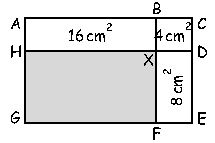
(a) 28 cm2
(b) 32 cm2
(c) 48 cm2
(d) 64 cm2
Answer : B
Question. Consider the following two statements.
Statement A : If edge of a cube measures 25 m and l = 20 m, b = 20m, h = 30 m are the measures of a cuboid then cuboid has the larger volume.
Statement B : Dilip breaks a rod of 90 cm into four equal pieces. Taking three parts he makes a triangle by joining end to end. Perimeter of the triangle is 67.5 cm.
Which one of the following option is correct about the above statements?
(a) Statement A is false and B is correct.
(b) Statement A is true and B is false.
(c) Both statements are true.
(d) Both statements are false.
Answer : A
Question. On the basis of following features identify the correct shape.
(A) It's length and breadth are equal.
(B) It's area is side × side.
(C) It's perimeter is 4 times its side.
(D) It is a four-sided polygon.
(a) Rectangle
(b) Parallelogram
(c) Square
(d) Trapezium
Answer : C
Question. The perimeter of an equilateral triangle and of a square measure the same. Which of the following can be the measures of the side of the equilateral triangle and of the square?
(a) Equilateral triangle = 9 cm; square = 12 cm
(b) Equilateral triangle = 12 cm; square = 9 cm
(c) Equilateral triangle = 15 cm; square = 10 cm
(d) Equilateral triangle = 6 cm; square = 4 cm
Answer : B
Question. Find the area and Perimeter of the given shape.

(a) Area 40; Perimeter 40
(b) Area 36; Perimeter 28
(c) Area 28; Perimeter 36
(d) Area 30; Perimeter 40
Answer : B
Question. Find the missing side length, when the area is 90 square units.

(a) 10
(b) 8
(c) 9
(d) 7
Answer : C
Question. On the basis of following features identify the correct shape.
(A) It is a four-sided polygon in which opposite sides are equal.
(B) It's perimeter is twice the sum of its length and breadth.
(C) It's area is calculated by multiply its length and breadth.
(a) Rectangle
(b) Parallelogram
(c) Square
(d) Trapezium
Answer : A
Question. Read the statement and choose the correct option.
Statement A : The side of a square is 3. So its area is 9 square unit.
Statement B : The Perimeter of a square is 12 with side length 3.
(a) Statement A is right B is wrong.
(b) Statement B is right A is wrong.
(c) Both the statements are wrong.
(d) Both the statements are right.
Answer : D
Question. The area of a square is 64 cm2. Then its perimeter is
(a) 64 cm
(b) 32 cm
(c) 46 cm
(d) 48 cm
Answer : B
Question. The perimeter of two squares is 12 cm and 24 cm. The area of the bigger square is how many times that of the smaller?
(a) 5 times
(b) 2 times
(c) 3 times
(d) 4 times
Answer : D
Question. Find the difference in perimeters between the two figures. (Figures are not drawn to scale)

(a) 5 cm
(b) 6 cm
(c) 8 cm
(d) 2 cm
Answer : B
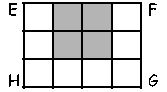
Question. In the given figure, the area of the shaded square is 196 cm2. What is the perimeter of the rectangle EFGH?
(a) 90 cm
(b) 54 cm
(c) 98 cm
(d) 49 cm
Answer : C
Question. In the figure, side of each square is 1 cm. The area, in square cm, of the shaded part is

(a) 11
(b) 8
(c) 9
(d) 10
Answer : A
Question. In the given figure, AB is 2/3 as long as BC and DE = EF = FG.

What is the perimeter of BCDE?
(a) 48 cm
(b) 50 cm
(c) 52 cm
(d) 28 cm
Answer : B
Question. The breadth of a rectangular painting is 3/4 of its length. If the length of the painting is 80 cm, what is the perimeter of the painting?
(a) 140 cm
(b) 190 cm
(c) 280 cm
(d) 380 cm
Answer : C
Question. Find the area and Perimeter of the given shape.

(a) Area 19; Perimeter 20
(b) Area 20; Perimeter 20
(c) Area 19; Perimeter 19
(d) Area 20; Perimeter 19
Answer : A
Question. Find the area of the shaded part
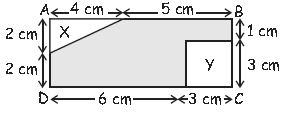
(a) 9 cm2
(b) 4 cm2
(c) 23 cm2
(d) 36 cm2
Answer : C
Question. Find the area of rectangular garden of length 18 m and breadth 10 m. Also, find the cost of manuring the garden at the rate of ₹5 per m2.
(a) 180 m2, ₹ 1800
(b) 180 m2, ₹ 900
(c) 28 m2, ₹ 280
(d) 14 m2, ₹ 450
Answer : B
Question. Which shape has the largest area?

(a) Q
(b) R
(c) P
(d) S
Answer : A
Question. The given figure is made up of identical squares. The total area of the figure is 576 cm2. What is the perimeter of the figure?
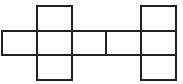
(a) 320 cm
(b) 160 cm
(c) 240 cm
(d) 200 cm
Answer : B
Question. Find the perimeter of the given figure. (Two rectangles are of same shape and size)
(FG = FH = GH)
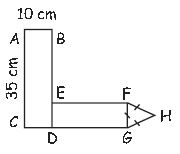
(a) 165 cm
(b) 150 cm
(c) 135 cm
(d) 170 cm
Answer : D
Question. The given figure is made up of a square and a rectangle. The breadth of the rectangle is (1/3)rd the length of the edge of the square. If the area of the whole figure is 384 cm2, find the length of the rectangle.

(a) 12 cm
(b) 8 cm
(c) 10 cm
(d) 9 cm
Answer : C
Area and Perimeter, & Volume
Objective Type
1. The amount of surface occupied by a figure is given by its _______________.
2. The amount of space occupied by a solid is called its _______________.
3. The distance around a closed figure is called its ______________.
4. Area is expressed in ______________ units.
5. Volume is expressed in ______________ units.
6. The area of a square of side 1 cm is ______________.
7. The volume of cube of edge 1 m is ______________.
8. The perimeter of a square of side 1 cm is ________________.
9. Area of rectangle = ______________ x breadth.
10. Volume of cuboid = length x breadth x ______________.
11. sq. m and sq. cm are units of measuring ___________________.
12. The measure of inner space of a hollow solid is called its ______________.
13. The formula used to find the perimeter of rectangle is ______________.
14. All sides of a square are ______________ in length.
15. Area of a square = ____________ x ______________.
16. Volume of a cube = ___________ x ___________ x __________
17. A ____________ is a special kind of rectangle whose length and breadth are equal.
18. A _______________ is a special cuboid whose length, breadth and height are equal.
19. Cubic meter and cubic centimeter are units of measuring ______________.
20. Perimeter of a rectangle = 2 x (______________ + breadth)
21. Perimeter is the _____________ of all sides.
22. Perimeter of a square = 4 x _______________
23. The ______________ of a figure is the number of times the unit square is continued in the figure.
24. 4 x side gives the ______________ of a square.
25. Length x breadth gives the ______________ of a rectangle.
Free study material for Mathematics
Area And Perimeter Printable Worksheets and Exercises for Class 5 Mathematics
Mastering Area And Perimeter with Printable Worksheets
Review targeted practice exercises for Class 5 Mathematics Area And Perimeter. Curated to match official CBSE guidelines, these printable problem sets support daily revision and improve overall test readiness.
Verified Solutions and NCERT Alignment
Each worksheet draws directly from authorized standard textbooks to maintain academic accuracy. Evaluating your finished exercises against expert-verified solutions helps master the formal presentation standards expected in school evaluations.
Additional Study Resources for Class 5 Mathematics
Follow up your worksheet practice by attempting the interactive online MCQ tests for Area And Perimeter to evaluate your execution speed. All printable assignments and revision sheets on our platform are updated for the 2026 session and available free of charge.
FAQs
You can download the latest chapter-wise printable worksheets for Class 5 Mathematics Area And Perimeter for free from StudiesToday.com. These have been made as per the latest CBSE curriculum for this academic year.
Yes, Class 5 Mathematics worksheets for Area And Perimeter focus on activity-based learning and also competency-style questions. This helps students to apply theoretical knowledge to practical scenarios.
Yes, we have provided solved worksheets for Class 5 Mathematics Area And Perimeter to help students verify their answers instantly.
Yes, our Class 5 Mathematics test sheets are mobile-friendly PDFs and can be printed by teachers for classroom.
For Area And Perimeter, regular practice with our worksheets will improve question-handling speed and help students understand all technical terms and diagrams.