

Chapter-wise Worksheets for Class 5 Mathematics: Math-Magic Chapter 01 The Fish Tale
Access comprehensive chapter-wise worksheets for Math-Magic Chapter 01 The Fish Tale using the CBSE Class 5 Mathematics The Fish Tale Worksheet Set 02. Designed to align with the 2026-27 academic syllabus for Class 5 Mathematics, these printable practice sets help students reinforce key concepts and improve their overall exam readiness.
Practice Class 5 Mathematics Worksheets: Math-Magic Chapter 01 The Fish Tale
Access the complete worksheet PDF for Class 5 Mathematics below. Regular practice with these targeted academic tasks builds familiarity with standard question patterns and helps secure higher marks in final school examinations.
Chapter-1: The Fish Tale
Q1. Find Each -
a) \(2398 \times 169\)
Answer: 4,05,262
In simple words: Multiply 2398 by 169 to get the product.
Exam Tip: Align columns carefully while multiplying large numbers to avoid calculation errors.
b) \(6809 \times 235\)
Answer: 16,00,115
In simple words: Multiply 6809 by 235 to find the product.
Exam Tip: Double check the addition step of partial products.
c) \(7499 \times 386\)
Answer: 28,94,614
In simple words: Multiply 7499 by 386 to get the final result.
Exam Tip: Keep track of carry-over digits during multiplication.
d) \(25290 \div 45\)
Answer: 562
In simple words: Divide 25290 by 45 to find the quotient.
Exam Tip: Use long division method and check your answer by multiplying the quotient with the divisor.
e) \(25220 \div 52\)
Answer: 485
In simple words: Divide 25220 by 52 to get the quotient.
Exam Tip: Estimate the nearest multiple before performing division.
f) \(16400 \div 80\)
Answer: 205
In simple words: Divide 16400 by 80 by canceling the trailing zero first.
Exam Tip: Cancel common zeros from dividend and divisor to simplify division.
Q2. A Log boat goes 6 km in 1 hour.
a) How long will it take to go 54 km?
Answer: Time taken = \(54 \div 6 = 9\) hours.
In simple words: Divide the total distance by the speed per hour to find the time.
Exam Tip: Formula: Time = Distance / Speed.
b) How far will it go in four and half hours?
Answer: Distance = Speed \(\times\) Time
Distance = \(6 \times 4.5 = 27\) km.
In simple words: Multiply the speed (6 km/hr) by 4.5 hours.
Exam Tip: Four and a half can be written as 4.5 or \(\frac{9}{2}\).
Q3. One Crore = -------- lakhs.
Answer: One Crore = 100 lakhs.
In simple words: 1 crore is equal to 100 times 1 lakh.
Exam Tip: Remember the Indian numbering system: 1 crore = 1,00,00,000 and 1 lakh = 1,00,000.
Q4. Write the smallest 8-digit number having five different digits.
Answer: 10,00,023
In simple words: To make the smallest 8-digit number, use the smallest available digits (0, 1, 2, 3, 4, etc.) without starting with 0.
Exam Tip: The first digit cannot be 0. Use ascending order of digits for the smallest number.
Q5. The speed of boat is 22 km per hour. How far will it go in 2 and half hours?
Answer: Distance = Speed \(\times\) Time
Distance = \(22 \times 2.5 = 55\) km.
In simple words: Multiply the speed of 22 km/hr by 2.5 hours.
Exam Tip: Always include the unit (km) in distance answers.
Q6. John bought 4500 kg of fresh fish at the rate Rs. 50 per kg and spent Rs. 8000 for salt and transport. After one month he sold the dry fish at the rate of Rs. 200 per kg. Find his gain or loss. (Note: - 3 kg of fish gives 1 kg of dry fish)
Answer:
Cost of 4500 kg of fresh fish = \(4500 \times 50 =\) Rs. 2,25,000
Money spent on salt and transport = Rs. 8,000
Total Cost Price = \(2,25,000 + 8,000 =\) Rs. 2,33,000
Quantity of dry fish obtained from 4500 kg of fresh fish = \(4500 \div 3 = 1500\) kg
Selling Price of 1500 kg of dry fish at Rs. 200 per kg = \(1500 \times 200 =\) Rs. 3,00,000
Since Selling Price (\(3,00,000\)) is greater than Total Cost Price (\(2,33,000\)), John made a gain.
Gain = \(3,00,000 - 2,33,000 =\) Rs. 67,000
In simple words: Subtract total expenses from total earnings to find the profit.
Exam Tip: Include additional expenses like transport in the total cost price.
Q7. Suyash takes Rs. 30450 from a bank. He gives back Rs. 3540 per month for a year.
a) How much amount will he pay back to the bank?
Answer: 1 year = 12 months
Total amount paid back = \(3540 \times 12 =\) Rs. 42,480
In simple words: Multiply the monthly installment by 12 months.
Exam Tip: Convert years into months before multiplying.
b) What interest will he pay?
Answer: Interest = Total amount paid back - Principal amount borrowed
Interest = \(42,480 - 30,450 =\) Rs. 12,030
In simple words: Subtract the original loan amount from the total amount paid.
Exam Tip: Interest is the extra money paid over the borrowed amount.
Q8. Anushka takes 9000 kg potatoes for Rs. 15 a kg, she dries it for chips. The chip is one third of the total. She sells chips for Rs. 70 a kg. How much profit will she earn?
Answer:
Cost of 9000 kg potatoes = \(9000 \times 15 =\) Rs. 1,35,000
Quantity of chips obtained = \(\frac{1}{3} \times 9000 = 3000\) kg
Selling Price of 3000 kg chips = \(3000 \times 70 =\) Rs. 2,10,000
Profit = Selling Price - Cost Price
Profit = \(2,10,000 - 1,35,000 =\) Rs. 75,000
In simple words: Find total cost, find weight of chips, calculate total selling price, and subtract to find profit.
Exam Tip: Clearly calculate the reduced weight of chips before finding selling price.
Q9. Twenty fisher women opened a bank. Each saves Rs. 30 per month.
a) How much amount will they deposit in one year?
Answer:
Savings by 1 woman in 1 month = Rs. 30
Savings by 20 women in 1 month = \(20 \times 30 =\) Rs. 600
Savings by 20 women in 1 year (12 months) = \(600 \times 12 =\) Rs. 7,200
In simple words: Multiply monthly savings by 20 women, then multiply by 12 months.
Exam Tip: You can multiply women by months first or total monthly savings by 12.
b) How much amount will they deposit in 15 years?
Answer:
Deposit in 1 year = Rs. 7,200
Deposit in 15 years = \(7200 \times 15 =\) Rs. 1,08,000
In simple words: Multiply the annual deposit by 15 years.
Q10. Pragya takes Rs. 4896 from Vidushi to buy an almirah. She returns Rs. 6072 in total in a year. How much does she gives in each month?
Answer:
Total amount returned in a year = Rs. 6,072
Number of months in a year = 12
Monthly payment = \(6072 \div 12 =\) Rs. 506
In simple words: Divide the total annual return amount by 12 months.
Exam Tip: The principal amount borrowed is extra information not needed for finding the monthly installment.
Q11. Aruna buys 12000 kg of fresh fish at Rs. 40 a kg. She dries it. The dried fish is one-third of the fresh fish. She sells the dried fish at Rs. 200 and pays Rs. 890 for transportation. How much does she earn in this whole transaction?
Answer:
Cost of 12000 kg fresh fish = \(12000 \times 40 =\) Rs. 4,80,000
Transportation cost = Rs. 890
Total Cost Price = \(4,80,000 + 890 =\) Rs. 4,80,890
Quantity of dried fish = \(\frac{1}{3} \times 12000 = 4000\) kg
Selling Price of 4000 kg dried fish = \(4000 \times 200 =\) Rs. 8,00,000
Earnings (Profit) = Total Selling Price - Total Cost Price
Earnings = \(8,00,000 - 4,80,890 =\) Rs. 3,19,110
In simple words: Subtract total cost and transport from total selling price of dried fish.
Exam Tip: Add transport charges to the cost of fish to find the exact total investment.
Q12. Radhika sells 8 kg octopus for Rs. 2408. At what price does she sell 1 kg?
Answer:
Price of 8 kg octopus = Rs. 2,408
Price of 1 kg octopus = \(2408 \div 8 =\) Rs. 301
In simple words: Divide the total price by 8 to get the price of 1 kg.
Q13. Mariya sells anabas fish for Rs. 80 a kg.
a) How much does she earn for seven and half kg of anabas?
Answer:
Price of 1 kg anabas = Rs. 80
Quantity = \(7.5\) kg
Total earning = \(80 \times 7.5 =\) Rs. 600
In simple words: Multiply Rs. 80 by 7.5 kg.
Exam Tip: Seven and a half is written as 7.5.
b) Priyanka pays Rs. 200 for anabas. How much fish does she get?
Answer:
Quantity of fish = Total money paid / Price per kg
Quantity = \(200 \div 80 = 2.5\) kg (or 2 kg 500 g)
In simple words: Divide total money by Rs. 80 to find the weight in kg.
Exam Tip: \(200 \div 80 = \frac{20}{8} = 2.5\).
Q14. Write number name for-
a) 8,64,07,359
Answer: Eight crore sixty-four lakh seven thousand three hundred fifty-nine.
In simple words: Write the number in words according to the Indian place value system.
Exam Tip: Use commas correctly to separate periods (crores, lakhs, thousands, hundreds).
b) 7,34,99,287
Answer: Seven crore thirty-four lakh ninety-nine thousand two hundred eighty-seven.
In simple words: Spell out the digits based on their place value.
Exam Tip: Check spelling of large number words like 'ninety' and 'thousand'.
c) 23,45,96,007
Answer: Twenty-three crore forty-five lakh ninety-six thousand seven.
In simple words: Notice there are no hundreds or tens, just 7 in the ones place.
Exam Tip: Omit mentioning zero values in number names.
d) 85,26,789
Answer: Eighty-five lakh twenty-six thousand seven hundred eighty-nine.
In simple words: Read up to the lakhs period.
Exam Tip: Double check hyphenations in compound numbers like twenty-six and eighty-nine.
e) 90,90,909
Answer: Ninety lakh ninety thousand nine hundred nine.
In simple words: Read each non-zero period carefully.
Exam Tip: Ensure every non-zero place value is clearly represented.
Q15. Fill in the blanks-
a) 1 crore = __________ thousands
Answer: 10,000 thousands
In simple words: 1 crore = 1,00,00,000, which has 10,000 thousands.
Exam Tip: Cancel three zeros from 1,00,00,000 to convert to thousands.
b) 10 lakhs = _________ hundreds
Answer: 10,000 hundreds
In simple words: 10 lakhs = 10,00,000, which equals 10,000 hundreds.
Exam Tip: Cancel two zeros from 10,00,000 to find hundreds.
c) 7 thousands = _______tens
Answer: 700 tens
In simple words: 7,000 divided by 10 gives 700 tens.
d) 85 hundreds = _______tens
Answer: 850 tens
In simple words: 85 hundreds = 8,500, which is equal to 850 tens.
Exam Tip: Multiply hundreds by 10 to get tens.
Q16. See the table and answer-
| Boats | Catch per trip (kg) | Speed |
|---|---|---|
| Motor boat | 50 kg | 25 km/hr |
| Log boat | 15 kg | 3 km/hr |
| Machine boat | 700 kg | 90 km/hr |
| Long tail boat | 25 kg | 10 km/hr |
| Double decker boat | 500 kg | 80 km/hr |
a) How for the motor goes in 7 hours?
Answer:
Speed of motor boat = 25 km/hr
Distance in 7 hours = \(25 \times 7 = 175\) km.
In simple words: Multiply speed (25 km/hr) by time (7 hours).
Exam Tip: Refer to the speed column for the motor boat.
b) How long the machine boat will take to go 540 km?
Answer:
Speed of machine boat = 90 km/hr
Time taken = Distance / Speed = \(540 \div 90 = 6\) hours.
In simple words: Divide total distance (540 km) by speed (90 km/hr).
c) How much fish can the double decker boat bring in 5 trips?
Answer:
Catch per trip for double decker boat = 500 kg
Catch in 5 trips = \(500 \times 5 = 2,500\) kg.
In simple words: Multiply catch per trip by 5 trips.
Exam Tip: Check the 'Catch per trip' column for double decker boat.
d) How much will each boat bring in 4 such trips?
Answer:
Motor boat: \(50 \times 4 = 200\) kg
Log boat: \(15 \times 4 = 60\) kg
Machine boat: \(700 \times 4 = 2,800\) kg
Long tail boat: \(25 \times 4 = 100\) kg
Double decker boat: \(500 \times 4 = 2,000\) kg
In simple words: Multiply each boat's catch per trip by 4.
Exam Tip: Calculate each boat separately and list clearly.
Q17. Draw 5 different fishes/vegetables using the given shape-
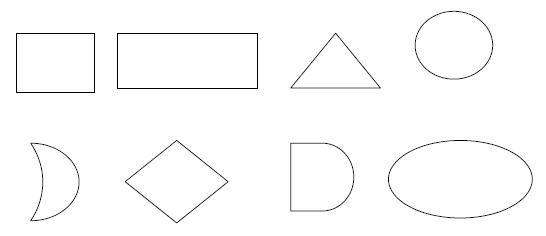
Answer:
1. Use rectangles and triangles to draw a fish body and tail.
2. Use circles and ellipses to draw round vegetables like tomatoes or pumpkins.
3. Combine rectangles and circles to draw bottle gourds or fish shapes.
In simple words: Sketch creative outlines of fishes or vegetables using the geometric shapes provided in the worksheet.
Exam Tip: Be creative and use clean pencil strokes for your drawings.
Q18. Write the successor of each number-
a) 89,799
Answer: 89,800
In simple words: Add 1 to the given number.
Exam Tip: Successor means the number that comes immediately after (+1).
b) 74,610
Answer: 74,611
In simple words: Add 1 to 74,610.
Exam Tip: Increment the ones digit by 1.
c) 3,49,849
Answer: 3,49,850
In simple words: Add 1 to 3,49,849.
Exam Tip: Carry over properly when changing 9 to 0.
Q19. Write the predecessor of each number-
a) 6,79,482
Answer: 6,79,481
In simple words: Subtract 1 from the given number.
Exam Tip: Predecessor means the number that comes immediately before (-1).
b) 5,55,555
Answer: 5,55,554
In simple words: Subtract 1 from 5,55,555.
Exam Tip: Decrease the ones digit by 1.
c) 68,68,689
Answer: 68,68,688
In simple words: Subtract 1 from 68,68,689.
Exam Tip: Decrement the last digit by 1.
Q20. Fill in the blanks using >, < or = signs -
a) 1 crore [ ] 1,00,00,000
Answer: 1 crore = 1,00,00,000
In simple words: Both values are equal.
Exam Tip: 1 crore in digits is written as 1,00,00,000.
b) 65,87,908 [ ] 7,84,900
Answer: 65,87,908 > 7,84,900
In simple words: A 7-digit number is greater than a 6-digit number.
Exam Tip: Compare the number of digits first; more digits means a larger number.
c) 56,92,284 [ ] 56,89,428
Answer: 56,92,284 > 56,89,428
In simple words: Compare digit by digit from left to right. 92 thousands is greater than 89 thousands.
Exam Tip: Compare place values from left when the number of digits is the same.
d) 80,12,03,349 [ ] 8,01,30,249
Answer: 80,12,03,349 > 8,01,30,249
In simple words: 80 crores is greater than 8 crores.
Exam Tip: 80,12,03,349 has 9 digits in crores while 8,01,30,249 has 8 digits.
e) 2,22,33,495 [ ] 2,23,32,495
Answer: 2,22,33,495 < 2,23,32,495
In simple words: 22 lakhs is less than 23 lakhs.
a) 1 crore = _________
Answer: 1,00,00,000
In simple words: 1 crore in standard numerical form.
Exam Tip: Count the zeros: 1 crore has 7 zeros.
b) 1 lakh = _________
Answer: 1,00,000
In simple words: 1 lakh in numerical form.
Exam Tip: 1 lakh has 5 zeros.
c) 10 crores = ________
Answer: 10,00,00,000
In simple words: 10 multiplied by 1 crore.
Exam Tip: 10 crores has 8 zeros.
d) 10 lakhs = _________
Answer: 10,00,000
In simple words: 10 multiplied by 1 lakh.
Exam Tip: 10 lakhs has 6 zeros.
e) 1 thousands = ________
Answer: 1,000
In simple words: 1 thousand in numerical form.
Exam Tip: 1 thousand has 3 zeros.
f) 10 thousands = ________
Answer: 10,000
In simple words: 10 thousand in numerical form.
Exam Tip: 10 thousand has 4 zeros.
g) 1 hundred = ________
Answer: 100
In simple words: 1 hundred in numerical form.
Exam Tip: 1 hundred has 2 zeros.
Free study material for Mathematics
Download Class 5 Mathematics Math-Magic Chapter 01 The Fish Tale Practice Worksheets
Mastering Math-Magic Chapter 01 The Fish Tale with Printable Worksheets
Access structured practice worksheets for Math-Magic Chapter 01 The Fish Tale aligned with the 2026 CBSE curriculum. These downloadable exercises for Class 5 Mathematics help students build accuracy and reinforce core concepts for upcoming school tests.
Verified Solutions and NCERT Alignment
Designed around the official curriculum for Class 5 Mathematics, these practice sheets guarantee standard compliance. Reviewing step-by-step solutions after completion sharpens your accuracy and clarifies complex sub-topics within Math-Magic Chapter 01 The Fish Tale.
Additional Study Resources for Class 5 Mathematics
Consistent engagement with these exercises builds familiarity with recurring exam themes. If specific areas within Math-Magic Chapter 01 The Fish Tale cause trouble, utilize our dedicated NCERT solutions for Class 5 Mathematics to clear up doubts immediately.
FAQs
You can download the latest chapter-wise printable worksheets for Class 5 Mathematics Math-Magic Chapter 01 The Fish Tale for free from StudiesToday.com. These have been made as per the latest CBSE curriculum for this academic year.
Yes, Class 5 Mathematics worksheets for Math-Magic Chapter 01 The Fish Tale focus on activity-based learning and also competency-style questions. This helps students to apply theoretical knowledge to practical scenarios.
Yes, we have provided solved worksheets for Class 5 Mathematics Math-Magic Chapter 01 The Fish Tale to help students verify their answers instantly.
Yes, our Class 5 Mathematics test sheets are mobile-friendly PDFs and can be printed by teachers for classroom.
For Math-Magic Chapter 01 The Fish Tale, regular practice with our worksheets will improve question-handling speed and help students understand all technical terms and diagrams.