

Download Class 12 History Concept Summaries: CBSE Class 12 History Notes Themes in Indian History
Explore reliable concept summaries and revision materials through the CBSE Class 12 History Notes Themes in Indian History. Tailored for Class 12 learners, utilizing these notes for History Theme I Chapter 01 Bricks, Beads and Bones The Harappan Civilisation ensures thorough preparation and strengthens core academic definitions before final evaluations.
Access Theme I Chapter 01 Bricks, Beads and Bones The Harappan Civilisation Notes and Study Material
Access the complete concept summary PDF for Theme I Chapter 01 Bricks, Beads and Bones The Harappan Civilisation below. Regular review of these targeted notes builds familiarity with complex Class 12 History themes and helps secure higher marks in final school evaluations.
Questions
Question. Describe any two features of the Harappan cities.
Answer. Citadel and the lower town
Question. Mention the articles on which the proof of writing was found.
Answer. Seals, rim of jars, tablets, etc
Question. What were seals? What were the seals used for?
Answer. Long distance communication, used for trade purpose, to identify the owner, etc
Question. Discuss the important features of Harappan drainage system.
Answer. The drains and streets were laid first and then houses were built along them.
Every house was connected with the street drains.
Very long drainage channels were provided. Etc
Question. Write a short note on the Great bath of Mohenjodaro.
Answer. It was in the citadel.
It was a rectangular tank.
It was made water tight by using mortar of gypsum
Question. Mention the causes of disappearance of the Harappan culture.
Answer. Climatic change, deforestation, Aryan invasion theory, etc
Question. Who was Cunningham?
Answer. Cunningham was the first Director genereal of the Archaelogical survey of India(ASI).
Question. Who were shamans?
Answer. Shamans were those people who claimed to have magical and healing power. They were men and women both. They claimed to have power of communicating with the other world.
Question. __________ deciphered Brahmi and Kharoshti.
Answer. James princep
Question. Who was John Marshal? How did he mark a change in the Indian Archaeology?
Answer. John Marshal was the Director general of the Archaeological survey of India(ASI). He was interested in new findings and looked for patterns of everyday life. He tended to excavate along regular horizontal units measured uniformly throughout the mound, ignoring the stratigraphy.
Question. Who was R.E.M Wheeler? Mention any one of his contribution in the field of Archeology?
Answer. He rectified the John marshal’s excavation and followed straitigraphy of
the mound to excavate.
Question. Harappan people led a prosperous life. Justify with examples.
Answer. You can explain the agriculture, crafts and industry, trade and commerce, weight and measures, profession etc..
Question. Mention any four items found in the graves of the Harappa.
Answer. Pottery, ornaments, jewellery etc
Question. How do archaeologists trace socio-economic differences in Harappan society?
Answer. By studying the burials and artifacts
Question. Compare the Indus valley civilization with other contemporary civilization of the world.
Answer. Compare it with Mesopotamia, Egypt.
Question. What do you know about the economic life of the Harappan civilization.
Answer. The do agriculture, trade, barter system, etc
Question. Describe some of the distinctive features of Mohenjodaro.
Answer. Well planned city, well planned drainage system, architecture, efficient civic organization, etc
Question. How do historians reconstruct the past?
Answer. Through different sources like Archaeological, literary, traveler accounts, etc
Question. Identify the image

Answer. Terracotta figurine of Mother Goddess
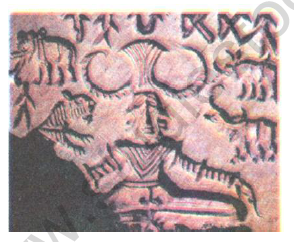
Answer. Proto shiva seal.
Question. Define stratigraphy?
Answer. Study of rock layers and laying process.
Question. What do understand by the term culture?
Answer. Term used for a group of objects distinctive in style usually found together within a specific geographical area and period of time.
Question. Find the correct matching pair from the following pairs.
a) Fire altars-- Kot Diji
b) Terracotta bull – Banawali
c) Shell objects—Rakhigarhi
d) Black clay jar—Chanhudaro
Answer. B
Question. The harappan civilization declined as a result of____________.
Answer. No definite factor was known.
Question. The economy of Indus Valley people was based on ________.
Answer. Agriculture, trade, crafts, etc.
Please click on below link to download CBSE Class 12 History Themes in Indian History Notes
Free study material for History
Study Material and Revision Notes for Class 12 History Theme I Chapter 01 Bricks, Beads and Bones The Harappan Civilisation
Quick Revision Notes: Theme I Chapter 01 Bricks, Beads and Bones The Harappan Civilisation (CBSE)
Review targeted chapter notes for Class 12 History Theme I Chapter 01 Bricks, Beads and Bones The Harappan Civilisation. Built according to official CBSE guidelines, these summaries highlight high-yield topics frequently tested in school evaluations.
Expert Study Material for Class 12 History
Cross-reference your comprehension with comprehensive NCERT solutions for Class 12 to ensure absolute clarity across all sub-topics in this chapter.
Complete Your Chapter Revision
Follow up your revision by attempting the interactive online History MCQ test and practice worksheets for this chapter to verify your mastery. All platform resources are free to access.
FAQs
You can download the teacher prepared revision notes for CBSE Class 12 History Notes Themes in Indian History from StudiesToday.com. These notes are designed as per 2026-27 academic session to help Class 12 students get the best study material for History.
Yes, our CBSE Class 12 History Notes Themes in Indian History include 50% competency-based questions with focus on core logic, keyword definitions, and the practical application of History principles which is important for getting more marks in 2026 CBSE exams.
Yes, our CBSE Class 12 History Notes Themes in Indian History provide a detailed, topic wise breakdown of the chapter. Fundamental definitions, complex numerical formulas and all topics of CBSE syllabus in Class 12 is covered.
These notes for History are organized into bullet points and easy-to-read charts. By using CBSE Class 12 History Notes Themes in Indian History, Class 12 students fast revise formulas, key definitions before the exams.
No, all study resources on StudiesToday, including CBSE Class 12 History Notes Themes in Indian History, are available for immediate free download. Class 12 History study material is available in PDF and can be downloaded on mobile.