

Download CBSE Class 11 Physics Useful Resources
Review targeted academic resources with the CBSE Class 11 Physics Work Energy Power Objective Questions. Built according to official CBSE standards for the 2026-27 term, these downloadable Class 11 Physics study materials support effective daily practice and deeper conceptual understanding for Chapter 05 Work Energy and Power.
Access CBSE Study Guides and Summaries
Navigate directly to the advanced Physics study materials using the digital viewer below. Each resource pack includes detailed conceptual summaries and solved practice questions, allowing students to instantly reinforce their learning.
1. A man cycles up a hill rising 1 metre vertically for every 50 metre along the slope at the rate of 3.6 km/ hour. If the weight of the man and cycle is 120 kg, the power of the man is
(a) 5.85 watt (b) 11.7 watt (c) 23.52 watt (d) 47.04 watt
2. A block of mass m slides down along the surface of a hemispherical bowl of radius R from its top portion of the rim to its lowermost point at its bottom. The velocity of the block at this point is
(a) √π Rg (b) √2π Rg (c) √2Rg (d) √Rg
3. A particle of mass M is moving in a horizontal circle of radius r under a centripetal force equal to − k/r2 , where k is a constant, its total energy is
(a) k/r (b) −k/r (c) k/2r (d) -k/2r
4. A small body of mass M starts sliding off the top of a smooth sphere of radius R. The angle θ with respect to the vertical direction at the centre corresponding to the point at which the body breaks off the sphere is
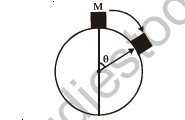
(a) cos–1(2/3) (b) tan–1 (2/3) (c) π/4 (d) π/2
5. An elastic string of unstretched length L and force constant k is stretched by a small length x. It is further stretched by a small length y. The work done in the second stretching is
(a) 1/2 ky2 (b) 1/2 k (x2 + y2) (c) 1/2 k (x + y)2 (d) 1/2 ky (2x + y)
6. A particle moves along the x-axis from x = 0 to x = 5m under the influence of a force given by F = 7 – 2x + 3x2. The work done in the process is
(a) 70 J (b) 270 J (c) 35 J (d) 135 J
7. A spring of force constant 10 N/m has initial stretch 0.2 m. In changing the stretch to 0.25 m, the increases of potential energy is about
(a) 0.11 J (b) 0.21 J (c) 0.31 J (d) 0.51 J
8. Under the action of a force, a 3 kg body moves such that its position x as a function of time is given by x = t3 /3; where x is in meters and t in seconds. The work done by the force in the first two seconds is
(a) 24 J (b) 81 J (c) 240 J (d) 810 J
9. A particle moves with a velocity v = 10iˆ − 6 ˆj + 12kˆ r m/s under the influence of a constant force F = 10iˆ + 10 ˆj + 20kˆ r N. The instantaneous power applied to the particle is
(a) 100 J/s (b) 280 J/s (c) 350 J/s (d) 400 J/s
10. A bucket tied to a string is lowered at a constant acceleration of g/4. If the mass of the bucket is m and it is lowered by a distance d, the work done by the string will be (assume the string to be massless)
(a) 1/4 mgd (b) – 3/4 mgd (c) –4/3 mgd (d) 4/3 mgd
11. The displacement x of a particle of mass m kg moving in one dimension, under the action of a force, is related to the time t by the equation t = √x + 3 where x is in metres and t is in seconds. The work done by the force in the first six seconds in joules is
(a) 0 (b) 3 (c) 6 (d) 9
12. A 2 kg block is dropped from a height of 0.4 m on a spring of force constant k = 1960 N/m. The maximum compression of the spring is
(a) 0.1 m (b) 0.2 m (c) 0.3 m (d) 0.4 m
13. A man who is running has half the kinetic energy of a body of half his mass. The man speeds up by 1 ms–1 and then has same kinetic energy as the body. The original speed of the boy was
(a) √2 ms–1 (b) √( 2 –1) ms–1 (c) 2 ms–1 (d) √2 +1 ms–1
14. A ball is projected vertically upwards with an initial velocity. Which of the following graphs best represents the K.E. of the ball as a function of time from the instant of projection till it reaches the point of projection ?

15. A particle at rest on a frictionless table is acted on by a horizontal force which is constant in size and direction. A graph is plotted of the work done on the particle W, against the speed of the particle v. If there are no frictional forces acting on the particle, the graph will look like

16. A sphere moving with velocity v strikes a wall moving towards the sphere with a velocity u. If the mass of the wall is infinitely large, the workdone by the wall during collision will be
(a) m u (u + v) (b) 2 m u (u + v) (c)2 m v (u + v) (d) 2 m (u + v)
17. A block of mass 10 kg accelerates uniformly from rest to a speed of 2 m/s in 30 second. What is the workdone on the block at the end of first 10 seconds ? Neglect friction.
(a) 20 J (b) 20/9 J (c) 20/3 J (d) 20/6 J
18. A man drags a box with uniform speed across a 10 m long rough floor. The coefficient of friction of the floor is 0.5. If the man pulls the box with a force of ( √3 ) kN at an angle 30º with the horizontal, what is the work done in draging the box ?
(a) 30 kJ (b) 15 kJ (c) 10 √3 kJ (d) 5 kJ.
19. A particle moves under the effect of a force F = cx from x = 0 to x = x1. The work done in the process is
(a) cx21 (b) 1/2 cx21 (c) cx31 (d) zero
20. Work done in time t on a body of mass m which is accelerated from rest to a speed v in time t1 as a function of time t is given by
(a) 1/2mv/t1 t2 (b) mv/t1 t2 (c) 1/2(mv/t1)2 t2 (d) 1/2mv2/t21 t2
21. A heavy box of 40 kg is pushed along 20 m by two coolies over a railway platform whose coefficient of friction with the box is 0.4. The work done by the two coolies (take g = 10 ms–2 and assume forces applied to be horizontal) is
(a) + 3200 J (b) – 3200 J (c) + 1600 J (d) – 1600 J
22. The potential energy of a particle is given by U = a/r2 – b/r where a and b are positive constants r is the distance from the centre of the field. The stable equilibrium position of the particle corresponds to the distance r0 given by
(a) r0 = a/2b (b) r0 = – a/b (c) r0 = 2a/b (d) r0 = a/b
Objectives
1. (c) 2. (c) 3. (d) 4. (a) 5. (d) 6. (d) 7. (a) 8. (a) 9. (b) 10. (b) 11. (a) 12. (a) 13. (d) 14. (c) 15. (b) 16. (b) 17. (b) 18. (b) 19. (b) 20. (d) 21. (a) 22. (c)
Free study material for Physics
Physics Class 11 Exam Resources: Chapter 05 Work Energy and Power
Quick Revision Material for Chapter 05 Work Energy and Power
Explore essential learning tools for Class 11 Physics Chapter 05 Work Energy and Power. This curated collection features in-depth notes and targeted practice questions built around the active 2026 curriculum to streamline your daily revision.
Expert Notes and Solved Exam Questions
Designed around the official curriculum, these study guides guarantee standard compliance. Reviewing step-by-step solutions clarifies complex sub-topics within Chapter 05 Work Energy and Power and demystifies standard marking schemes for Physics evaluations.
Additional Study Resources for Class 11
Maximize your grade potential by utilizing Class 11 Physics practice papers in tandem with these structured notes. All printable assignments and interactive mock tests on our platform are updated for the 2026 session and available free of charge.
FAQs
Our advanced study package for Chapter 05 Work Energy and Power includes detailed concepts, diagrams, Mind Maps, and explanation of complex topics to ensure Class 11 students learn as per syllabus for 2026 exams.
The Mind Maps provided for Chapter 05 Work Energy and Power act as visual anchors which will help faster recall during high-pressure exams.
Yes, teachers use our Class 11 Physics resources for lesson planning as they are in simple language and have lot of solved examples.
Yes, You can download the complete, mobile-friendly PDF of the Physics Chapter 05 Work Energy and Power advanced resources for free.
Yes, our subject matter experts have updated the Chapter 05 Work Energy and Power material to align with the rationalized NCERT textbooks and have removed deleted topics and added new competency-based questions.