

Class 11 Physics Study Guide: CBSE Class 11 Physics Kinematics Exam Notes
Explore structured advanced study materials through the CBSE Class 11 Physics Kinematics Exam Notes. Tailored for Class 11 learners, utilizing these Physics resources ensures thorough preparation and strengthens foundational knowledge before final CBSE evaluations.
Download Chapter 05 Laws of Motion Study Material PDF
View or download the dedicated CBSE Class 11 Physics Kinematics Exam Notes resource below. Engaging with these advanced study guides under focused conditions ensures continuous academic progress and mastery of the 2026-27 curriculum for Chapter 05 Laws of Motion.
INTRODUCTION
Mechanics deals with motion of various types of bodies, relations of forces, mechanical properties of bodies and matter etc. Kinematics deals with the motion of particles and rigid bodies without accounting for the forces responsible for their motion. If the body is, however, of a small size such that its motion can be described by a point mass moving along a straight line, such a motion is called rectilinear motion or motion in one dimension.
MOTION
When the body changes position w.r.t. observer, the body is said to be in motion. If the body doesn’t change position then it is said to be at rest w.r.t. observer. For example if two passengers are travelling in moving train they are at rest w.r.t. each other while they are in motion w.r.t. an observer standing on the ground.
A PARTICLE
A particle is physical analogue of a point. A body of finite size may be considered as a particle only if all parts of the body undergo same displacement and have same velocity and acceleration. Thus, for a particle like body, its motion can be described by studying the motion of any point on the body
DISTANCE AND DISPLACEMENT
As a particle moves in space with respect to time it follows a curve or a straight line, which is called its path or trajectory. Distance is the actual length covered along the path, while displacement is the difference between the final and initial positions of the particle. The position of a particle is given by a position vector drawn from the origin to the particle.
The figure illustrates the difference between distance and displacement. The curve length AB is called the distance; the vector rAB = rB – rA is called the displacement.
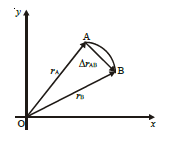
(a) Distance is a scalar; displacement is vector.
(b) The magnitude of displacement is always less than or equal to distance.
(c) For a moving body, displacement can be zero but distance cannot be zero.
For a body moving in a straight line from point A to point B along x-axis such that its initial and final position is at a distance xi and xf respectively, the minimum distance between final and initial position is called displacement, Δx
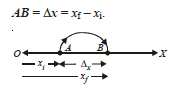
Displacement is a vector from initial position to final position. If the path of the body is not along a straight line, the total length of the actual path covered by the body is called the distance covered by the body and is a scalar quantity. The displacement is independent of the actual path covered by the body.
AVERAGE SPEED AND AVERAGE VELOCITY
The average speed in a time interval is defined as the total distance travelled by the particle divided by the time interval.
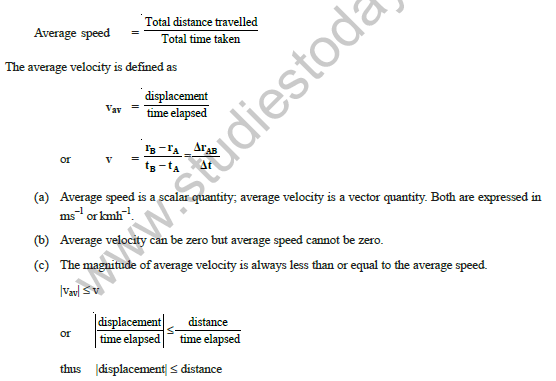
The distance travelled by a body per unit time in a specific direction is called the velocity. It is a vector quantity measured in m/s or similar units. The distance covered by a body per unit time is without any reference to its direction of motion.
Free study material for Physics
CBSE Class 11 Physics Study Material: Chapter 05 Laws of Motion
Quick Revision Material for Chapter 05 Laws of Motion
Explore essential learning tools for Class 11 Physics Chapter 05 Laws of Motion. This curated collection features in-depth notes and targeted practice questions built around the active 2026 curriculum to streamline your daily revision.
Expert Notes and Solved Exam Questions
Built using official NCERT guidelines for Class 11 Physics, these materials provide reliable academic support. Integrating past examination questions and step-by-step solutions helps students understand official CBSE grading criteria.
Additional Study Resources for Class 11
Maximize your grade potential by utilizing Class 11 Physics practice papers in tandem with these structured notes. All printable assignments and interactive mock tests on our platform are updated for the 2026 session and available free of charge.
FAQs
Our advanced study package for Chapter 05 Laws of Motion includes detailed concepts, diagrams, Mind Maps, and explanation of complex topics to ensure Class 11 students learn as per syllabus for 2026 exams.
The Mind Maps provided for Chapter 05 Laws of Motion act as visual anchors which will help faster recall during high-pressure exams.
Yes, teachers use our Class 11 Physics resources for lesson planning as they are in simple language and have lot of solved examples.
Yes, You can download the complete, mobile-friendly PDF of the Physics Chapter 05 Laws of Motion advanced resources for free.
Yes, our subject matter experts have updated the Chapter 05 Laws of Motion material to align with the rationalized NCERT textbooks and have removed deleted topics and added new competency-based questions.