

Official CBSE Study Materials for Class 11 Physics
Review targeted academic resources with the CBSE Class 11 Physics Kinematics Objective Questions. Built according to official CBSE standards for the 2026-27 term, these downloadable Class 11 Physics study materials support effective daily practice and deeper conceptual understanding for Chapter 05 Laws of Motion.
Advanced Resources for Physics
Navigate directly to the advanced Physics study materials using the digital viewer below. Each resource pack includes detailed conceptual summaries and solved practice questions, allowing students to instantly reinforce their learning.
1. A body is projected vertically upwards with a velocity v. It returns to the point from which it was projected after some time. The average velocity and speed for the total time of flight are respectively.
(a) v/2 , v (b) 0, v/2 (c) 0, 0 (d) v/2 ,0.
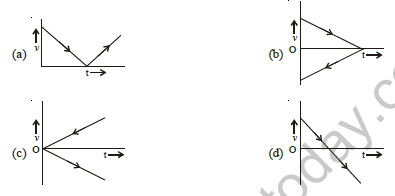
2. A body is thrown vertically upwards with a velocity u. Which of the following graphs represents the variation of velocity with time correctly ?
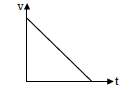
3. A ball is thrown vertically upwards and its velocity v varies with time t as shown in the figure. Which of the graphs (a), (b), (c), (d) shows the correct curve of displacement versus time

4. A particle moving with a constant acceleration from A to B in the straight line AB has velocities u and v at A and B respectively. If C is the mid-point of AB then the velocity of particle while passing C will be

5. An aeroplane is flying in a horizontal direction with a velocity of 900 km/h and at a height of 1960 m. When it is vertically above the point A on the ground, a body is dropped from it. The body strikes the ground at point B. The distance AB will be (take g = 9.8 m/s2)
(a) 3.33 km (b) 5 km (c) 10 km (d) 18 km
6. To a man walking at the rate of 3 km/h the rain appears to fall vertically. When he increases his speed to 6 km/h it appears to meet him at an angle of 45º with vertical from the front. The actual speed of rain is
(a) 3 km/hr (b) 4 km/hr (c) 3 √2 km/h (d) 2 √3 km/h
7. A body is released from the top of a tower of height h metre, it takes t second to reach the ground. Where is the body at the time 2t ?
(a) at h/2 meters from the ground (b) at h/4 m from the ground
(c) depends on the mass and velocity of body (d) at 3h/4 m from the ground
8. If a body travels half of its total path in the last second of its fall from rest then the total time of its fall will be
(a) 1.82 s (b) 3.4 s (c) 3.41 (d) 3.73
9. A particle moves along the positive branch of the curve y = x2/2 with x governed by x = t2/2 where x and y are measured in metre and t in second. At t = 2 s, the velocity of the particle is
(a) 2i – 4j m/s (b) 2i + 4j m/s (c) 4i + 2j m/s (d) 4i – 2j m/s
10. A balloon is ascending at the rate of 12 m/s. When it is at a height of 65 m from the ground, a packet is dropped from it. The packet will reach the ground after time of about (take g = 10 m/s2)
(a) 10 s (b) 2.5 s (c) 5 s (d) 7.5 s
11. Two cars are moving in the same direction with a speed of 30 km/h. These are separated from each other by 5 km. Another third car moving in the opposite direction meets the two cars after an interval of 4 minutes. The speed of the third car is
(a) 45 km/h. (b) 40 km/h (c) 35 km/h (d) 30 km/h.
12. The displacement of a particle undergoing rectilinear motion along the x-axis is given by x = 2t3 – 21t2 + 60t + 6. The acceleration of the particle when its velocity is zero will be.
(a) 36 m/sec2 (b) 9 m/sec2 (c) –9m/sec2 (d) –18m/sec2
13. A passenger sitting by the window of a train moving with a velocity of 72 km/h observes for 10 seconds that a train moving with a velocity of 32.4 km/h completely passes by it in 10 seconds. The length of the second train is
(a) 110 m (b) 145 m (c) 210 m (d) 290 m
14. The points A, B, C and D lie in a vertical line such that AB = BC = CD. If a body falls from rest at A, then the times of descent through AB, BC and CD are in the ratio of
(a) 1 : √2 : √3 (b) √2 : √3 : 1 (c) √3 : 1 : √2 (d) 1: ( √2−1):( √3− √2)
15. A body is thrown up in a lift with a velocity u relative to a lift and its time of flight is found to be t. The acceleration with which the lift is moving up will be.
(a) u−gt/2 (b) 2u−gt/t (c) u2 −gt/t (d) u2/gt
16. A body falls from a certain height. Two seconds later another body falls from the same height. How long after the beginning of motion of the first body is the distance between the bodies twice the distance at the moment the second body starts to fall ?
(a) 3 s (b) 10 s (c) 15 s (d) 20 s
Free study material for Physics
Physics Class 11 Exam Resources: Chapter 05 Laws of Motion
Quick Revision Material for Chapter 05 Laws of Motion
Review targeted study resources for Chapter 05 Laws of Motion tailored for Class 11 learners. Utilizing these structured notes and quick-revision tools ensures complete alignment with current CBSE evaluation standards.
Expert Notes and Solved Exam Questions
Designed around the official curriculum, these study guides guarantee standard compliance. Reviewing step-by-step solutions clarifies complex sub-topics within Chapter 05 Laws of Motion and demystifies standard marking schemes for Physics evaluations.
Additional Study Resources for Class 11
For peak performance in upcoming evaluations, integrate official Physics sample papers directly into your study schedule. Follow up your revision by attempting online MCQ tests for Chapter 05 Laws of Motion to refine calculation speed and precision.
FAQs
Our advanced study package for Chapter 05 Laws of Motion includes detailed concepts, diagrams, Mind Maps, and explanation of complex topics to ensure Class 11 students learn as per syllabus for 2026 exams.
The Mind Maps provided for Chapter 05 Laws of Motion act as visual anchors which will help faster recall during high-pressure exams.
Yes, teachers use our Class 11 Physics resources for lesson planning as they are in simple language and have lot of solved examples.
Yes, You can download the complete, mobile-friendly PDF of the Physics Chapter 05 Laws of Motion advanced resources for free.
Yes, our subject matter experts have updated the Chapter 05 Laws of Motion material to align with the rationalized NCERT textbooks and have removed deleted topics and added new competency-based questions.