

Advanced Study Material for Class 11 Physics: Chapter 05 Laws of Motion
Review targeted academic resources with the CBSE Class 11 Physics Kinematics Solved Examples.. Built according to official CBSE standards for the 2026-27 term, these downloadable Class 11 Physics study materials support effective daily practice and deeper conceptual understanding for Chapter 05 Laws of Motion.
Practice Class 11 Physics Resources: Chapter 05 Laws of Motion
View or download the dedicated CBSE Class 11 Physics Kinematics Solved Examples. resource below. Engaging with these advanced study guides under focused conditions ensures continuous academic progress and mastery of the 2026-27 curriculum for Chapter 05 Laws of Motion.
Solved examples on kinematics for CBSE Class 11 and 12 Physics, covering velocity-time and acceleration-time graphs, uniformly accelerated motion, relative velocity, river and boat problems, motion under gravity, projectile motion on level ground, on a tower and on an inclined plane, and circular motion with tangential acceleration, with complete working and teacher's notes.
SOLVED EXAMPLES
Ex.1: The graph in the figure shows the velocity of a body plotted as a function of time.
(a) Find the instantaneous acceleration at t = 3 s, 7 s, 10 s and 13 s.
(b) How far does the body go in first 5 s, 9 s and 14 s?
(c) Find the total distance covered by the body during the motion.
(d) What is the average velocity for the motion?


Answer:
(a) 1. From 0 to 5 s the velocity is constant at 20 m/s, so the acceleration at t = 3 s is zero.
2. From 5 s to 9 s the velocity rises from 20 m/s to 45 m/s, so a = \( \frac{45 - 20}{9 - 5} \) = 6.25 m/s².
3. From 9 s to 12 s the velocity falls from 45 m/s to 15 m/s, so a = \( \frac{15 - 45}{12 - 9} \) = -10 m/s² at t = 10 s.
4. From 12 s to 16 s the velocity falls from 15 m/s to 0, with a = \( \frac{0 - 15}{16 - 12} \) = -3.75 m/s² at t = 14 s.
5. Hence, the accelerations are 0 at 3 s, 6.25 m/s² at 7 s, -10 m/s² at 10 s and -3.75 m/s² at 13 s and 14 s respectively.
(b) 6. Distance in 5 s = area of rectangle = 20 × 5 = 100 m.
7. Distance in 9 s = 100 + \( \frac{1}{2} \)(20 + 45) × 4 = 100 + 130 = 230 m.
8. Distance in 14 s = 230 + \( \frac{1}{2} \)(45 + 15) × 3 + \( \frac{1}{2} \)(15 + 7.5) × 2 = 230 + 90 + 22.5 = 342.5 m.
(c) 9. Total distance = 342.5 + \( \frac{1}{2} \) × 7.5 × 2 = 350 m.
(d) 10. Average velocity = \( \frac{350}{16} \) = 21.9 m/s, in the direction of motion.
Teacher's Note:
a) The printed acceleration at t = 10 s, -7.5 m/s², is wrong; the fall from 45 m/s to 15 m/s happens over 3 s, so the correct value is -10 m/s².
b) Distance is the area under the v-t graph, and it is not the same as displacement when the velocity changes sign.
c) Average velocity is displacement divided by time, and here it equals the average speed because the motion is in one direction.
d) Use the same time limits for each area; mixing 12 s and 13 s breaks the calculation.
Ex.2: A particle moves along the path ABCD shown in the figure with constant speed 1 m/s. Determine the average speed and average acceleration from A to B, A to C and A to D.
Answer:
A to B: 1. Time tAB = 1 s. Displacement = 1 m.
2. Average speed = \( \frac{1}{1} \) = 1 m/s, directed from A to B.
3. Velocity does not change in magnitude or direction along AB, so average acceleration = 0.
A to C: 4. Time tAC = 2 s. Path length = 2 m, so average speed = \( \frac{2}{2} \) = 1 m/s.
5. Displacement = √(1² + 1²) = √2 m, so average velocity = \( \frac{\sqrt{2}}{2} \) = \( \frac{1}{\sqrt{2}} \) m/s from A to C.
6. vi is along AB and vf is along CD, perpendicular to vi, so |Δv| = √2 m/s.
7. Average acceleration = \( \frac{\sqrt{2}}{2} \) = \( \frac{1}{\sqrt{2}} \) m/s², directed from B to D.
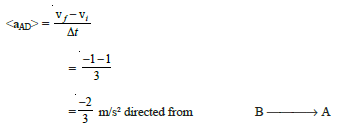
A to D: 8. Time tAD = 3 s. Path length = 3 m, so average speed = \( \frac{3}{3} \) = 1 m/s.
9. Displacement = 1 m from A to D, so average velocity = \( \frac{1}{3} \) m/s from A to D.
10. vi = 1 m/s and vf = -1 m/s, so average acceleration = \( \frac{-1 - 1}{3} \) = -\( \frac{2}{3} \) m/s², directed from B to A.
Teacher's Note:
a) Average speed uses the path length, while average velocity uses the displacement.
b) Speed is constant along the path, but velocity changes at each corner.
c) The sign of the acceleration depends on the change in velocity, not on the path.
Ex.3: A particle starts from rest at time t = 0 and undergoes acceleration, a, as shown in the figure.
(a) Draw a neat sketch showing the velocity of the particle as a function of time during the interval 0 to 4 seconds, indicating each second on the abscissa.
(b) Draw a neat sketch showing the displacement of the particle as a function of time during 0 to 2 second. In both the cases, explain the various steps.
Answer:
(a) 1. From 0 to 2 s the acceleration is +3 m/s², so the velocity rises uniformly from 0.
2. At t = 1 s, v = 3 × 1 = 3 m/s; at t = 2 s, v = 3 × 2 = 6 m/s.
3. From 2 s to 4 s the acceleration is -3 m/s², so the velocity falls uniformly.
4. At t = 3 s, v = 6 - 3 = 3 m/s; at t = 4 s, v = 6 - 6 = 0 m/s.
5. The v-t graph is a triangle with its peak of 6 m/s at t = 2 s and its base from 0 to 4 s.
(b) 6. From 0 to 2 s the particle starts from rest with constant acceleration, so s = \( \frac{1}{2} \)at² = 1.5t², which is a parabola.
7. At t = 0.5 s, s = 0.375 m (= \( \frac{3}{8} \) m); at t = 1 s, s = 1.5 m; at t = 1.5 s, s = 3.375 m (= \( \frac{27}{8} \) m); at t = 2 s, s = 6 m.
8. From 2 s to 3 s the displacement is 6 × 1 - \( \frac{1}{2} \) × 3 × 1 = 4.5 m, so s(3 s) = 10.5 m.
9. From 2 s to 4 s the displacement is 6 × 2 - \( \frac{1}{2} \) × 3 × 4 = 6 m, so s(4 s) = 12 m.
10. The displacement graph is a parabola up to t = 2 s, and then its curvature reverses as the acceleration turns negative.
Teacher's Note:
a) The area under the a-t graph gives velocity, and the area under the v-t graph gives displacement.
b) Velocity is zero at t = 4 s, so the particle stops at that instant.
c) Displacement keeps increasing after 2 s because the velocity stays positive until 4 s.
Ex.4: A point mass moves along a straight line with a deceleration which is equal to K√v in magnitude, where K is a positive constant and v is the velocity of the particle. The velocity of the point mass initially at t = 0 is equal to v0. Find the distance it will travel before it stops and the time it will take to cover this distance.
Answer:
1. Acceleration = \( \frac{dv}{dt} \) = -K√v.
2. Separating variables: \( \frac{dv}{\sqrt{v}} \) = -K dt.
3. Let t0 be the time to stop. Integrating from v0 to 0 gives 2(√v0 - 0) = K t0.
4. Hence, t0 = \( \frac{2\sqrt{v_0}}{K} \).
5. Writing a = v \( \frac{dv}{ds} \), we get v \( \frac{dv}{ds} \) = -K√v, so \( \sqrt{v}\, dv \) = -K ds.
6. Integrating from v0 to 0 over distance S0: \( \frac{2}{3} \)v03/2 = K S0.
7. Hence, S0 = \( \frac{2 v_0^{3/2}}{3K} \).
Teacher's Note:
a) The deceleration must be K√v for the answer to be finite; with K v alone the velocity would never reach zero.
b) Writing acceleration as v dv/ds is useful whenever the question asks for distance.
c) The answers depend on K, so check the units of K before substituting.
Ex.5: A person moving on horizontal road with velocity 8 m/s observes rain to be falling vertically downward. When he increases his speed to 12 m/s, the rain seems to be falling at an angle 30° with vertical. Determine the speed of rain with respect to ground.
Answer:
1. Let the velocity of rain relative to ground be Vr = V1i + V2j.
2. Case I: rain appears vertical, so Vrm = (V1 - 8)i + V2j has no horizontal part. Hence V1 = 8 m/s.
3. Case II: the speed of the man is 12 m/s, so Vrm = (V1 - 12)i + V2j.
4. The rain appears at 30° with the vertical, so tan 30° = \( \frac{|8 - 12|}{|V_2|} \), which gives |V2| = 4√3 m/s.
5. Taking the downward direction, V2 = -4√3 m/s.
6. Hence Vr = 8i - 4√3j, and |Vr| = √(8² + (4√3)²) = √112 = 4√7 ≈ 10.6 m/s.
Teacher's Note:
a) Relative velocity of rain with respect to the man is the rain velocity minus the man's velocity.
b) The horizontal component of rain is equal to the man's speed when rain looks vertical.
c) The final speed is 4√7 m/s, which is the magnitude of the rain velocity relative to ground.
Ex.6: Two trains, each of length 100 m moving in opposite directions along parallel lines with their respective speeds 60 km/h and 30 km/h. If their respective accelerations are 30 cm/s² and 20 cm/s², find the time they take to pass each other.
Answer:
1. Relative displacement needed to pass each other = 100 + 100 = 200 m.
2. Relative initial speed = 60 + 30 = 90 km/h = 90 × \( \frac{5}{18} \) = 25 m/s.
3. Relative acceleration = (30 + 20) × 10⁻² = 0.5 m/s².
4. Using S = ut + \( \frac{1}{2} \)at², 200 = 25t + \( \frac{1}{2} \) × 0.5 × t².
5. This gives 0.5t² + 50t - 400 = 0.
6. t = \( \frac{-50 + \sqrt{2500 + 800}}{1} \) = -50 + √3300 = -50 + 57.45 ≈ 7.44 s, taking the positive root.
7. Hence, the trains pass each other in about 7.44 s.
Teacher's Note:
a) Relative speed is the sum of the two speeds because the trains move in opposite directions.
b) Convert km/h to m/s by multiplying by 5/18 before using the equations.
c) Discard the negative root, because time cannot be negative.
Ex.7: A motor-boat going downstream overcame a raft at a point P. The motor-boat turned back after 60 minutes and it passed the raft at a distance of 12 km from the point P. Find the velocity of the stream assuming that the motor-boat while has a uniform velocity in still water.
Answer:
1. Let u km/h be the speed of the boat in still water and v km/h the speed of the stream.
2. In 60 minutes, the boat goes downstream a distance (u + v) km from P.
3. The raft drifts with the stream, so it covers 12 km in time t = \( \frac{12}{v} \) hours.
4. After turning, the boat moves upstream at (u - v) km/h. It covers the distance (u + v) - 12 in time (t - 1).
5. So (u + v) - 12 = (u - v)(t - 1) = (u - v)\( \left(\frac{12}{v} - 1\right) \).
6. Simplifying, uv + v² - 12v = 12u - uv - 12v + v², which gives 2uv = 12u.
7. Hence v = 6 km/h.
Teacher's Note:
a) The raft moves only with the stream, so its speed is v and it does not depend on the boat's speed.
b) The boat's time for the whole trip equals the raft's time, which gives the equation.
c) The stream speed does not depend on the boat's still-water speed u.
Ex.8: A man can swim at a speed of 3 km/h in still water. He wants to cross a 500 m wide river flowing at 2 km/h. He always keeps himself at an angle of 120° with the river flow while swimming. Find (a) the time he takes to cross the river, (b) the distance from the point opposite the point of starting where he will arrive.
Answer:
1. Let vmr = 3 km/h be the man's velocity relative to the river, and vrg = 2 km/h the river's velocity relative to ground.
2. The man's heading makes 120° with the flow, so its component across the river is 3 sin 120° = \( \frac{3\sqrt{3}}{2} \) km/h.
3. The width to cross is 0.5 km, so t = \( \frac{0.5}{3\sqrt{3}/2} \) = \( \frac{1}{3\sqrt{3}} \) h ≈ 0.192 h, which is about 11.5 minutes.
4. Along the river, the man's velocity relative to ground is 2 + 3 cos 60° × (-1) = 2 - 1.5 = 0.5 km/h, in the direction of flow.
5. Drift = 0.5 × \( \frac{1}{3\sqrt{3}} \) = \( \frac{1}{6\sqrt{3}} \) km ≈ 0.096 km = 96 m.
6. Hence, he takes about 11.5 minutes and arrives about 96 m downstream of the point opposite his starting point.
Teacher's Note:
a) The angle with the flow is measured from the direction of the flow, so only the cross-stream part of the swimming velocity takes him across.
b) The printed working uses the angle 30° with the bank; the value of the drift is the same once the angle is taken from the flow.
c) The time does not depend on the river speed, but the drift does.
Ex.9: An engine driver running a train at full speed suddenly applies brakes and shuts off steam. The train then travels 24 m in the first second and 22 m in the next second. Assuming that the brakes produce a constant retardation, find (a) original speed of the train, (b) the time elapsed before it comes to rest, (c) the distance travelled during the interval, (d) If the length of the train is 44 m, find the time that the train takes to pass an observer standing at a distance 100 m ahead of the train at the time when the brake was applied.
Answer:
(a) 1. Distance in the nth second is Sn = u - \( \frac{a}{2} \)(2n - 1), with retardation a.
2. S1 = 24 = u - \( \frac{a}{2} \) and S2 = 22 = u - \( \frac{3a}{2} \).
3. Subtracting, S1 - S2 = a, so a = 2 m/s².
4. u = 24 + \( \frac{2}{2} \) = 25 m/s.
(b) 5. Time to stop: 0 = 25 - 2t, so t = 12.5 s.
(c) 6. Distance to stop: S = \( \frac{u^2}{2a} \) = \( \frac{625}{4} \) = 156.25 m.
(d) 7. The front of the train covers 100 m: 100 = 25t - t², so t² - 25t + 100 = 0, giving t = 5 s or 20 s. The train stops at 12.5 s, so t = 5 s.
8. The rear of the train covers 100 + 44 = 144 m: 144 = 25t′ - t′², so t′² - 25t′ + 144 = 0, giving t′ = 9 s or 16 s. The train has stopped by 12.5 s, so t′ = 9 s.
9. Time taken to pass the observer = 9 - 5 = 4 s.
Teacher's Note:
a) The nth-second formula gives the distance covered in one particular second, not the total distance.
b) Reject the root that is later than the stopping time, because the train never moves beyond the stopping point.
c) The time to pass an observer is the difference between the times for the rear and the front.
Ex.10: A particle is projected vertically upwards from a point A on the ground. It takes a time t1 to reach a point B at a height h above the ground. As it continues to move, it takes a further time t2 to reach the ground. Find (a) the height h, (b) the maximum height reached, (c) the velocity of the particle at half the maximum height.
Answer:
1. Total time of flight from A to the ground = t1 + t2 = \( \frac{2u}{g} \), so u = \( \frac{g(t_1 + t_2)}{2} \).
(a) 2. Height h = ut1 - \( \frac{1}{2} \)gt1² = \( \frac{g(t_1 + t_2)t_1}{2} - \frac{g t_1^2}{2} \) = \( \frac{g t_1 t_2}{2} \).
(b) 3. Maximum height H = \( \frac{u^2}{2g} \) = \( \frac{g(t_1 + t_2)^2}{8} \).
(c) 4. At height H/2, v² = u² - 2g(H/2) = u² - gH = \( \frac{g^2(t_1 + t_2)^2}{4} - \frac{g^2(t_1 + t_2)^2}{8} \) = \( \frac{g^2(t_1 + t_2)^2}{8} \).
5. Hence, v = \( \frac{g(t_1 + t_2)}{2\sqrt{2}} \), directed upwards on the way up.
Teacher's Note:
a) The time of flight from A to B and from B to the ground together give the total time of the upward and downward journey.
b) The velocity at half the maximum height is smaller than the initial velocity.
c) Students often forget that the particle passes height h twice, once going up and once coming down.
Ex.11: A body is moving with velocity 9 m/s. It is subjected to a retardation of 2 m/s². What is the distance travelled by body in fifth second.
Answer:
1. The body stops at t = \( \frac{9}{2} \) = 4.5 s.
2. Displacement up to t = 4 s: s(4) = 9 × 4 - \( \frac{1}{2} \) × 2 × 4² = 36 - 16 = 20 m.
3. Displacement up to t = 4.5 s: s(4.5) = 9 × 4.5 - \( \frac{1}{2} \) × 2 × (4.5)² = 40.5 - 20.25 = 20.25 m.
4. The body stops at 4.5 s and then returns, so the distance in the fifth second is S = 2(S4.5 - S4) = 2[4.5 - 4.25] = 2 × 0.25 = 0.5 m.
5. Hence, the distance travelled in the fifth second is 0.5 m.
Teacher's Note:
a) The nth-second formula gives zero here, which is displacement and not distance, because the body reverses direction at 4.5 s.
b) Always check whether the body stops before the given second.
c) The distance is twice the forward distance (4 s to 4.5 s) because the body goes forward 0.25 m and returns 0.25 m, giving 0.5 m.
Ex.12: A stone is projected from the ground with a velocity of 25 m/s. Two seconds later, it just clears a wall 5 m high. Find (a) the angle of projection of the stone, (b) the greatest height reached, (c) how far behind the wall the stone again hits the ground. Neglect air resistance. Assume g = 10 m/s².
Answer:
(a) 1. Let θ be the angle of projection. Vertical component = 25 sin θ.
2. Using h = ut - \( \frac{1}{2} \)gt² with h = 5 m, t = 2 s and g = 10 m/s²: 5 = 50 sin θ - 20.
3. So sin θ = 0.5, and θ = 30°.
(b) 4. Greatest height H = \( \frac{(25 \sin 30°)^2}{2 \times 10} \) = \( \frac{156.25}{20} \) = 7.81 m.
(c) 5. Total time of flight = \( \frac{2 \times 25 \sin 30°}{10} \) = 2.5 s.
6. Time after clearing the wall = 2.5 - 2.0 = 0.5 s.
7. Horizontal distance covered in 0.5 s = 25 cos 30° × 0.5 = 10.8 m.
8. Hence, the stone hits the ground 10.8 m beyond the wall.
Teacher's Note:
a) Use the vertical equation to find the angle, since the wall height is given.
b) Greatest height depends only on the vertical component of the velocity.
c) The distance asked is measured from the wall, not from the point of projection.
Ex.13: A gun kept on a straight horizontal road is used to hit a car travelling along the same road with a uniform speed of 72 km/h away from the shell of a gun. The car is at a distance of 500 m from the gun when the gun is fired at an angle of 45° to the horizontal. Find (a) the distance of the car from the gun when the shell hits it and (b) speed of the projection of the shell from the gun (g = 9.8 m/s²).
Answer:
1. Speed of car = 72 km/h = 20 m/s.
2. Let u be the speed of projection. Time of flight t0 = \( \frac{2u \sin 45°}{g} \) = \( \frac{\sqrt{2}\,u}{g} \).
3. Horizontal range of the shell OB = \( \frac{u^2 \sin 90°}{g} \) = \( \frac{u^2}{g} \).
4. The car moves 20 t0 in this time, so OB = 500 + 20t0, which gives \( \frac{u^2}{g} \) = 500 + \( \frac{20\sqrt{2}\,u}{g} \).
5. So u² - 20√2 u - 4900 = 0, and u = \( \frac{20\sqrt{2} + \sqrt{20400}}{2} \) ≈ 85.6 m/s.
(a) 6. Distance of the car from the gun = OB = \( \frac{u^2}{g} \) = \( \frac{7320}{9.8} \) ≈ 747 m.
(b) 7. Speed of projection u ≈ 85.6 m/s.
Teacher's Note:
a) The printed value of u, 86.94 m/s, and the distance, 771.3 m, do not satisfy the equation; the correct values are about 85.6 m/s and 747 m.
b) Check the answer by adding the car's distance to its displacement during the flight: 500 + 247 = 747 m.
c) A 45° projection gives the maximum range, so the shell's horizontal range depends only on u².
Ex.14: From the top of a tower of height 40 m, a ball is projected upwards with a speed of 20 m/s at an angle of 30° to the horizontal. (a) When and at what distance does the ball hit the ground? (b) What is the velocity of the ball at this instant? Assume g = 10 m/s².
Answer:
(a) 1. Horizontal component ux = 20 cos 30° = 10√3 m/s; vertical component uy = 20 sin 30° = 10 m/s.
2. Taking the ground as reference, -40 = 10t - 5t², so t² - 2t - 8 = 0.
3. t = 4 s, which is the positive root.
4. Horizontal distance = 10√3 × 4 = 40√3 ≈ 69.3 m from the foot of the tower.
(b) 5. Vertical velocity at the ground = 10 - 10 × 4 = -30 m/s.
6. Horizontal velocity = 10√3 m/s.
7. Speed = √(30² + (10√3)²) = √1200 ≈ 34.6 m/s.
8. The angle with the horizontal is given by tan α = \( \frac{-30}{10\sqrt{3}} \) = -√3, so α = -60°, that is, 60° below the horizontal.
Teacher's Note:
a) Measure the vertical displacement from the point of projection, and take the sign carefully for a point below it.
b) The ball rises first, so its initial vertical velocity is positive.
c) The speed at impact is larger than the speed of projection because the ball falls 40 m.
Ex.15: Two guns, situated on the top of a hill of height 10 m, fire one shot each with the same speed 5√3 m/s at some interval of time. One gun fires horizontally and the other fires upwards at an angle of 60° with the horizontal. The shots collide in air at a point P. Find (a) the time interval between the firings and (b) the coordinates of the point P. Take origin of the coordinate system at the foot of the hill right below the muzzle and take trajectories in x-y plane.
Answer:
1. Let the horizontal gun fire at time t1 and the other gun at t2, with both shots reaching P at x.
2. For the horizontal shot, x = vt1, so t1 = \( \frac{x}{v} \).
3. For the inclined shot, x = v cos 60° t2, so t2 = \( \frac{2x}{v} \).
(a) 4. Time interval t2 - t1 = \( \frac{x}{v} \).
5. Equating the heights, 10 - \( \frac{1}{2} \)gt1² = 10 + v sin 60° t2 - \( \frac{1}{2} \)gt2², which gives x = \( \frac{2\sqrt{3}\,v^2}{3g} \) = 5√3 m.
6. Hence, t2 - t1 = \( \frac{5\sqrt{3}}{5\sqrt{3}} \) = 1 s.
(b) 7. y = 10 - \( \frac{1}{2} \)g t1² = 10 - 5 × 1² = 5 m.
8. Hence, the coordinates of P are (5√3, 5) m, that is, about (8.66 m, 5 m).
Teacher's Note:
a) Both shots have the same horizontal distance at the meeting point, which gives the two times.
b) The height of P is measured from the ground, so y must include the 10 m height of the hill.
c) The point of collision is at height 5 m above the ground.
Ex.16: A particle is projected with a certain velocity so as to pass through a point at a horizontal distance R from the point of projection. If t1 and t2 are times it takes to reach this point in two possible ways in which the particle can be projected with the given velocity, find a relation between t1, t2 and range.
Answer:
1. Horizontal motion gives R = v cos θ · t, so cos θ = \( \frac{R}{vt} \).
2. Time of flight to return to the horizontal level is 2t′ = \( \frac{2v \sin\theta}{g} \), so sin θ = \( \frac{gt}{2v} \).
3. Using sin²θ + cos²θ = 1: \( \frac{g^2 t^2}{4v^2} + \frac{R^2}{v^2 t^2} = 1 \), which gives g²t⁴ - 4v²t² + 4R² = 0.
4. Taking t² as x, the two roots x1 and x2 have product \( \frac{4R^2}{g^2} \).
5. Hence, t1²t2² = \( \frac{4R^2}{g^2} \), so t1t2 = \( \frac{2R}{g} \).
Teacher's Note:
a) The two times correspond to the two angles of projection that give the same range.
b) The result does not depend on v, which is a useful check.
c) Taking the positive root is correct because t1 and t2 are both positive.
Ex.17: A body A at a height of 2 m is thrown horizontally with a velocity of 8 m/s towards another body B at a height 6 m which is thrown simultaneously towards A at an angle of 45° to the horizontal in the downward direction with velocity v0 such that A and B collide in flight. The horizontal distance between points A and B equals 8 m. Calculate the initial velocity v0 of the body thrown at an angle 45°, the co-ordinates (x, y) of the point of collision, the time of flight t of the bodies before colliding and velocities vA, vB of the two bodies at the instant of collision. The trajectories lie in a single plane.
[Figure: Two bodies in one vertical plane. Body A is at the left at height 2 m and is projected horizontally at 8 m/s. Body B is at the right at height 6 m and is projected at 45° downward towards A with velocity v0. The horizontal distance between A and B is 8 m. The point of collision P is marked at (x, y) above the origin O on the ground.]
Answer:
1. Horizontal distance covered by A: x = 8t; by B: x1 = \( \frac{v_0}{\sqrt{2}} \)t.
2. Since x + x1 = 8, we get 8t + \( \frac{v_0}{\sqrt{2}} \)t = 8.
3. Vertical drop of A: y1 = \( \frac{1}{2} \)gt², and the height of A at P is 2 - \( \frac{1}{2} \)gt².
4. Height of B at P is 6 - \( \frac{v_0}{\sqrt{2}} \)t - \( \frac{1}{2} \)gt².
5. Equating the two heights gives \( \frac{v_0}{\sqrt{2}} \)t = 4.
6. Substituting in step 2: 8t + 4 = 8, so t = 0.5 s.
7. Then v0 = \( \frac{4\sqrt{2}}{0.5} \) = 8√2 ≈ 11.31 m/s.
8. Point of collision: x = 8 × 0.5 = 4 m, and y = 2 - \( \frac{1}{2} \) × 9.8 × 0.25 = 2 - 1.225 = 0.775 m. So (x, y) = (4 m, 0.775 m).
9. Velocity of A at P: vAx = 8 m/s, vAy = gt = 4.9 m/s downward, so vA = √(8² + 4.9²) ≈ 9.4 m/s.
10. Velocity of B at P: vBx = -\( \frac{v_0}{\sqrt{2}} \) = -8 m/s; downward component = 8 + 9.8 × 0.5 = 12.9 m/s, so vB = √(8² + 12.9²) ≈ 15.2 m/s.
Teacher's Note:
a) The printed value of v0, 11.28 m/s, is a rounding slip; 8√2 = 11.31 m/s.
b) Both bodies start at the same time, so both have the same time of flight to P.
c) Velocity of B is found from its horizontal and vertical components, not from the initial speed alone.
Ex.18: A body falling freely from a given height H hits an inclined plane in its path at a height h. The direction of velocity of the body due to this impact becomes horizontal. Find the value of h/H so that the body will take maximum time to reach the ground.
Answer:
1. Time to fall from A to B (through H - h): t1 = √\( \frac{2(H - h)}{g} \).
2. After impact the velocity is horizontal, so the body falls vertically from B to the ground through height h: t2 = √\( \frac{2h}{g} \).
3. Total time t = √\( \frac{2}{g} \)(√(H - h) + √h).
4. For maximum t, \( \frac{dt}{dh} \) = 0, so -\( \frac{1}{2\sqrt{H - h}} \) + \( \frac{1}{2\sqrt{h}} \) = 0.
5. Hence √(H - h) = √h, so H - h = h.
6. Therefore h = \( \frac{H}{2} \), and \( \frac{h}{H} = \frac{1}{2} \).
Teacher's Note:
a) The total time is a sum of two square-root terms, so setting its derivative to zero gives the maximum.
b) The impact removes the vertical velocity, which is why the second part is a free fall from rest.
c) The value h/H = 1/2 is the answer, and it is independent of g.
Ex.19: A shell is fired from a gun from the bottom of a hill along its slope. The slope of the hill α is 30° and the angle of the barrel to the horizontal β is 60°. The initial velocity of the shell is 21 m/s. Find (i) the distance from the gun to the point at which the shell falls and (ii) the time when the projectile hits the plane.
Answer:
1. Take the gun as origin, with the x-axis horizontal and the y-axis vertical. The hill slope is α = 30°, and the barrel angle is β = 60°.
2. The shell lands on the slope at (l cos α, l sin α), where l is the distance along the slope.
3. Horizontal motion: l cos α = v cos β · t, so t = \( \frac{l \cos\alpha}{v \cos\beta} \).
4. Vertical motion: l sin α = v sin β · t - \( \frac{1}{2} \)gt².
5. Substituting t and simplifying gives l = \( \frac{2v^2 \cos\beta \sin(\beta - \alpha)}{g \cos^2\alpha} \).
6. l = \( \frac{2 \times 21^2 \times 0.5 \times 0.5}{9.8 \times 0.75} \) = 30 m.
(ii) 7. t = \( \frac{l\cos\alpha}{v\cos\beta} \) = \( \frac{30 \times 0.866}{21 \times 0.5} \) = 2.47 s.
Teacher's Note:
a) The angle of the barrel is measured from the horizontal, while the slope is measured from the horizontal too; keep them separate.
b) Using sin(β − α) makes the algebra shorter and gives the range along the slope.
c) The answer 2.47 s is the time of flight measured to the point where the shell meets the slope.
Ex.20: A ball starts falling with zero initial velocity on a smooth inclined plane forming an angle α with the horizontal. After falling through a distance h, the ball rebounds elastically off the inclined plane. At what distance from the impact point will the ball rebound for the second time?
Answer:
1. Speed at first impact: v0 = √(2gh).
2. After an elastic rebound the ball leaves the plane with the same speed v0, at the same angle with the normal.
3. Taking axes along and perpendicular to the plane, the time T in the air between the two impacts is T = \( \frac{2v_0}{g} \).
4. Distance along the plane: l = v0 sin α · T + \( \frac{1}{2} \)g sin α · T² = \( \frac{4v_0^2 \sin\alpha}{g} \).
5. Substituting v0² = 2gh gives l = \( \frac{4 \times 2gh \sin\alpha}{g} \) = 8h sin α.
Teacher's Note:
a) An elastic rebound keeps the speed the same, so the speed at impact is also the speed at rebound.
b) The distance is measured along the plane, not vertically.
c) The result is independent of the mass of the ball.
Ex.21: A particle starts moving from rest at t = 0 on a circular path of radius 1 m under tangential acceleration of 2t m/s². What is the angle made by the net acceleration at t = 1 s with the radial acceleration?
Answer:
1. Tangential acceleration aT = \( \frac{dv}{dt} \) = 2t.
2. Integrating from rest: v = t² m/s.
3. Radial acceleration aR = \( \frac{v^2}{R} \) = t⁴ m/s² (R = 1 m).
4. At t = 1 s, aT = 2 m/s² and aR = 1 m/s².
5. The angle θ of the net acceleration with the radial direction is given by tan θ = \( \frac{a_T}{a_R} \) = \( \frac{2}{1} \) = 2.
6. Hence θ = tan⁻¹ 2 ≈ 63.4°.
Teacher's Note:
a) The tangential and radial accelerations are perpendicular, so the net acceleration is their vector sum.
b) Radial acceleration increases with v², so it is zero at the start.
c) The angle is measured from the radial direction, not from the tangent.
Ex.22: A car goes on a circular road of radius R, the speed increasing at constant rate = a. The friction co-efficient between the road and tyre is μ. Find the speed at which the car skids.
Answer:
1. Limiting friction on the tyres = μN = μmg.
2. The tangential acceleration is a, and the centripetal acceleration is \( \frac{v^2}{R} \).
3. The car skids when the net force needed on the tyres exceeds the limiting friction: m²(a² + \( \frac{v^4}{R^2} \)) > μ²m²g².
4. To avoid skidding, a² + \( \frac{v^4}{R^2} \) ≤ μ²g².
5. So v⁴ ≤ R²(μ²g² - a²).
6. Hence the car skids at speed v = [R²(μ²g² - a²)]^{1/4}.
Teacher's Note:
a) The friction must supply both the tangential and the centripetal parts of the acceleration.
b) The speed at which skidding starts depends on μ, g, R and a.
c) If a is larger than μg, the car will skid even at low speed.

Free study material for Physics
CBSE Class 11 Physics Study Material: Chapter 05 Laws of Motion
Quick Revision Material for Chapter 05 Laws of Motion
Access comprehensive study material for Chapter 05 Laws of Motion, including revision notes, concept maps, and high-probability questions. These resources are designed in alignment with the latest 2026 CBSE syllabus for Class 11 Physics to support effective exam preparation.
Expert Notes and Solved Exam Questions
Built using official NCERT guidelines for Class 11 Physics, these materials provide reliable academic support. Integrating past examination questions and step-by-step solutions helps students understand official CBSE grading criteria.
Additional Study Resources for Class 11
Wrap up your chapter revision by testing your knowledge against standard objective question formats. Explore our full library of free, up-to-date sample papers and online assessments to secure top grades in your CBSE examinations.
FAQs
Our advanced study package for Chapter 05 Laws of Motion includes detailed concepts, diagrams, Mind Maps, and explanation of complex topics to ensure Class 11 students learn as per syllabus for 2026 exams.
The Mind Maps provided for Chapter 05 Laws of Motion act as visual anchors which will help faster recall during high-pressure exams.
Yes, teachers use our Class 11 Physics resources for lesson planning as they are in simple language and have lot of solved examples.
Yes, You can download the complete, mobile-friendly PDF of the Physics Chapter 05 Laws of Motion advanced resources for free.
Yes, our subject matter experts have updated the Chapter 05 Laws of Motion material to align with the rationalized NCERT textbooks and have removed deleted topics and added new competency-based questions.