

Advanced Study Material for Class 11 Physics: Mechanical Wave in Strings
Access comprehensive study materials and useful resources for Mechanical Wave in Strings using the CBSE Class 11 Physics Mechanical Wave in Strings Solved Examples. Designed to align with the 2026-27 CBSE academic guidelines, these advanced resources help Class 11 Physics students reinforce core concepts beyond standard textbooks.
Practice Class 11 Physics Resources: Mechanical Wave in Strings
Access the complete useful resource PDF for Class 11 Physics below. Regular practice with these targeted academic notes builds familiarity with complex topics and helps secure higher marks in final school evaluations.
This Class 12 Physics set of solved examples on Mechanical Waves in Strings covers the travelling and stationary nature of a harmonic wave, phase difference, particle velocity, superposition of two simple harmonic motions, wave speed on a stretched string, intensity and displacement amplitude, the sonometer and its loops, and the change of wave speed along a hanging rope, each worked out step by step.
SOLVED EXAMPLES: MECHANICAL WAVES IN STRINGS
Ex.1 A transverse harmonic wave on a string is described by y(x, t) = 3.0 sin(36t + 0.018x + \( \frac{\pi}{4} \)) where x, y are in cm and t in sec. The positive direction of x is from left to right. (i) Is this a travelling or stationary wave ? If it is travelling, what are the speed and direction of propagation ? (ii) What are its amplitude and frequency ? (iii) What is the initial phase at the origin ? (iv) What is the distance between two successive crests in the wave ?

Answer: (i) Travelling wave, speed 20 m/s, moving from right to left. (ii) Amplitude 3.0 cm and frequency about 5.7 s⁻¹. (iii) Initial phase \( \frac{\pi}{4} \). (iv) Distance between successive crests about 3.5 m.
1. Compare with the standard form y = a sin(2πt/T - 2πx/λ + φ). The coefficients give 2π/T = 36 and 2π/λ = -0.018, so the wave has the form of a travelling wave.
2. The wave speed is v = nλ = (36 / 0.018) with a negative sign, so v = -2000 cm/s = -20 m/s. The negative sign shows the wave moves from right to left.
3. Amplitude a = 3.0 cm = 3.0 × 10⁻² m, and n = 36 / (2π) ≈ 5.7 s⁻¹.
4. Initial phase φ = π/4, and λ = 2π / 0.018 cm ≈ 349 cm ≈ 3.5 m.
Teacher's Note:
a) The sign of the x-coefficient decides the direction of travel.
b) Common mistake: quoting the speed as positive when the wave is moving in the negative x direction.
Ex.2 For the travelling harmonic wave y = 2.0 cos (10t - 0.0080x + 0.35). Where x and y are in cm and t in sec. What is the phase difference between oscillatory motion at two points separated by a distance of (i) 4 m, (ii) 0.5 m, (iii) A/2, (iv) 3λ / 4
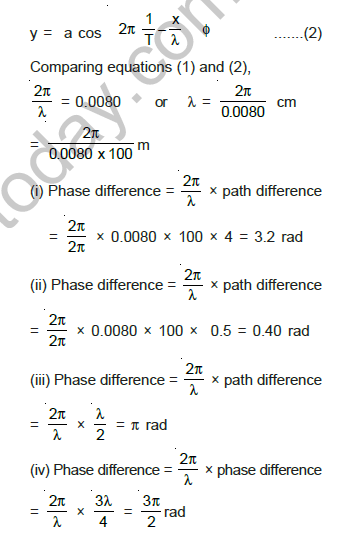
Answer: (i) 3.2 rad, (ii) 0.40 rad, (iii) π rad, (iv) 3π/2 rad.
1. Comparing with y = a cos(2πt/T - 2πx/λ + φ) gives 2π/λ = 0.0080 per cm, so λ = 2π / 0.0080 cm ≈ 7.85 m.
2. Phase difference = (2π/λ) × path difference = 0.0080 × path in cm.
3. (i) For 4 m = 400 cm, phase difference = 0.0080 × 400 = 3.2 rad.
4. (ii) For 0.5 m = 50 cm, phase difference = 0.0080 × 50 = 0.40 rad.
5. (iii) For a path of λ/2, phase difference = π rad. The printed question writes A/2, which the solution takes as λ/2.
6. (iv) For a path of 3λ/4, phase difference = 2π × 3/4 = 3π/2 rad.
Teacher's Note:
a) Phase difference depends only on the path difference divided by the wavelength, times 2π.
b) Keep the units consistent: convert metres to centimetres before using 0.0080 per cm.
Ex.3 A simple harmonic wave-train is travelling in a gas in the positive direction of the x-axis. Its amplitude is 2cm, velocity 45metre/sec and frequency 75per sec. Find out the displacement of the particle of the medium at a distance of 135 cm from the origin in the direction of the wave at the instant t = 3 second.
(A) 2cm
(B) -2cm
(C) -4cm
(D) -1cm
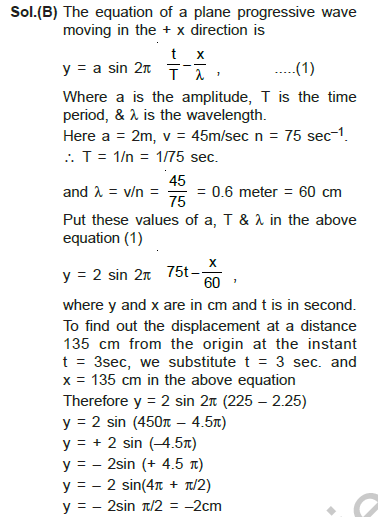
Answer: (B) -2 cm
1. Amplitude a = 2 cm, n = 75 s⁻¹, and λ = v / n = 45 / 75 = 0.6 m = 60 cm.
2. The wave equation is y = 2 sin 2π(75t - x/60), with x and y in cm and t in seconds.
3. At t = 3 s and x = 135 cm: y = 2 sin 2π(225 - 2.25) = 2 sin(450π - 4.5π) = -2 sin(4.5π) = -2 sin(π/2) = -2 cm.
Teacher's Note:
a) Reduce the angle by whole turns of 2π before reading the sine value.
b) Common mistake: taking the answer as +2 cm because sin(4.5π) looks positive.
Ex.4 Two particles C and D are executing simple harmonic motion with same amplitude a and same frequency along same straight line. The maximum distance between two particles is a√2. The initial phase difference between the two will be -
(A) π/4
(B) π/2
(C) π
(D) zero
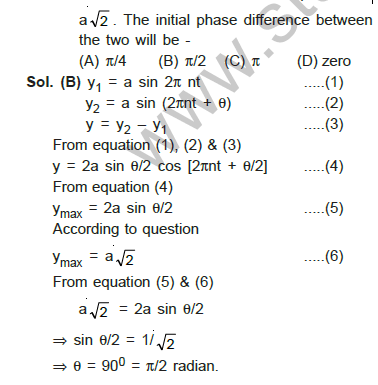


Answer: (B) π/2
1. Let y1 = a sin 2πnt and y2 = a sin(2πnt + θ). Their difference is y = 2a sin(θ/2) cos(2πnt + θ/2).
2. The maximum value of the difference is y_max = 2a sin(θ/2).
3. Setting y_max = a√2 gives sin(θ/2) = 1/√2, so θ/2 = π/4 and θ = π/2.
Teacher's Note:
a) Two equal-amplitude motions give a difference whose amplitude depends on the phase difference only.
b) Check: for θ = π/2 the largest separation is a√2, as given.
Ex.5 The equation of plane progressive wave motion is y = a sin 2π/λ (vt - x). Velocity of particle is-
(A) y dv/dx
(B) v dy/dx
(C) -y dv/dx
(D) -v dy/dx
Answer: (D) -v dy/dx
1. The particle velocity is ∂y/∂t = (2πv a / λ) cos(2π(vt - x)/λ).
2. The slope is ∂y/∂x = -(2π a / λ) cos(2π(vt - x)/λ).
3. Dividing, (∂y/∂t) / (∂y/∂x) = -v, so ∂y/∂t = -v ∂y/∂x.
Teacher's Note:
a) This relation holds for any progressive wave of the form f(vt - x).
b) Common mistake: giving the answer as + v dy/dx, which drops the minus sign.
Ex.6 If equation of transverse wave is y = x₀ cos 2π (nt - x/λ). Maximum velocity of particle is twice of wave velocity, if λ is-
(A) π/2 x₀
(B) 2πx₀
(C) πx
(D) πx₀
Answer: (D) πx₀
1. The particle velocity is ∂y/∂t = x₀ × (2πn) and the maximum value is 2πn x₀.
2. The wave velocity is v = nλ.
3. Given 2πn x₀ = 2nλ, so λ = π x₀.
Teacher's Note:
a) The maximum particle velocity is the amplitude times the angular frequency.
b) Common mistake: confusing the particle velocity with the wave velocity.
Ex.7 A string of mass 2.50 kg is under a tension of 200 N. The length of the stretched string is 20.0 m. If a transverse jerk is struck at one end of the string, how long does the disturbance take to reach the other end.
Answer: 0.5 s
1. Mass per unit length m = 2.50 / 20.0 = 0.125 kg/m.
2. Wave speed v = √(T/m) = √(200 / 0.125) = 40 m/s.
3. Time t = distance / speed = 20 / 40 = 0.5 s.
Teacher's Note:
a) The speed of a transverse wave on a string depends only on the tension and mass per unit length.
b) Common mistake: using the total mass in place of the mass per unit length.
Ex.8 Calculate the velocity of transverse waves in a copper wire 1 mm² in cross-section, under the tension produced by 1 kg wt. The relative density of copper = 8.93.
Answer: 33.12 m/s
1. Tension T = 1 kg wt = 9.8 N.
2. Mass per unit length m = a × ρ = 10⁻⁶ × 8.93 × 1000 = 8.93 × 10⁻³ kg/m.
3. v = √(T/m) = √(9.8 / 8.93 × 10⁻³) ≈ 33.12 m/s.
Teacher's Note:
a) The relative density gives the density 8930 kg/m³ of copper.
b) Convert the area from mm² to m² (1 mm² = 10⁻⁶ m²) before finding the mass per unit length.
Ex.9 A steel wire has a length of 12.0 m and a mass of 2.10 kg. What should be the tension in the wire so that the speed of a transverse wave on wire equals the speed of sound in dry air at 20°C (= 343 m/s).
Answer: 2.06 × 10⁴ N
1. Mass per unit length m = 2.10 / 12.0 = 0.175 kg/m.
2. For equal speeds, √(T/m) = 343 m/s, so T = v² m = (343)² × 0.175.
3. T ≈ 2.06 × 10⁴ N.
Teacher's Note:
a) Equal wave speeds require the tension to be found from v² = T/m.
b) Common mistake: using the length of the wire in place of the mass per unit length.
Ex.10 A 5 watt source sends out waves in air at frequency 1000 s⁻¹. Deduce the intensity at a 100 metre distance, assuming spherical distribution. If v = 350 ms⁻¹ and ρ = 1.3 kg/m³, deduce the displacement amplitude.
Answer: Intensity 4 × 10⁻⁵ W/m²; displacement amplitude about 6.67 × 10⁻⁸ m.
1. Intensity I = P / (4πr²) = 5 / (4π × 100²) ≈ 4 × 10⁻⁵ W/m².
2. Using I = 2π²ρvn²a², the amplitude is a = √(I / (2π²ρvn²)).
3. Substituting I = 4 × 10⁻⁵, ρ = 1.3, v = 350 and n = 1000 gives a ≈ 6.67 × 10⁻⁸ m.
Teacher's Note:
a) The power spreads over a sphere, so the intensity falls as the square of the distance.
b) Keep the SI units: the amplitude comes out in metres.
Ex.11 (a) Compute the fundamental frequency of a sonometer wire of the length 20.0 cm, T = 20 N, m = 5.2 × 10⁻³ kg/m. (b) A resonance air column resonates with a tuning fork of the frequency 512 Hz at the length 17.4 cm. Neglecting the end correction, deduce the speed of the sound in air. Is your answer unique for the given data.
Answer: (a) about 155 Hz; (b) 356.35 m/s, and the answer is unique for the fundamental mode.
1. (a) Fundamental frequency n = (1 / 2l) √(T / m) = (1 / 0.4) × √(20 / 5.2 × 10⁻³) ≈ 155 Hz.
2. (b) For the fundamental mode of a closed air column, λ = 4 × 0.174 m = 0.696 m.
3. Speed v = n λ = 512 × 0.696 ≈ 356.35 m/s.
4. The result is unique because the length corresponds to the first resonance, the fundamental mode.
Teacher's Note:
a) For a closed air column the fundamental wavelength is four times the air column length.
b) Common mistake: using λ = 2 × 0.174 m, which is the open-pipe value.
Ex.12 A sitar wire is under a tension of 30 N and the length between the bridges is 80 cm. A 10 metre sample of that wire has a mass of 2.2 gm. Deduce (i) the speed of the transverse waves on the wire (ii) the frequency of the fundamental and (iii) the frequencies of the first two overtones.
Answer: (i) 369.27 m/s; (ii) 230.8 Hz; (iii) first overtone 461.6 Hz and second overtone 692.4 Hz.
1. Mass per unit length m = 2.2 × 10⁻³ / 10 = 2.2 × 10⁻⁴ kg/m.
2. (i) v = √(T/m) = √(30 / 2.2 × 10⁻⁴) ≈ 369.27 m/s.
3. (ii) Fundamental n₁ = v / (2l) = 369.27 / 1.6 ≈ 230.8 Hz.
4. (iii) First overtone n₂ = 2n₁ ≈ 461.6 Hz and second overtone n₃ = 3n₁ ≈ 692.4 Hz.
Teacher's Note:
a) The fundamental frequency of a string is v divided by twice its length.
b) Overtones are integer multiples of the fundamental frequency.
Ex.13 In an experiment it was found that the string vibrated in three loops when 8 g were placed on the scale pan. What mass must be placed on the pan to make the same string vibrate in six loops? Neglect the mass of the string and the scale pan.
Answer: 2 g
1. For a fixed frequency and length, n = (p / 2l)√(T/m), so p√T is constant, or p²T is constant.
2. Using T₁p₁² = T₂p₂² with p₁ = 3, T₁ = 8 g and p₂ = 6: T₂ = 8 × 3² / 6² = 2 g.
Teacher's Note:
a) More loops at the same frequency need less tension, because the frequency depends on p√T.
b) Common mistake: writing T₂ = 8 × (6/3)² = 32 g, which reverses the relation.
Ex.14 The length of a wire between the two ends of a sonometer is 105 cm. Where should the two bridges be placed so that the fundamental frequencies of the three segments are in the ratio of 1 : 3 : 15?
(A) 75 cm, 25 cm
(B) 25 cm, 75 cm
(C) 75 cm, 100 cm
(D) None
Answer: (C) 75 cm and 100 cm from one end
1. The three segments have lengths l₁, l₂ and l₃ with frequencies in ratio 1 : 3 : 15, so l₂ = l₁/3 and l₃ = l₁/15.
2. Total length l₁ + l₂ + l₃ = 105 cm, so l₁(1 + 1/3 + 1/15) = 105, giving l₁ = 75 cm.
3. Then l₂ = 25 cm and l₃ = 5 cm, so the bridges are at 75 cm and at 75 + 25 = 100 cm from one end.
Teacher's Note:
a) The frequency of a segment is inversely proportional to its length for the same string.
b) Check the total: 75 + 25 + 5 = 105 cm.
Ex.15 A uniform rope of length 12 metre & mass 6 kg, is swinging vertically from rigid base. From its free end, one 2 kg mass is attached. At its bottom end one transverse wave is produced of wavelength 0.06 metre. At upper end of rope, wavelength will be-
(A) 1.2 m
(B) 0.12 m
(C) 0.12 cm
(D) 0.12 mm
Answer: (B) 0.12 m
1. Tension at the bottom end T₁ = 2 × 9.8 N.
2. Tension at the upper end T₂ = (6 + 2) × 9.8 N = 4T₁.
3. Wave speed v = √(T/m), so v₂ = 2v₁.
4. Frequency does not depend on the medium, so λ₂ = 2λ₁ = 2 × 0.06 = 0.12 m.
Teacher's Note:
a) The tension increases going up the rope because it supports the weight below.
b) Common mistake: keeping the wavelength the same, since the frequency is constant but the speed changes.
Free study material for Physics
Physics Class 11 Exam Resources: Mechanical Wave in Strings
Comprehensive Study Resources for Mechanical Wave in Strings
Access comprehensive study material for Mechanical Wave in Strings, including revision notes, concept maps, and high-probability questions. These resources are designed in alignment with the latest 2026 CBSE syllabus for Class 11 Physics to support effective exam preparation.
Understanding Marking Schemes
Built using official NCERT guidelines for Class 11 Physics, these materials provide reliable academic support. Integrating past examination questions and step-by-step solutions helps students understand official CBSE grading criteria.
Complete Revision for Physics
Wrap up your chapter revision by testing your knowledge against standard objective question formats. Explore our full library of free, up-to-date sample papers and online assessments to secure top grades in your CBSE examinations.
FAQs
Our advanced study package for Mechanical Wave in Strings includes detailed concepts, diagrams, Mind Maps, and explanation of complex topics to ensure Class 11 students learn as per syllabus for 2026 exams.
The Mind Maps provided for Mechanical Wave in Strings act as visual anchors which will help faster recall during high-pressure exams.
Yes, teachers use our Class 11 Physics resources for lesson planning as they are in simple language and have lot of solved examples.
Yes, You can download the complete, mobile-friendly PDF of the Physics Mechanical Wave in Strings advanced resources for free.
Yes, our subject matter experts have updated the Mechanical Wave in Strings material to align with the rationalized NCERT textbooks and have removed deleted topics and added new competency-based questions.