

Class 11 Physics Study Guide: CBSE Class 11 Physics Mechanical Wave in Strings Theory and Examples
Access comprehensive study materials and useful resources for Mechanical Wave in Strings using the CBSE Class 11 Physics Mechanical Wave in Strings Theory and Examples. Designed to align with the 2026-27 CBSE academic guidelines, these advanced resources help Class 11 Physics students reinforce core concepts beyond standard textbooks.
Download Mechanical Wave in Strings Study Material PDF
View or download the dedicated CBSE Class 11 Physics Mechanical Wave in Strings Theory and Examples resource below. Engaging with these advanced study guides under focused conditions ensures continuous academic progress and mastery of the 2026-27 curriculum for Mechanical Wave in Strings.
1. INTRODUCTION
There are two modes of energy transfer -
(a) Particle Motion - When particle is transferred from one part of space to the other it carries energy with it.
(b) Wave Motion - When no particle is transferred from one part of space to the other although energy is transported.
2. CLASSIFICATION OF WAVES
Waves may be of following two types :
2.1 Electro-Magnetic Waves (E.M waves) :
(Medium is not necessary for propagation)
(I) Periodic changes takes place in electric & magnetic fields hence, it is called electromagnetic wave
(II) In Vacuum, E.M. waves travel with light velocity
(III) E.M. waves can be polarised
(IV) E.M. waves are transverse in nature
(V) Medium is not required for propagation of E.M. Waves
(VI) E.M. waves has momentum e.g. Radio waves, light waves, thermal radiation.
2.2 Mechanical Wave - (Medium is essential)
(I) Method of energy propagation, in which disturbance propagates with definite velocity without changing its form, is called mechanical wave.
(II) Energy & momentum propagates by motion of particles of medium. But medium remain at previous position, Mass transfer does not take place.
(III) Propagation is possible due to property of medium viz. Elasticity & inertia. Mechanical waves may be of two types :
2.2.1 Transverse Waves -
(a) The particles of medium vibrate in adirection perpendicular to the direction of propagation of wave.e.g. Vibration of string, the surface wavesproduced on the surface of solid and liquid.
(b) Crest & Trough are formed.
NOTE: Polarisation of transverse waves is possible (but it is not possible for longitudinal waves.)
2.2.2 Longitudinal Waves -
(a) Vibration of the particles of the medium are in the direction of wave propagation. e.g. Sound waves, Waves in gases
(b) Wave proceeds in form of compression (C) & rarefaction (R).
(c) At places of compression the pressure and density are maximum, while at places of rarefaction those are minimum.
Ex.1 The sound wave produced in a gas is always -
(A) longitudinal (B) Transverse (C) Stationary (D) Electro magnetic
Sol.(A) In gases only longitudinal waves can propagate.
3. EQUATION OF A PLANE PROGRESSIVE WAVE
(1) When a particle execute S.H.M. then displacement is given by : y = A sin(ωt + φ) where φ is phase difference
(2) In progressive wave each particle performs S.H.M & transfer its energy & momentum to nearest particle. Let point P is reference point and it oscillates in simple harmonic manner. y = A sin ωt. This is oscillation equation of point P. Let wave travels in (+) ve direction with constant velocity (v). Point Q is at x distance from point P. At time t, the displacement of point Q will be same as that of displacement of point P at time (t – x/v)
∴ displacement of point Q at time t,
y = A sin ω (t - x/v) .....................(a)
(i) Equation of progressive wave in positive x direction -
y = A sin ω (t – x/v) .......................(1)
x is coordinate of point P w.r.t origin
(ii) Equation of progressive wave in negative x direction -
y = A sin ω (t + x/v) .......................(2)
x is coordinate of point Q w.r.t. origin.
NOTE :
(1) Equation (1) & (2) represents displacement of particle from equilibrium at time t. It means that y is displacement of point Q from mean position.
(2) Periodic motion of point Q can be expressed by y = A sin ωt, in the same way as that of point P. In equation (1) & (2), it is supposed that point P is reference point, that's why sign of x is opposite, otherwise equation (1) & (2) is same.
(3) At time t, Velocity of particle =dy/dt,Wave velocity =dx/dt
(4) Equation (A) represents displacement of particle in the perpendicular direction of wave motion w.r.t. mean position. By this equation we can calculate displacement of particle in
the direction perpendicular to wave motion. Equation (A) is called the equation of plane progressive wave.
4. VARIOUS TERMS RELATED TO WAVE MOTION
(1) Amplitude (A) - The maximum displacement of a vibrating particle of the medium from the mean position. 'A' shows amplitude in
y = A sin ωt
(2) Periodic time (T) - Time taken to complete one oscillation and denoted by T.
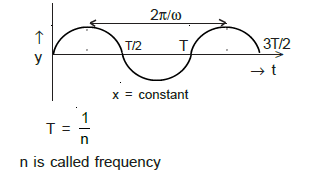
(3) Wave Frequency (n) - Number of vibrations made per second by the particles and is denoted by n.
n = 1/T unit : Hz
Angular Frequency : ω = 2πn
unit : rad/sec
(4) Wave Length (λ) - The distance between two consecutive particle in the same phase or the distance travelled by the wave in one periodic time and denoted by λ Q Wave Velocity V = nλ

(5) Intensity of Wave : In medium, propagation energy perpendicular to per unit area per second is called intensity of wave.I = 2π2n2a2ρv
Where ρ = density of the medium ,v = Wave velocity, a = amplitude ,n = Wave frequency Unit : W/m2 It v & ρ is constant, then
I α (frequency)2 & I α (Amplitude)2
(6) Energy Density : Energy per unit volume is called energy density.
E = Energy density =Energy Intensity/ Energy Velocity
=2π2n2a2ρv/v , E = 2π2n2a2ρ
(7) Wave Pressure : When a wave incidents on surface then it produces pressure on it, it is called wave pressure.
Free study material for Physics
Physics Class 11 Exam Resources: Mechanical Wave in Strings
Comprehensive Study Resources for Mechanical Wave in Strings
Review targeted study resources for Mechanical Wave in Strings tailored for Class 11 learners. Utilizing these structured notes and quick-revision tools ensures complete alignment with current CBSE evaluation standards.
Understanding Marking Schemes
Each resource draws directly from authorized textbooks to maintain academic accuracy. Evaluating solved examples allows Class 11 students to master the formal presentation and answer-writing standards expected in upcoming school exams.
Complete Revision for Physics
For peak performance in upcoming evaluations, integrate official Physics sample papers directly into your study schedule. Follow up your revision by attempting online MCQ tests for Mechanical Wave in Strings to refine calculation speed and precision.
FAQs
Our advanced study package for Mechanical Wave in Strings includes detailed concepts, diagrams, Mind Maps, and explanation of complex topics to ensure Class 11 students learn as per syllabus for 2026 exams.
The Mind Maps provided for Mechanical Wave in Strings act as visual anchors which will help faster recall during high-pressure exams.
Yes, teachers use our Class 11 Physics resources for lesson planning as they are in simple language and have lot of solved examples.
Yes, You can download the complete, mobile-friendly PDF of the Physics Mechanical Wave in Strings advanced resources for free.
Yes, our subject matter experts have updated the Mechanical Wave in Strings material to align with the rationalized NCERT textbooks and have removed deleted topics and added new competency-based questions.