

Class 11 Physics Study Guide: CBSE Class 11 Physics Work Energy Power Exam Notes
Access comprehensive study materials and useful resources for Chapter 05 Work Energy and Power using the CBSE Class 11 Physics Work Energy Power Exam Notes. Designed to align with the 2026-27 CBSE academic guidelines, these advanced resources help Class 11 Physics students reinforce core concepts beyond standard textbooks.
Download Chapter 05 Work Energy and Power Study Material PDF
Navigate directly to the advanced Physics study materials using the digital viewer below. Each resource pack includes detailed conceptual summaries and solved practice questions, allowing students to instantly reinforce their learning.
WORK
If a constant force F displaces a body through displacement s then the work done, W, is given by
W= Fscos θ =F.s
Where s is magnitude of displacement and θ is angle between force and displacement
S.I. unit of work is Joule or Newton-metre.
If the work is done by a variable force F which displaces body from position A to B; having respective
position vectors r1 and r2 , the work WAB is given by
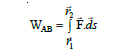
where ds is a small displacement of the body between A and B. Work is a scalar quantity. If a number of forces are acting, the total work on the body is equal to the sum of the work done by all the forces.
SIGN CONVENTION OF WORK
When 0 < θ < 90°
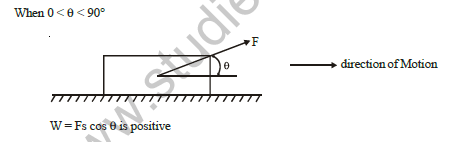
i.e., when the force supports the motion of the body, work done by that force is said to positive but when ∏/2<θ≤∏
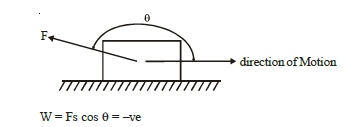
i.e. in this case force opposes the motion of the body and so work done by that force is said to be negative.
If a spring of spring constant k is stretched from initial extension xi to final extension xf, then the force opposes extension such that F = –kx. The work dW done in extending the spring through dx is given by
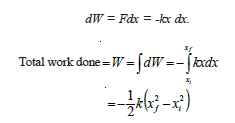
The work done by a spring force is negative. Force of friction also does some work which can be negative, zero or positive depending upon whether the friction force is opposing motion, causing no relative motion between surfaces and friction force is supporting the motion respectively.
ENERGY
The energy of a body is the capacity of the body to do the work. It is a scalar quantity with the same unit as that for work (Joule in S.I. unit). In mechanics, kinetic and potential energies are involved with the dynamics of the body.
KINETIC ENERGY
It is the energy possessed by a body by virtue of its motion. A body of mass m moving with a velocity v has a kinetic energy, Ek=1/2mv2.
since velocity is a relative parameter so KE is also a relative parameter
TYPES OF FORCES
CONSERVATIVE AND NON-CONSERVATIVE FORCES
A force is said to be conservative if the work done by the force in moving a particle from one point to another point does not depend upon the path taken but depends upon the initial and final positions. The work done by a conservative force around a closed path is zero. Gravitational force, electric force, spring force etc. are examples of conservative forces. All central forces are conservative forces. If the work done by a force in moving a body from one point to another point depends upon the path followed, then the force is said to be non-conservative. The work done by such a force in moving a particle around a closed path is not zero. For example, the frictional forces and viscous forces works in an irreversible manner and a part of energy is lost in overcoming these frictional forces (Mechanical energy is converted to other energy forms such as heat, sound etc.). Therefore these are non-conservative forces.
POTENTIAL ENERGY
It is the energy of a body possesed by virtue of its position or the energy possessed by the body due to its state.
It is independent of the way in which body is taken to this state. It is a relative parameter and depends upon its value at reference level.
Free study material for Physics
CBSE Class 11 Physics Study Material: Chapter 05 Work Energy and Power
Quick Revision Material for Chapter 05 Work Energy and Power
Review targeted study resources for Chapter 05 Work Energy and Power tailored for Class 11 learners. Utilizing these structured notes and quick-revision tools ensures complete alignment with current CBSE evaluation standards.
Expert Notes and Solved Exam Questions
Designed around the official curriculum, these study guides guarantee standard compliance. Reviewing step-by-step solutions clarifies complex sub-topics within Chapter 05 Work Energy and Power and demystifies standard marking schemes for Physics evaluations.
Additional Study Resources for Class 11
Wrap up your chapter revision by testing your knowledge against standard objective question formats. Explore our full library of free, up-to-date sample papers and online assessments to secure top grades in your CBSE examinations.
FAQs
Our advanced study package for Chapter 05 Work Energy and Power includes detailed concepts, diagrams, Mind Maps, and explanation of complex topics to ensure Class 11 students learn as per syllabus for 2026 exams.
The Mind Maps provided for Chapter 05 Work Energy and Power act as visual anchors which will help faster recall during high-pressure exams.
Yes, teachers use our Class 11 Physics resources for lesson planning as they are in simple language and have lot of solved examples.
Yes, You can download the complete, mobile-friendly PDF of the Physics Chapter 05 Work Energy and Power advanced resources for free.
Yes, our subject matter experts have updated the Chapter 05 Work Energy and Power material to align with the rationalized NCERT textbooks and have removed deleted topics and added new competency-based questions.